
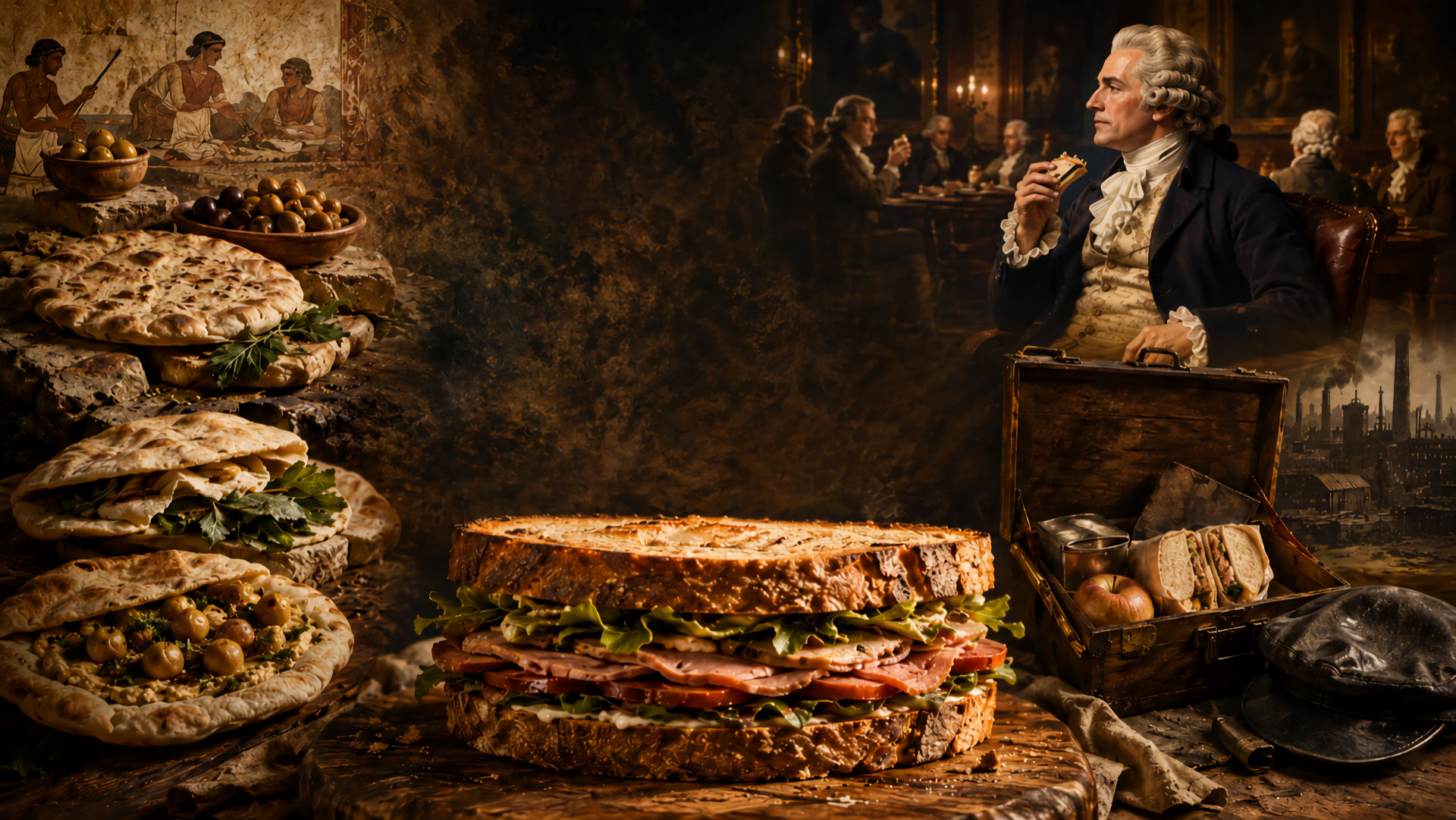
The History of the Sandwich
Long before anyone used the word sandwich, people had already discovered one of the simplest truths in food history: bread is useful because it can carry things. Across the ancient world, flatbreads, coarse loaves, and unleavened breads were used not just as food in themselves, but as plates, scoops, wrappers, and edible tools. In societies where knives and forks were rare or unnecessary, bread helped people eat meat, cheese, vegetables, pulses, and sauces without needing much more than their hands.
The idea appears in many forms. In the Middle East and Mediterranean, flatbreads could be wrapped around fillings or used to pick up stews and dips. In ancient Jewish tradition, the scholar Hillel the Elder is associated with eating bitter herbs and lamb between pieces of matzah during Passover, a custom sometimes described as an early symbolic sandwich. In medieval Europe, thick slices of stale bread known as trenchers were used as edible plates for meat and gravy. They soaked up juices, kept tables cleaner, and could be eaten afterwards or given to servants or the poor.
These foods were not sandwiches in the modern sense, but they mattered because they showed how natural the idea was. Bread was portable, filling, cheap, and adaptable. It could hold expensive ingredients for the wealthy, or scraps and leftovers for ordinary people. It could make a meal easier to carry, easier to share, and easier to eat while working, walking, travelling, or standing in a crowded market.
The key point is that the sandwich did not arrive out of nowhere like a culinary thunderbolt from a very well-dressed aristocrat. The basic concept had been forming for centuries through ordinary habits and practical needs. People had long understood that putting food with bread made sense. What changed in the eighteenth century was not the idea itself, but the name, the social setting, and the way one particular version of bread and filling became famous enough to enter everyday language.
That takes us from the ancient world of flatbreads and trenchers to eighteenth-century Britain, where a convenient snack acquired a title, a story, and a slightly scandalous association with late nights, politics, and gambling tables.
The Earl, the Card Table, and the Birth of a Name
The sandwich gets its name from John Montagu, the 4th Earl of Sandwich, an eighteenth-century British aristocrat, politician, and naval administrator. Born in 1718, Montagu held several important offices during his lifetime, including First Lord of the Admiralty. Yet despite his political career, he is best remembered today not for naval policy, parliamentary manoeuvring, or imperial administration, but for lending his title to lunch. History can be brutal like that.
The familiar story says that the Earl was so absorbed in gambling that he asked for meat to be placed between two slices of bread so he could continue playing cards without stopping for a proper meal. Other players then supposedly asked for “the same as Sandwich”, and the name stuck. The tale is usually linked to the early 1760s, and although it may contain exaggeration, it captures something believable about the period. Gentlemen’s clubs, gaming rooms, coffee houses, and long evenings of conversation created a demand for food that was quick, tidy, and easy to eat without interrupting the action.
There is another possible explanation. Montagu was also a busy public figure, and some historians have suggested that he may have eaten this way while working rather than gambling. That version is a little less colourful, though probably better for his reputation. Either way, the important part is not whether the Earl was hunched over a card table or buried in paperwork. The important part is that the dish became associated with his name at exactly the right moment, in the right social circles, among people who spread fashionable habits quickly.
The word “sandwich” began to appear in English usage during the eighteenth century, and once it had a name, the food became much easier to discuss, order, copy, and popularise. Naming matters. Plenty of people had eaten bread with meat before, but now there was a neat label for a particular style of eating. A snack became a social object, something associated with modern leisure, convenience, and a certain aristocratic informality.
The Earl did not invent the underlying concept, but he helped turn it into a recognisable category. From there, the sandwich began its slow journey out of elite clubs and into drawing rooms, inns, railway stations, factories, schools, shops, and lunchboxes. The name may have begun with privilege, but the food was far too useful to remain there for long.
From Aristocratic Snack to Everyday Meal
Once the sandwich had a name, it began to move through British society with impressive speed. In the late eighteenth and early nineteenth centuries, it was still associated with polite settings as much as rough practicality. Sandwiches appeared at social gatherings, evening entertainments, and later at teas, where they could be served neatly and eaten without fuss. Thinly sliced bread, delicate fillings, and careful presentation turned the sandwich into something respectable, even refined.
This mattered because British dining habits were changing. The rigid formality of large meals remained important among the wealthy, but there was also increasing room for smaller, lighter occasions. Tea became more than a drink, especially in middle and upper class households. It became a social ritual, and sandwiches fitted beautifully into that world. Cucumber sandwiches, egg sandwiches, ham sandwiches, and other neat varieties could be cut into small shapes and presented as signs of good taste rather than mere hunger.
At the same time, the sandwich was becoming useful outside elegant rooms. Travellers needed food that would keep reasonably well and could be eaten on the move. Inns, coaching routes, and later railway refreshment rooms all encouraged forms of eating that were quicker than formal dining. A sandwich could be prepared in advance, wrapped, packed, carried, and eaten without plates or ceremony. It belonged equally well in a picnic basket, a gentleman’s club, or the pocket of someone who had no intention of sitting down for long.
The nineteenth century also saw cookery books and household manuals giving more attention to practical prepared foods. As domestic service, middle class entertaining, and public travel expanded, so did the need for reliable, repeatable recipes. Sandwiches were adaptable enough to suit many budgets. Fine white bread and expensive meats could make them genteel, while simpler loaves, cheese, cold cuts, or leftovers could make them economical.
This was the sandwich’s great advantage. It could move between classes without losing its identity. It could be fancy enough for guests, but simple enough for daily use. It could be delicate, hearty, plain, or indulgent, depending on what was available and who was eating it.
By the time Britain entered the age of factories, railways, mass employment, and urban growth, the sandwich was already well placed to become something more than a fashionable snack. It was about to become one of the defining foods of working life.
Industrial Britain, Packed Lunches, and the Working Class Sandwich
The Industrial Revolution changed not just how people worked, but how they ate. As more people moved into towns and cities, daily routines became tied to factory shifts, office hours, shop work, railway timetables, and school schedules. Meals had to fit around the clock. The sandwich suited this new world almost perfectly because it was portable, affordable, and could be eaten quickly during a short break.
For many workers, especially in industrial towns, the midday meal had to be practical rather than leisurely. Some people could return home, particularly if they lived close to their workplace, but many could not. A packed lunch became essential, and bread with cheese, meat, dripping, jam, or leftovers provided a filling answer. The sandwich was not glamorous, but glamour is not much use when you have a ten minute break and machinery waiting for you.
The rise of mass produced bread also helped. As baking became more commercialised and food distribution improved, bread became increasingly standardised and widely available. Later developments in slicing and packaging would make sandwiches even easier to prepare, but the basic direction was already clear. Industrial society rewarded food that could be made quickly, carried easily, and eaten cleanly. The sandwich, which had once sounded like the snack of an aristocrat avoiding either work or a lost card game, now became part of the ordinary rhythm of labour.
Schools also played a role in making sandwiches familiar from childhood. A sandwich in a lunch tin or wrapped in paper became a common feature of the school day. It could be nutritious, dull, comforting, or tragic, depending on the filling and the enthusiasm of whoever made it. Generations of children learned that lunch could arrive in two slices of bread, sometimes with a heroic packet of crisps standing by for morale.
By the late nineteenth and early twentieth centuries, the sandwich had become deeply embedded in British food culture. It could be bought in shops, packed for work, carried on trains, eaten at picnics, served at teas, or made from whatever was left in the kitchen. It was democratic in a way few foods are. The same basic format could stretch from refined smoked salmon to cheese and pickle, from hotel lounge to factory bench.
This flexibility helped the sandwich travel beyond Britain and adapt wherever it went. Once bread, fillings, work habits, migration, and local tastes met each other around the world, the sandwich stopped being a British named snack and became a global family of foods.
The Sandwich Goes Global: Clubs, Subs, Bánh Mì, Toasties, and Beyond
As the sandwich spread, it changed shape according to local ingredients, cultures, and appetites. In the United States, it became central to diners, delis, lunch counters, and fast food. The club sandwich, stacked with layers of toast, poultry, bacon, lettuce, tomato, and mayonnaise, became a symbol of hotel dining and American abundance. The submarine sandwich, along with hoagies, heroes, grinders, and similar regional names, turned the sandwich into something long, hefty, and designed for serious commitment.
Immigration played a major role in this global development. Jewish delis in New York helped popularise towering sandwiches filled with pastrami, corned beef, or brisket. Italian American communities shaped the meatball sub and other long roll sandwiches. Cuban sandwiches brought together roast pork, ham, Swiss cheese, pickles, and mustard, pressed until crisp and hot. Each one reflected movement, adaptation, and the way food carries memory from one place to another.
In Vietnam, the bánh mì emerged from the meeting of French colonial bread traditions and Vietnamese flavours. A baguette style roll could be filled with meats, pâté, pickled vegetables, coriander, chilli, and sauces, creating something that was neither simply French nor simply Vietnamese in origin, but unmistakably its own. It is one of the clearest examples of how the sandwich can absorb history, including difficult colonial history, and transform it into a distinct national and global food.
Britain, meanwhile, developed and embraced its own variations. The toastie made heat and melted cheese central to the experience. Bacon sandwiches became almost ceremonial, especially in the context of weekend mornings, roadside cafés, and recovery from questionable decisions the night before. Fish finger sandwiches, chip butties, sausage sandwiches, and coronation chicken all showed how flexible the form could be. The British sandwich could be elegant, but it was often at its best when slightly chaotic and proudly comforting.
The sandwich also blurred borders with related foods. Burgers, wraps, kebabs, tacos, and filled rolls all raise awkward questions about definition. Are they sandwiches, cousins of sandwiches, or independent bread based republics? The answer often depends on who is asking and how much they enjoy arguing on the internet.
By the twentieth century, the sandwich had become a global language of convenience. Every culture that adopted it changed it, and every change proved the same point. The sandwich was not one dish anymore. It was a structure, a method, and a blank canvas with crumbs.
The Modern Sandwich: Fast Food, Meal Deals, and the Endless Argument Over What Counts
In the modern world, the sandwich is everywhere. It sits in supermarket chillers, office lunch bags, petrol stations, cafés, fast food chains, airport kiosks, school canteens, and kitchen counters at midnight. It has become one of the most familiar meals on earth precisely because it answers so many modern needs. It is quick, customisable, easy to sell, easy to carry, and capable of being either cheap fuel or an artisanal event involving sourdough and a price tag that needs a sit down.
The rise of pre-packed sandwiches transformed lunch habits, especially in Britain. Supermarkets and high street chains turned the sandwich into a major convenience food, offering everything from basic ham and cheese to elaborate seasonal specials. The meal deal became a small cultural institution, combining sandwich, snack, and drink into a daily ritual of budget calculation and emotional compromise. Few experiences are more modern than standing in front of a chilled cabinet, trying to decide whether today is a BLT day or a “why is this prawn mayonnaise judging me?” day.
Fast food also changed the sandwich’s place in global eating. Burgers, chicken sandwiches, breakfast muffins, and filled rolls became part of huge international systems of branding, franchising, and standardisation. At the same time, independent cafés and food trucks pushed in the opposite direction, reviving slow cooked meats, better bread, local ingredients, and regional traditions. The sandwich could be mass produced by the million, but it could also be treated as craft.
Health trends have repeatedly reshaped it too. Wholegrain bread, gluten free options, plant based fillings, low carbohydrate alternatives, and high protein versions all show how the sandwich adapts to changing concerns. It can be criticised as processed and unimaginative, yet reinvented as fresh, balanced, and creative. Like all long lived foods, it survives by refusing to stay still.
Then there is the great definitional battlefield. Is a hot dog a sandwich? Is a burger a sandwich? Does a wrap count? What about an open sandwich, where the top slice has simply resigned from duty? These arguments are funny because they reveal how deeply familiar the format is. Everyone knows what a sandwich is, until someone asks them to define it.
The history of the sandwich is therefore not just the history of bread and filling. It is the history of convenience, class, work, travel, empire, migration, lunch breaks, childhood, commerce, and comfort. From ancient flatbreads to aristocratic snacks, from factory lunches to supermarket meal deals, the sandwich has followed people wherever they needed food to be practical. It may be humble, but it has quietly conquered the world, two slices at a time.
The History of the Sandwich FAQ
The sandwich is often linked to John Montagu, the 4th Earl of Sandwich, in the 18th century, but people had been eating bread with fillings, toppings, or wraps for centuries before his name became attached to it.
The name comes from the Earl of Sandwich. According to popular tradition, he wanted meat served between slices of bread so he could eat without interrupting other activities, though the exact details are debated.
Yes. Many cultures had long used bread as a way to hold, wrap, or accompany food. Flatbreads, trenchers, filled rolls, and similar meals existed well before the modern English word “sandwich” became popular.
Sandwiches became popular because they are portable, cheap, adaptable, and easy to eat quickly. They suited changing work patterns, travel, school lunches, factories, offices, cafés, and eventually fast food culture.
The name “sandwich” is strongly associated with Britain, but the idea of combining bread with fillings has deep roots in many cultures. The modern sandwich is best understood as both a British-named food and a global eating tradition.


