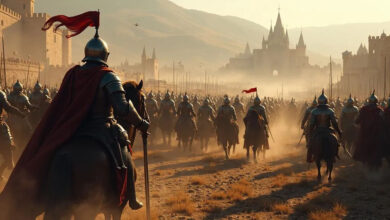
The Battle of Salamis
By the late summer of 480 BC, the Greek world stood on the edge of annihilation. The heroic stand at Thermopylae had delayed the inevitable but not stopped it. With the Spartan king Leonidas dead and the pass breached, the road into central Greece lay open. For the vast Persian Empire, this was not a setback but a prelude. The invasion rolled forward with overwhelming force, and the small, divided Greek city-states now faced the full weight of imperial conquest.
At the head of this advance was Xerxes I, ruler of the largest empire the world had yet seen. His campaign against Greece was not merely punitive. It was meant to be final. Athens and Eretria had dared to support revolts in Asia Minor, and Xerxes intended to erase that insult permanently. His army was immense by Greek standards, drawn from across the empire and supported by a massive fleet that hugged the coastline as the army marched south.
The psychological impact of Thermopylae cut both ways. For the Persians, it removed the last serious land barrier in northern Greece. For the Greeks, it was a grim reminder of how fragile their resistance truly was. Yes, the Spartan sacrifice became a rallying symbol, but symbols alone could not stop an army. City after city now faced an impossible choice: resist and be destroyed, or submit and survive.
Athens was particularly exposed. With no natural defences on land and no hope of standing against the Persian army in open battle, the city faced certain destruction. Many Greeks still believed that decisive warfare happened on land. Naval power was secondary, supportive, even optional. But the situation now demanded a radical rethink. If the Persians could not be stopped from marching south, perhaps they could be broken at sea.
Panic spread. Refugees flooded out of threatened regions. Oracles were consulted obsessively, often delivering cryptic warnings rather than comfort. One prophecy spoke of Athens being saved by “wooden walls”, a phrase that would soon be argued over with almost desperate intensity. Did it mean fortifications? Ships? Or something else entirely?
Greek unity was fragile at best. Sparta led the land forces but was cautious, conservative, and reluctant to commit beyond the Peloponnese. Athens possessed the largest navy, but its voice carried less traditional authority. Mutual suspicion ran deep. Some city-states openly sided with Persia, calculating that resistance was hopeless. Others waited, hedging their bets.
By the time the Persian army reached Attica, the crisis had peaked. Athens was evacuated, its population sent to nearby islands and the Peloponnese. The city itself was left to its fate. Temples stood empty. Homes were abandoned. The future of Greece no longer hinged on walls or hoplites, but on the sea.

With Persia advancing and Greek morale stretched to breaking point, the coming confrontation would decide more than territory. It would determine whether Greece remained a collection of free, quarrelling cities or became another province in an empire that already seemed unstoppable. Salamis was about to turn desperation into strategy.
Themistocles’ Gamble: Strategy, Politics and a Naval Vision
If the Greek resistance at Salamis had a single driving mind behind it, it was Themistocles. Where many Greek leaders still thought in terms of hoplites and land battles, Themistocles understood something profoundly modern for his time: this war would be won or lost at sea. His gamble was not just tactical. It was political, psychological, and deeply controversial.
Themistocles had spent years preparing Athens for precisely this moment, often against fierce opposition. Earlier in the century, he had persuaded the Athenians to use newfound silver wealth from the mines at Laurium not on public handouts, but on ships. Triremes, fast and agile warships powered by oars, became the backbone of Athenian power. Many of his rivals saw this as reckless spending. Themistocles saw it as survival.
After Thermopylae, his arguments gained urgency. Athens could not defend itself on land, and the city had already been abandoned to the advancing Persians. The only meaningful way for Athens to remain in the fight was through its navy. Yet convincing the wider Greek alliance was another matter entirely. Sparta and its allies still prioritised land defence of the Peloponnese and were reluctant to risk everything on a naval battle.
Themistocles’ brilliance lay not only in strategy, but in manipulation. He understood Greek politics intimately and knew how to apply pressure. He argued that abandoning the fleet would doom Athens permanently and fracture the alliance. More bluntly, he implied that if the Greeks refused to fight at sea, Athens might simply sail away and leave them to face Persia alone. It was not an idle threat. The Athenian navy represented a significant portion of the allied fleet.
He also grasped the psychology of the enemy. The Persian fleet was vast but unwieldy, made up of ships from across the empire with differing languages, command structures, and levels of training. In open water, Persian numbers would be overwhelming. In confined waters, however, that advantage could become a liability. The narrow straits near Salamis offered exactly the conditions Themistocles wanted.
To force the issue, he resorted to deception. According to ancient accounts, Themistocles sent secret messages to Xerxes I, suggesting that the Greek alliance was on the verge of collapse and planning to flee. The message was carefully designed to provoke a hasty Persian attack and draw their fleet into the straits before Greek unity could fracture further.
It was an extraordinary risk. If the Greeks broke ranks, or if the Persians refused the bait, the plan would fail catastrophically. But Themistocles understood that delay favoured Persia, not Greece. His gamble forced a decision.
At Salamis, the Greeks would not fight because they were ready. They would fight because Themistocles left them no other choice.
The Persian Armada: Scale, Confidence and Imperial Power at Sea
By the time the opposing fleets gathered near Salamis, the balance of power appeared overwhelmingly in Persia’s favour. Xerxes I commanded the largest naval force ever assembled in the ancient world, a floating extension of an empire that stretched from India to the Aegean. To Persian eyes, Greek resistance looked stubborn rather than threatening. The outcome, at least on paper, seemed inevitable.
The Persian fleet was vast and diverse. Ships and crews came from across the empire, including Phoenicians, Egyptians, Cypriots, Cilicians, and Ionian Greeks. Many of these sailors were highly experienced, particularly the Phoenicians, whose seamanship was among the best in the Mediterranean. The fleet likely numbered several hundred warships, far outstripping the Greek alliance in sheer size. It was a display of imperial reach as much as military strength.
This diversity, however, was both a strength and a weakness. While Persian commanders benefited from enormous manpower and resources, coordination was a constant challenge. Crews spoke different languages, followed different traditions, and answered to different regional leaders. Loyalty varied. Some contingents, especially Greek subjects of Persia, fought with reluctance rather than enthusiasm. The fleet was powerful, but it was not unified in spirit.
Persian naval doctrine reflected imperial confidence. Their ships were often larger and higher-sided than Greek triremes, built to overwhelm opponents through boarding actions and missile fire. Archers and marines played a central role, turning naval combat into something closer to land warfare at sea. In open water, this approach made sense. Numbers, height, and firepower could crush smaller, lighter enemy vessels.
The campaign up to Salamis had reinforced this confidence. Persian naval forces had supported the army’s advance, captured territory, and survived violent storms that had wrecked parts of the fleet without halting the invasion. Athens had been evacuated and burned. From the Persian perspective, Greek resistance was already collapsing. A decisive naval victory would simply tidy up the last loose ends.
Xerxes himself observed the fleet closely and took an active interest in its performance. Ancient sources describe him positioning himself on high ground to watch the coming battle, a ruler expecting confirmation of dominance rather than a test of survival. His expectation was not merely victory, but spectacle, the visible submission of Greek defiance to imperial order.
What the Persians underestimated was how scale could become a liability. Their confidence rested on the assumption that more ships meant more power, regardless of terrain. They did not fully account for how narrow waters could neutralise numbers, disrupt formation, and turn coordination into chaos.
At Salamis, the Persian armada represented the height of imperial might, disciplined, confident, and seemingly unstoppable. But that confidence would soon be tested in waters where size and certainty mattered far less than control, timing, and room to manoeuvre.
The Straits of Salamis: Geography, Deception and Deadly Waters
The waters between the island of Salamis and the Athenian mainland were narrow, cluttered, and unforgiving, precisely the opposite of where a massive imperial fleet should have wanted to fight. Yet this was exactly where the Persians were drawn, and the geography of the straits would prove as decisive as any ship or commander.
The straits funnelled vessels into tight channels, limiting manoeuvre and compressing formations. For the Greek fleet, made up mainly of lighter, faster triremes, this was ideal terrain. Greek ships relied on speed, precision rowing, and ramming tactics. They needed room to accelerate briefly, strike, and withdraw. In confined waters, they could deny the enemy space while still executing disciplined attacks. For the Persians, whose numerical advantage depended on the open sea, the straits were a trap.
The message sent to Xerxes by Themistocles has been carefully calibrated to appeal to Persian confidence and impatience, and Xerxes took the bait. Rather than allow the Greeks to escape, he ordered his fleet to move into position overnight, blocking the western exits of the straits. The intention was to trap the Greek ships and destroy them at dawn. In practice, the manoeuvre forced hundreds of Persian vessels into confined waters before daylight, creating congestion, confusion, and exhausted crews before the battle even began.
As morning broke, the Persian fleet found itself crowded, poorly aligned, and struggling to maintain formation. Ships collided. Commands were delayed or misunderstood. Rowers, many of whom had spent the night at the oars, were already fatigued. The Greeks, by contrast, had waited in organised lines, familiar with the currents and shoreline, ready to move as a coordinated force.
The geography now did its work. Persian ships, larger and less agile, struggled to turn or retreat. Their height and reliance on missile fire mattered far less when space was limited, and angles collapsed. Greek triremes surged forward, striking at exposed flanks and sterns. Each disabled Persian vessel became an obstacle for the ships behind it, compounding the chaos.
What had looked like a clever encirclement became self-entrapment. The straits amplified every Persian weakness, numbers, diversity, and command complexity, while magnifying Greek strengths in discipline and local knowledge. By choosing where the battle would be fought, the Greeks had already shaped how it would be lost.
At Salamis, geography was not a backdrop. It was a weapon, deliberately wielded, and it would soon turn Persian confidence into catastrophe.
The Battle of Salamis: Oars, Ramming and Chaos at Close Quarters
At dawn, the Greek fleet advanced into the straits in tight formation, oars biting the water in unison. From the Persian side, the sight should have signalled danger. Instead, it confirmed expectations. Xerxes believed he was about to witness the destruction of a trapped enemy. What followed was the opposite.
Greek triremes surged forward with purpose, their crews trained to accelerate, turn sharply, and strike with precision. The first collisions were devastating. Bronze rams punched into Persian hulls at the waterline, splintering planks and sending ships flooding within moments. Disabled vessels spun helplessly, fouling the oars of ships behind them. The narrow waters magnified every mistake. Momentum mattered more than numbers, and the Greeks had it.
Persian ships attempted to respond with archers and boarding parties, tactics that worked in open water. In the crush of the straits, those advantages evaporated. Elevated decks became liabilities as vessels struggled to manoeuvre. Orders were shouted across decks in multiple languages, often drowned out by the noise of impact and panic. Coordination collapsed almost immediately.
Greek commanders exploited the chaos ruthlessly. Ships struck, withdrew, and struck again, targeting sterns and flanks where Persian vessels were most vulnerable. Each successful ram created another obstacle, tightening the bottleneck and increasing confusion. Persian captains found themselves boxed in, unable to turn or retreat, their crews fighting fires and flooding rather than enemies.
The battle quickly became a slaughter rather than a contest. Persian ships collided with one another, oars snapping, hulls grinding together. Men were thrown into the water, weighed down by armour, while Greek crews, closer to shore and better swimmers, often escaped if their ships were damaged. Familiarity with local currents allowed Greek vessels to reposition while their opponents drifted helplessly.
Leadership mattered here as much as tactics. The Greeks fought as a coalition, but with shared purpose and coordination forged by desperation. The Persians fought as an empire, powerful but fragmented. When momentum turned, it turned everywhere at once. Fear spread faster than commands.
By mid-morning, the outcome was clear. Persian losses mounted rapidly, and attempts to reorganise failed under constant pressure. The Greek fleet pressed the advantage, driving the enemy back toward open water where retreat was possible. What remained of the Persian armada withdrew in disarray, leaving wreckage and bodies scattered across the straits.
Watching from shore, Xerxes saw his fleet unravel. The defeat was not just military, but psychological. The invincible empire had been outmanoeuvred, outthought, and humiliated by a smaller force fighting on its own terms.
At Salamis, naval warfare was reduced to its rawest elements: timing, discipline, and nerve. Oars and rams decided the fate of empires. The Greeks had chosen the battlefield. In the confined waters of the straits, that choice proved decisive.
Aftermath and Legacy: How Salamis Changed the Course of History
The victory at Salamis did not end the Persian invasion, but it transformed it. What had looked like an unstoppable imperial advance was suddenly fragile, uncertain, and exposed. For the Greek alliance, Salamis was not just a battlefield success; it was a psychological turning point that proved Persia could be beaten, decisively and on Greek terms.
In the immediate aftermath, the consequences were stark. Xerxes I withdrew the bulk of his fleet and returned to Asia, leaving a land army in Greece under subordinate command. This decision alone speaks volumes. Persian strategy depended on naval dominance to supply and support the army. Without control of the sea, the invasion became risky rather than inevitable. Salamis had broken the logistical backbone of the campaign.
For the Greeks, the victory stabilised an alliance that had been close to collapse. City-states that had argued, delayed, and hedged their bets now had proof that unity worked. Athens, whose city had been burned and abandoned, emerged as the moral and strategic centre of the resistance. Its navy, championed by Themistocles, had saved Greece when walls and hoplites could not.
The war itself continued. Persian forces would be defeated on land the following year at Plataea, while the Greek fleet struck again at Mycale. But those victories were built on the foundation laid at Salamis. Without naval success, none of them would have been possible. Salamis shifted the war from survival to momentum.
The long-term consequences were even greater. Greek independence preserved the political experiments underway in the city-states, especially in Athens. Democracy, philosophy, drama, and historical inquiry flourished in the decades that followed. This was not inevitable, and it mattered. A Persian victory would not have erased Greek culture overnight, but it would have reshaped it fundamentally, redirecting its development within an imperial system.
Salamis also redefined warfare. It demonstrated that naval power could decide the fate of continents, that terrain mattered as much at sea as on land, and that intelligence and deception could outweigh numerical superiority. Future commanders would study Salamis as a lesson in how strategy could neutralise brute force.
For Persia, the defeat was a warning rather than a collapse. The empire remained vast and powerful for generations. But Salamis marked the western limit of its expansion. The idea of effortless conquest of Greece was gone, replaced by caution and containment. Salamis endures because of what it preserved. It kept open the path for a distinct Greek world to develop on its own terms, influencing Rome, Europe, and eventually the modern West. It was not simply a naval battle. It was a hinge of history, where oars, rams, and narrow water decided the direction of civilisation itself.
The Battle of Salamis FAQ
The Battle of Salamis was a naval battle fought in 480 BC between the Greek city-states and the Persian Empire during the second Persian invasion of Greece.
Salamis stopped Persian naval dominance, forced Xerxes to retreat, and ensured the survival of Greek independence, shaping the future of Greek culture and politics.
The Greek fleet was led strategically by Themistocles of Athens, whose plan lured the Persian navy into narrow waters where their numbers became a disadvantage.
The Greeks used the confined straits of Salamis to neutralise Persian numbers, relying on superior manoeuvring, discipline, and coordination among their triremes.
Following the defeat, Xerxes withdrew much of his army from Greece, leaving Persian forces vulnerable and setting the stage for later Greek victories.