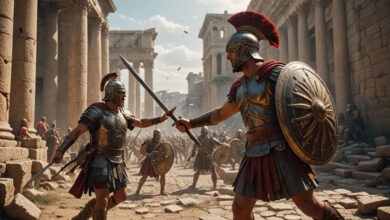
The Fall of Constantinople
By the mid-fifteenth century, Constantinople was a city living on reputation as much as reality. Once the glittering capital of the Roman and Byzantine worlds, it had been Europe’s largest and richest city for centuries, a centre of trade, learning, and imperial power. By 1453, however, it was a relic of former greatness, isolated, underpopulated, and surrounded by enemies. It was still called the Queen of Cities, but the crown sat uneasily.
The Byzantine Empire that ruled from Constantinople was now a shadow of its former self. Where emperors once governed vast territories across the Mediterranean, their authority had shrunk to little more than the city itself and a handful of nearby lands. Civil wars, economic decline, and repeated invasions had drained imperial strength. The disastrous sack of Constantinople by Western crusaders in 1204 had inflicted wounds from which the empire never fully recovered. Even after the city was reclaimed in 1261, it never regained its population or prosperity.
Yet Constantinople remained symbolically powerful. Its massive walls, built and expanded over centuries, were still the most formidable defences in Europe. They had repelled sieges by Persians, Arabs, and Bulgars, earning the city a reputation for being effectively impregnable. To many Christians, Constantinople was not just a city but the last living remnant of the Roman world, a spiritual and historical anchor linking medieval Europe to classical antiquity.
Inside the walls, life was quieter than legend suggested. Large areas of the city lay abandoned or had reverted to farmland. The population had dwindled dramatically, perhaps to fewer than 50,000 people. Grand churches and palaces still stood, but many were crumbling, maintained more by devotion than wealth. Trade continued through the Bosphorus, but the profits increasingly flowed to Italian merchant republics rather than the imperial treasury.
Religiously, Constantinople was divided and vulnerable. Efforts to reunite the Eastern Orthodox Church with the Roman Catholic Church, made in hopes of securing Western military aid, had caused deep resentment among the population. Many citizens mistrusted Latin Christians almost as much as they feared Muslim attackers. Unity, the city’s greatest historical strength in times of siege, was fragile.
Despite all this, the city endured. Constantinople’s rulers understood that survival depended not on conquest, but on endurance, diplomacy, and the deterrent power of its walls. They played rival powers against one another, bought time with treaties, and relied on the city’s symbolic importance to attract aid.
By 1453, however, the margins for survival had all but vanished. Constantinople stood alone, proud, exhausted, and defiant. It was still Roman in name and memory, but the world around it had changed. The question was no longer whether the city would fall, but when, and who would claim its immense legacy when it did.

The Young Conqueror: Mehmed II and Ottoman Ambition
In stark contrast to the ageing empire he would soon destroy, Mehmed II was young, ambitious, and intensely focused on destiny. When he became Ottoman sultan for the second time in 1451, he was just nineteen years old, but he already carried a singular obsession: the capture of Constantinople. To Mehmed, the city was not merely a prize of territory. It was the key to legitimacy, empire, and history itself.
The Ottomans had been encircling Constantinople for decades. By the mid-fifteenth century, their empire stretched across much of Anatolia and the Balkans, surrounding the Byzantine capital on almost every side. Constantinople stood like a stubborn island in an Ottoman sea, controlling the Bosphorus and symbolising a rival imperial tradition that refused to die. As long as it remained unconquered, Ottoman authority felt incomplete.
Mehmed was determined to finish what his predecessors had begun. He was highly educated, fluent in multiple languages, and deeply aware of Roman and Islamic history. He saw himself not just as an Ottoman ruler, but as a successor to the Roman emperors. Capturing Constantinople would allow him to claim that inheritance and present himself as a universal sovereign, ruling both East and West.
Unlike earlier sultans, Mehmed prepared methodically. He reformed the army, strengthened central authority, and ensured absolute loyalty among his commanders. He invested heavily in new military technology, especially artillery, understanding that the ancient walls of Constantinople could no longer be challenged by traditional siege methods alone. The future of warfare, he believed, lay in gunpowder, and he intended to exploit it fully.
Diplomacy was used as a weapon as well as an art. Mehmed neutralised potential threats through treaties, bribery, and intimidation, ensuring that Constantinople would face the coming siege essentially alone. He carefully managed relations with Venice, Hungary, and other regional powers, buying time while his preparations continued. Every delay worked in his favour.
Religious motivation also played a role, though it was tightly bound to ambition rather than fanaticism. Islamic tradition contained prophecies about the conquest of Constantinople, and Mehmed was keenly aware of their symbolic power. A successful siege would elevate his standing not just politically, but spiritually, casting him as a ruler favoured by history and faith.
By 1453, Mehmed was ready. He commanded a vast, disciplined army and possessed the tools needed to challenge defences that had stood for a thousand years. Constantinople was no longer facing a loose coalition of attackers or opportunistic raiders. It faced a ruler who had shaped his reign around its destruction.
The city had survived countless sieges. This time, it faced an enemy who believed it was his destiny to end its story and begin his own.
Walls, Guns and Faith: Preparing for the Final Siege
As 1453 approached, the coming conflict between Constantinople and the Ottomans was shaped as much by preparation as by intent. Both sides understood that if the city were to fall, it would not be through surprise or negotiation, but through a brutal test of endurance, technology, and belief. The defenders relied on tradition and faith. The attackers placed their trust in innovation and overwhelming force.
Constantinople’s greatest asset remained its walls. The Theodosian Walls, built under Emperor Theodosius II in the 5th century, were a vast system of moats, outer ramparts, and towering inner defences, had protected the city for nearly a thousand years. Even in decline, they were formidable. Recent repairs had been made where possible, and weak points were reinforced with earth and timber. However, manpower was scarce. The city could not properly garrison every section of its defences, leaving long stretches thinly defended.
The defenders numbered perhaps seven to eight thousand fighting men, including local troops and foreign volunteers. Among them were experienced soldiers from Genoa and Venice, drawn by duty, faith, or the promise of reward. Their presence brought valuable expertise, particularly in artillery and naval defence. Still, they were vastly outnumbered. The defenders would need discipline and coordination to compensate for their lack of numbers.
On the Ottoman side, Mehmed II prepared for a siege on a scale Constantinople had never faced. His army may have exceeded eighty thousand men, supported by engineers, sappers, and artillery crews. The centrepiece of his strategy was gunpowder. Massive cannons, including enormous bombards capable of hurling stone balls weighing hundreds of kilograms, were cast specifically to batter the ancient walls. These weapons represented a turning point in siege warfare.
Logistics were equally critical. Mehmed ensured steady supply lines, built roads, and established camps designed to support a prolonged siege. A fleet was assembled to blockade the city by sea, aiming to cut off resupply and prevent Western reinforcements from arriving. Even the famous chain across the Golden Horn, long a barrier to enemy ships, was accounted for in Ottoman planning.
Inside the city, preparation took on a spiritual dimension. Emperor Constantine XI led efforts to strengthen morale, urging unity among a population divided by religious and political tensions. Processions, prayers, and vigils filled the streets. Many believed the city’s survival depended as much on divine favour as on stone and steel.
By April 1453, both sides were ready. The walls stood, the cannons were positioned, and belief hardened into resolve. What followed would determine whether tradition could withstand technology, and whether faith alone could hold back the future.
The Siege of Constantinople: Cannon Fire and Desperate Defence
The siege of Constantinople began in earnest on 6 April 1453, when Ottoman artillery opened fire on the city’s ancient walls. From the outset, it was clear this would be unlike any previous assault the city had endured. Mehmed II had brought firepower on a scale that transformed the very nature of siege warfare, and the defenders quickly realised that tradition alone would not be enough to save them.
The great cannons thundered day after day, hurling massive stone shot against the Theodosian Walls. Sections that had withstood centuries of attack began to crack and crumble. Each breach was met with frantic repair efforts, resulting in them being filled with rubble, timber, and earth whilst under constant fire. Civilians worked alongside soldiers through the night, rebuilding what had been shattered by day. The walls no longer symbolised invincibility. They had become a race against exhaustion.
Naval pressure added to the strain. Ottoman ships attempted to blockade the city, cutting off supplies and hope of reinforcement. In one of the siege’s most audacious moves, Mehmed ordered ships dragged overland on greased logs and launched into the Golden Horn behind the city’s defensive chain. This manoeuvre stunned the defenders and forced them to stretch their already limited resources even further. Constantinople was now threatened from directions once thought secure.
Inside the city, leadership mattered desperately. Emperor Constantine XI remained a visible presence on the walls, encouraging troops and sharing the dangers of defence. His refusal to abandon the city strengthened morale, but it could not compensate for the widening imbalance in numbers and firepower. The defenders fought with discipline and courage, but fatigue crept in relentlessly.
Ottoman tactics combined brute force with psychological pressure. Continuous bombardment denied the defenders rest. Probing attacks tested weak points. Drums, horns, and shouted prayers filled the night, reminding the city that the siege never truly paused. At times, the Ottomans attempted tunnelling operations, trying to collapse walls from below. These efforts were countered by desperate underground fighting, with defenders collapsing tunnels and engaging enemies in darkness and choking dust.
Despite everything, Constantinople held on for weeks. Each day of resistance felt miraculous, yet each night brought the sense that the end was approaching. Ammunition dwindled. Wounds went untreated. The defenders were running out of time, men, and strength.
By late May, the walls were scarred beyond recognition, patched together by willpower rather than stone. The siege had become a slow strangulation. Constantinople was still standing, but only just, and everyone on both sides understood that the final assault was no longer a question of if, but when.
The City Falls: Breach, Sack and the Death of an Empire
In the early hours of 29 May 1453, after nearly two months of relentless pressure, the final assault on Constantinople began. Mehmed II ordered a coordinated, all-out attack, throwing wave after wave of troops against the battered Theodosian Walls. The bombardment intensified, drums and horns echoed across the darkness, and the city’s exhausted defenders braced for what they knew would be the last stand.
The Ottomans attacked in stages. Irregular troops were sent forward first, designed to exhaust the defenders and locate weak points. They were followed by better-equipped infantry, and finally by elite Janissaries, disciplined and relentless. Somewhere along the central defences near the Gate of St Romanus, the walls finally gave way. A breach opened that could not be repaired quickly enough. The defenders fought desperately to contain it, but their numbers were too few and their strength nearly gone.
Amid the chaos, Emperor Constantine XI made his final decision. Refusing to flee, he cast aside the imperial insignia and joined the fighting as an ordinary soldier. His exact death remains uncertain, but he was killed in the melee near the breached walls, becoming the last Roman emperor to die defending Constantinople. With his fall, the Byzantine Empire, successor to Rome itself, came to an end.
Once Ottoman forces poured into the city, organised resistance collapsed rapidly. Fighting continued in pockets, but by mid-morning the outcome was decided. Mehmed ordered his banner raised, signalling victory. According to the customs of the time, the city was subjected to sack. For three days, soldiers looted homes, churches, and palaces. Many inhabitants were killed or enslaved. The trauma was immense, marking a violent rupture in the city’s long history.
Yet the destruction was not total. Mehmed moved quickly to assert control and restore order. He reportedly entered the city in the afternoon, riding to the great church of Hagia Sophia, which was converted into a mosque. This act symbolised both conquest and continuity. Constantinople was not to be destroyed. It was to be transformed into a new imperial capital.
The fall of the city was more than a military defeat. It was the extinction of a state that traced its roots back to ancient Rome. For the Christian world, it was a catastrophe. For the Ottomans, it was a triumph that confirmed their empire as a dominant power.
On that morning in May, an empire that had endured for over a thousand years finally fell, not with quiet surrender, but in blood, fire, and defiance.
Aftermath and Legacy: How 1453 Changed the World
The fall of Constantinople in 1453 sent shockwaves far beyond the ruined walls of the city itself. What had ended as a brutal siege marked the beginning of a profound global shift, politically, culturally, and economically. The capture of the city confirmed the Ottoman Empire as a major world power. It closed the final chapter of the Roman imperial tradition that had endured, in one form or another, for nearly fifteen centuries.
For Mehmed II, the victory transformed reputation into reality. He was no longer merely a successful conqueror, but a ruler of imperial stature. Constantinople became the new Ottoman capital, later known as Istanbul, strategically positioned between Europe and Asia. Mehmed moved quickly to repopulate and rebuild the city, encouraging Muslims, Christians, and Jews to settle there. Rather than ruling over ruins, he sought to revive Constantinople as a thriving imperial centre.
The psychological impact on Christian Europe was immense. The loss of the city was mourned as a civilisational catastrophe. Constantinople had long been seen as a bulwark against eastern invasion and a living link to the Roman and early Christian past. Its fall shattered any lingering illusion that medieval Christendom was secure. Appeals for crusade followed, but they were fragmented, delayed, and ultimately ineffective.
Culturally, the consequences were transformative. Greek scholars and refugees fled westward, particularly to Italy, carrying with them ancient manuscripts and classical knowledge preserved in Byzantine libraries. Their arrival helped fuel the Renaissance, accelerating European interest in Greek philosophy, science, and literature. In this sense, the fall of Constantinople helped reshape Western intellectual life rather than extinguish it.
Economically, the balance of trade shifted. Ottoman control of key land routes between Europe and Asia disrupted established commercial networks. This encouraged European powers to seek alternative paths to the East, contributing directly to the age of maritime exploration. The search for new trade routes would soon lead to voyages around Africa and across the Atlantic, reshaping global history.
For the Orthodox Christian world, the loss of Constantinople forced a reimagining of identity. Other centres, particularly Moscow, began to present themselves as heirs to the Byzantine tradition, laying foundations for new religious and political claims that would echo for centuries. The fall of Constantinople did not simply end an empire. It reordered the world. It marked the close of the medieval age and helped open the door to the modern one. Few events so clearly divide history into a before and an after.
The Fall of Constantinople FAQ
The Fall of Constantinople was the capture of the city by the Ottoman Empire on 29 May 1453 after a prolonged siege, ending the Byzantine Empire.
The fall marked the end of the Eastern Roman Empire, strengthened Ottoman power, and helped shift European trade routes, contributing to the Age of Exploration.
The Ottoman army was led by Sultan Mehmed II, who was just 21 years old at the time and determined to make Constantinople his capital.
After the conquest, Constantinople became the Ottoman capital, later known as Istanbul, and was transformed into a major political, cultural, and religious centre.
While historians debate exact dates, 1453 is often used as a symbolic marker for the end of the medieval era and the beginning of early modern history.