The Reconquista
The Reconquista, or “Reconquest,” was a centuries-long series of military campaigns, political manoeuvrings, and religious conflicts that saw Christian kingdoms in the Iberian Peninsula gradually reclaim territory from Muslim rule. Spanning from 711 CE, when Islamic forces first crossed into Spain, to 1492 CE, when the last Muslim stronghold of Granada fell, the Reconquista shaped the religious, cultural, and political landscape of medieval Europe and set the stage for the rise of Spain as a global empire.
Origins of Muslim Rule in Iberia
In 711 CE, Muslim armies, composed mainly of North African Berbers under Arab leadership, crossed the Strait of Gibraltar and swiftly defeated the Visigothic kingdom at the Battle of Guadalete. Within a few years, they had taken control of most of the Iberian Peninsula, establishing the Umayyad Emirate of Al-Andalus. This new Muslim territory quickly became a centre of culture, trade, and learning, particularly in cities like Córdoba, which rivalled the great urban centres of the Islamic world.
The early years of Muslim rule were marked by relative tolerance, with Christians and Jews (known as dhimmi) allowed to practice their religions in exchange for a special tax. However, tensions remained, and resistance from Christian enclaves in the north began almost immediately. The blending of Islamic, Christian, and Jewish cultures led to notable developments in science, philosophy, and architecture. Yet beneath the surface, religious and political friction simmered, fuelling centuries of conflict.
The Christian Resistance
The seeds of the Reconquista were sown in the mountains of northern Iberia, where Christian kingdoms such as Asturias, León, Navarre, Aragon, and later Castile held out against Muslim dominance. One of the earliest victories came at the Battle of Covadonga in the 720s, a symbolic if small-scale success led by the Visigothic noble Pelayo. This battle became a foundational myth for the Christian kingdoms, representing divine favour and the beginning of a long journey to reclaim Iberia.
Over the next several centuries, Christian rulers gradually expanded southward, taking advantage of political fragmentation within Al-Andalus. Muslim rule in Iberia was not monolithic; internal strife, succession crises, and the fragmentation into smaller taifa kingdoms weakened their ability to resist coordinated Christian advances. These smaller kingdoms often found themselves forced to pay tribute (parias) to their Christian neighbours or seek alliances that ultimately undermined their stability.
Key Phases and Turning Points
The Reconquista was not a continuous military campaign but a series of offensives and retreats, punctuated by alliances, truces, and internal conflicts among both Christian and Muslim factions.
- The Battle of Las Navas de Tolosa (1212): One of the most decisive victories for Christian forces came in this battle, where a coalition of Christian armies defeated the Almohad Caliphate. This victory opened the way for rapid advances into Andalusia by the kingdoms of Castile and Aragon.
- The Fall of Toledo (1085): Toledo, a former Visigothic capital and key centre of learning, was captured by Alfonso VI of Castile. This marked a significant cultural and strategic gain, symbolising Christian resurgence. Toledo later became a centre for the translation of classical and Islamic texts, serving as a bridge between cultures.
- The Role of the Military Orders: Religious military orders like the Knights Templar, the Order of Santiago, the Order of Calatrava, and the Order of Alcántara played a vital role in securing and colonising reconquered territories. These orders built fortresses, administered land, and acted as frontier garrisons.
- The Use of Repopulation (Repoblación): As territories were retaken, Christian rulers implemented repopulation strategies, encouraging settlers from the north to move south and repopulate empty or depopulated towns. These settlers were granted privileges and land in return for loyalty and military service.
- The Unification of Castile and Aragon: The marriage of Ferdinand II of Aragon and Isabella I of Castile in 1469 unified two of the most powerful Christian kingdoms, providing the political and military cohesion necessary for the final push against the Nasrid Kingdom of Granada.
The Fall of Granada
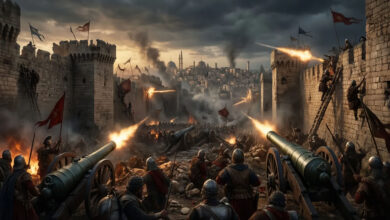
The Reconquista concluded with the siege and fall of Granada in 1492. The Catholic Monarchs, Ferdinand and Isabella, launched a concerted military campaign against the last Muslim stronghold. After a prolonged siege, Emir Muhammad XII (Boabdil) surrendered the city on 2 January 1492.

The surrender terms initially allowed for religious and cultural autonomy, but these promises were soon broken. Forced conversions, the expulsion of Muslims and Jews, and the establishment of the Spanish Inquisition followed, as Spain sought religious uniformity under Catholicism. Mosques were converted into churches, Arabic texts were burned, and Islamic traditions were suppressed.
Cultural and Political Consequences
The Reconquista had far-reaching consequences:
- Religious Homogeneity: The drive for Catholic unity led to the persecution and eventual expulsion of Jews (1492) and Muslims (1502 and beyond), drastically altering the demographic and cultural makeup of Spain.
- Expansion of Royal Power: The monarchs of Castile and Aragon gained vast new territories, bolstering royal authority and diminishing the influence of the feudal nobility.
- Rise of Spanish National Identity: The Reconquista helped forge a collective identity rooted in Catholicism, chivalry, and resistance to Islam. Religious festivals, chivalric tales, and architectural projects reinforced a triumphalist narrative.
- Impact on the New World: The conclusion of the Reconquista coincided with the beginning of Spanish exploration and conquest overseas. Just months after the fall of Granada, Ferdinand and Isabella sponsored Christopher Columbus’s voyage to the Americas. The techniques and mentalities developed during the Reconquista, including religious zeal and military colonisation, were exported to the New World.
- Architectural and Cultural Legacy: The blending of Christian and Islamic influences is evident in Spain’s art, architecture, and language. Cities like Toledo, Seville, and Córdoba retain a rich Moorish heritage, even as they symbolise Christian victory.
- Legal and Administrative Innovations: The Christian kingdoms developed new systems for administering conquered lands, including the use of fueros (local laws), land charters, and municipal councils. These institutions shaped later Spanish colonial governance.
Legacy and Interpretation
The Reconquista remains a deeply symbolic episode in Spanish history. To some, it represents the triumph of Christian civilisation over Islamic rule. To others, it marks the loss of a pluralistic society where Muslims, Christians, and Jews coexisted. Modern historians often emphasise the complexity of this period, cautioning against viewing it solely through a religious or nationalist lens.
The concept of “convivencia,” or coexistence, has been re-examined in recent scholarship. While there were certainly moments of tolerance and collaboration, these were punctuated by episodes of violence, forced conversions, and political machinations. The myth of a peaceful multicultural Al-Andalus contrasts sharply with the eventual drive for religious homogeneity during and after the Reconquista. While the Reconquista officially ended in 1492, its legacy endures in debates over identity, memory, and the long shadow of religious conflict. The narrative of reconquest would later be used to justify both the conquest of the Americas and political unity under Catholic rule. Today, the Reconquista continues to shape how Spain and the wider world understand the intersection of faith, power, and empire.
The Reconquista FAQ
The Reconquista was a centuries-long conflict in which Christian kingdoms in the Iberian Peninsula sought to reclaim territory from Muslim rule, culminating in 1492 with the fall of Granada.
It began in 711 CE, following the Muslim conquest of most of Iberia, and ended in 1492 CE with the capture of Granada by the Catholic Monarchs, Ferdinand and Isabella.
The Reconquista reshaped the religious, cultural, and political landscape of Spain and Portugal, leading to the rise of powerful Christian kingdoms and the decline of Muslim rule in western Europe.
Notable figures include El Cid, King Ferdinand of Aragon, Queen Isabella of Castile, and the Nasrid rulers of Granada.