The Disappearance of the Beaumont Children
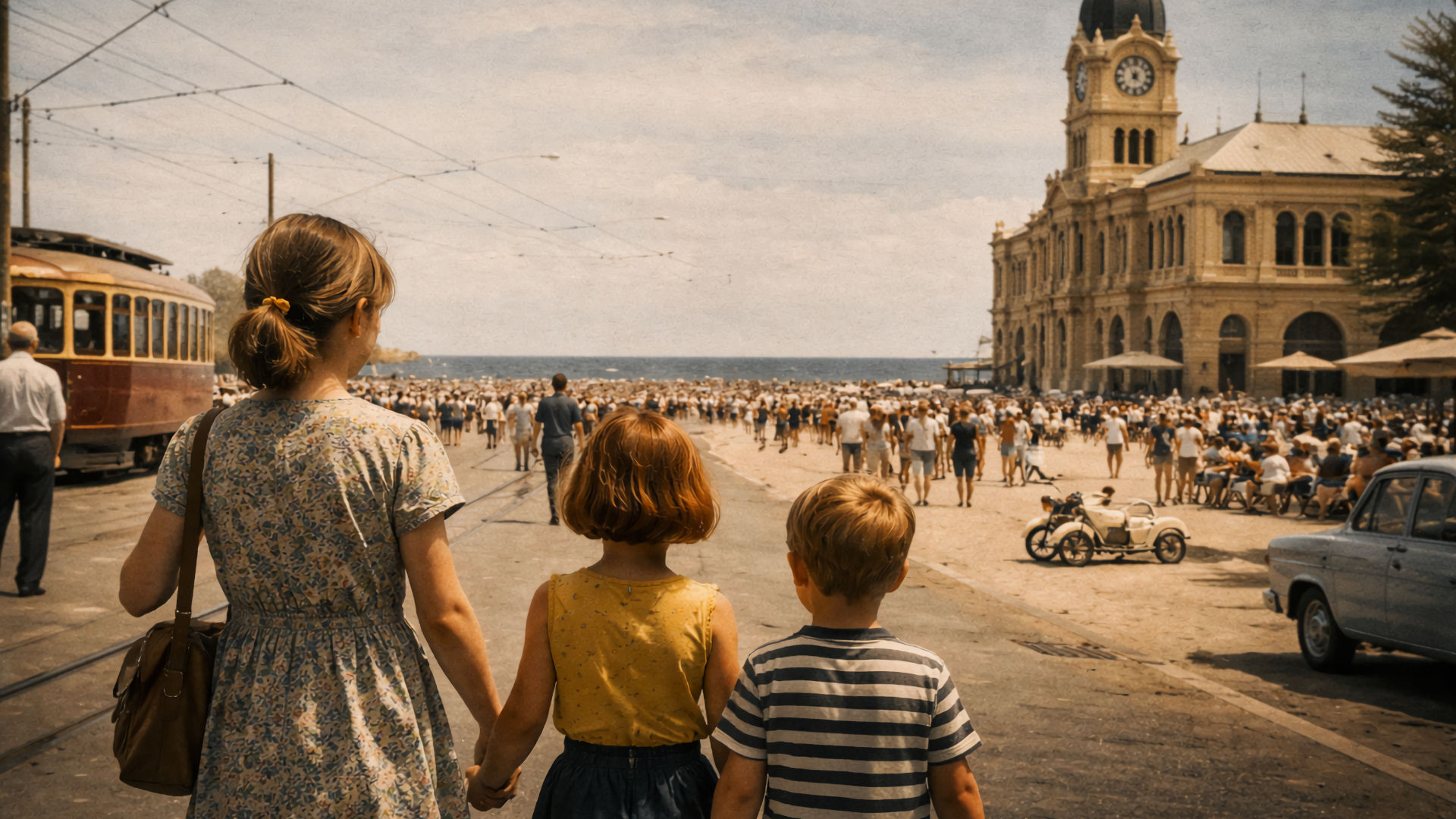
On Wednesday, 26 January 1966, Australia Day, the Beaumont family in Somerton Park, a coastal suburb of Adelaide, began what seemed like an ordinary summer holiday morning. The three Beaumont children, Jane Nartare Beaumont, aged 9, Arnna Kathleen Beaumont, aged 7, and Grant Ellis Beaumont, aged 4, had become used to going by themselves to nearby Glenelg Beach, a popular seaside destination on the edge of Holdfast Bay. At that time, the outing did not seem remarkable. In mid-1960s Australia, many parents still felt that local beaches, shopping strips, and tram or bus routes were familiar, manageable spaces for children, especially in daylight on a public holiday.
The children lived with their parents, Jim and Nancy Beaumont, and by all accounts, theirs was a normal family life. Glenelg was close enough to feel accessible, and the journey from Somerton Park was one the children already understood. Nothing about the day initially suggested panic, danger, or family upheaval. This was not a story that began with raised voices, threats, or signs of disruption. It began with routine, sunshine, and the ordinary trust of a family who believed their children were doing something familiar and safe.
The date also mattered. Australia Day brought crowds to the beach, and Glenelg was busy with swimmers, families, and holidaymakers. In another sense, that busy setting would later become one of the most haunting features of the case. The Beaumont children did not vanish from an isolated road or a lonely stretch of countryside. They disappeared from one of South Australia’s best-known public beaches, in broad daylight, in a place full of people. That contrast, between the cheerful openness of the setting and the fear that would follow, is one reason the case lodged itself so deeply in Australian memory.
By the start of that morning, though, none of that was visible yet. It was simply a trip to the beach on a hot January day, and three children heading into a world that still looked safe.
The Hours When Everything Changed
On the morning of Wednesday, 26 January 1966, the Beaumont children left their home in Harding Street, Somerton Park, and travelled to Glenelg Beach by themselves on the bus. Jane, aged 9, was the eldest and was trusted to look after Arnna, aged 7, and Grant, aged 4. Reports differ slightly on the exact departure time, with some accounts placing it at about 8:45 am and others closer to 10:00 am, but the broad outline is clear: the three children made the short journey to Glenelg on Australia Day and were expected home around midday. At the time, that level of independence was not considered extraordinary, especially for a beach trip in familiar surroundings.
As the morning wore on, the children were seen by several people around Glenelg. Witnesses later reported seeing them on the beach and nearby reserve, and one of the most important later accounts placed them in the company of an unknown adult man. Another sighting placed them at Wenzel’s cake shop in Mosley Street, where Jane is said to have bought food with a one-pound note. That detail drew attention because the children had left home with only a small amount of money, suggesting that someone else musts have given it to them. It was one of the first clues that the day had not unfolded in the ordinary way their mother had imagined when she let them go.
Back at home, Nancy Beaumont expected the children to return on the noon bus. When they did not arrive, concern began to replace routine. She waited for the 2:00 pm bus as well, hoping they had simply stayed longer at the beach than planned. But when that bus came and went without them, the situation became far more serious. Jim Beaumont, who had been away on a work trip, returned home early at about 3:00 pm and went straight to Glenelg to search for the children himself. He could not find them.
That was the moment the day changed completely. What had begun as a bright holiday outing turned into a frantic search across one of Adelaide’s busiest seaside districts. By about 5:30 pm, the Beaumonts reported their three children missing to police at Glenelg. From there, the case stopped being a family emergency and became a public mystery that would haunt Australia for decades.
Once the Beaumont children were reported missing on the evening of 26 January 1966, the response moved quickly beyond a worried family scanning the beach for three overdue children. Police began searching Glenelg almost at once, working first on the assumption that Jane, Arnna, and Grant were nearby, delayed, confused, or perhaps injured. The initial search covered the beach itself, nearby streets, the foreshore, and public areas around Glenelg. As the hours passed and nothing was found, the search widened to include other coastal areas, nearby buildings, and possible routes out of the district. Officers also monitored transport links and roads, because by then the possibility of abduction could no longer be ignored.
What made the case especially alarming was the speed with which it escalated. This was not a disappearance hidden for days before anyone noticed. By the evening of 26 January, police were already involved, and within hours the case had become a major operation. ABC’s reconstruction of the first night records the children being reported missing at about 7:20 pm, followed by searches of the Glenelg beach area and then other parts of the Adelaide coastline, including Brighton, West Beach, and Henley Beach. Even volunteer search efforts were being offered that same night.
By the next day, the case had spread far beyond Adelaide. Reports were carried widely, and public anxiety grew with remarkable speed. One reason was the children’s ages: Jane was only 9, Arnna 7, and Grant just 4. Another was the setting. These were not children who had disappeared in some remote bushland accident. They had vanished from a crowded seaside suburb on a public holiday, in daylight, with witnesses around. That combination made the case feel both shocking and deeply unsettling, because it suggested that something terrible could happen in a place that looked completely normal.
Within twenty-four hours, the disappearance had become national news, and within days, newspapers were already reflecting a darker fear, that the children had not merely wandered off, but had been taken. Searches even extended to places like the Patawalonga Boat Haven, which was drained after a reported sighting prompted police attention, though no trace of the children was found. The investigation would continue for decades, but this was the moment the case changed from an urgent local search into one of Australia’s defining unsolved mysteries.
Witnesses, Sightings, and Strange Leads
As the search widened, police were flooded with witness statements from people who believed they had seen the Beaumont children at Glenelg on the day they vanished. The sheer number of people at the beach on Australia Day should, in theory, have made the case easier to untangle. Instead, it created a fog of overlapping memories, partial observations, and details that were difficult to verify with certainty. Even so, a few witness accounts quickly stood out because they appeared to place Jane, Arnna, and Grant in the company of an unknown adult man. Several people described this man in broadly similar terms, as tall, tanned, thin-faced, and fair-haired, and those reports would become central to the investigation.
One of the most important leads came from a shopkeeper who recalled Jane purchasing food with a one-pound note. That detail mattered because, according to their mother, the Beaumont children left home with a lot less than that amount, not enough to explain such a purchase. Police, therefore, considered the possibility that an adult had given the children extra cash, which seemed to support witness reports that they had been seen with a man. It was a small clue, but in a case with no confirmed physical evidence, small clues carried enormous weight.
Police responded by producing a composite sketch based on witness descriptions of the man. That image became one of the most enduring visual elements of the case, not because it solved anything, but because it gave the public a face, or at least the outline of one, to connect to the mystery. Yet even here, there were limits. A sketch is only as good as memory, and memory in a crowded holiday setting is rarely neat. Some reports may have referred to the same man, while others may have captured ordinary interactions later made sinister by hindsight.
The investigation also drew in stranger leads, as famous unresolved cases often do. Over time, false hopes, rumours, and hoaxes began to attach themselves to the Beaumont mystery. But in the early stage of the investigation, the most important thread was still the simplest one: three children had apparently been seen alive at Glenelg, later than first assumed, and at least some witnesses believed they were not alone. That possibility shifted the case away from an accident and towards deliberate intervention by another person. It also set the stage for the long and often frustrating hunt for suspects, theories, and explanations that followed.
Suspects, Theories, and Lingering Doubts
As the years passed, the Beaumont case accumulated what many famous unsolved cases do: a long queue of suspects, theories, and half-convincing explanations, none of them strong enough to close the case. Investigators and later researchers repeatedly returned to one central idea: that the children were likely lured away by an adult they did not fear. That would fit the witness reports from Glenelg, suggesting the children were seen with a man and that they appeared calm rather than distressed. But identifying that man proved maddeningly difficult, and the absence of bodies, a crime scene, or reliable forensic evidence meant suspicion could spread far more easily than proof.
One of the most discussed later suspects was Harry Phipps, an Adelaide businessman and owner of the Castalloy foundry. Interest in him grew decades after the disappearance, largely because of claims from his son and arguments advanced by private investigators and writers who believed Phipps matched elements of the case. That suspicion helped drive excavations at the former Castalloy site, including searches in 2013, 2018, and again in 2025. Yet despite the attention, these digs did not produce conclusive evidence linking Phipps to the children’s disappearance. The theory remains one of the most prominent in public discussion, but still falls into the frustrating category of “possible, not proven”.
Other names have also surfaced over the decades. Media summaries of the case have pointed to figures such as Bevan Spencer von Einem, a convicted murderer associated with crimes against young people, and Arthur Stanley Brown, who was investigated in connection with the 1970 Townsville child murders. These men drew attention because of patterns that appeared, at least on the surface, to overlap with the Beaumont case. But again, overlap is not the same thing as evidence. No one was ever charged over the disappearance of Jane, Arnna, and Grant, and no suspect has been conclusively tied to the crime.
That is why the Beaumont mystery remains so stubborn. There are enough leads to keep hope alive, enough suspicious details to sustain new theories, and just enough uncertainty to stop any of them from fully settling into fact. Every few years, a new dig, a new witness claim, or a new proposed suspect makes headlines. And each time, the same grim truth returns: after all the searches, sketches, interviews, and speculation, nobody can yet say with certainty what happened after those three children left Glenelg Beach in January 1966.
Why the Beaumont Children Are Still Remembered
Nearly sixty years after Jane, Arnna, and Grant Beaumont disappeared from Glenelg Beach on 26 January 1966, the case still holds a powerful place in Australian memory. It remains open, it still generates new leads, and it continues to return to public attention whenever investigators, journalists, or private search teams revisit old evidence. In 2025, for example, another excavation at the former Castalloy site in Adelaide’s west again made national headlines, even though it failed to uncover any remains. That alone says a great deal about the case’s grip on the public imagination: decades later, people are still searching, still hoping, and still unable to let the story rest.
Part of that lasting impact comes from what the case seemed to change in Australia. Later reflections on the disappearance have often described it as a moment when public confidence was shaken, particularly the belief that children could safely move through ordinary suburban spaces with little fear. The Beaumont children did not vanish in secret or in some remote and frightening setting. They disappeared from a bright, crowded beach on a public holiday, which made the case feel unnervingly close to everyday family life. That sense of violated normality is one reason the case has remained emotionally potent for generations.
The case also endures because it offers no final answer, only a long trail of unanswered questions. There have been witness statements, suspect theories, media reconstructions, excavations, and periodic claims of fresh information, but none have produced certainty. An unsolved case leaves room for memory to keep working, and in this one, the missing children never became abstract names in an archive. Their photographs, their ages, and the ordinary details of that summer day have stayed vivid in the public mind. ABC noted in 2025 that Adelaideans of a certain generation could still picture their faces immediately, which helps explain why the story remains more than a historical puzzle. It is remembered as a wound that never fully closed. Jim and Nancy Beaumont spent the rest of their lives living with the unanswered loss of Jane, Arnna, and Grant. For years after the disappearance, they remained in the family home at Somerton Park, holding on there until their eventual divorce, after which they lived separately and kept largely out of public view. Even so, the case never truly left them, and police remained aware of their whereabouts. Nancy Beaumont died in Adelaide on 16 September 2019 at the age of 92, and Jim Beaumont died in Adelaide on 9 April 2023 at the age of 97, both having gone to their graves without knowing what happened to their children.
The Disappearance of the Beaumont Children FAQ
The Beaumont Children were Jane, Arnna, and Grant Beaumont, three siblings who disappeared from Glenelg Beach near Adelaide on 26 January 1966.
They disappeared on Australia Day, Wednesday 26 January 1966, after travelling to Glenelg Beach from their home in Somerton Park.
No, despite extensive searches and decades of investigation, the Beaumont Children have never been found.
The case became one of Australia’s most famous unsolved mysteries because the children vanished from a crowded public beach in daylight, and no conclusive answer has ever emerged.
Over the years, several suspects and theories have been explored, including Harry Phipps and others, but nobody has ever been charged with the disappearance.