The Freeway Phantom
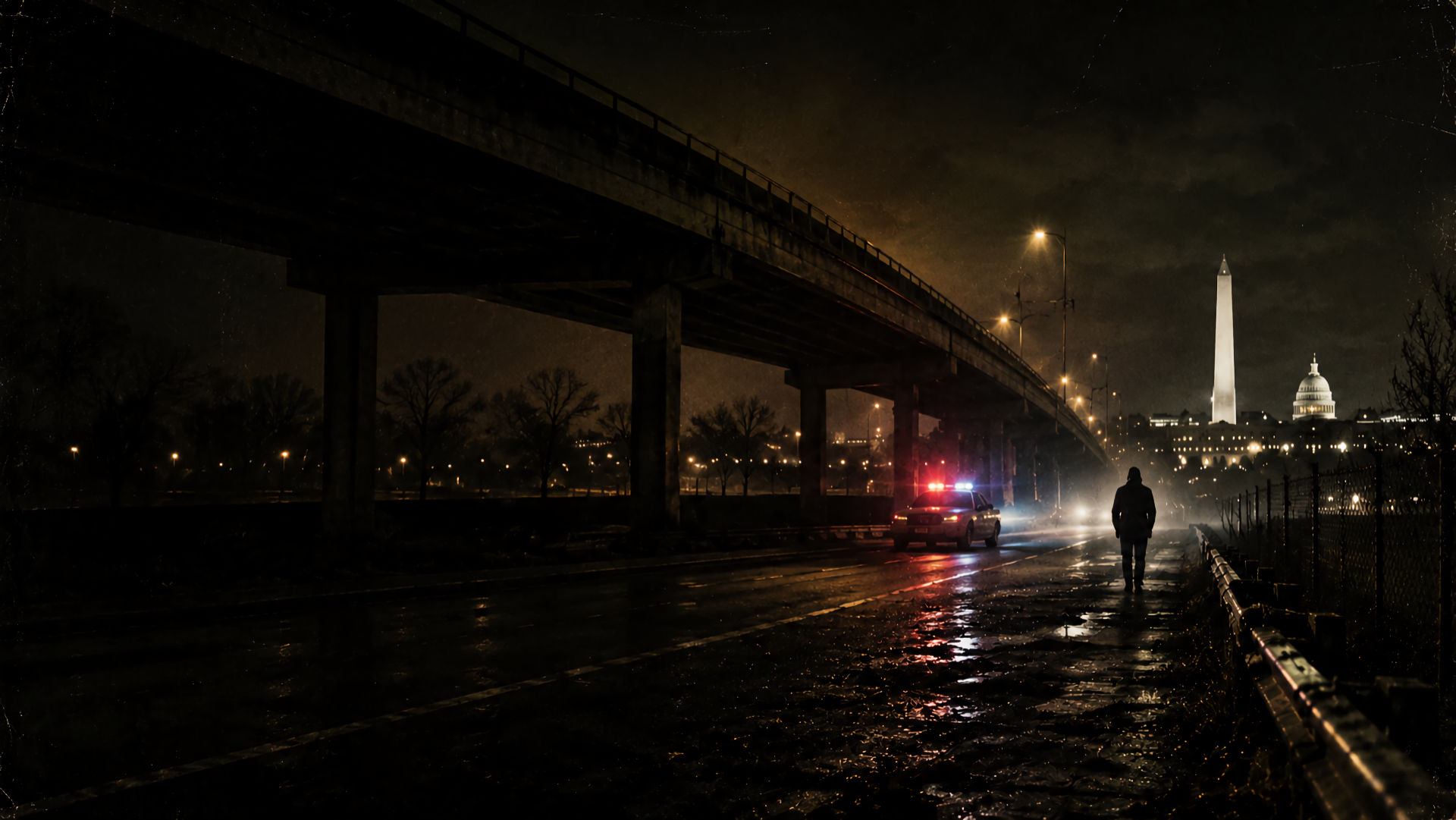
Washington, D.C., in the early 1970s, was a city under pressure from every direction. The Vietnam War had brought protests to the capital’s streets, the aftermath of the civil rights era had exposed deep racial and economic wounds, and police resources were stretched thin by demonstrations, ordinary crime, and mistrust between law enforcement and many of the communities they served.
In Southeast Washington, daily life carried its own quieter tensions. Families worked, children went to school, teenagers took buses to jobs and shops, and neighbourhoods functioned through familiar routines. That sense of routine is important to understand, because the Freeway Phantom case did not begin with a dramatic stranger bursting through a door. It began with an errand, the kind of ordinary errand that should have ended with a child walking safely home.
On 25 April 1971, 13-year-old Carol Denise Spinks left her home to go to a nearby shop. She did not return. Her family knew immediately that something was wrong. Still, in cases involving young people, especially Black children from working-class neighbourhoods, missing person reports were too often met with assumptions rather than urgency. The possibility that Carol had simply run away was raised, while her family insisted that this was not who she was.
Six days later, Carol’s body was found near Interstate 295, behind St. Elizabeth’s Hospital. She had been sexually assaulted and strangled. The discovery turned a disappearance into a murder investigation, but at first it was still treated as one terrible case rather than the opening of a pattern.
That first killing is important because it established several elements that would later feel horribly familiar. Carol had disappeared from her neighbourhood while doing something normal. Her body was left near a major road. Her killer had either moved her across the city or used the road system to discard her quickly and vanish into traffic. Her shoes were missing, a detail that would appear again and again.
For the community, Carol’s murder brought grief, but not yet the full understanding of what was coming. The name “Freeway Phantom” did not exist. There was no accepted theory of a serial killer hunting young Black girls in Washington. There was only a family without a daughter, neighbours whispering about danger, and police searching for answers while the city around them kept moving.
That is how some of the most frightening crime patterns begin. Not with certainty, not with a clear villain, and not with a headline ready-made for history. They begin with one absence that is misread, one body that is found, and one set of clues that do not yet have enough echoes to be recognised.
Within months, those echoes would arrive. Each new disappearance would force investigators and families to look back at Carol’s murder and ask whether the city had missed the first warning sign of something far larger.
The First Victims and the Shape of a Pattern
The second victim was 16-year-old Darlenia Denise Johnson, who disappeared on 8 July 1971. Like Carol Spinks, she was from Southeast Washington, and like Carol, she vanished while going about an ordinary part of life. Darlenia was reportedly on her way to a summer job at the Oxon Hill Recreation Centre when she failed to arrive.
Her disappearance brought a sharper fear into the neighbourhood, because Carol’s murder was still fresh enough to sit in everyone’s memory. Then came one of the details that made the case feel not only violent, but taunting. Darlenia’s mother reportedly received silent phone calls, followed by a call from a man claiming that he had killed her daughter. Whether that caller was truly the murderer, police could not prove, but the cruelty of it deepened the terror.
Darlenia’s body was later found close to the place where Carol’s had been discovered. The state of her remains made some forensic conclusions difficult, but investigators found evidence consistent with strangulation. Again, the body had been left near a road. Again, a young Black girl had vanished from a normal setting and been discarded as if the killer understood how to move through the area without drawing lasting attention.
Then, on 27 July 1971, 10-year-old Brenda Faye Crockett disappeared after being sent to the shop. Her case introduced one of the most haunting elements in the whole series. Brenda managed to telephone home while she was still alive. She was frightened and confused, telling family members that a man had picked her up and that she believed she was in Virginia. During a second call, she seemed to be repeating information that may have been fed to her.
Those calls suggested a killer who was not simply abducting and murdering quickly. He may have been controlling his victims for hours, perhaps using the calls to mislead families and police, perhaps enjoying the panic he created. Brenda’s body was found early the next morning in Prince George’s County, Maryland, near Route 50 and the Baltimore-Washington Parkway. She had been raped and strangled.
By this point, the pattern could no longer be dismissed as coincidence. Three victims, all young Black girls, all abducted from everyday circumstances, all found near major roads, all killed with similar violence. The city’s freeways were no longer just transport routes. They had become part of the crime itself.
The next victim, 12-year-old Nenomoshia Yates, disappeared on 1 October 1971 after visiting a shop. Her body was found only hours later, near Pennsylvania Avenue in Prince George’s County. With her death, fear hardened into recognition. Washington was not facing isolated murders. Someone was hunting children.
For parents, the danger was almost impossible to guard against. The victims were not disappearing from reckless situations or distant places. They were being taken from the ordinary geography of childhood itself.
Notes, Phone Calls, and the Name “Freeway Phantom”
After the fourth murder, local newspapers and residents began to speak about the killings as the work of one offender. The nickname “Freeway Phantom” grew from the geography of the case. Bodies were found near major roads, especially around Interstate 295 and routes linking Washington with Maryland. The killer seemed able to use the road network as both cover and signature.
The name was chillingly effective. It suggested someone who appeared and vanished, someone present in the city but impossible to pin down. Yet a nickname can also distort a case. It can turn a murderer into a shadowy figure of folklore, while the victims risk being reduced to a sequence. Carol, Darlenia, Brenda, and Nenomoshia were not clues in a legend. They were children whose lives had been interrupted by an offender who had found opportunity in a city that was not protecting them.
On 15 November 1971, the fifth victim was found. Brenda Denise Woodard was 18, older than the other victims but still a young woman with ordinary plans and ordinary movements. She had eaten dinner with a school friend and was travelling home when she disappeared. Her body was discovered the next morning near Prince George’s County Hospital, close to an access road from the Baltimore-Washington Parkway.
Brenda Woodard’s murder changed the public face of the case because the killer left a note. It was found in one of her coat pockets and was signed “Free-way PhanTom.” The message was rambling, threatening, and taunting. Its most notorious line suggested that the writer would “admit the others” when caught, followed by a challenge: “if you can.” The note gave the case a direct voice for the first time.
Investigators believed the note may have been written on paper taken from Brenda’s own school notebook. There were also suggestions that she may have been forced to write it, or that the killer had dictated it to her before murdering her. That possibility made the note even more disturbing. It was not simply a boast after the fact. It may have been part of the control he exerted over his victim.
The note created a psychological shift. Before Brenda Woodard, the killer’s presence had been inferred through body locations, victim profiles, and repeated methods. Now he had apparently stepped forward, not to confess in any meaningful moral sense, but to mock the police and terrify the public.
This kind of communication can seduce an investigation into chasing personality. Was the writer educated? Was the odd capitalisation meaningful? Was the wording deliberate or chaotic? Those questions mattered, but they also risked obscuring something simpler and more brutal: while the city studied his message, five young women and girls were already dead.
The killer had named himself, but the name solved nothing. If anything, it showed how confident he had become, and how little he feared discovery.
A Fractured Investigation in a Divided Washington
By late 1971, the Freeway Phantom investigation had become a multi-jurisdictional nightmare. The victims were abducted from Washington, D.C., but some bodies were found in Prince George’s County, Maryland. That meant different police departments, different procedures, and different chains of command had to share information in a case where every hour mattered.
The geography complicated everything. A killer using roads could cross boundaries in minutes, and the places where bodies were found were often not the places where the attacks began. Investigators had to consider bus routes, shopping areas, neighbourhood streets, secluded roadsides, and the possibility that the killer had access to a car that would not attract attention. They also had to work without the forensic tools modern audiences now expect from cold-case stories.
DNA profiling did not exist in 1971. Fingerprints, witness statements, fibres, vehicle descriptions, handwriting, phone calls, and behavioural assumptions carried much of the weight. Some leads pointed towards particular vehicles, including reports of victims being seen in cars, but nothing produced an arrest. Police investigated known offenders and received tips from prisoners, informants, and the public, yet promising lines of enquiry repeatedly collapsed.
The social context mattered too. These murders happened in a city where many Black residents already distrusted police, and with reason. Families of the victims felt that the response lacked the urgency they would have seen if the victims had been white, wealthier, or from more politically powerful neighbourhoods. That criticism has never entirely faded. It remains one of the central reasons the Freeway Phantom case is remembered not only as a murder investigation, but as a failure of attention.
In September 1972, nearly a year after Brenda Woodard’s death, 17-year-old Diane Denise Williams became the sixth recognised victim. She had cooked dinner for her family, visited her boyfriend, and was last seen catching a bus. Her body was found near Interstate 295, again linking the case to the roads that had shaped the killer’s identity in the press.
Diane’s murder revived public fear and raised the possibility that the Phantom had paused rather than stopped. Yet after her death, the recognised series ended. That created another problem. Serial investigations often rely on fresh evidence, repeated behaviour, and the offender making mistakes. When the murders stopped, the flow of new clues stopped with them.
Over time, suspects came and went. Some men were examined because of other violent crimes. Others were named through rumours or weak tips. A task force pursued the case, but no charge followed. The Phantom had not outsmarted one detective in a neat duel. He had slipped through the gaps between overburdened systems, damaged trust, thin evidence, and a city slow to see the pattern clearly.
That is what makes the investigation so frustrating. It was not one missed clue, but a chain of missed chances, each one making the next harder to repair.
Families, Fear, and the Victims Behind the Case
The phrase “Freeway Phantom” is memorable, but it is also dangerous. It keeps attention on the offender’s invented identity, when the heart of the story belongs to six victims: Carol Denise Spinks, Darlenia Denise Johnson, Brenda Faye Crockett, Nenomoshia Yates, Brenda Denise Woodard, and Diane Denise Williams. Their names matter because the killer’s name was never real. Theirs were.
Carol was 13, one of several children in a family that knew her habits and knew she would not simply vanish. Darlenia was 16 and trying to get to work. Brenda Faye Crockett was only 10, young enough that the phone calls she made home still feel almost unbearable to read about. Nenomoshia was 12, returning from a shop. Brenda Woodard was 18, moving between dinner with a friend and home. Diane was 17, a schoolgirl whose evening had been full of domestic normality before it turned fatal.
These details are not decoration. They correct the distance that time creates. True crime can sometimes flatten victims into ages, dates, and locations, but each of these girls and young women had a household arranged around her presence. When each disappeared, someone waited. Someone searched. Someone replayed the last conversation. Someone wondered whether a quicker police response, a better witness, or a different headline might have changed the ending.
The victims’ families also had to live through the long aftermath of an unsolved case. They endured anniversaries without answers and public retellings that often focused more on the killer’s mystique than on their loss. Some relatives became outspoken about the failures of the investigation, particularly the apparent loss or destruction of evidence that might have been useful when forensic science improved.
That loss became one of the bitterest parts of the case. Years later, when Detective Romaine Jenkins helped revive interest in the Freeway Phantom murders, investigators discovered that important files and evidence had not been preserved as they should have been. For families, this was not an administrative mistake. It meant that material collected from their daughters and sisters, material they had hoped might one day identify the killer, had vanished into institutional carelessness.
The renewed investigation did produce attempts to reconstruct the files and reassess the case. Behavioural profiling suggested the offender may have been a local man, possibly familiar with Southeast Washington, perhaps trusted enough by some victims to get close without immediate alarm. But profiling is not proof. It can shape questions, not answer them.
What remains most powerful is the community memory. The Freeway Phantom case is not remembered only because the killer escaped justice. It is remembered because six families were forced to carry the weight of fear, grief, and neglect long after the headlines moved on.
Their persistence is why the case has never disappeared completely. Even when institutions failed, relatives, journalists, and local historians kept saying the names out loud.
Why the Freeway Phantom Still Haunts America’s Unsolved Murders
More than half a century later, the Freeway Phantom remains one of Washington, D.C.’s most disturbing unsolved murder cases. Its power comes partly from the violence itself, but also from the unanswered questions around it. Who was he? How did he approach the victims? Did he live nearby? Did anyone suspect him and stay silent? Did he stop, die, move away, go to prison for another offence, or continue hurting people elsewhere?
The case also haunts because it exposes the limits of investigation when urgency, resources, and preservation fail. In theory, time can help a cold case. Witnesses may come forward. Old suspects can be re-examined. DNA technology can transform evidence that once seemed useless. But time can also destroy. Memories fade, witnesses die, records vanish, and physical evidence decays or is lost. The Freeway Phantom case suffered from exactly that kind of erosion.
Modern retellings have returned attention to the murders, including documentaries, podcasts, newspaper features, and renewed public discussion of the victims’ lives, which is important because obscurity is another form of injustice. The Phantom killed six young Black girls and women in the nation’s capital, yet the case never entered the American true-crime imagination in the same way as killers whose victims were white or whose crimes were framed through more sensational media narratives.
That imbalance is not a side issue. It sits at the centre of why the case still feels unresolved, even beyond the absence of an arrest. Families and commentators have repeatedly asked whether the investigation would have received more sustained pressure if the victims had been from different backgrounds. The question is uncomfortable, but the case demands it. Murder not only tests detectives. It tests which victims a society chooses to see.
There is also the terrible mystery of the killer’s confidence. The note left with Brenda Woodard suggested a man who wanted recognition, but not enough to risk capture. The phone calls connected to earlier victims suggest cruelty and control. The body dump sites suggest someone practical, mobile, and familiar with roads. Yet after Diane Williams, the known murders stopped. The silence that followed is almost as unsettling as the killings themselves.
The Freeway Phantom did not disappear because the story reached a clean ending. He disappeared because the trail went cold. That is why the case remains so difficult to leave behind. It offers no courtroom, no confession, no final explanation, and no clear moral order restored.
Instead, it leaves six names, six families, and a city forced to remember what was missed. The Phantom wanted a name that made him sound untouchable. The better answer is to remember Carol, Darlenia, Brenda Faye, Nenomoshia, Brenda Woodard, and Diane, because they were never shadows. They were the story.
And until someone can finally answer for what happened to them, that story remains open, painful, and unfinished.
The Freeway Phantom FAQ
The Freeway Phantom was the name given to an unidentified killer linked to the murders of six young Black girls and women in the Washington, D.C. area between 1971 and 1972. The killer has never been caught.
Six victims are commonly linked to the Freeway Phantom case: Carol Denise Spinks, Darlenia Denise Johnson, Brenda Faye Crockett, Nenomoshia Yates, Brenda Denise Woodard, and Diane Denise Williams.
The name came from the fact that several victims were found near major roads and freeways around Washington, D.C. A note found with one victim was also signed “Free-way PhanTom.”
No. Despite investigations, renewed interest, and decades of public attention, no one has ever been convicted of the Freeway Phantom murders.