The Battle of Borodino
By the summer of 1812, Napoleon Bonaparte stood at the height of his power, but also at the edge of one of history’s great military disasters. His empire stretched across much of Europe, either directly controlled by France or bound to it through alliances, treaties, satellite kingdoms, and nervous obedience. Russia, ruled by Tsar Alexander I, had once been Napoleon’s uneasy partner after the Treaty of Tilsit in 1807, but that partnership had steadily cracked under the weight of pride, economics, and strategy.
The main dispute centred on the Continental System, Napoleon’s attempt to weaken Britain by shutting British goods out of Europe. Russia suffered economically from this policy and gradually loosened its commitment to it, much to Napoleon’s fury. To him, Russian defiance threatened the whole structure of his European dominance. To Alexander, Napoleon’s pressure was becoming intolerable, especially as French influence crept closer to Russia’s borders.
Napoleon did not set out with a modest expedition. In June 1812, he crossed the River Niemen with the Grande Armée, one of the largest military forces Europe had ever seen. It was not a purely French army. It included Poles, Germans, Italians, Dutch, Swiss, Croats, and troops from several allied or dependent states. On paper, it looked overwhelming. In practice, it was a huge, hungry, complicated beast that required food, fodder, roads, discipline, and luck in quantities no army commander could just order into existence.
Napoleon hoped to force the Russians into a decisive battle near the frontier, destroy their main army, and compel Alexander to negotiate. That had been his pattern in earlier campaigns. Move quickly, find the enemy, smash them in battle, dictate terms, and let everyone else admire the terrifying efficiency. The problem was that the Russians refused to play their assigned part. Under commanders such as Barclay de Tolly and Prince Bagration, they retreated deeper into Russia, avoiding the decisive engagement Napoleon desperately wanted.
This retreat infuriated many Russian officers and civilians, who saw it as cowardice or incompetence. Yet it also stretched Napoleon’s army across vast distances, through poor roads, burned supplies, and exhausting heat. Disease, hunger, desertion, and skirmishing began weakening the Grande Armée long before it reached Moscow. Napoleon was advancing, but the further he went, the less his great army resembled the unstoppable machine that had crossed the Niemen.
By late summer, Russian pressure for a stand had become impossible to ignore. The army could not simply abandon the road to Moscow forever. Russia needed a battle, not because battle guaranteed victory, but because retreat without resistance risked shattering morale and political confidence. That pressure brought an old soldier back to centre stage, Field Marshal Mikhail Kutuzov, whose task was simple to state and dreadful to perform. He had to stop Napoleon, or at least bleed him badly enough that Russia could survive what came next.
Kutuzov Chooses His Ground
Mikhail Kutuzov was not the sort of commander who dazzled like Napoleon. He was older, cautious, physically marked by earlier wounds, and sometimes underestimated by enemies and allies alike. Yet he understood Russia’s position with a clarity that mattered more than theatrical brilliance. Napoleon wanted a decisive victory. Kutuzov needed to deny him the kind of victory that would break Russia’s will.
When Kutuzov took command, he inherited an army that had been retreating for weeks and a nation demanding resistance. Moscow was not Russia’s official capital, but it was its spiritual and historic heart. To abandon it without a major battle would have been politically explosive. Kutuzov therefore searched for ground where the Russian army could stand, fight, and impose a price on Napoleon’s advance.
He found that ground near the village of Borodino, west of Moscow, along the old Smolensk road. The position was not perfect, because battlefields have an irritating habit of being selected by geography rather than by committee. Still, it offered useful defensive possibilities. The Kolocha River and broken terrain helped shape the battlefield, while Russian engineers strengthened key points with earthworks. These field fortifications would become famous, especially the Bagration flèches on the Russian left and the Great Redoubt, also known as the Raevsky Redoubt, closer to the centre.
The Bagration flèches were arrow-shaped earthworks designed to protect the vulnerable left flank. They were named after Prince Pyotr Bagration, one of Russia’s most respected commanders. The Great Redoubt, positioned on a rise, housed artillery that could dominate parts of the battlefield. Together, these defences did not create an impregnable wall, but they gave Russian troops places to anchor themselves and forced the French to attack into deadly fire.
Kutuzov’s plan was not subtle in the sense of manoeuvre. He knew Napoleon would attack and that the Russian army would have to endure enormous punishment. He hoped to hold long enough, damage the French badly enough, and keep the Russian army intact enough to continue the war. In that sense, Borodino was not merely about who held the field at sunset. It was about whether Napoleon could destroy the Russian army as a fighting force.
Before the main battle, there was a sharp fight for the Shevardino Redoubt on 5 September 1812. This forward position stood ahead of the main Russian line and became the scene of intense combat. The French eventually captured it, giving Napoleon a clearer view of the Russian position and confirming that Kutuzov intended to stand. It also gave both armies a grim preview of what was coming.
By the evening before the battle, fires burned across the camps and thousands of soldiers prepared themselves as best they could. Some wrote letters. Some cleaned muskets. Some prayed. Others tried to sleep while knowing that dawn would bring one of the largest and bloodiest battles of the Napoleonic Wars. Borodino was ready, and nobody on either side was likely to leave it unchanged.
The Armies Gather at Borodino
On 7 September 1812, the armies facing each other at Borodino represented two very different military situations. Napoleon still commanded a formidable force, filled with experienced officers and veterans of earlier campaigns. Yet his army had already been reduced by the long advance into Russia. The men who reached Borodino were not the fresh mass that had crossed the Niemen. They were tired, hungry, and increasingly aware that Russia was not behaving like Austria or Prussia.
The French and allied army still possessed tremendous attacking power. Napoleon had marshals such as Davout, Ney, Murat, and Eugène de Beauharnais at his disposal, each commanding large formations. Davout was disciplined and methodical, Ney was aggressive and brave, Murat was flamboyant cavalry personified, and Eugène was capable and loyal. It was a strong command team, although not always a perfectly harmonious one. Napoleon’s marshals were brilliant men, but brilliant men under cannon fire can still disagree like cats in a sack.
The Russian army, meanwhile, had the advantage of fighting closer to its own heartland and on ground it had prepared. Its soldiers had endured retreat, criticism, and uncertainty, but Borodino gave them a chance to stand. The army included regular infantry, cavalry, artillery, Cossacks, militia, and guards units. Its commanders included Bagration on the left and Barclay de Tolly in the centre and right, both men carrying the burden of earlier controversy. Barclay, in particular, had been criticised for retreating, yet that retreat had helped preserve the army for this moment.
The scale of the coming battle was immense. Estimates vary, but both sides together placed well over 200,000 men near the field, supported by hundreds of cannon. Artillery would play a devastating role. Borodino was not a neat chess match of elegant manoeuvres. It became a grinding struggle in which massed guns, infantry assaults, cavalry charges, and stubborn defensive stands collided for hour after hour.
Napoleon’s options were debated then and have been debated ever since. He could attempt a frontal assault against the fortified Russian line, or try to turn one of its flanks. Marshal Davout reportedly favoured a wider movement against the Russian left, which might have unhinged the defence. Napoleon rejected a risky sweeping manoeuvre, partly because of the terrain, partly because of the army’s condition, and partly because he wanted to keep his forces concentrated. The result was a more direct battle, one that would hammer the Russian line rather than elegantly bypass it.
Kutuzov, for his part, did not need to defeat Napoleon in the classic sense. He needed to avoid destruction. His dispositions were imperfect, and some parts of the Russian line were vulnerable, but his army had depth, artillery, and stubborn morale. The men in the earthworks knew the French would come for them. The French knew those earthworks had to be taken. Both sides could see enough of the battlefield to understand the day’s basic bargain. Advance, defend, fire, endure, and hope that courage would last longer than flesh.
The Fight for the Flèches and the Great Redoubt
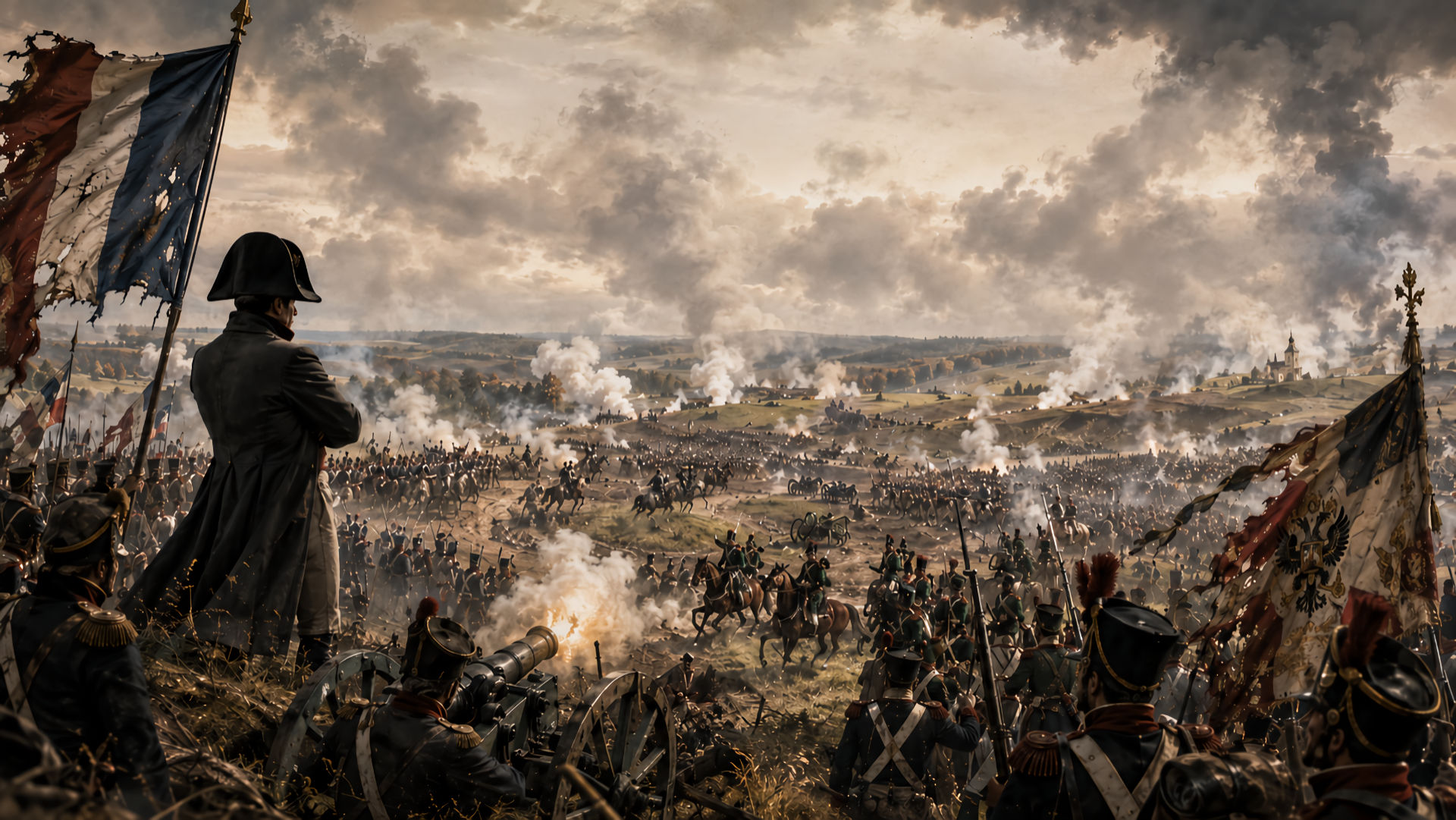
The battle began before sunrise with artillery fire, and soon the French attacks struck the Russian left. The Bagration flèches became one of the main killing grounds of the day. Davout, Ney, and Murat pushed troops forward against these earthworks, while Russian defenders poured musketry and cannon fire into the attackers. Positions were taken, lost, and retaken in a brutal rhythm that left the ground littered with dead and wounded men.
The flèches were not massive stone fortresses. They were fieldworks of earth, timber, and determination. That made them vulnerable to assault, but also difficult to neutralise while Russian troops continued to feed men and guns into the fighting. French infantry advanced under artillery fire, closed on the works, and fought at close range. Russian units counterattacked with equal ferocity. This was not warfare as a tidy map arrow. This was smoke, shouting, splintered wood, torn uniforms, shattered bodies, and officers trying to impose order on chaos.
Prince Bagration was badly wounded during the struggle, a severe blow to Russian morale and command on the left. His removal from the field weakened coordination, although Russian resistance did not collapse. The French eventually gained control of the flèches, but by then they had paid heavily. Their success did not produce the decisive rupture Napoleon needed. Instead of opening the road to total victory, the fight absorbed men, time, and energy.
At the same time, the centre of the Russian line came under terrible pressure. The Great Redoubt, defended by Russian troops and artillery, became another focal point. Eugène de Beauharnais’s forces attacked it, and the struggle around the position was savage. The redoubt’s guns inflicted heavy losses, but French assaults eventually carried the position after repeated fighting. Once again, success came at appalling cost.
Cavalry also played a major role, though not always with decisive effect. Murat’s horsemen launched charges across ground torn by cannon fire, while Russian cavalry countered where possible. There were moments when the battlefield seemed to tremble under the movement of mounted troops, but cavalry could not magically transform exhaustion into victory. Horses, despite centuries of military propaganda, are not especially fond of cannonballs.
One of the most famous questions of the day concerns Napoleon’s Imperial Guard. The Guard was his elite reserve, the final hammer he often used when victory was within reach. At Borodino, his marshals urged him to commit it, arguing that one final blow might break the Russians. Napoleon refused. He was deep inside Russia, far from secure supply lines, and unwilling to risk his last great reserve so far from France. To his critics, this was excessive caution. To his defenders, it was prudence in a campaign already devouring his army.
By late afternoon, the Russians had been forced back from key positions, but they were not destroyed. The French had taken the flèches and the Great Redoubt, yet the Russian army still existed, battered but coherent enough to withdraw. Napoleon had won ground, but ground alone was not the prize he had come for. He needed the Russian army broken. Borodino gave him blood instead.
A Field Won at Terrible Cost
When the firing faded, Borodino was one of the bloodiest single-day battles of the nineteenth century. Exact casualty figures vary, as they often do when history has to count through smoke, confusion, and national pride. A reasonable estimate is that the French and their allies suffered around 28,000 to 35,000 casualties, while Russian losses may have been around 40,000 to 45,000. Whatever the precise numbers, the human cost was staggering.
The battlefield itself was a horror. Earthworks had been blasted apart, villages burned or damaged, and fields churned by artillery, cavalry, and infantry. Thousands of wounded men lay between the lines, many waiting hours or longer for help that could never come quickly enough. Medical care in Napoleonic warfare was brave, limited, and overwhelmed. Surgeons worked with brutal urgency, and survival often depended as much on luck as treatment.
Napoleon could claim victory because his army had taken the principal Russian positions and forced Kutuzov to retreat. In conventional battlefield terms, this was important, as the French held the field at the end of the fighting. Yet the victory was strangely hollow. The Russian army had not been surrounded, annihilated, or rendered incapable of further resistance. It had been mauled, certainly, but it remained alive.
Kutuzov understood this distinction. After Borodino, he faced a terrible decision. Moscow lay ahead, and many expected another stand. Instead, after consultation at Fili, he chose to preserve the army and abandon Moscow. This decision was painful, controversial, and strategically vital. Cities could be lost, however symbolic. An army, once destroyed, could not be rebuilt in time to save the state.
For Napoleon, Borodino was deeply frustrating. It was the battle he had sought, but not the outcome he required. He had forced a major engagement and technically won it, yet the political result did not follow. Tsar Alexander did not sue for peace. Russia did not collapse. The path to Moscow opened, but it led not to a negotiated settlement but to a trap made of distance, fire, weather, and silence.
The psychological cost was also significant. Napoleon’s aura depended on decisive victories. Austerlitz had dazzled Europe. Jena had shattered Prussia. Wagram had compelled Austria. Borodino, by contrast, was a bruising slog that left both armies wounded and neither side truly satisfied. The French had advanced, but they had done so through a storm of losses they could ill afford. The Russians had retreated, but they could tell themselves that they had endured the worst Napoleon could throw at them.
This is why Borodino remains so difficult to classify neatly. It was a French tactical victory, because Napoleon gained the field, and the Russians withdrew. It was also a Russian strategic success, because Kutuzov preserved the army and denied Napoleon the decisive destruction he needed. History does enjoy being awkward like that. Borodino gave Napoleon Moscow, but it did not give him Russia.
The Road Beyond Borodino
After Borodino, the road to Moscow lay open. Napoleon entered the city on 14 September 1812, expecting that possession of Moscow would force Alexander to negotiate. Instead, he found a city largely abandoned and soon ravaged by fire. Whether caused by deliberate Russian action, disorder, accident, or a mixture of factors, the fires deprived the French of shelter and supplies on the scale they had expected. Napoleon had reached the symbolic heart of Russia, but the prize was cold, damaged, and politically useless.
The Tsar refused to make peace. This refusal was perhaps the most important fact after Borodino. Napoleon’s system worked when defeated rulers negotiated after battlefield disaster. Alexander did not. The Russian government withdrew, the Russian army recovered, and irregular forces continued harassing French communications. The longer Napoleon waited in Moscow, the worse his position became. Autumn deepened, supplies dwindled, and the campaign’s original logic fell apart.
When the retreat finally began in October, the Grande Armée was already in grave danger. The army tried to move back west through devastated territory, pursued by Russian forces and battered by hunger, cold, disease, and exhaustion. The retreat from Moscow became one of the most infamous military disasters in history. Borodino had not destroyed Napoleon, but it had helped create the conditions in which the campaign itself would destroy his army.
The battle’s consequences reached far beyond the road from Moscow. Napoleon’s losses in Russia weakened his empire and encouraged enemies across Europe. Prussia, Austria, Britain, Russia, and others would play their parts in the campaigns that followed. The myth of Napoleon’s invincibility had been badly damaged. He remained dangerous, brilliant, and capable of raising new armies, but after 1812 the balance had shifted. Europe had seen that he could bleed.
For Russia, Borodino became a symbol of endurance and sacrifice. It was not a clean victory in the ordinary sense, but national memory does not always require tidy scorecards. The defence at Borodino, the abandonment of Moscow, and the survival of the army all became part of a larger patriotic story. Russian soldiers had stood before Napoleon’s greatest military machine and had not been broken. That mattered enormously.
The battle also invites a wider lesson about war and decision-making. Napoleon won many battles by forcing events into a pattern he understood better than his enemies. In Russia, that pattern failed. Space replaced speed. Attrition replaced decision. Political will outlasted battlefield shock. Borodino was the moment when Napoleon got the major battle he wanted, only to discover that even victory could be insufficient.
The Battle of Borodino, therefore, stands as one of the defining clashes of the Napoleonic Wars. It was enormous, brutal, tactically French, strategically ambiguous, and historically decisive in ways that were not immediately obvious at sunset. Napoleon stood on the field, but Kutuzov kept the war alive. The French entered Moscow, but Russia did not surrender. Borodino was not the end of the 1812 campaign. It was the blood-soaked doorway into its most disastrous chapter.
The Battle of Borodino FAQ
The Battle of Borodino was fought on 7 September 1812 during Napoleon’s invasion of Russia. It took place west of Moscow and became the largest and bloodiest battle of the campaign.
The French-led Grande Armée was commanded by Napoleon Bonaparte. The Russian army was commanded by Field Marshal Mikhail Kutuzov, with important subordinate commanders including Prince Pyotr Bagration and Barclay de Tolly.
Napoleon’s army held the battlefield at the end of the fighting, so it is often described as a French tactical victory. However, the Russian army was not destroyed, and Napoleon failed to gain the decisive victory he needed.
Borodino opened the road to Moscow, but it also badly weakened Napoleon’s army. The battle showed that Russia could absorb terrible losses and continue the campaign, which became disastrous for the French after the occupation of Moscow.
Exact figures vary, but the combined casualties are usually estimated at around 70,000 or more killed, wounded, or missing. It was one of the bloodiest single-day battles of the nineteenth century.