The Courrières Mine Disaster
At the beginning of the twentieth century, northern France was one of the beating industrial hearts of the country. Beneath the towns and villages of Pas-de-Calais lay rich seams of coal, and above them lived communities whose daily life was shaped by the mine. Men and boys went underground before dawn, families waited for the whistles and cages that marked the rhythm of each shift, and entire local economies depended on coal being cut, hauled, weighed and sold.
The Courrières mining company operated one of the largest coal networks in the region. Its workings stretched below several communities, including Méricourt, Sallaumines, Billy-Montigny and Noyelles-sous-Lens. These were not isolated shafts with neat boundaries, but a connected industrial maze of galleries, crosscuts, levels and working faces. That complexity helped production, but it also meant that danger could travel quickly once something went wrong.
Coal mining had always been hazardous, and miners knew it better than anyone. They lived with rock falls, flooding, fires, bad air, machinery accidents and the ever-present risk of gas. Methane, known to miners as firedamp, could gather in pockets and ignite. Coal dust, which covered surfaces and hung in the air, could turn a local blast into a violent chain reaction. A mine was not simply a workplace. It was a buried machine, and every part of that machine depended on ventilation, discipline and luck.
The men who descended into Courrières were not reckless. They were skilled workers used to reading the underground world through sound, smell and habit. A change in air, the behaviour of a lamp, the warmth of a wall or the presence of smoke could all mean something. But in an age when industrial output often pushed ahead of worker safety, warnings were not always enough to stop production. The coal had to come up. The orders had to be met.
By March 1906, the Courrières mine was already a place of concern. Smoke and toxic gas had reportedly been noticed in the days before the disaster. A fire had also been detected deep underground before the main explosion. Attempts were made to isolate and smother it, a standard response when flames threatened a mine. Yet sealing a fire underground could also trap heat, gases and uncertainty in a place where uncertainty was deadly. By the morning of 10 March, the mine was not quiet. It was waiting.
A Dangerous Morning in March 1906
Saturday, 10 March 1906, began like countless working mornings in the coalfield. Miners arrived in the half-light, collected equipment, entered cages and descended into the earth. Many would have been thinking less about danger than about wages, food, family and the end of the shift. Mining communities lived with risk so constantly that ordinary routine could sit beside mortal danger without ceremony. That was part of the tragedy. Disaster did not arrive on a day that announced itself as special.
The concern from the previous day had not disappeared. A fire had been reported in the workings, and efforts had been made to shut off the affected area. In theory, depriving a fire of air should help extinguish it. In practice, underground fires were treacherous things. They could smoulder unseen, generate poisonous gases, weaken structures and create pockets of explosive atmosphere. The men responsible for the mine had to balance the danger of the fire against the pressure to keep work moving.
That balance would soon prove catastrophic. If flammable gas escaped near the smouldering fire, or if coal dust was disturbed and ignited, the mine could become a tunnelled weapon. Modern investigations still cannot state the precise initial cause with certainty. What is clear is that the conditions existed for a massive underground explosion. The mine held fuel, air, confinement and ignition. In other words, it had the ingredients for disaster, arranged in the worst possible place.
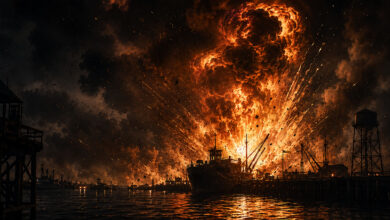
At around half past six in the morning, the explosion tore through the workings. It was not merely a local blast. It travelled through the galleries with devastating force, turning the mine’s connected design against the men inside it. Flames, pressure, smoke, dust and poisonous gases moved through the underground network. Lift cages were damaged or hurled upwards. Surface buildings were struck. People above ground felt the violence of something that had begun far below their feet.
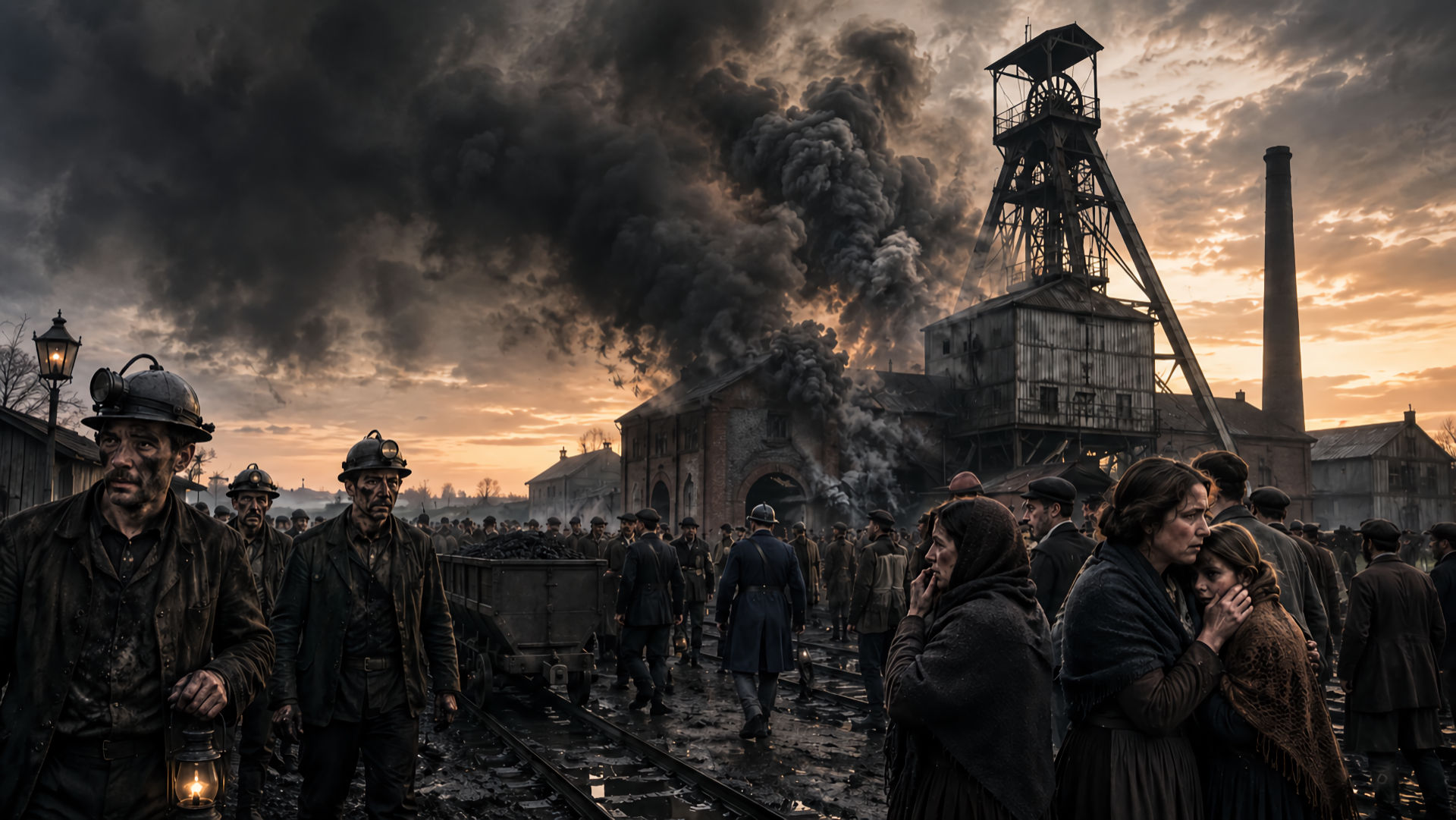
For families in the nearby mining settlements, the first sign was confusion, then dread: a sound, a tremor, smoke from a shaft, people running towards the pithead. In mining villages, news travelled faster than any official statement. Wives, parents, children and neighbours gathered where they could, desperate for names. Some men escaped quickly, burned, injured or poisoned by gas. Others were alive but trapped beyond debris, flame and collapsed passageways. Many were already dead.
The disaster had begun in seconds, but its meaning would unfold over days and weeks. At first, people still hoped for rescues. Mines could trap men in pockets of air, and miners were resourceful survivors. Yet the scale of the blast made hope fragile. Courrières was no longer just an industrial accident. It had become a race between rescuers, fire, gas and time.
Explosion in the Galleries
Inside the mine, the explosion created a world of darkness and ruin. Galleries that had been familiar routes became blocked, shattered or filled with smoke. Timber supports were splintered, rails twisted, walls blackened, and airways disrupted. Men who had survived the first blast faced the next killers almost immediately. Fire took some. Carbon monoxide and other poisonous gases took others. Falling rock and wreckage trapped many where they stood.
The violence of a coal-dust explosion lies in how it feeds itself. A first ignition can lift dust from floors, beams and ledges. That dust then burns in the air, extending the blast through connected tunnels. Each new pressure wave can raise more dust, creating another burst of flame and force. In a large mine such as Courrières, this meant that destruction could travel far beyond the original point of ignition. The mine’s underground size became part of the disaster.
For some miners, survival depended on instinct. They tried to move towards fresh air, follow known routes or find working shafts. But the explosion had changed the geography. A passage that should have led to safety might now be blocked. A familiar turn might lead into smoke. In the blackness, injured men had to make choices with little information and less strength. The mine they knew had become a hostile, broken labyrinth.
The first survivors who reached the surface brought with them terrible clues. Many were burned or dazed. Some were barely conscious from gas inhalation. Their injuries suggested not a small accident but a catastrophe spread across the workings. Each rescued man was a relief and a warning. If the men who were able to escape looked like this, then those still inside were in desperate condition.
Above ground, the pitheads became scenes of fear and pressure. Families demanded information, officials tried to organise access, and mine staff struggled to understand the condition of the shafts. Rescue attempts began quickly, but speed did not mean success. The mine was still dangerous. Fires continued. Gas remained a threat. Collapses could kill rescuers as easily as trapped miners. Every descent required courage, but courage could not clear blocked tunnels by itself.
By the end of the first day, Courrières had become a mass casualty disaster. The number of dead was still uncertain, but everyone knew it would be high. Bodies began to be recovered, and temporary mortuary arrangements were made. Identification was painful and difficult. Families waited between hope and recognition, fearing both silence and certainty. The mine had swallowed a generation of workers, and the villages above it were left counting who had not come home.
Rescue Efforts, Rage, and Impossible Choices
The rescue effort at Courrières was shaped by bravery, confusion and bitter disagreement. Miners, engineers, doctors, gendarmes and local volunteers all became part of the response. Some rescuers entered passages despite fire, smoke and unstable ground. Others tried to restore ventilation or reach blocked areas from different shafts. The scale of the disaster overwhelmed normal procedures almost immediately. There were too many missing men, too many damaged routes and too little certainty about where survivors might be.
France did not yet have the kind of specialised mine rescue system that later disasters would make essential. Equipment, training and breathing apparatus were limited. Help came from outside the region, including experienced rescuers from Germany, whose arrival was striking at a time when Franco-German relations were often tense. Underground disaster briefly cut across national rivalry. In the face of smoke and death, practical skill mattered more than flags.
Yet the rescue also became the centre of public anger. After only a few days, search efforts were officially wound down, with the remaining missing men effectively presumed dead. Company officials argued that conditions underground were too dangerous and that fire and gas made further rescue nearly impossible. Many families and miners saw something colder in that decision. They believed the company was too eager to protect the mine, the coal seams and future production.
It is important not to flatten the story into simple villainy. Underground rescue after a major explosion was genuinely terrifying and technically difficult. Sending men into burning, poisoned galleries could create more victims. Ventilation changes might help one area while killing men in another. Sealing off sections could contain fire, but also cut off possible survivors. Every decision carried risk, and some choices had no humane outcome.
Even so, grief does not wait politely for technical explanations. Families at the pitheads wanted fathers, sons, husbands and brothers brought back, alive if possible and identifiable if not. Rumours spread. Newspapers reported the disaster widely. Political voices seized on Courrières as proof that industrial workers were treated as expendable. The disaster became not only a tragedy of mining but a symbol of class anger in industrial France.
Funerals drew huge crowds, and the mourning quickly became political. Strikes broke out across the mining region, fuelled by outrage over working conditions, wages, safety and the handling of the rescue. The French state sent officials and soldiers to maintain order, while ministers tried to calm a situation that had become explosive in more ways than one. Courrières had exposed a brutal truth. When a mine collapsed, it did not only break underground galleries. It could crack open an entire society.
The Miners Who Refused to Die
Just when Courrières seemed to have moved from rescue to mourning, the disaster produced one of the most astonishing survival stories in mining history. On 30 March 1906, twenty days after the explosion, thirteen miners emerged alive. They had been trapped in the underground darkness long after official hopes had faded. Their return stunned the region and horrified it at the same time. If these men had survived, people asked, how many others might have lived if searches had continued more aggressively?
The survivors had endured conditions almost beyond imagination. They moved through dark galleries, avoiding dangerous areas and searching for air, water and anything edible. Accounts describe them surviving on what they could find underground, including food intended for pit animals and, in some versions, parts of a dead mine horse. They drank water from the mine walls and rationed strength as carefully as food. This was survival reduced to its most basic form, breath by breath and step by step.
Among the survivors were men and boys of different ages. The group later became famous, and several names were recorded in contemporary accounts, including Henri Nény and Charles Pruvost. Some were teenagers. Others were experienced older miners whose knowledge of the underground world may have helped keep the group moving. They were not rescued from a comfortable pocket of safety. They had crawled, searched, endured and refused to surrender to the mine.
Their physical condition shocked those who saw them. They were filthy, exhausted, weakened and changed by hunger, thirst and darkness. Yet they were alive, and that fact transformed the emotional landscape of the disaster. Mourning families were forced to imagine the unbearable possibility that their own missing relatives might also have survived for days after being declared lost. Hope returned, but now it came sharpened with anger.
A final survivor was reportedly found several days later, adding another extraordinary chapter to the story. But these miracles did not soften criticism of the company. They intensified it. The men who came out alive became living evidence that the official timetable of despair had been wrong. In a disaster already marked by distrust, their survival seemed to confirm the worst fears of mining families.
The survivors became symbols, but they were also traumatised human beings. Their story carried courage, endurance and horror in equal measure. It showed the skill and stubbornness of miners who understood the underground world better than many of those who managed it from above. It also exposed the limits of an industrial system that depended on such men while failing to protect them properly. Courrières was no longer only about those who died. It was also about those who came back to tell the living what had been abandoned below.
After Courrières: Grief, Blame, and the Fight for Safer Mines
The final death toll from the Courrières Mine Disaster was 1,099 people. It remains one of the worst mining disasters in European history and one of the darkest industrial tragedies ever suffered by France. Numbers that large can become strangely numb on the page, but each one represented a household altered forever. Mining villages lost fathers, sons, brothers, neighbours, wage earners and friends. In some streets, grief was not an exception. It was the shared condition of daily life.
Blame followed the burials. Investigations examined the fire, the possible ignition sources, the spread of coal dust, the mine’s layout and the decisions made before and after the explosion. Critics argued that warning signs had been ignored and that the company’s response placed property and production above human life. Defenders pointed to the technical difficulty of fighting underground fires and the uncertainty faced by managers and engineers. The truth lay in both the immediate disaster and the wider culture that had made such danger routine.
The political consequences were significant. The disaster strengthened demands for better mine safety, improved rescue organisation and stronger protections for workers. It also fed the labour movement in northern France, where miners already understood that their bodies carried the cost of industrial progress. Courrières gave that anger a name, a date and a death toll. It became a rallying point for those who argued that modern industry could not be allowed to measure success only in tonnes of coal.
The disaster also changed how people thought about rescue. The survival of the trapped miners proved that the window for saving lives could be longer than officials assumed. It underlined the need for trained rescue teams, better breathing apparatus, clearer mine plans and more systematic emergency procedures. Later, mine safety reforms across Europe did not come from one disaster alone, but Courrières stood as a powerful warning. Underground rescue could not depend on improvisation and bravery. It needed preparation.
Memory has kept Courrières alive because the story contains so many layers. It is a tale of industrial ambition, technical failure, working-class suffering, official controversy and human endurance. It shows how a disaster can begin with a spark but grow from many accumulated choices. It also reminds us that progress has often been powered by people asked to accept risks they did not create. The miners of Courrières went underground to earn a living, not to become symbols. Yet history made them symbols all the same. Their disaster forced France and Europe to look more closely at the hidden cost of coal, the limits of corporate responsibility and the urgent need to protect those who worked beneath the surface. The mine was supposed to produce heat, power and prosperity. On 10 March 1906, it revealed the terrible price of forgetting the men who made that prosperity possible.
The Courrières Mine Disaster FAQ
The Courrières Mine Disaster was a catastrophic coal mine explosion in northern France on 10 March 1906. It killed 1,099 people and became one of the deadliest mining disasters in European history.
The disaster happened in the Pas-de-Calais coalfield in northern France, in mining workings connected to communities including Méricourt, Sallaumines, Billy-Montigny and Noyelles-sous-Lens.
The exact ignition source has never been proven with certainty, but the disaster is widely associated with a massive coal dust explosion, possibly linked to underground fire, gas or blasting activity.
The accepted death toll is 1,099 people. Many were killed by the explosion itself, while others died from burns, suffocation, poisonous gases or collapsing underground galleries.
Yes. Hundreds escaped in the hours after the explosion, and a famous group of survivors emerged 20 days later after enduring darkness, hunger, thirst and dangerous underground conditions.