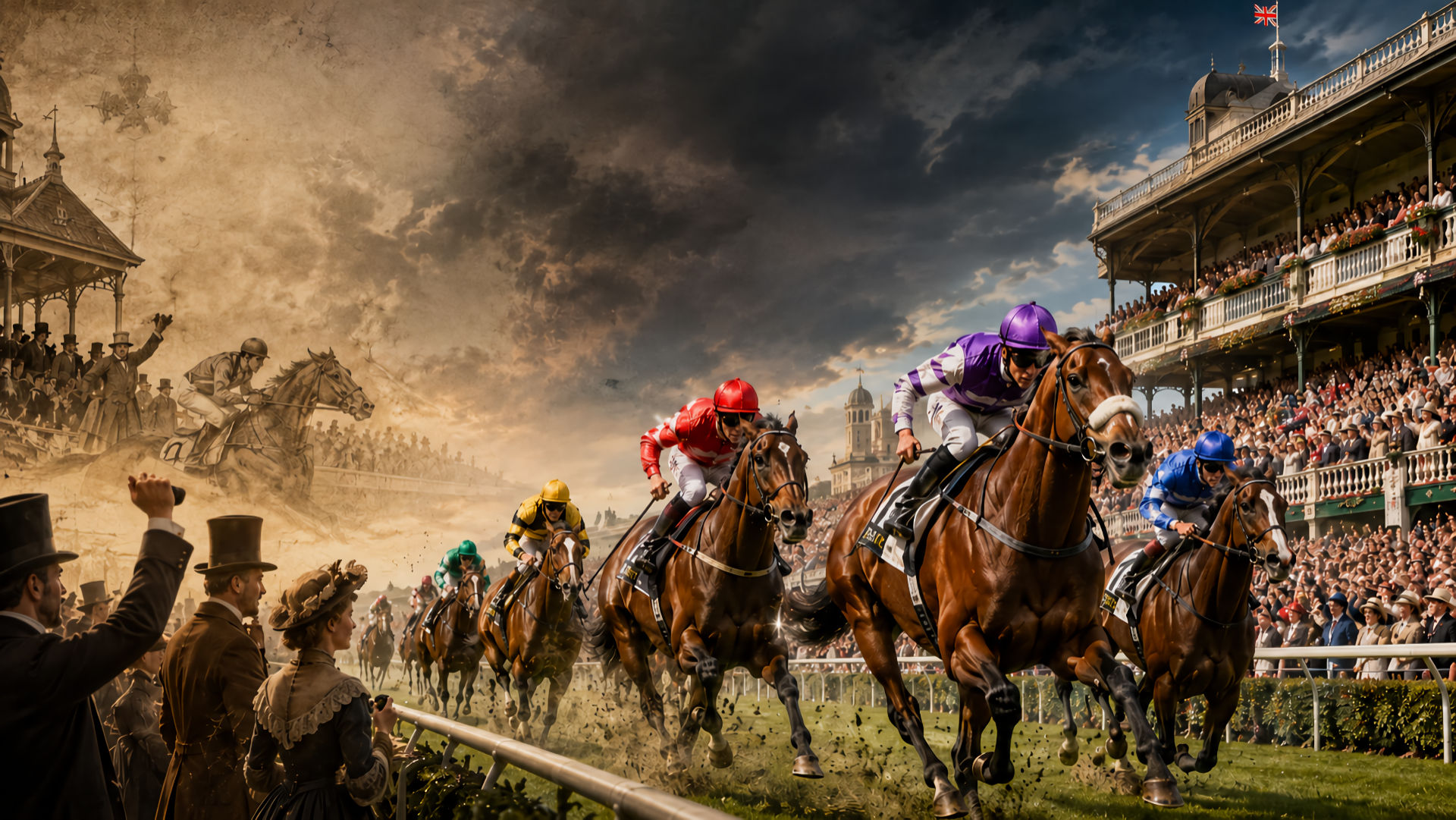
The History of Horse Racing
Long before horse racing became a sport of grandstands, betting slips, silk colours, and photo finishes, it began with something much simpler: the human fascination with speed, strength, and control. Horses changed the course of civilisation, first as working animals, then as engines of war, transport, status, and spectacle. Once people had learned to ride them and harness them, it was almost inevitable that someone, somewhere, would wonder whose horse was fastest. In that sense, horse racing is one of the oldest sports in the world, born not in a stadium, but in the dust of ancient roads and battlefields.
The earliest organised forms of horse racing were closely connected to chariot racing. In ancient Greece, chariot races became part of the Olympic Games in 680 BC, and they were among the most dramatic and dangerous events in the ancient sporting calendar. Drivers raced lightweight vehicles pulled by teams of horses, often at terrifying speeds, with crashes common and injuries expected. It was not exactly a gentle family day out, unless your family happened to enjoy wheels flying off at corners.
The Romans took chariot racing and turned it into mass entertainment on an enormous scale. At the Circus Maximus in Rome, tens of thousands of spectators gathered to watch rival teams compete in contests that combined sport, politics, gambling, and celebrity culture. Successful drivers could become famous, wealthy, and adored by the public. The crowds followed factions with fierce loyalty, much as modern fans support football clubs, although with rather more sandals and slightly fewer replica shirts.
Mounted horse racing also existed in the ancient world, but it developed more slowly than chariot racing as a public spectacle. Riding required different skills, and horses bred for speed, endurance, and agility became increasingly prized. Across the Middle East, Central Asia, North Africa, and Europe, racing traditions developed in different forms, often linked to military training and aristocratic culture. A fast horse was not just a sporting asset; it was a symbol of power and survival.
By the medieval period, racing in Europe was becoming more recognisable as a pastime of kings, nobles, and wealthy landowners. Knights and courtiers compared horses, arranged contests, and valued animals that could combine strength with speed. Racing was still informal by modern standards, but the foundations were there: prestige, competition, breeding, and spectatorship. The horse had moved from battlefield necessity to elite entertainment, and the next step would be to organise the sport properly.
The Birth of Organised Racing in Britain
Britain did not invent horse racing, but it played a huge role in shaping the modern version of the sport. By the Tudor and Stuart periods, racing had become a recognised aristocratic pastime, with monarchs and noble families taking a keen interest in breeding and competition. Henry VIII kept a royal stud and passed laws aimed at improving horse breeding, partly for military reasons and partly because powerful rulers rarely dislike owning impressive animals. In royal circles, a fine horse was both a practical asset and a very expensive way of saying, “Look how splendid I am.”
The sport became more organised under James I, who helped establish Newmarket as one of the great centres of English racing. According to tradition, he discovered the heath at Newmarket in the early seventeenth century and saw its potential as ideal racing ground. The wide open land allowed horses to be tested over distance, and the royal connection gave the location prestige. Newmarket would eventually become the headquarters of British flat racing, a role it still holds today.
Charles II, who reigned after the Restoration in 1660, was especially important in raising racing’s status. He was an enthusiastic rider and supporter of the sport, earning the nickname “the father of the English turf” in some later accounts. He attended races at Newmarket, competed himself, and helped make racing fashionable among the court and upper classes. When royalty takes up a sport, society usually follows, preferably while pretending it discovered the idea first.
As racing grew, so did the need for rules. Early contests often involved matches between two horses, arranged privately between owners and run over agreed distances. These match races attracted wagers and prestige, but they also created disputes. Questions over weights, eligibility, distances, and payments needed clearer regulation. Without rules, racing could easily become a chaotic argument between wealthy men with fast horses and selective memories.
The eighteenth century brought a more formal racing culture. Race meetings became regular events, courses became better established, and the sport attracted larger crowds beyond the aristocracy. The creation of the Jockey Club in the mid-eighteenth century marked a major step towards regulation. Based at Newmarket, the Jockey Club helped standardise rules, settle disputes, and oversee the conduct of racing. It was not a modern governing body in the democratic sense, but it became enormously influential.
By this point, British racing had begun to develop the structure that would define it for centuries. There were recognised racecourses, named races, professional jockeys, owners, trainers, and a growing culture of breeding. The sport was still closely tied to class and privilege, but it was no longer simply an elite amusement. It was becoming a national institution, and at its heart was the animal that would transform everything: the Thoroughbred.
Thoroughbreds, Stud Books, and the Making of a Racing Breed
The rise of organised racing created a new obsession: breeding the perfect racehorse. Owners did not merely want a strong or handsome animal; they wanted speed, stamina, courage, and the ability to pass those qualities to future generations. This turned horse breeding into a science, a gamble, and occasionally an exercise in wishful thinking dressed up in aristocratic confidence. The result was the development of the Thoroughbred, the breed most closely associated with flat racing today.
The Thoroughbred emerged in Britain during the seventeenth and eighteenth centuries through the crossing of native mares with imported stallions from the Middle East and North Africa. Three foundation sires became especially famous: the Byerley Turk, the Darley Arabian, and the Godolphin Arabian. Their bloodlines helped shape the breed, and many modern Thoroughbreds can trace their ancestry back to them. These horses were valued not only for speed, but for the refinement, endurance, and competitive spirit they brought into British racing stock.
The development of the Thoroughbred changed racing because it made breeding records essential. If a horse’s ancestry affected its value, then owners needed reliable proof of lineage. This led to the publication of the General Stud Book, first issued in 1791 by James Weatherby. It recorded pedigrees and helped define which horses could be recognised as Thoroughbreds. In a sport where money, pride, and family trees all mattered intensely, paperwork became almost as important as hooves.
Pedigree transformed the economics of racing. A successful horse could earn fame on the course and then become even more valuable at stud. Owners began to think not just about winning one race, but about building bloodlines across generations. Mares, stallions, trainers, and breeders all became part of a long chain of calculation. A champion racehorse might be admired for a few minutes of glory, but its offspring could shape the sport for decades.
The growth of breeding also created specialised roles within racing. Trainers prepared horses for competition, jockeys developed professional expertise, and breeders focused on producing animals suited to particular distances and conditions. A sprinter required different qualities from a long-distance horse, and a muddy course could favour different strengths from firm ground. Racing was becoming more technical, more strategic, and much more expensive. The horses may have done the running, but humans were busy building an entire industry around them.
By the late eighteenth and early nineteenth centuries, the Thoroughbred had become central to British racing’s identity and influence. British bloodstock was exported abroad, helping shape racing cultures in other countries. The breed’s reputation gave British racing international prestige, while the sport’s growing calendar gave breeders a stage on which to prove their judgement. With the horses refined, the rules developing, and the crowds expanding, racing was ready to become a public spectacle on a grander scale.
Racecourses, Classics, and the Rise of the Public Spectacle
As horse racing became more organised, its great racecourses and famous events began to define the sport’s calendar. Racing was no longer just a private contest between owners or a royal diversion at Newmarket. It became a public occasion, drawing crowds from across society and turning race days into a mixture of sport, social display, gambling, food, noise, and fashion. In other words, the horses were the main attraction, but the humans were determined to make a performance of themselves as well.
Several British racecourses developed national importance. Newmarket remained the spiritual home of flat racing, but other venues acquired their own identities. Epsom became famous for the Derby, first run in 1780 and named after the 12th Earl of Derby. Doncaster was associated with the St Leger, first run in 1776, while Ascot, founded under Queen Anne in 1711, became closely linked with royal attendance and high society. These courses were not interchangeable stages. Each had its own geography, traditions, and atmosphere.
The Classic races became especially important. In Britain, the five Classics are the 2,000 Guineas, the 1,000 Guineas, the Derby, the Oaks, and the St Leger. They were established between the late eighteenth and early nineteenth centuries and became tests of excellence for three-year-old Thoroughbreds. Winning one Classic marked a horse as exceptional. Winning more than one could turn it into a legend. Racing loves statistics, but it loves mythology even more.
The Derby in particular became a national event. Held at Epsom, it attracted huge crowds and became associated with holiday-making, social mixing, and popular celebration. By the nineteenth century, Derby Day was not just about elite horse owners. Workers, tradespeople, aristocrats, bookmakers, entertainers, and pickpockets all found reasons to attend. The racecourse became a rare space where different social classes gathered together, although not necessarily in the same enclosure or with the same sandwiches.
National Hunt racing, involving jumps and obstacles, also developed its own powerful appeal. Steeplechasing is often traced to informal races across the countryside, supposedly from one church steeple to another, hence the name. Over time, these rough cross-country contests became formalised into organised jump racing. Events such as the Grand National, first officially run at Aintree in 1839, brought a different kind of drama, where endurance and bravery mattered as much as speed.
By the Victorian era, horse racing had become deeply embedded in British life. Railways made it easier for spectators and horses to travel to meetings, newspapers spread racing news, and public interest widened. The sport was glamorous, risky, controversial, and thrilling. It had royal approval, popular enthusiasm, and commercial momentum. Yet as racing grew, so did one of its most powerful and problematic companions: betting.
Betting, Bookmakers, and the Business of the Turf
Betting has been linked to horse racing for centuries, and it is almost impossible to separate the history of the sport from the history of wagering. Racing provided uncertainty, speed, clear results, and endless opportunities for opinion, which is basically catnip for gamblers. From early private wagers between aristocrats to modern betting markets, the chance to win money has helped fuel racing’s popularity. It has also created scandal, regulation, addiction, and a steady supply of people convinced they have discovered a foolproof system.
In the early days of organised racing, wealthy owners often raced horses in match contests backed by large personal stakes. These wagers were part of the sport’s culture of honour and rivalry. A horse was not only running for a prize, but for reputation and financial reward. As race meetings grew and crowds expanded, betting spread far beyond the aristocracy. Spectators wanted to back their judgement, their favourite horse, or in many cases, the animal with the nicest name.
Bookmakers became central figures in the racing world. They offered odds, accepted bets, and balanced risk across different outcomes. By the nineteenth century, betting rings were a familiar part of racecourses, full of shouted prices, quick calculations, and carefully watched movements in the market. The bookmaker was part mathematician, part salesperson, part theatre performer, and occasionally part villain in the public imagination. Racing gave them their stage.
The growth of newspapers also transformed betting culture. Racing papers and form guides helped punters study horses, jockeys, trainers, weights, distances, and past performances. The idea that racing could be analysed scientifically became increasingly popular. Some people genuinely became skilled judges of form, while many others simply found more complicated ways to lose money. Still, the availability of information made racing more engaging for the wider public.
Betting also brought problems. Fixed races, doping, bribery, and insider knowledge all threatened the sport’s credibility at different times. Racing authorities had to protect the idea that contests were fair, because without trust, betting markets and sporting prestige could collapse. Regulations were developed in response to these dangers, with stewards, rules of racing, licensing systems, and penalties for misconduct. The sport needed gambling’s money and attention, but it also needed to keep gambling from eating the furniture.
In the twentieth century, betting shops changed the relationship between racing and the public. In Britain, off-course betting shops were legalised in 1961, allowing people to place bets away from racecourses. Television and radio coverage brought races into homes and betting shops, making the sport more accessible. Later, online gambling transformed the industry again, creating instant markets on races around the world. Racing had become not just a sport, but a major business, tied to media, data, breeding, hospitality, sponsorship, and regulation. That business would soon stretch far beyond Britain.
From Global Sport to Modern Controversy and Reform
Horse racing spread across the world through empire, trade, migration, and local enthusiasm. Britain’s influence was especially strong, but many countries developed racing cultures with their own traditions and heroes. In the United States, racing became popular from the colonial period onwards, with the Kentucky Derby, first run in 1875, becoming one of the sport’s most famous events. In Australia, the Melbourne Cup, first held in 1861, became known as “the race that stops a nation.” France, Ireland, Japan, Hong Kong, the United Arab Emirates, and many other racing centres built powerful reputations of their own.
The globalisation of racing changed the sport’s scale. Elite horses, trainers, jockeys, and owners increasingly moved between international events. Major races such as the Prix de l’Arc de Triomphe, the Breeders’ Cup, the Dubai World Cup, and the Japan Cup became part of a global calendar. Bloodstock markets became international too, with yearlings and breeding rights sold for vast sums. The horse that once represented a local stable could now be part of a worldwide network of investment, competition, and prestige.
Technology also changed racing. Starting stalls improved race organisation, photo finishes helped determine close results, and television turned major races into shared national moments. Later, digital timing, veterinary science, data analysis, and online streaming altered how races were run, studied, and consumed. Modern racing is awash with information, from sectional times to genetic research. The old instinctive judgement of horse people still matters, but it now shares space with spreadsheets. Somewhere, a Victorian bookmaker is probably frowning.
Yet modern horse racing faces serious challenges. Animal welfare has become one of the most important issues surrounding the sport. Fatal injuries, whip use, intense training regimes, breeding practices, and the fate of retired racehorses have all attracted criticism. Supporters argue that racing has improved veterinary care, safety standards, aftercare programmes, and regulation. Critics argue that further reform is needed, and some question whether the sport can ever fully escape the ethical problem of using animals for human entertainment and profit.
The industry has responded in different ways. Racecourses have reviewed obstacles and surfaces, veterinary checks have become more sophisticated, and welfare standards have received greater public attention. Rules on whip use have been tightened in several jurisdictions, and retirement and retraining schemes have gained importance. These reforms are partly moral, partly practical. Racing depends on public acceptance, and public acceptance cannot be taken for granted. The history of horse racing is therefore not simply a story of speed. It is a story of human ambition, animal breeding, class, gambling, spectacle, technology, and changing ideas about responsibility. From ancient chariots to global festivals, racing has survived because it keeps reinventing itself while preserving the thrill of the contest. The central image remains beautifully simple: a horse in full stride, a crowd holding its breath, and the finish line rushing closer. Whether the sport can balance tradition with reform will decide how strong that image remains in the future.
The History of Horse Racing FAQ
Horse racing has ancient roots, with early forms appearing in civilisations such as ancient Greece, Rome, Egypt, and the Middle East. Chariot racing became especially popular in the Roman world, while mounted racing later developed into a sport linked with military skill, wealth, and prestige.
Horse racing became known as the sport of kings because it was strongly associated with royalty, aristocracy, and wealthy landowners. In Britain, monarchs helped shape the sport by supporting race meetings, breeding horses, and turning places such as Newmarket and Ascot into major centres of racing culture.
Modern horse racing began to take recognisable shape in Britain during the seventeenth and eighteenth centuries. The development of organised race meetings, formal rules, thoroughbred breeding, and major races such as the Derby helped create the foundations of the sport we know today.
Betting played a major role in the growth of horse racing. Wagering added excitement, attracted crowds, and helped racing become both a social event and a commercial enterprise. It also led to the development of bookmakers, odds, racing newspapers, and later regulated betting systems.
Horse racing remains popular because it combines sport, tradition, spectacle, gambling, breeding, and social occasion. Major events such as Royal Ascot, the Grand National, the Kentucky Derby, and the Melbourne Cup continue to attract huge audiences and carry a strong sense of history.