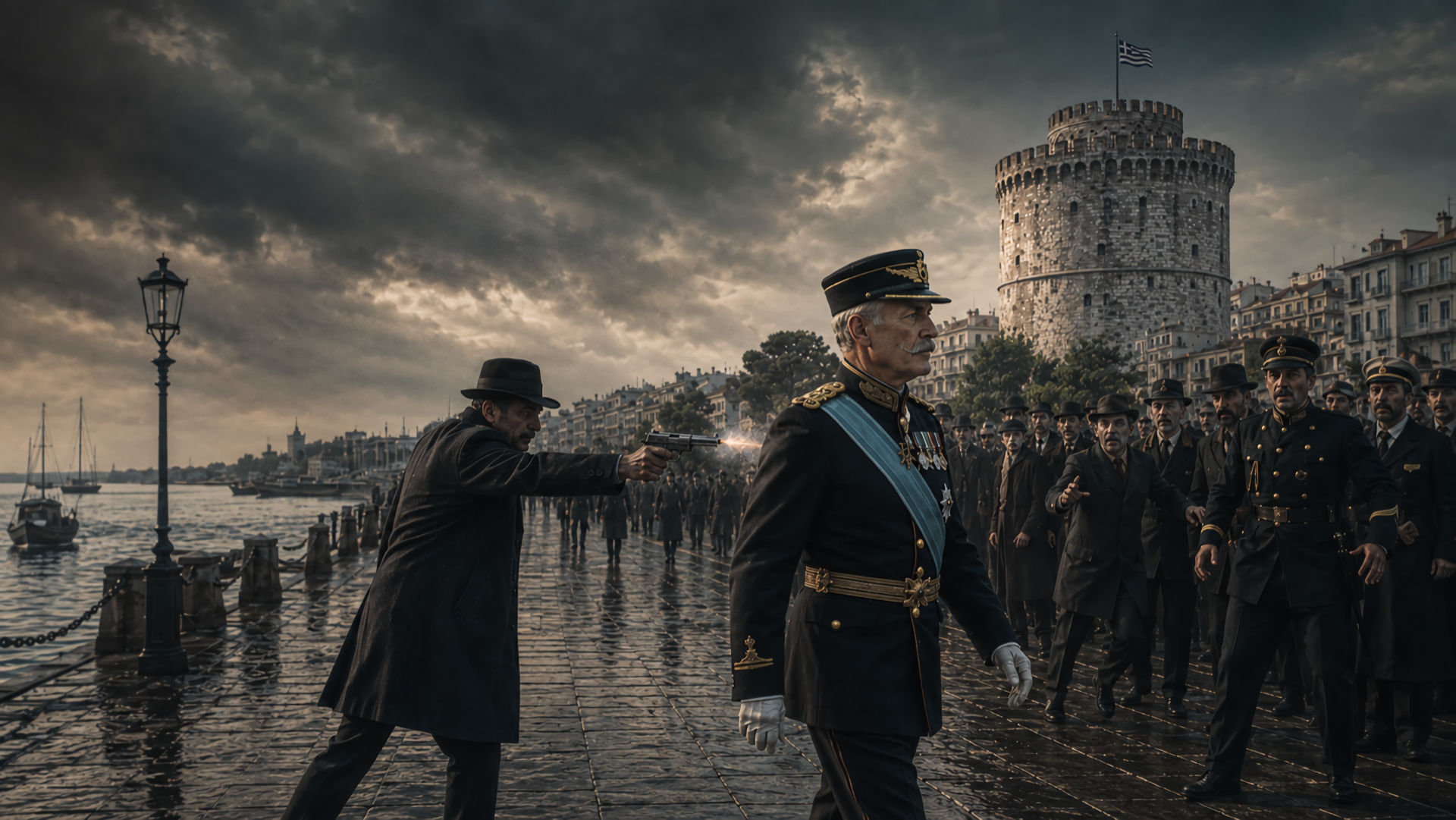
The Assassination of King George I of Greece
King George I of Greece began life far from the country he would one day rule. He was born in Copenhagen on 24 December 1845 as Prince William of Denmark, a younger son of Prince Christian of Schleswig-Holstein-Sonderburg-Glücksburg, later King Christian IX of Denmark. His family would become one of the great dynastic networks of nineteenth-century Europe, with siblings connected to the thrones of Britain, Russia and Denmark. That family tree was less a tree and more a royal railway junction, with crowns departing from every platform.
Greece, meanwhile, was still a young kingdom. It had won independence from the Ottoman Empire in the 1820s and 1830s, but its political life remained fragile. Its first king, Otto of Bavaria, never fully won over his subjects. He was foreign, Catholic in an overwhelmingly Orthodox country, and increasingly unpopular. In 1862, Otto was deposed, leaving Greece in need of a new monarch who could satisfy Greek aspirations while keeping the Great Powers of Europe reasonably calm.
The choice fell on Prince William. Backed by Britain, France and Russia, and accepted by the Greek National Assembly in 1863, the seventeen-year-old Danish prince became George I, King of the Hellenes. The title mattered. He was not merely “King of Greece”, but “King of the Hellenes”, a phrase that spoke to Greek identity beyond the borders of the small kingdom. It nodded towards the Megali Idea, the dream of uniting Greek-speaking or historically Greek lands under one state.
George arrived with obvious disadvantages. He was young, foreign and new to Greek politics, which was hardly a gentle paddling pool for beginners. Yet he also had qualities Otto had lacked. He was Protestant rather than Catholic, which made conversion to Orthodoxy less of a dynastic minefield for future heirs. He learned Greek, adopted Greek customs, and worked steadily to present himself not as an imported overseer but as a constitutional monarch embedded in the national project.
In 1867, he married Grand Duchess Olga Konstantinovna of Russia, strengthening his royal connections and giving the Greek dynasty Orthodox roots through their children. Over time, George’s calm manner and willingness to work within constitutional limits helped him survive crises that might have destroyed a less adaptable ruler. By the early twentieth century, he had become not just a king, but a symbol of continuity in a country still trying to define its future. That future, however, would be shaped by war, reform and a city whose streets would become the setting for his final walk.
A Long Reign in a Restless Kingdom
George I’s reign lasted nearly fifty years, making it one of the defining chapters in modern Greek history. When he took the throne, Greece was small, politically unstable and economically limited. Its borders did not yet include many regions that Greek nationalists considered part of the wider Hellenic world. Its politics were factional, its institutions still developing, and its ambitions far larger than its resources. It was a kingdom with a heroic past, a difficult present and a to-do list that would have frightened a committee of saints.
One of George’s most important achievements was simply endurance. Nineteenth-century Greece saw repeated changes of government, intense party rivalries and frequent disputes over the power of the crown. George was not always passive, and he could intervene in politics when he believed the monarchy’s position required it, but he gradually settled into the role of a constitutional monarch. In 1875, the principle that governments should reflect the confidence of parliament became an important step in Greek political development. It helped move the country away from palace-centred manoeuvring and towards more recognisably parliamentary rule.
The reign was not all steady progress. Greece’s desire to expand into Ottoman-held territories led to repeated tensions and periodic humiliation. The Greco-Turkish War of 1897 was a disaster for Greece. The army performed poorly, the country was defeated, and international intervention was needed to prevent a worse outcome. For George, it was a dangerous moment. Defeat exposed military weakness, political confusion and the gap between national dreams and national capacity. The monarchy survived, but the lesson was bruising.
By 1909, dissatisfaction within the army produced the Goudi Coup, a military movement demanding reform rather than outright republican revolution. The crisis helped bring Eleftherios Venizelos, a gifted Cretan politician, into national prominence. Venizelos became prime minister and began reshaping Greek political and military life. George, by then an elderly monarch with decades of experience, recognised the opportunity. Rather than resisting Venizelos, he worked with him, allowing the monarchy to align itself with national renewal.
This partnership mattered enormously. Greece modernised its armed forces, strengthened its administration and prepared for the possibility of war in the Balkans. When the First Balkan War broke out in 1912, Greece joined Serbia, Bulgaria and Montenegro against the Ottoman Empire. This time, unlike in 1897, Greek forces performed effectively. They advanced in Macedonia and Epirus, and the navy played a vital role in the Aegean.
For George, the victories of 1912 and 1913 seemed to crown a long and often difficult reign. Greece was expanding, its army was triumphant, and Venizelos had become the political architect of national confidence. Yet success brought fresh dangers. Newly captured territories were ethnically mixed, strategically vital and fiercely contested. Thessaloniki, in particular, was a prize so valuable that simply occupying it was not enough. Greece had to show the world, and its rivals, that it intended to stay.
Thessaloniki, 1913: Victory, Tension and a Royal Visit
Thessaloniki was not just another captured city. It was one of the great urban centres of the eastern Mediterranean, a port of immense commercial and strategic importance, and a city with a long, layered history. For centuries, it had been part of the Ottoman Empire, home to Greeks, Jews, Muslims, Slavs, Armenians and others. Its streets reflected the complexity of the Balkans, where identity, empire, religion and trade all jostled for space like impatient passengers at a railway station.
During the First Balkan War, the Greek army moved rapidly towards Thessaloniki. Bulgaria also coveted the city, and timing became crucial. In November 1912, Greek forces entered Thessaloniki and accepted the Ottoman surrender. The arrival of the Greek army was a moment of immense national celebration, but the situation remained tense. The city was newly occupied, not yet securely integrated. Bulgaria’s ambitions had not vanished. Ottoman power was collapsing, but the future borders of the region were still uncertain.
King George’s presence in Thessaloniki, therefore, carried political weight. A royal visit was not merely ceremonial. It signalled possession. By walking through the city, receiving officials and appearing before soldiers and civilians, George embodied the Greek claim to Thessaloniki. He had reigned since the days when Greece was a small kingdom struggling to establish itself. Now, in his old age, he stood in one of the greatest prizes of the Balkan Wars. The symbolism was impossible to miss.
There was also a personal dimension. George was approaching the fiftieth anniversary of his accession, and there were reports that he intended to step aside in favour of his son, Crown Prince Constantine, after his golden jubilee. Constantine had commanded Greek forces in the Balkan campaign and had become closely associated with military victory. If George did plan to abdicate, Thessaloniki represented a fitting final triumph. He had come to Greece as a teenage foreign prince. He could leave the throne as the monarch who had lived to see the kingdom enlarged and strengthened.
Yet Thessaloniki in March 1913 was not a settled place. It was packed with soldiers, officials, displaced people, political agents, rumours and resentments. The city was a crossroads of competing interests. Greeks celebrated liberation, but not every community experienced the change in the same way. Foreign diplomats watched closely. Rival Balkan states calculated their next moves. Beneath the victory parades lay uncertainty, and uncertainty is the natural habitat of conspiracy theories, opportunists and men with grievances.
George, however, was known for moving with surprisingly light security. He often walked with only minimal protection, trusting habit, dignity and perhaps the affection he believed surrounded him. On 18 March 1913, that confidence proved fatal. In a city Greece had only recently claimed, the king set out for an ordinary walk. Within minutes, an ordinary walk would become an assassination, and a royal symbol of triumph would be transformed into a national body on a stretcher.
The Walk That Changed Greek History
On the afternoon of 18 March 1913, King George I went walking through Thessaloniki. He was sixty-seven years old, a veteran monarch who had survived political crises, military defeats, reforms, coups and wars. He had seen Greece change from a fragile state into a growing Balkan power. He had also developed the confidence of a man accustomed to public life. He did not surround himself with a heavy guard. For a king in a tense, newly occupied city, this was either admirable simplicity or reckless optimism. History, with its usual lack of tact, chose the second interpretation.
George was accompanied by an aide-de-camp, commonly identified as Colonel Ioannis Frangoudis. The king’s route took him through the city near the White Tower area and along streets that had recently become part of the Greek national story. The day was meant to be unremarkable. There was no grand ceremony, no battlefield inspection, no public speech. That is part of what makes the killing so striking. It did not happen amid a riot or a battle. It came in the middle of routine, the moment when history slips through a side door rather than entering with a brass band.
Alexandros Schinas approached the king from behind. He fired a revolver at close range. The bullet struck George in the back and pierced vital organs, including the heart. The king collapsed almost immediately. The shock was instant and absolute. Those nearby seized Schinas, who made little meaningful attempt to escape. The wounded king was placed on a stretcher or taken towards medical help, but there was no saving him. After almost half a century on the Greek throne, George I died in the city that had seemed to mark his greatest political triumph.
The assassination sent Thessaloniki into uproar. News travelled quickly through military and political circles, then across Greece and Europe. A king had been murdered at a moment of victory, not defeat. That fact gave the event a disturbing quality. George had not fallen during the humiliations of 1897 or the turbulence of the Goudi movement. He had been killed when Greece was expanding, when national morale was high, and when his reign appeared to be nearing a dignified close.
There was an immediate need to impose order on the story. Authorities had the assassin in custody, but custody did not mean clarity. Who was Schinas? Why had he fired? Was he a lone unstable man, an anarchist, a socialist, a beggar with a grudge, or the visible hand of some hidden political force? In another murder, those questions might have waited. In Thessaloniki in 1913, they burst open at once.
George’s body became a symbol as powerful in death as his presence had been in life. The old king, who had represented continuity, had been removed in a single gunshot. In his place came uncertainty, suspicion and succession. The murder itself had taken seconds. Its consequences would unfold over years.
Alexandros Schinas: Assassin, Motive and Mystery
Alexandros Schinas remains one of those historical figures who appears suddenly in the record, commits an act of enormous consequence, and then leaves behind more fog than explanation. He was reportedly in his early forties at the time of the assassination, and accounts of his life vary. Some described him as an impoverished drifter. Others linked him with radical politics, including socialism or anarchism. There were claims that he had spent time abroad, possibly in New York, and that he had once studied medicine without completing a recognised career. Almost every detail seems to arrive with a question mark attached.
After his arrest, Schinas gave explanations that did little to settle the matter. One version suggested personal grievance. He had supposedly sought assistance from the palace and been refused, leaving him resentful towards the king. Another account presented him as mentally unstable, suffering from illness and delirium. Authorities leaned towards portraying him as a deranged individual rather than the agent of a political plot. That interpretation had obvious advantages. A lone madman is frightening, but manageable. A conspiracy in the Balkans in 1913 was a much larger and more inconvenient beast.
The radical interpretation was also plausible enough to survive. Europe in the late nineteenth and early twentieth centuries had seen a wave of political assassinations by anarchists and revolutionary militants. Kings, presidents, prime ministers and empresses had all been targeted. The murder of George I could be fitted into that pattern, especially if Schinas had indeed absorbed anti-monarchical ideas. A man with a revolver and a doctrine could change a nation’s course. The age had already proved that grim point several times.
Yet the Balkan context encouraged darker theories. Thessaloniki was contested, Greece and Bulgaria were edging towards conflict, and the Great Powers all had interests in the region. Some suspected Bulgarian involvement. Others whispered about German influence, especially because George was seen as broadly pro-British, while his son Constantine had strong German connections through marriage and outlook. These theories remain unproven, but they flourished because the murder seemed too politically convenient to some observers. History does love a coincidence, but people rarely trust one.
Schinas’s death ensured that suspicion would deepen. On 6 May 1913, only weeks after the assassination, he fell from a window while in custody in Thessaloniki. Officially, he may have jumped. Others believed he was pushed or silenced. Either way, the one man who might have clarified his motive was dead before any public trial could test the evidence. Reports also state that important depositions were later lost, adding another layer to the mystery.
The result is a case with a known killer but an uncertain motive. Schinas fired the shot. That much is clear. Why he fired it remains murkier. Personal resentment, mental illness, radical politics and international intrigue all compete for space in the story. It is a murder case where the body is found, the weapon is known, the assassin is captured, and yet the central question still refuses to sit quietly in its chair.
After George: Grief, Succession and a Kingdom on the Brink
The death of George I struck Greece at a moment of extraordinary transition. The country was celebrating military success, but it was also managing the risks that came with expansion. New territories had to be governed, rival claims had to be handled, and the alliance that had defeated the Ottoman Empire was already cracking. Into that delicate situation came the murder of a king who had provided continuity for nearly five decades. George’s reign had not been free of trouble, but his presence had become familiar. In politics, familiarity can be a surprisingly powerful form of glue.
His body was taken from Thessaloniki and eventually brought to Athens for mourning and burial. Public grief was sincere, but it was also political. George represented the generation that had guided Greece from the aftermath of independence towards the brink of a larger national future. He had not personally created every reform or victory, but he had remained on the throne while Greece changed around him. His death allowed the nation to mourn not only a man, but an era.
The throne passed to his son, Constantine I. Constantine was a very different figure from his father. He was Greek-born, Orthodox, militarily admired and closely associated with the victories of the Balkan Wars. Many Greeks saw him as a heroic commander, almost a Byzantine echo brought into modern uniform. There were even calls for him to be styled Constantine XII, linking him symbolically to Constantine XI Palaiologos, the last Byzantine emperor. That sort of historical symbolism is intoxicating stuff, especially for nations with long memories and unfinished dreams.
Yet Constantine’s accession also changed the balance of Greek politics. George had been cautious, pragmatic and experienced. Constantine was more rigid, more military in temperament, and more inclined towards Germany, partly through his marriage to Sophia of Prussia, sister of Kaiser Wilhelm II. This mattered enormously when Europe moved towards the First World War. Prime Minister Eleftherios Venizelos favoured alignment with the Entente powers, while Constantine preferred neutrality, with sympathies that many interpreted as pro-German. The disagreement became the National Schism, a bitter division that split Greek political life.
It would be too simple to say George’s survival would have prevented all of this. History is not a tidy machine where one spare part fixes the whole engine. The pressures on Greece were immense, and the First World War would have tested any monarch. Still, George’s long experience and diplomatic instincts might have softened the clash between crown and government. His murder removed a stabilising figure just as Greece entered one of the most dangerous decades in its modern history. The assassination of George I, therefore, stands as more than a royal killing. It was the violent interruption of a reign, the unresolved act of a shadowy assassin, and the opening note of a more turbulent age. In Thessaloniki, a king walked through a city meant to symbolise Greek victory. A gunshot turned that victory into mourning, and left behind a mystery still capable of troubling the historical record.
The Assassination of King George I of Greece FAQ
King George I of Greece was born Prince William of Denmark in 1845. He was chosen as King of the Hellenes in 1863 after the deposition of King Otto, and he ruled Greece for nearly fifty years.
King George I of Greece was assassinated on 18 March 1913 in Thessaloniki. Some older accounts may use 5 March 1913 because Greece was still using the Julian calendar at the time.
King George I was killed by Alexandros Schinas, a Greek man who shot the king at close range while he was walking through Thessaloniki.
The motive remains uncertain. Explanations have included personal grievance, mental illness, radical politics and possible conspiracy, but no single explanation has ever been firmly established.
George I was succeeded by his son, Constantine I. His death came at a sensitive moment, during the Balkan Wars and shortly before the First World War, when Greece was entering a period of deep political tension.