The Black Saturday Bushfires
By the beginning of February 2009, Victoria was not simply dry. It was primed. Years of drought had stripped moisture from forests, grasslands and farms, leaving huge areas of the state brittle, exhausted and dangerously flammable. In the bush, leaves, bark and fallen branches had dried into fuel. In open country, grasslands that might once have slowed a fire had become fast-burning corridors. Around small towns and rural roads, homes sat close to trees, scrub and paddocks, often in beautiful places that carried an ugly risk.
Victoria had always lived with fire, but the danger by 2009 had been sharpened by weather, settlement and history. The state’s earlier bushfire disasters, including Black Friday in 1939 and Ash Wednesday in 1983, had already shown what could happen when extreme heat, wind and fuel arrived together. Even so, many people still understood bushfire through the experience of more ordinary fire days. A fire might be frightening, destructive and fast, but it could also sometimes be defended. For decades, public advice had often revolved around the idea of preparing properly, then deciding whether to leave early or stay and defend.
That advice depended on conditions being survivable. Black Saturday would expose how fragile that assumption could become. Many homes in bushfire-prone areas were defended by residents with pumps, hoses, cleared gutters and water tanks. Some people had fire plans written down. Others had looser plans, based on memory, instinct or what had worked before. In places such as Kinglake, Marysville, Strathewen and St Andrews, bush living was part of the attraction, with forest roads, ridgelines and valleys forming the backdrop to everyday life. The same landscape that made these communities desirable also made escape harder when smoke, fallen trees and fire fronts cut across the roads.
The warning signs were there before 7 February arrived. A severe heatwave had struck south-eastern Australia in late January and early February, pushing electricity systems, transport networks and public health services under immense strain. Melbourne recorded several days above 43 degrees Celsius, and the wider state endured heat that seemed less like weather than punishment. By the end of that heatwave, the landscape had lost what little resilience it had left. Plants were stressed, soil was baked, and the air itself seemed to carry a warning.
On Friday, 6 February, Victorian Premier John Brumby warned that the following day could be one of the worst fire days in the state’s history. Fire agencies prepared, crews were placed on alert, and residents in high-risk areas were urged to think seriously about their plans. Yet warnings are only useful when people can imagine what they are being warned about. On 7 February 2009, Victoria was about to face a fire day beyond the scale of ordinary imagination.
The Day the Weather Turned Against Victoria
Saturday, 7 February 2009, began with heat that felt hostile from the start. Melbourne reached around 46 degrees Celsius, its hottest day on record at the time, while parts of regional Victoria endured temperatures even higher. The air was dry, the humidity was dangerously low, and north-westerly winds drove hot air across the state like a giant fan heater pointed at the landscape. By late morning, the fire danger was already extreme. For firefighters, emergency controllers and residents across Victoria, the day had the look of a catastrophe waiting for a spark.
The sparks came from different causes in different places. Some fires were linked to power lines, some to machinery, lightning or suspected arson. One of the most destructive began near Kilmore East at about 11.47 am, when fallen power lines ignited grassland near Saunders Road. In the conditions of that day, ignition was not the beginning of a small local incident. It was the release of a force that could move faster than people could process. Within minutes, flames were running through paddocks and into plantations, feeding on dry grass, trees and wind.
The Kilmore East fire crossed the Hume Freeway by early afternoon, a grim sign of its speed and intensity. Major roads that might have been escape routes or control lines became obstacles, hazards or scenes of confusion. Spot fires leapt ahead of the main front as burning embers were carried kilometres through the air. In some cases, embers were reported far ahead of the flames, landing in gardens, gutters, paddocks and forest litter. This meant people could find themselves threatened from more than one direction, with the fire not simply advancing as a single visible wall, but appearing suddenly around them.
Then came one of the day’s most deadly features, the wind change. During the afternoon and evening, powerful winds shifted direction, turning the long flanks of some fires into a new front. A fire that had been moving one way could suddenly attack communities from another. Residents who believed they knew where the danger was coming from were confronted by a rapidly changing fireground. Firefighters faced the same problem, with control strategies undermined by speed, heat and violent shifts in wind.
Communication struggled under the pressure. Emergency services issued warnings, but many communities were hit so quickly that official information could not keep pace with events on the ground. Phone lines failed, power went out, mobile coverage became unreliable, and smoke reduced visibility. Families tried to contact each other while deciding whether to leave, defend or shelter. Some waited too long because the scale of the threat was unclear. Others tried to flee and found roads blocked by smoke, flames, fallen branches or crashed vehicles.
By evening, almost 400 fires had been recorded across Victoria. What had begun as a feared fire weather day had become a statewide disaster, with multiple emergency fronts demanding attention at once. The weather had not merely assisted the fires. It had transformed them into fast-moving, unpredictable firestorms.
Firestorms Across the Landscape
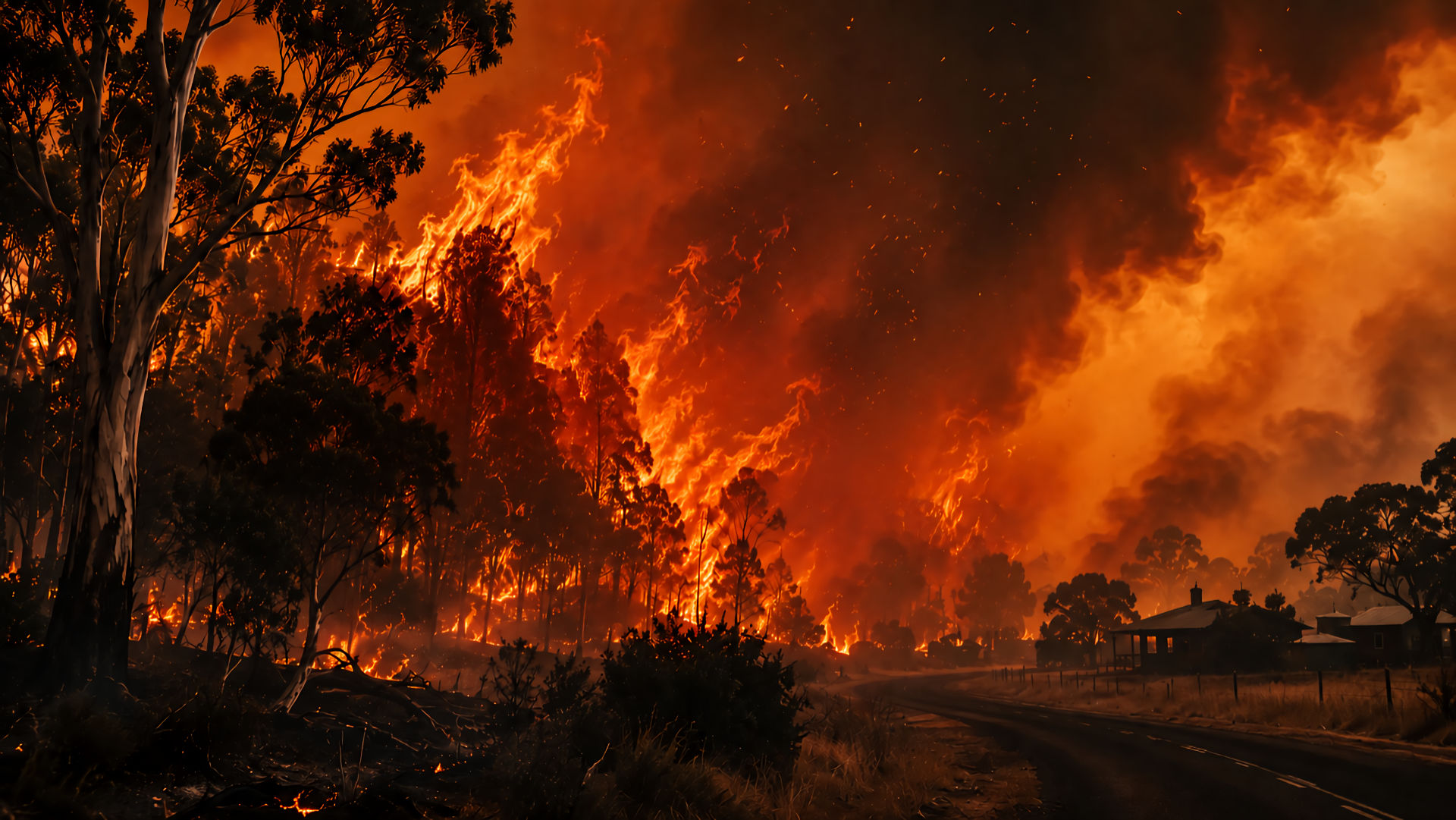
The fires of Black Saturday did not behave like ordinary bushfires. In the most severe areas, they became firestorms, generating their own winds, throwing embers far ahead of the flames and creating towering columns of smoke and heat. In forested country, flames could rise through the canopy and become crown fires, burning across treetops rather than just through ground fuel. Witnesses described roaring noise, orange darkness and heat so intense that survival outside proper shelter became almost impossible. This was not a line of flame that could be watched and judged at a distance. It was a moving system of heat, smoke, wind and debris.
The Kilmore East fire became one of the deadliest parts of the disaster. Driven south-east by extreme winds, it burned through Wandong, Clonbinane and areas around Mount Disappointment before threatening communities including Humevale, Kinglake West, Strathewen, St Andrews and Kinglake. Houses, sheds, vehicles and fences were destroyed in rapid succession. Some people died in homes they had tried to defend. Others died in cars while attempting to escape. Roads that normally connected communities became terrifying channels of smoke, flames and confusion.
A second major fire began near Murrindindi, north of a sawmill on Wilhelmina Falls Road, at about 3 pm. It moved quickly through the Murrindindi State Forest and the Black Range, reaching Narbethong by late afternoon. Marysville, a well-known tourist town surrounded by forest, was struck in the early evening. The fire front arrived with such speed and violence that most of the town was destroyed. Only a small number of buildings survived. For many Australians watching the news that night and the next morning, Marysville became one of the most haunting symbols of the disaster.
On 8 February, the Kilmore East and Murrindindi fires merged to form what became known as the Kinglake Fire Complex. This enormous fire area burned through state forests, national parks, farms and settlements, creating devastation on a scale that was difficult to map, let alone comprehend. Flames were recorded at heights of around 30 metres in some areas. The heat created convection columns that helped lift burning material into the air, spreading new fires ahead of the main front. Once this process took hold, firefighting became less about stopping the fire immediately and more about saving lives wherever possible.
Other parts of Victoria were also burning. The Churchill fire, which began in Gippsland, killed 11 people and destroyed more than a hundred homes. The Bendigo fire burned through suburbs including Long Gully and Eaglehawk, killing one person and destroying dozens of homes. The Beechworth fire killed two people and damaged rural communities in north-eastern Victoria. Fires also affected Bunyip, Horsham, Redesdale, Narre Warren and Upper Ferntree Gully. The disaster was not one fire, but many fires, each with its own geography, timing and human story.
Firefighters faced conditions that no amount of courage could fully overcome. More than 19,000 Country Fire Authority personnel were involved in response, control and support roles, joined by other emergency workers, police, ambulance crews, volunteers and government agencies. Their work saved lives and properties, but Black Saturday proved that some fire conditions exceed direct attack. On that day, the landscape itself seemed to have become part of the fire.
Towns Caught in the Path
The names of the worst-hit communities became part of Australian disaster memory. Kinglake, Kinglake West, Strathewen, St Andrews, Marysville, Narbethong, Flowerdale and Churchill were no longer just places on a map. They became shorthand for loss, survival and unanswered questions. Each town faced the fires differently, depending on its location, roads, warning time, terrain and the direction from which the flames arrived. Yet the pattern repeated across the state. People looked outside and saw smoke, then embers, then darkness, then fire moving faster than expected.
In Strathewen, a small community north-east of Melbourne, the impact was catastrophic. The fire reached the area with terrifying speed, destroying homes and killing many residents. The terrain made evacuation difficult, with narrow rural roads, heavy smoke and fire approaching through bushland and paddocks. Families were separated, neighbours tried to warn neighbours, and some people sheltered wherever they could. The intimacy of small communities made the losses even sharper. When dozens of people are killed in a place where everyone knows someone, grief does not arrive as an abstract statistic. It sits at every table.
Kinglake and nearby settlements were hit by the Kilmore East fire after it had gathered force across a wide front. Many residents had prepared for a bushfire, but not for a fire of such intensity. Some homes were defended successfully, often through extraordinary effort and luck. Others were lost in minutes. People who survived spoke of sheltering in houses, cars, dams, clearings and makeshift refuges, sometimes with fire passing directly over or around them. For those trapped in the path, decisions had to be made in seconds, often with poor visibility and little reliable information.
Marysville faced a different but equally devastating sequence. The Murrindindi fire reached Narbethong and then Marysville during the evening, when residents had already endured hours of heat, smoke and uncertainty. The town’s setting, surrounded by forested hills, left it highly exposed once the fire front arrived. Buildings that had stood for generations were destroyed. Hotels, homes, shops and community spaces vanished. The physical loss was enormous, but the emotional damage was deeper, because a town is not only its buildings. It is habits, memories, routes, landmarks and the sense that tomorrow will look roughly like yesterday.
Not every affected area suffered the same loss of life, but the property damage across Victoria was vast. In Bendigo, the fire pushed into suburban streets, reminding Australians that bushfires are not confined to remote forests. In Horsham, a fast-moving grassfire threatened homes and community buildings. In Churchill and the surrounding areas, the fire tore through plantations and settlements, leaving death and destruction in its wake. Across the state, thousands of people were suddenly displaced. Many had escaped with little more than the clothes they were wearing.
The fires also killed animals on a huge scale. Livestock, pets and wildlife died in the flames or from burns and smoke inhalation. Surviving animals wandered through blackened paddocks and forests, injured and disoriented. For rural communities, the loss of animals was not only emotional but also economic. Farms lost fencing, pasture, equipment, sheds and stock. The disaster attacked homes, livelihoods and landscapes at the same time.
By the time the immediate crisis began to ease, Victoria had been altered. Some communities were physically erased. Others were scarred but standing. All were left with the same impossible task: to account for the missing, care for the living and begin to understand what had happened.
The Human Cost and the Search for Answers
The final death toll from Black Saturday was 173. Another 414 people were injured, and more than 2,000 homes were destroyed. Behind those numbers were families, friendships, workplaces, schools and local histories torn apart in a single afternoon and evening. Some victims were elderly or vulnerable. Others were fit, prepared and experienced in bushfire conditions. Children died, parents died, neighbours died while trying to help others, and people died while making decisions that, in less extreme circumstances, might have saved them.
Identification of the dead was a major challenge. In the worst-hit areas, fires burned so intensely that forensic teams faced exceptionally difficult conditions. Temporary mortuary arrangements were needed, and police, coronial staff and disaster victim identification specialists worked through the aftermath. For families waiting for news, the days after the fires were agonising. Some people did not know whether missing relatives had escaped, been taken to hospital or died. Rumours moved faster than confirmed information, while official numbers changed as investigators reached ruined properties and vehicles.
Survivors faced immediate practical problems as well as trauma. Thousands needed shelter, clothing, medication, food, transport and information. Relief centres became hubs of grief and survival, where people searched noticeboards, registered names and tried to locate friends and relatives. Donations arrived from across Australia and overseas. The Victorian Bushfire Appeal Fund, established with the Australian Red Cross and government support, raised hundreds of millions of dollars. Money could help rebuild houses, replace belongings and support recovery, but it could not restore the dead or return communities to what they had been before.
The disaster also raised urgent questions about responsibility. The Victorian Bushfires Royal Commission was announced by Premier John Brumby on 13 February 2009 and formally established soon after. It examined the causes of the fires, preparation, emergency response, warnings, planning, power infrastructure, building standards and the advice given to residents. The Commission heard from hundreds of witnesses and studied one of the most complex disasters in Australian history. Its work mattered because Black Saturday was not only a natural disaster. It was also a test of systems built by people.
Some causes were investigated through criminal and civil proceedings. The Churchill fire was linked to arson, and a man was later convicted over that blaze. Major civil cases were brought in relation to fires associated with electrical infrastructure, including the Kilmore East and Murrindindi fires. These cases led to enormous settlements, reflecting the scale of loss and the importance of powerline safety in extreme fire conditions. For survivors, legal outcomes could provide recognition and compensation, but they could not simplify the grief.
The Royal Commission’s final report made 67 recommendations. These covered public warnings, emergency command, evacuation advice, bushfire shelters, planning controls, building standards, fuel management and the safety of electricity networks. At the heart of the findings was a hard lesson. Saving life had to be the central priority, and advice built around staying to defend a property had to be reconsidered when conditions became catastrophic.
What Black Saturday Changed
Black Saturday changed the way Australia talked about bushfires. Before 2009, many residents in fire-prone areas had grown up with the idea that a well-prepared person might stay and defend a home. After Black Saturday, the limits of that idea became painfully clear. There are fire conditions in which preparation helps, but does not guarantee survival. There are days when a house cannot be defended safely, when roads become deadly too late, and when the only sensible decision is to leave long before smoke appears on the horizon.
One major change was the shift towards clearer public warning and fire danger systems. The language of catastrophic fire danger became more prominent, making it easier to describe days when ordinary assumptions no longer applied. Emergency warnings were improved, with greater emphasis on direct, urgent communication. Systems such as telephone alerts, clearer incident warnings and stronger public messaging were developed in the years after the disaster. The aim was not simply to tell people that a fire existed, but to help them understand what action they should take and how quickly they needed to take it.
Building and planning rules also came under scrutiny. Homes in bushfire-prone areas had to be considered in relation to vegetation, access, defendable space, construction materials and exposure to radiant heat. The idea of Neighbourhood Safer Places, sometimes called places of last resort, was developed so communities could identify locations that might offer some protection if other plans failed. These were not meant to replace leaving early, but Black Saturday had shown that people sometimes needed a final option when roads were cut, or decisions had collapsed under pressure.
Power infrastructure became another major focus. Several destructive fires were associated with electrical failures, and the disaster accelerated attention on inspection, maintenance, powerline replacement and safety systems. In a state where hot, windy days could turn a single fault into a mass-casualty fire, utilities were no longer a background technical issue. They were part of disaster prevention. The same applied to land and fuel management, although debates continued over planned burning, environmental protection, risk reduction and the practical limits of controlling fuel across vast landscapes.
The social legacy was just as important. Recovery took years, and for many people it never truly ended. Rebuilt houses did not erase trauma. New trees did not immediately replace old landscapes. Anniversaries, hot windy days and the smell of smoke could bring memories back with force. Studies of affected communities showed that mental health, family life, employment, community identity and trust in institutions could all be shaped by the disaster long after the flames were extinguished.
Black Saturday remains one of Australia’s defining modern disasters because it exposed the full danger of extreme bushfire in settled landscapes. It showed how climate, fuel, infrastructure, planning, communication and human decision-making can combine in deadly ways. It also showed courage, endurance and the strength of communities under almost unbearable pressure. The fires of 7 February 2009 burned through more than land and buildings. They burned through old assumptions, leaving behind a harder, clearer understanding of what bushfires can do when a state is waiting to burn.
The Black Saturday Bushfires FAQ
The Black Saturday Bushfires were a series of devastating bushfires that swept across Victoria, Australia, on 7 February 2009. They became Australia’s deadliest bushfire disaster, killing 173 people and destroying more than 2,000 homes.
The fires were driven by extreme heat, very low humidity, strong winds and years of drought. These conditions allowed fires to spread rapidly, create dangerous ember attacks and overwhelm many communities before people could safely escape.
Some of the worst-hit communities included Kinglake, Marysville, Strathewen, Kinglake West and areas around Churchill, Narbethong and St Andrews. Many towns and rural settlements suffered severe loss of life, property and infrastructure.
After the disaster, the Victorian Bushfires Royal Commission made 67 recommendations. These led to major changes in fire warnings, emergency planning, public advice, building standards, powerline safety and the way catastrophic fire danger is communicated.
More than 2,000 homes were destroyed during the Black Saturday Bushfires. Thousands of people were displaced, and many communities faced years of rebuilding and recovery.