
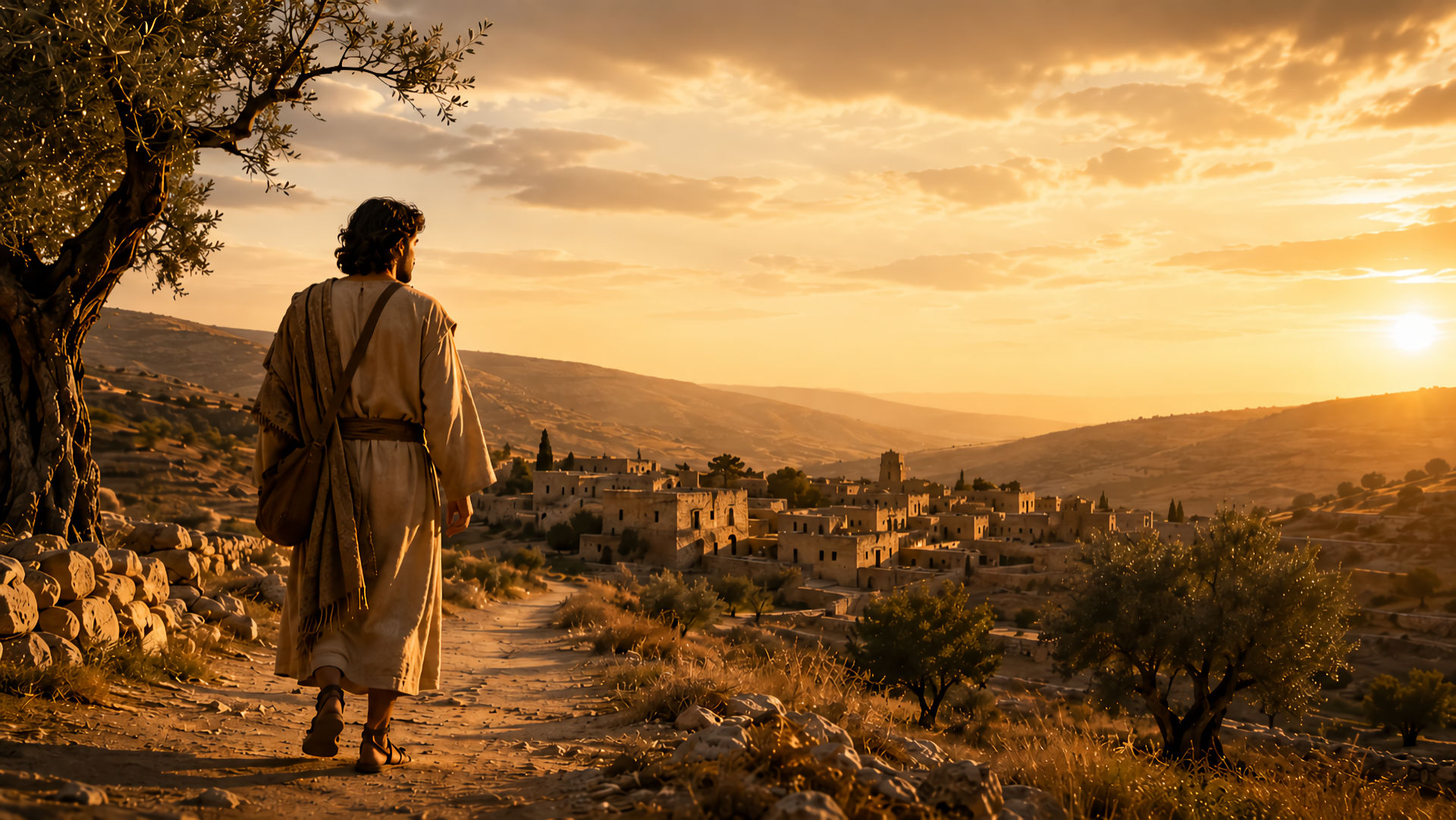
The Mystery of the Missing Years of Jesus Christ
There is a strange quiet at the centre of one of history’s most familiar lives. The story of Jesus Christ is known across the world: the birth in Bethlehem, the ministry in Galilee, the journey to Jerusalem, the crucifixion, and, for Christians, the resurrection. Yet between the young Jesus in the Temple and the adult Jesus beginning his public ministry, the Gospel narrative gives us almost nothing. This silence has become known as the mystery of the “lost years”, the missing period between roughly the age of twelve and the age of about thirty.
The last clear glimpse of Jesus as a child comes in the Gospel of Luke. Mary and Joseph travel to Jerusalem for Passover, as they do each year, and the twelve-year-old Jesus stays behind in the Temple. When his parents finally find him, he is among the teachers, listening, asking questions, and astonishing those present with his understanding. It is a dramatic scene, not because it tells us everything, but because it tells us so little. It gives one brief flash of intelligence, confidence, and spiritual awareness, then the curtain drops again. Luke then says Jesus returned to Nazareth and was obedient to his parents, growing in wisdom and favour. After that, the story moves forward to his adult life.
By the time Jesus reappears in the Gospel narrative as a public teacher, Luke describes him as “about thirty years old” when he begins his ministry. That leaves nearly two decades largely unrecorded, a remarkable gap for someone whose later words and actions would shape world history.
The silence is especially powerful because the rest of the story is so intense. The adult ministry of Jesus is crowded with encounters, parables, healings, arguments, journeys, followers, enemies, and symbolic acts. It feels almost as though the Gospels suddenly begin moving at great speed. Before that, however, there is ordinary life, hidden life, and unknowable life.
That is what makes the lost years so fascinating. They are not a mystery because something dramatic definitely happened. They are a mystery because the sources do not say. In that absence, later generations have imagined many possibilities. Some are cautious and historically plausible. Others are bold, spiritual, romantic, or openly speculative. To understand the mystery properly, we first have to begin with the evidence we actually have, because the strongest mysteries are not built from wild invention. They begin with a silence that refuses to explain itself.
What the Bible Says, and What It Leaves Unsaid
The first thing to understand about the lost years is that they are not a hidden chapter removed from the Bible. There is no known canonical Gospel passage that gives a continuous biography of Jesus from adolescence into adulthood. The New Testament writers were not producing a modern cradle-to-grave biography. They were writing theological accounts focused on identity, teaching, fulfilment, suffering, and salvation. That means they preserved what they considered essential to their message, not everything a modern reader might want to know.
The Gospel of Luke offers the most detailed account of Jesus’ childhood, including the journey to Jerusalem when he was twelve. Even there, the scene functions as a signpost rather than a full childhood memoir. Jesus is shown in the Temple, at the heart of Jewish worship and learning, already displaying unusual insight. Yet Luke’s purpose is not to record his teenage education, friendships, daily work, or family responsibilities. The episode points forward. It suggests who Jesus is becoming, then returns him to Nazareth.
The next clues are brief, but they are important. In Mark’s Gospel, people in Jesus’ hometown refer to him as “the carpenter” and as Mary’s son. In Matthew, he is called “the carpenter’s son”. These lines suggest that Jesus was known locally in relation to manual work, family, and village life. They do not describe an exotic traveller returning from distant lands. They describe someone familiar, perhaps too familiar, to the people of Nazareth.
The people who reject him in these passages do so partly because they think they already know him. Their reaction is not, “Where has this mysterious foreign-trained teacher come from?” It is closer to, “Isn’t this the local man we know?” That detail does not prove every year of his life was spent in Nazareth, but it does support the idea that he was recognised as part of the community.
The biblical silence, then, leaves room for questions but not unlimited freedom. It tells us Jesus was raised in Nazareth, was connected with a working family, grew up within Jewish religious culture, and emerged as an adult teacher in Galilee and Judea. What it does not tell us is whether he received formal training, how Joseph’s trade shaped his life, when Joseph may have died, what role Jesus had in supporting his family, or how his understanding developed during those hidden years.
That is where mystery begins. Not with a secret map or a missing scroll, but with ordinary details that would have mattered enormously to real life and yet were left outside the written story.
Growing Up in Nazareth: The Most Plausible Lost Years
The most historically grounded explanation for the lost years is also the least sensational: Jesus probably spent most of them in and around Nazareth, growing up in a Jewish village, working, worshipping, learning, and living within the rhythms of family and community. That may sound simple, but simple does not mean empty. A quiet life in first-century Galilee would still have been full of labour, memory, faith, political tension, and social expectation.
Nazareth in the early first century was not a great city. Archaeological discussion generally presents it as a small Galilean settlement, probably numbering only in the hundreds, much smaller than nearby urban centres such as Sepphoris. It was not a place of imperial power or elite education. It was a village of households, fields, stone, wood, water, paths, religious observance, and close communal knowledge.
That setting helps explain why Jesus’ later return to his hometown could provoke resistance. In a small village, identity was not private. People knew your parents, your work, your relatives, your habits, and your place in the social order. If Jesus had spent years in ordinary labour, that would not have made him insignificant. It would have placed him deeply inside the life of the people he later addressed.
The term often translated as “carpenter” can suggest a craftsman or builder, someone working with wood, stone, or construction materials. In Galilee, that may have meant practical labour rather than the modern image of a neat workshop full of polished furniture. Jesus may have helped build or repair homes, tools, agricultural structures, or fittings. Whether he worked directly alongside Joseph for many years cannot be proven, but the Gospel references make it reasonable to see him as connected to a working trade.
There would also have been religious formation. Jesus’ later teaching shows deep familiarity with Jewish Scripture, festivals, prayer, law, prophecy, and the life of the synagogue. That does not require imagining a secret academy abroad. It points naturally to a Jewish upbringing in Galilee, shaped by family instruction, synagogue life, oral tradition, pilgrimage, and reflection.
This version of the lost years is quieter than the legends, but it is not dull. It suggests that Jesus’ public ministry emerged from the real textures of village life: debts, harvests, illness, family honour, Roman rule, religious hope, and the daily struggles of ordinary people. His later parables are filled with seeds, vineyards, wages, houses, lamps, bread, weddings, and shepherds. They sound like the language of someone who knew everyday life from the inside.
Before looking at the more dramatic legends, this is the baseline. The lost years may not have been lost to those who lived them. They may only be lost to us.
Legends of Journeys East and West
Once the silence of the Gospels became noticeable, it invited stories. Some traditions imagined Jesus travelling far beyond Galilee before beginning his public ministry. These claims have taken him east to India, Kashmir, Ladakh, and Tibet, and west to Britain. They are fascinating, not because they are well supported historically, but because they show how deeply people have wanted to fill the gap.
The most famous eastern theory is associated with Nicolas Notovitch, a Russian writer who published The Unknown Life of Jesus Christ in 1894. Notovitch claimed that during his travels in Ladakh, he had encountered material at Hemis Monastery describing the life of “Issa”, identified by him as Jesus. According to this story, Jesus travelled to India during his youth, studied among religious teachers, and later returned to Palestine. The claim caused great interest, but it was strongly challenged almost immediately. Later scholarship has generally treated Notovitch’s account as unreliable, and the supposed manuscript has never been accepted as authentic evidence for the life of Jesus.
The attraction of the India theory is easy to understand. It appears to connect Jesus with the spiritual traditions of Asia, presenting him as a universal sage who learned across cultures before returning with a transformed message. For some readers, especially in the modern period, this version offered an alternative to institutional Christianity. It allowed Jesus to be seen not only as a Jewish teacher in Roman Palestine, but as a figure who somehow belonged to all spiritual traditions at once.
There are also Western legends, especially those connecting Jesus with Britain. The Glastonbury tradition, later linked in popular imagination with Joseph of Arimathea, has suggested that Jesus may have visited the West Country as a young man. Glastonbury Abbey itself treats these stories as myths and legends, noting the tradition that Christ may have visited with Joseph of Arimathea, a figure known in the Gospels for burying Jesus after the crucifixion.
These stories are rich in atmosphere, but atmosphere is not evidence. There is no strong historical basis for placing the young Jesus in Britain, India, Tibet, or anywhere else beyond the world suggested by the earliest Christian sources. Yet dismissing the legends too quickly would miss something important. They reveal what different cultures have wanted Jesus to be: local, universal, hidden, enlightened, ancient, and somehow present in their own landscape.
The lost years became a blank canvas. Onto it, people painted journeys, teachers, monasteries, trade routes, sacred hills, and secret manuscripts. The more silent the original sources remained, the more crowded the later imagination became.
Why the Missing Years Became a Magnet for Mystery
The lost years of Jesus attract speculation because they sit at the meeting point of biography, faith, history, and longing. A modern audience expects a complete life story. We want childhood influences, turning points, education, early friendships, private struggles, and the moment when a person becomes who they are. With Jesus, the most famous figure in Christian history, that expectation is even stronger. The silence feels almost impossible to leave alone.
Part of the fascination comes from the sheer scale of the gap. Eighteen years is not a small omission. It covers adolescence, early adulthood, and the period when most people form their adult identity. For an ordinary historical figure, this would already be intriguing. For Jesus, whose public ministry is presented as world-changing, it becomes irresistible. What did he know at twelve? How did he understand his mission at twenty? Did he work quietly until the right time? Did he study under teachers? Did he experience grief, responsibility, and pressure inside his family? The Gospels do not answer these questions directly.
Another reason the mystery persists is that the adult Jesus appears so fully formed. In the Gospel narratives, he teaches with authority, debates religious experts, gathers followers, heals the sick, speaks in parables, challenges hypocrisy, and announces the kingdom of God. Readers naturally wonder how that public voice developed. Since the sources do not provide a developmental biography, later imagination tries to build one.
The mystery also allows different groups to claim a connection with Jesus. Some spiritual movements have imagined him as a traveller to India or Tibet. Some local traditions have placed him in Britain. Some modern writers have used the lost years to make Jesus fit their own philosophy, whether mystical, political, esoteric, or anti-institutional. In each case, the silence becomes useful. It can be shaped into an answer that the surviving evidence does not actually give.
There is also a deeper human reason. Hidden years are compelling because everyone has them. Every public life rests on private years. Every voice that seems sudden has been forming somewhere. The lost years of Jesus remind us that even the most interpreted life in history contains areas beyond reach. That does not weaken the story. In some ways, it intensifies it.
The most responsible approach is to separate possibility from probability. It is possible to imagine many journeys. It is probable, based on the earliest evidence, that Jesus remained rooted in the Jewish world of Galilee. The mystery does not require us to accept every legend. It asks us to recognise the difference between a silence, a clue, and a claim.
Faith, History, and the Power of the Unknown
In the end, the lost years of Jesus Christ remain mysterious because the sources that matter most do not try to satisfy modern curiosity. The Gospels are not indifferent to Jesus’ identity, but they are selective about his biography. They give us a child in the Temple, a man baptised by John, and then a ministry that moves rapidly towards conflict, death, and resurrection. Between those points lies silence.
For historians, the most cautious reconstruction is that Jesus spent these years within the ordinary world of Nazareth and Galilee. He was part of a Jewish family, connected with manual labour, formed by Scripture and worship, and known by the people of his hometown. That explanation may not offer secret monasteries or dramatic voyages, but it fits the evidence better than the later legends. It also gives the adult ministry a powerful grounding. Jesus’ teaching did not float above real life. It spoke from within it.
For believers, the silence can carry a different meaning. It may suggest humility, hiddenness, patience, and preparation. Much of Jesus’ earthly life, in this view, was not public, celebrated, or recorded. It was lived quietly. The idea that the Son of God could spend years in ordinary obscurity has been spiritually meaningful to many Christians. It suggests that hidden years are not wasted years, and that preparation may happen away from public attention.
For sceptics and investigators, the lost years are a reminder of the limits of evidence. Ancient lives are rarely documented in full, especially the lives of people born outside political and literary elites. Jesus became world-famous because of what happened later, but his youth belonged to a small village world that did not produce detailed records for future historians. The absence is not surprising, even if it is frustrating.
The legends will almost certainly continue. Jesus in India, Jesus in Tibet, Jesus in Britain, Jesus learning secret wisdom in distant places: these stories endure because they are imaginative, portable, and emotionally satisfying. They turn a historical gap into an adventure. Yet they tell us more about later hopes and cultures than about first-century Galilee.
The real mystery may be quieter and more powerful. If Jesus did spend those years in Nazareth, working, learning, praying, and living among ordinary people, then the missing years are not empty. They are hidden foundations. They suggest that before the sermons, crowds, miracles, trials, and theology, there was a long season of life almost completely unseen.
That is why the lost years still matter. They remind us that history is shaped not only by what survives, but also by what vanishes. And sometimes, the silence around a life can become almost as compelling as the words that were preserved.
The Mystery of the Missing Years of Jesus Christ
The lost years of Jesus Christ refer to the period between his appearance in the Temple at around the age of twelve and the beginning of his public ministry at about thirty. The canonical Gospels give very little detail about this part of his life.
They are considered a mystery because the Bible does not provide a continuous account of Jesus’ adolescence and early adulthood. This has led historians, theologians, and later storytellers to ask what he may have been doing during those missing years.
Some later legends claim that Jesus travelled to places such as India, Tibet, or Kashmir, but these stories are not supported by strong historical evidence. Most historians consider them much later traditions rather than reliable accounts of Jesus’ life.
The most historically plausible explanation is that Jesus spent most of those years in or near Nazareth, living within a Jewish family, working in a trade, worshipping, learning, and growing up in the ordinary world of first-century Galilee.
The Gospels were not written as modern biographies. Their focus is on Jesus’ identity, teaching, ministry, death, and resurrection, rather than recording every stage of his early life.


