The Axeman of New Orleans
New Orleans in 1918 was already a city of noise, heat, tension, and rumour. It had music in its streets, commerce in its neighbourhoods, and old fears sitting just beneath the surface like something unpleasant under floorboards. Then, in May of that year, a killer stepped into the city’s imagination carrying an axe, or at least using one once he arrived.
The first major attack usually associated with the Axeman came on the night of 22 May 1918, when Joseph Maggio and his wife, Catherine, were attacked in their home. Joseph was an Italian grocer, and like many of the later victims, he lived close to his business. The attacker entered by removing a panel from the back door, a detail that would become one of the most unnerving features of the case. The weapon was not brought like a careful assassin’s tool, but taken from the victims’ own home. That detail made the crimes feel especially intimate, as though the murderer turned ordinary domestic objects into instruments of terror.
The Maggio attack was savage. Both Joseph and Catherine had their throats cut with a razor before being struck with an axe. Catherine died at the scene, and Joseph survived only briefly after being discovered by his brothers. Nothing valuable appeared to have been taken, so robbery did not make much sense as a motive. Police were left with a brutal double murder, an odd method of entry, a discarded weapon, and a city suddenly wondering whether the killer had chosen the Maggios for a reason or merely because their door could be breached.
New Orleans was not simply dealing with one crime scene. It was dealing with a story that began to spread faster than the facts could keep up. The victims were Italian immigrants, part of a community that had grown significantly in the city by the early twentieth century, particularly in the grocery trade. That made the murders more than private tragedies. They landed in a city already shaped by prejudice, suspicion, ethnic tensions, and the uneasy relationship between immigrant neighbourhoods and the authorities.
From the beginning, the Axeman case was tangled in fear and guesswork. Was this a vendetta? Was it organised crime? Was it a personal grudge disguised as something larger? Or was New Orleans facing a killer who needed no motive that ordinary people could recognise? The first attack did not answer those questions. It merely opened the door, quite literally, to something worse.
The First Attacks and the Pattern Begins to Form
A month after the Maggios were killed, the pattern returned. On 27 June 1918, Louis Besumer and Harriet Lowe were attacked in the living quarters behind Besumer’s grocery. The attacker again seems to have entered through the back of the property, and again an axe belonging to the household was used. Both victims were found alive but badly injured, which left investigators with something they had not had from Catherine Maggio: survivors. Unfortunately, survival did not mean clarity. It meant confusion, accusation, and one of those investigative tangles that make future historians reach for a strong coffee and a quiet lie down.
At first, the Besumer attack appeared to fit neatly into the emerging pattern. The victims were connected to a grocery store. The entry point suggested planning. The violence was extreme, yet valuables were left behind. But the aftermath quickly became a circus. Harriet Lowe was not Besumer’s wife, as some first assumed, but his mistress. Newspapers seized on the scandal, while police tried to work out whether they were dealing with the same attacker, a domestic quarrel, or a crime deliberately made to look like part of a series.
Lowe later died from complications linked to her injuries, but before her death, she accused Besumer. She also reportedly claimed he was a German spy, which, in the atmosphere of the First World War, was the kind of accusation that could turn a murder investigation into a national security pantomime. Besumer was arrested, but the case against him was weak. He had suffered a serious head injury himself, and after months of uncertainty, he was acquitted. The Axeman case had gained another death, another failed prosecution, and another layer of murk.
Then came further attacks in August 1918. Anna Schneider, who was pregnant, was attacked in her home and survived. Days later, Joseph Romano, an elderly Italian grocer, was struck in his room and later died of his injuries. Witnesses saw a fleeing figure, but descriptions were vague and shaped by the racial language and assumptions of the time. Once again, a panel had been removed, and once again, theft did not explain the violence.
By now, New Orleans could no longer treat the crimes as isolated horrors. The repeated features were too striking. Night-time attacks. Homes entered from the rear. Axes or similar weapons found at the scene. Grocers, often Italian, were among the victims. Police still lacked a name, but the public had one. The Axeman was no longer just a murderer. He was becoming a presence.
Fear, Rumour, and the Axe at the Door
By late 1918, the Axeman had become the kind of fear people carry into bed with them. Ordinary sounds changed their meaning. A creak in the hallway became a warning. A loose shutter became a possible sign of entry. Back doors, once simply back doors, became weak points in a citywide siege. New Orleans had dealt with violence before, but this was different because the danger seemed to come not in the street, but through the home itself.
The repeated targeting of Italian grocers gave the case a particular social charge. Italian and Sicilian immigrants had become deeply involved in the corner grocery trade in New Orleans, and by the early twentieth century, many such businesses were family operations. A shop was not just a shop. It was a livelihood, a home, and often the centre of a small immigrant world. When the Axeman struck these households, he attacked not only individuals, but a community already viewed with suspicion by some of the wider city. Italian immigrants in New Orleans lived amid xenophobia and racial prejudice, which shaped both public reaction and police assumptions.
Rumour filled the spaces where evidence should have been. Some people suspected the Black Hand, a term often used for Italian extortion rackets, sometimes accurately and sometimes as a convenient bucket into which any crime involving Italians could be thrown. Others thought the murders might be vendettas, business disputes, or personal quarrels. Police arrested suspects, released suspects, and watched public confidence drain away like water through a cracked basin. In a case like this, every theory sounded possible for five minutes, then ridiculous for the next five.
The fear was sharpened by the method of entry. The idea that a killer could chisel out a door panel and slip inside while a family slept was almost theatrical in its cruelty. It suggested patience, quiet, and a willingness to stand close to sleeping victims before the violence began. It also meant that the killer did not need to carry much. New Orleans supplied the weapon. That small detail made the crimes feel even more invasive, as though the city’s homes were betraying their own occupants.
After Joseph Romano’s death, panic deepened. Newspapers reported the city’s fear, and families took precautions. Men sat awake guarding households. Suspicious noises were reported. Axes found in yards or misplaced tools could become evidence in the imagination before police had even arrived. The Axeman had not only injured bodies. He had altered behaviour.
And then, after months of terror, there was a pause. It was not reassuring. Silence from a killer is not the same as safety.
The Letter That Turned Murder into Theatre
The Axeman returned to public attention with terrible force in March 1919. On the night of 10 March, Charles Cortimiglia, his wife Rosie, and their young daughter Mary were attacked in Gretna, across the Mississippi River from New Orleans. Charles and Rosie were badly injured. Mary, only a child, was killed. The attack followed the familiar pattern closely enough to be linked to the same terror, and it pushed the case into an even darker place. The killer had now crossed a new threshold.
The aftermath of the Cortimiglia attack exposed another horror, the danger of desperation dressed up as justice. Suspicion fell on neighbours Iorlando Jordano and his teenage son Frank, who were also grocers and had reportedly been involved in a business dispute with the Cortimiglias. The evidence against them was weak, relying heavily on Rosie’s identification after she had initially said she did not know who attacked her. Both men were convicted, with Iorlando sentenced to life imprisonment and Frank sentenced to hang. Months later, Rosie retracted her testimony, saying she had been pressured, and the men eventually walked free in December 1920.
Then came the letter. On 16 March 1919, the Times-Picayune published a message from someone claiming to be the Axeman. It was dated “Hell, March 13, 1919.” The writer mocked the police, claimed not to be human, called himself a demon, and boasted that he had never been caught. Whether the letter genuinely came from the killer remains uncertain, but its effect was immediate. It transformed a murder case into public theatre.
The most infamous part of the letter was its threat. The writer announced that at 12:15 a.m. on the following Tuesday night, he would pass over New Orleans. Any home with jazz music playing, he said, would be spared. Anyone who failed to “jazz it” risked the axe. It was grotesque, absurd, and terrifying in equal measure. It also understood New Orleans perfectly. In a city where music already poured through the streets, the letter turned jazz into a survival tactic.
That was the genius of the threat, if we can call anything about it genius without wanting to wash our hands afterwards. The writer did not simply promise another murder. He gave the city instructions. He made thousands of people participants in his drama. Fear had already entered bedrooms. Now it entered parlours, dance halls, cafés, and music shops.
Jazz Night, Panic, and the Hunt for a Phantom
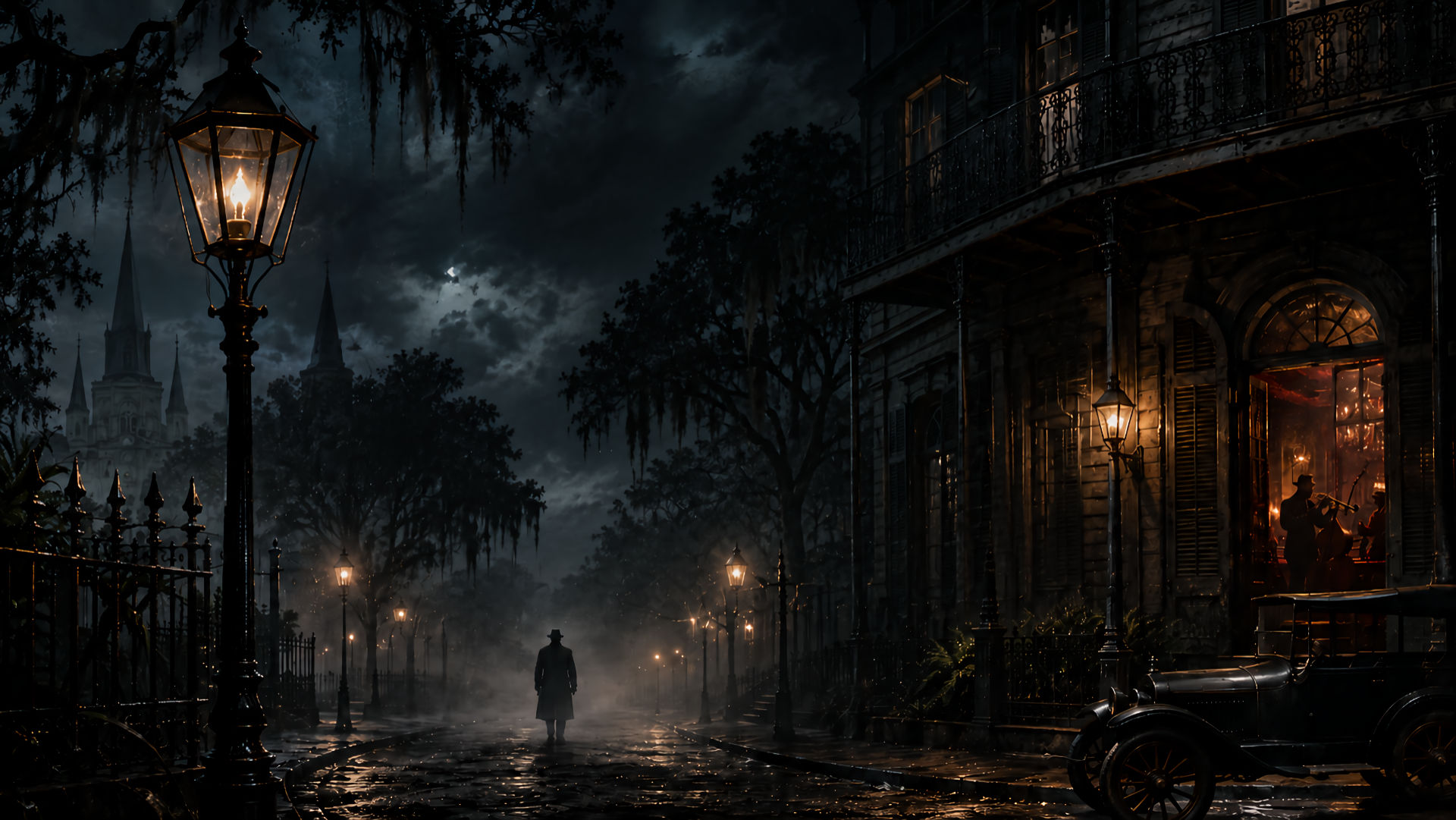
On the night of 19 March 1919, New Orleans played. It played because of fear, but it played all the same. Dance halls and bars were filled. Private homes arranged bands, pianists, gramophones, or whatever musical defence they could manage. For one night, the city became a strange orchestra of self-preservation, with jazz floating through neighbourhoods as if rhythm itself could bar the doors. The Historic New Orleans Collection notes that parties were quickly organised, cafés and bars were crowded, and the Axeman did not strike that evening.
The episode became famous partly because it sounds almost too strange to be real. A serial killer threatens a city. The city responds by throwing the bleakest jazz festival in history. It is macabre, theatrical, and deeply New Orleans. But underneath the folklore sits a more serious truth. The letter showed how powerless the authorities appeared. People did not play because they trusted the police. They played because they did not.
The letter also inspired commercial opportunism almost immediately, because capitalism has never knowingly walked past a nightmare without asking whether it could be merchandised. Composer Joseph John Davilla wrote “The Mysterious Axman’s Jazz,” also known as “Don’t Scare Me Papa,” reportedly inspired by the letter and the panic surrounding it. Sheet music turned terror into novelty, preserving the moment as both cultural artefact and grim joke. That may sound tasteless, and it probably was, but it also shows how quickly fear can be folded into popular culture.
For a while after jazz night, the attacks seemed to stop. Spring passed. Much of the summer passed. But the Axeman legend did not vanish, because legends are stubborn things and, annoyingly, rarely respect everyone’s need for a quiet life. Then, in August 1919, grocer Steve Boca was attacked in his home. He survived but could remember little. The familiar signs appeared again, including a removed back door panel and the absence of a clear robbery motive.
In September, Sarah Laumann was attacked and badly injured. A bloody axe was found outside, though her case differed from the classic pattern because entry appears to have been through a window, leading some to wonder whether it was genuinely the same attacker or a copycat. In October 1919, Mike Pepitone, a grocer and father, was murdered in what is often described as the final Axeman attack. Then the violence stopped. Not solved. Not explained. Just stopped.
The Suspects, the Silence, and the Mystery That Would Not Die
The Axeman was never caught, which is one reason the case still grips people more than a century later. Unsolved crimes leave an itch in the historical record. They invite theories, arguments, dramatic reconstructions, and the occasional wildly confident internet comment from someone who has watched three documentaries and now considers themselves Scotland Yard. In this case, the uncertainty is genuine. The evidence was limited, the investigations were flawed, and the crimes themselves may not all have been committed by the same person.
Several theories have competed for attention. One is that the attacks were connected to organised crime or Black Hand extortion, especially because many victims were Italian grocers. That theory has an obvious appeal, given the victims’ backgrounds and the tensions within immigrant commercial communities. Yet it does not fully fit. The Axeman often left victims alive, stole nothing, and used a method that seemed more ritualistic than practical. If the purpose was intimidation for profit, it was a strangely inefficient business model, even by the standards of criminals with poor customer service.
Another theory focuses on a man often named as Joseph Mumfre, or sometimes similar variants such as Manfre or Monfre. This suspect became linked to the case largely because of Mike Pepitone’s widow, who later shot and killed a man in Los Angeles whom she claimed was responsible for her husband’s murder. Some accounts suggest he had a criminal background and had left New Orleans after the final killing. However, the trail is muddy, and later researchers have questioned whether the traditional version of the Mumfre story can be verified. He has been described as the only serious suspect often linked to the Axeman identity, but doubts surround the evidence.
There is also the possibility that “the Axeman” was never one person at all. The crimes shared features, but not every attack matched perfectly. Some may have been copycat crimes. Some may have been domestic attacks, business disputes, or unrelated assaults pulled into the same terrifying narrative by newspapers and public fear. Once a city has a monster, it becomes tempting to feed every shadow to it.
What remains certain is the human cost. Families were destroyed. Innocent suspects were jailed. A city was frightened into sleeplessness. Jazz night became folklore, but the victims were not folklore. They were people attacked in their homes, often while sleeping, by someone who used the city’s own fear as part of his weapon. The Axeman disappeared from the record after 1919, leaving behind no confession, no conviction, and no final answer. That silence is why the case endures. The killer claimed to be a demon, but the more disturbing possibility is simpler. He may have been entirely human, and he may have walked away.
The Axeman of New Orleans FAQ
The Axeman of New Orleans was the name given to an unidentified attacker linked to a series of axe attacks and murders in and around New Orleans between 1918 and 1919. The killer was never conclusively identified.
The main Axeman attacks took place between May 1918 and October 1919, with victims attacked in their homes, often at night, and often with axes or similar tools found at the scene.
The case became famous because of its brutality, its unsolved nature, and a bizarre letter sent to a newspaper in 1919 claiming that homes playing jazz music would be spared from attack.
Many of the victims were Italian or Italian American grocers, which led to theories involving organised crime, extortion, or prejudice. However, not every detail fits neatly, and the motive remains uncertain.
No. Several suspects were investigated or accused, but no one was ever definitively proven to be the Axeman, and the case remains unsolved.