Pelé
Edson Arantes do Nascimento was born on 23 October 1940 in Três Corações, a small city in the Brazilian state of Minas Gerais. The world would come to know him as Pelé, but at the beginning, he was simply Dico, a boy from a poor family with a football at his feet and very little else. His father, João Ramos do Nascimento, known as Dondinho, had been a footballer himself, but injury limited his career. His mother, Celeste Arantes, wanted something more stable for her son. Football, to her, looked like a route to disappointment.
Brazil, though, had other ideas. Football was everywhere, played in streets, yards, fields, and patches of dust wherever children could find space. Pelé grew up in Bauru, in São Paulo state, where his family moved when he was young. Money was tight, and like many Brazilian boys of his generation, he learned the game without proper equipment. When there was no ball, he used a sock stuffed with paper or rags. When there were no boots, he played barefoot. None of this made the game smaller. If anything, it sharpened him.
The nickname Pelé has never had one completely settled explanation, but the most common story is that it came from his childhood attempts to pronounce the name of a goalkeeper called Bilé. He apparently disliked the nickname at first, which is one of those details history enjoys. The name he tried to avoid became one of the most famous in sport.
As a child, he was coached and encouraged by his father, who taught him not only technique, but respect for the game. Pelé later remembered watching his father cry after Brazil lost the 1950 World Cup final to Uruguay at the Maracanã. He was only nine years old, but he promised his father that he would one day win the World Cup for Brazil. It sounds almost too neat, the sort of line a screenwriter would be told to tone down. But in Pelé’s life, the impossible often behaved rather badly and became true anyway.
His talent was soon obvious. He joined local youth sides and later played for a team coached by Waldemar de Brito, a former Brazilian international. De Brito recognised that this was not just another skilful boy. He took Pelé to Santos, one of Brazil’s leading clubs, and reportedly told them he would become the greatest footballer in the world.
In 1956, at just fifteen, Pelé signed for Santos. He was leaving childhood behind before most people had properly begun to choose a future. Brazil had produced brilliant players before, but this boy carried something different. He had balance, speed, imagination, and a frightening calm in front of goal. Santos had not merely signed a promising teenager. They had opened the door to a phenomenon.
The Teenager Who Took Brazil to the World
Pelé made his senior debut for Santos in 1956 and scored almost immediately, setting the tone for everything that followed. He was still small, still young, and still learning how to live as a professional, but on the pitch, he seemed older than his years. Defenders quickly discovered that ordinary methods did not work. Give him space, and he ran through you. Stand close, and he slipped away. Try to force him wide, and he found an angle that did not appear to exist five seconds earlier.
By 1957, he had been called up to the Brazilian national team. He made his debut against Argentina at the Maracanã and scored, becoming, at the time, Brazil’s youngest goalscorer. It was a remarkable rise. Less than two years earlier, he had been a boy from Bauru trying to prove he belonged at Santos. Now he was wearing the yellow shirt of Brazil, a shirt already heavy with expectation because of the national trauma of 1950.
Brazil travelled to the 1958 World Cup in Sweden with a squad full of talent, but Pelé arrived injured and uncertain of his place. He was only seventeen. In most teams, that would have meant watching and waiting. Brazil, however, soon turned to him. Alongside players such as Garrincha, Didi, Vavá, Nilton Santos, and Mário Zagallo, Pelé entered the tournament and changed its temperature.
His first World Cup goal came in the quarter-final against Wales, a tight match settled by a moment of quick control and sharp finishing. In the semi-final against France, he scored a hat-trick, becoming the youngest player to do so in a World Cup. Then came the final against Sweden. Brazil won 5-2, and Pelé scored twice, including a famous goal in which he lifted the ball over a defender before volleying it into the net. At seventeen, he had kept his childhood promise to his father.
The victory meant more than a trophy. Brazil had won its first World Cup, and Pelé had become an international star almost overnight. Newspapers across the world searched for ways to describe him. He was not simply a goalscorer. He had the grace of a dancer, the strength of an athlete, and the instinct of someone who seemed to know what would happen before everyone else had finished reacting.
Back home, he became a national treasure. For many Brazilians, Pelé represented a new confidence, a symbol of beauty and brilliance emerging from a country that wanted to be seen on its own terms. Yet fame arrived with pressure. He was still a teenager, but he could no longer move through life as an ordinary one. Santos needed him, Brazil adored him, opponents feared him, and the wider world wanted to see whether this astonishing boy could possibly do it again.
That question would define the next stage of his career. Winning one World Cup could be a miracle. Staying at the top, year after year, would require something more durable than surprise.
1958, 1962, 1970: Building the Pelé Legend
After 1958, Pelé was no longer a secret. Every defender knew his name. Every crowd wanted a glimpse. Every match seemed to ask whether he could match the legend already forming around him. The remarkable answer was that he usually could. At Santos, he scored with a regularity that looked almost impolite. For Brazil, he became the figure through whom a golden generation was understood.
The 1962 World Cup in Chile began as another stage for Pelé. He scored in Brazil’s opening match against Mexico, but injury struck in the next game against Czechoslovakia. A thigh problem forced him out of the rest of the tournament. For most nations, losing their greatest player would have been fatal. Brazil still had Garrincha, whose dazzling performances helped carry the team to a second consecutive World Cup. Pelé received a winner’s medal, but his personal tournament had been brutally short.
By 1966, expectations were enormous. The World Cup in England should have been another chance for Pelé to dominate, but it became one of the most frustrating chapters of his career. Brazil were poorly prepared, the squad was unsettled, and opponents targeted Pelé with relentless physical treatment. He was injured against Bulgaria, missed the next match, and returned against Portugal, only to be fouled repeatedly. Brazil were eliminated in the group stage. Pelé was so disillusioned that he suggested he might never play in another World Cup.
Fortunately for football, he changed his mind. The 1970 World Cup in Mexico became the tournament that fixed his image forever. Brazil arrived with one of the greatest teams ever assembled, including Jairzinho, Tostão, Rivelino, Gérson, Clodoaldo, Carlos Alberto, and Pelé himself. If 1958 had introduced him as a prodigy, 1970 presented him as a master. He no longer needed to prove he was extraordinary. He now controlled games with intelligence, movement, and timing.
Some of his most famous moments from 1970 were not goals. Against Czechoslovakia, he attempted a shot from the halfway line that narrowly missed. Against England, his powerful header was saved brilliantly by Gordon Banks, in one of the most celebrated saves in football history. Against Uruguay, he sold a dummy to the goalkeeper without touching the ball, then just missed from a narrow angle. These near-misses became part of the legend because they showed the scale of his imagination.
In the final against Italy, Pelé scored the opening goal with a commanding header. Brazil won 4-1, and the final goal, finished by Carlos Alberto after a sweeping team move, was shaped by Pelé’s perfectly weighted pass. It was football as art, but not art floating in the clouds. It was precise, practical, and devastating.
With that victory, Pelé became the only player to win three World Cups. The achievement was astonishing on paper, but even greater in meaning. Across twelve years, through youth, injury, disappointment, and revival, he had remained central to Brazil’s football identity. Yet the World Cups were only part of the story. For most of his career, his weekly stage was Santos, and that was where the legend was built brick by brick.
The Santos Years: Goals, Glory, and Global Fame
Pelé’s club career was dominated by Santos, the Brazilian side he joined as a teenager and transformed into a global attraction. In an era before wall-to-wall television coverage, Santos became a travelling showpiece, crossing continents to play friendlies and tournaments because everyone wanted to see Pelé in person. Today, that might sound like a scheduling nightmare with shin pads. At the time, it was also business. Clubs, promoters, and crowds knew that Pelé could fill stadiums.
During his Santos years, he won domestic titles, dazzled in Brazil’s fiercely competitive football landscape, and helped take the club to the summit of South American and world football. Santos won the Copa Libertadores in 1962 and 1963, then beat European champions Benfica and AC Milan in the Intercontinental Cup. Those victories mattered because they showed that Santos were not simply a local powerhouse. With Pelé leading the attack, they could beat the best teams anywhere.
His partnership with players such as Coutinho became famous. They seemed to play by private signal, finding each other through crowded penalty areas and bewildered defenders. Pelé was often described as a complete forward, and the phrase fits. He could score with either foot, head the ball superbly, dribble past opponents, pass creatively, and read the rhythm of a match. He was not unusually tall, but his leap was explosive. He was not merely fast, but quick in thought, which is worse news for defenders. Legs can chase. Brains often arrive late.
One of the most celebrated milestones of his Santos career came on 19 November 1969, when he scored what was recorded as his thousandth goal, a penalty at the Maracanã against Vasco da Gama. The exact count of Pelé’s goals remains debated because it includes friendlies and unofficial matches, but the symbolism of that moment was huge. The match stopped, crowds surged, and Pelé dedicated the goal to the children of Brazil. Even allowing for football’s love of grand theatre, it was a remarkable scene.
His status also had political dimensions. Brazil’s military dictatorship, which began in 1964, understood the power of sporting fame. Pelé was useful as an image of national success, though he later faced criticism from some who felt he did not speak strongly enough against political repression. His defenders argued that he lived under real constraints and carried responsibilities few athletes could understand. Like many global icons, he became larger than sport, and that meant being judged by standards that shifted depending on who was looking.
By the early 1970s, Pelé had given Santos nearly everything. He had become the most famous footballer on earth while spending almost his entire prime in Brazil, rather than moving to Europe. That choice helped preserve his connection to Brazilian football, but it also made him a rare figure, both local hero and international spectacle.
In 1974, he retired from Santos. It seemed like the end. But then came an unexpected second act, one that took him not to Madrid, Milan, or Manchester, but to New York.
New York, Retirement, and Life Beyond the Pitch
When Pelé joined the New York Cosmos in 1975, he was already a legend. He had retired from Santos, his greatest years were behind him, and American soccer was still fighting for mainstream attention. That was precisely why the move mattered. The North American Soccer League wanted a star who could attract crowds, cameras, and credibility. Pelé did not merely join a club. He became the face of an entire sporting project.
His arrival in the United States was greeted with enormous publicity. At a time when football, or soccer as Americans called it, sat far behind baseball, American football, basketball, and ice hockey in the national imagination, Pelé gave the sport glamour. He was joined at the Cosmos by other famous names, including Franz Beckenbauer and Carlos Alberto. The team became a curious mixture of sporting ambition, celebrity culture, and 1970s New York confidence. It was not always tidy, but it was rarely dull.
Pelé’s spell with the Cosmos lasted from 1975 to 1977. He helped them win the Soccer Bowl in 1977, giving his American adventure a proper sporting conclusion. His final match was an exhibition between the Cosmos and Santos on 1 October 1977. He played one half for each side, which was a neat solution to the problem of belonging to two footballing homes. Rain fell during the match, and the scene took on a cinematic quality. Even the weather appeared to have read the script.
After retirement, Pelé remained one of the most recognisable people in the world. He worked as a global ambassador for football, appeared in films and adverts, promoted charitable causes, and became involved in public life. In the 1990s, he served as Brazil’s Minister of Sport, where his name was attached to legislation known as the Pelé Law, intended to modernise aspects of Brazilian football and give players greater contractual rights.
His post-playing life, however, was not free from complications. Pelé’s business ventures did not always succeed, and his personal life attracted public attention. He married three times and had several children. Questions around family relationships, politics, money, and celebrity followed him, as they often do with people who become symbols before they have had much chance to be ordinary adults. The image of Pelé, the footballing king, was simple. The life of Edson Arantes do Nascimento was more human.
In later years, his health declined. He underwent treatment for colon cancer, and on 29 December 2022, he died in São Paulo at the age of eighty-two. Tributes came from across the world, not only from footballers, but from presidents, artists, fans, and people who had never seen him play live but knew what his name meant.
His death closed a life that had travelled from poverty in Brazil to global fame, from barefoot games to packed stadiums, from teenage prodigy to elder statesman of the sport. But the final question was never simply how many goals he scored or how many trophies he won. It was what football became because Pelé had played it.
The King’s Legacy: How Pelé Changed Football Forever
Pelé’s legacy begins with numbers, but it does not end there. Three World Cup victories, more than a thousand goals by some counts, two Copa Libertadores titles with Santos, global fame before the age of modern media, and a career that stretched across continents. The statistics are impressive, even when debated, but they only explain part of his importance. Pelé changed the way football imagined greatness.
Before Pelé, there had been brilliant players. After him, the idea of the football superstar became global. He was not just admired in Brazil or South America. He was known in Europe, Africa, Asia, and North America. He became a sporting language that crossed borders. Even people who argued about football styles, leagues, and generations could understand what the name Pelé represented.
He also helped define Brazil’s football identity. The yellow shirt existed before him, but he gave it a glow that never fully faded. Brazil in 1970 became the standard by which attacking football was measured, and Pelé was its central figure. That team combined discipline with beauty, and Pelé embodied the balance. He could entertain, but he was not a circus act. He was creative because creativity helped win matches.
His influence on later players is impossible to miss. Every great attacking footballer who followed, from Johan Cruyff and Diego Maradona to Zinedine Zidane, Ronaldo, Lionel Messi, Cristiano Ronaldo, Neymar, and Kylian Mbappé, inherited a world Pelé had helped create. Some may have surpassed him in particular skills, records, or eras of club competition. None removed him from the conversation. That is the thing about foundations. You can build higher, but you are still standing on them.
There are fair debates around his career. He spent his prime at Santos rather than in Europe, and many of his goal totals include friendlies from an era when top clubs toured constantly. Football in the 1950s, 1960s, and 1970s was also different in fitness, tactics, refereeing, and global exposure. Yet those points do not shrink him so much as place him properly in time. Pelé dominated the world he was given, and then expanded it.
His greatest achievement may be that he made football feel bigger. He turned a match into a stage, a player into a symbol, and a boy from Três Corações into a name recognised almost everywhere. He carried joy, expectation, politics, pressure, and myth, sometimes gracefully and sometimes imperfectly. That imperfection matters. Without it, he would be a statue, not a person.
Pelé was called “O Rei”, the King, and the title stuck because it captured something beyond success. Kingship in football is not inherited. It is performed, defended, doubted, and remembered. Pelé earned it in Sweden, protected it in Brazil, restored it in Mexico, and carried it around the world for the rest of his life.
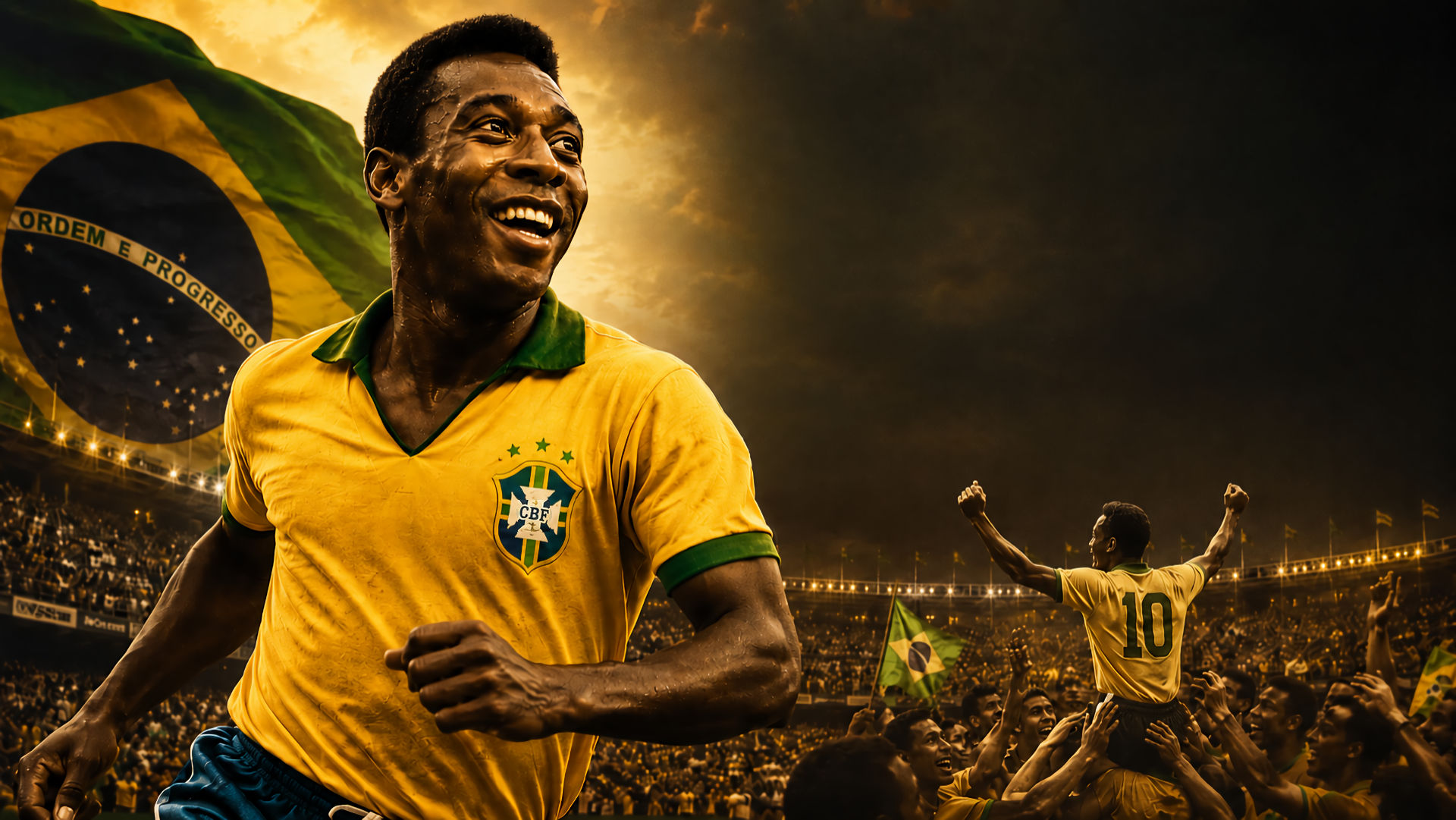
Long after the final whistle, the image remains: Pelé rising above defenders, smiling with the World Cup, shaping the ball as if it had agreed to obey him. Football has changed many times since he first played barefoot as a child, but every version of the modern game still contains a little of Pelé.
Pelé FAQ
Pelé’s real name was Edson Arantes do Nascimento. He was born in Três Corações, Brazil, on 23 October 1940, and became known around the world by the nickname Pelé.
Pelé won three FIFA World Cups with Brazil: 1958, 1962, and 1970. He remains the only player to have won the World Cup three times.
Pelé spent most of his club career with Santos in Brazil, where he became a global star. Later, he joined the New York Cosmos in the United States, helping raise the profile of football there.
Pelé is considered one of the greatest footballers ever because of his extraordinary skill, goalscoring record, creativity, three World Cup victories, and global influence on the popularity and image of football.