The Fukushima Daiichi Nuclear Disaster
On the afternoon of 11 March 2011, Japan was struck by one of the most powerful earthquakes ever recorded. At 2:46 p.m. local time, a magnitude 9.0 undersea earthquake tore open a section of the Japan Trench, around 70 kilometres off the east coast of Honshu. The shaking lasted for several minutes, long enough for buildings to sway, roads to split, and people across the region to understand that this was not an ordinary tremor.
Japan is one of the most earthquake-ready countries in the world. Its buildings, transport systems, emergency services, and public warning networks had been shaped by generations of living on the Pacific Ring of Fire. When the ground began moving, reactors at nuclear power stations along the coast automatically detected the seismic activity and shut down. At Fukushima Daiichi, a six-reactor nuclear power station operated by the Tokyo Electric Power Company, the three reactors that were running at the time, Units 1, 2, and 3, shut down as designed. Units 4, 5, and 6 were already offline for maintenance.
That shutdown, however, did not mean the danger was over. Nuclear reactors continue producing heat after the chain reaction stops. This is called decay heat, caused by radioactive by-products inside the fuel. It is far less intense than the heat generated during normal operation, but it still has to be removed. Without cooling water circulating through the reactor cores, temperatures rise, pressure builds, and the fuel can become damaged. So, even after the automatic shutdown, Fukushima Daiichi still needed electricity.
The plant had systems for this. When the external power grid failed because of the earthquake, emergency diesel generators started up. They were there to keep pumps, valves, and control systems working until grid power could be restored. For a short time, the plant appeared to have survived the earthquake itself. The reactors had shut down, the generators were running, and operators were dealing with a serious but manageable emergency.
But the earthquake was only the first act. Out at sea, the sudden movement of the ocean floor had displaced a vast volume of water. A tsunami was racing towards the coast of north-eastern Japan. In some places, the waves would reach heights far beyond what coastal defences had been built to withstand. Warnings went out, sirens sounded, and people moved to higher ground where they could.
Fukushima Daiichi sat beside the Pacific, protected by a seawall that proved tragically inadequate for what was coming. The disaster that would unfold there was not caused by a single failure, but by a chain of events in which each safeguard depended on another, and each minute made the next decision harder. The earthquake had shaken the plant. The sea was about to test everything else.
When the Sea Reached the Shore
The tsunami that struck Japan on 11 March 2011 was not just a wall of water. It was a moving landscape of destruction, carrying boats, cars, homes, trees, fuel tanks, and debris deep inland. Along parts of the Tōhoku coast, entire communities were swept away. More than 18,000 people were killed or went missing in the earthquake and tsunami, making it one of the worst natural disasters in modern Japanese history.
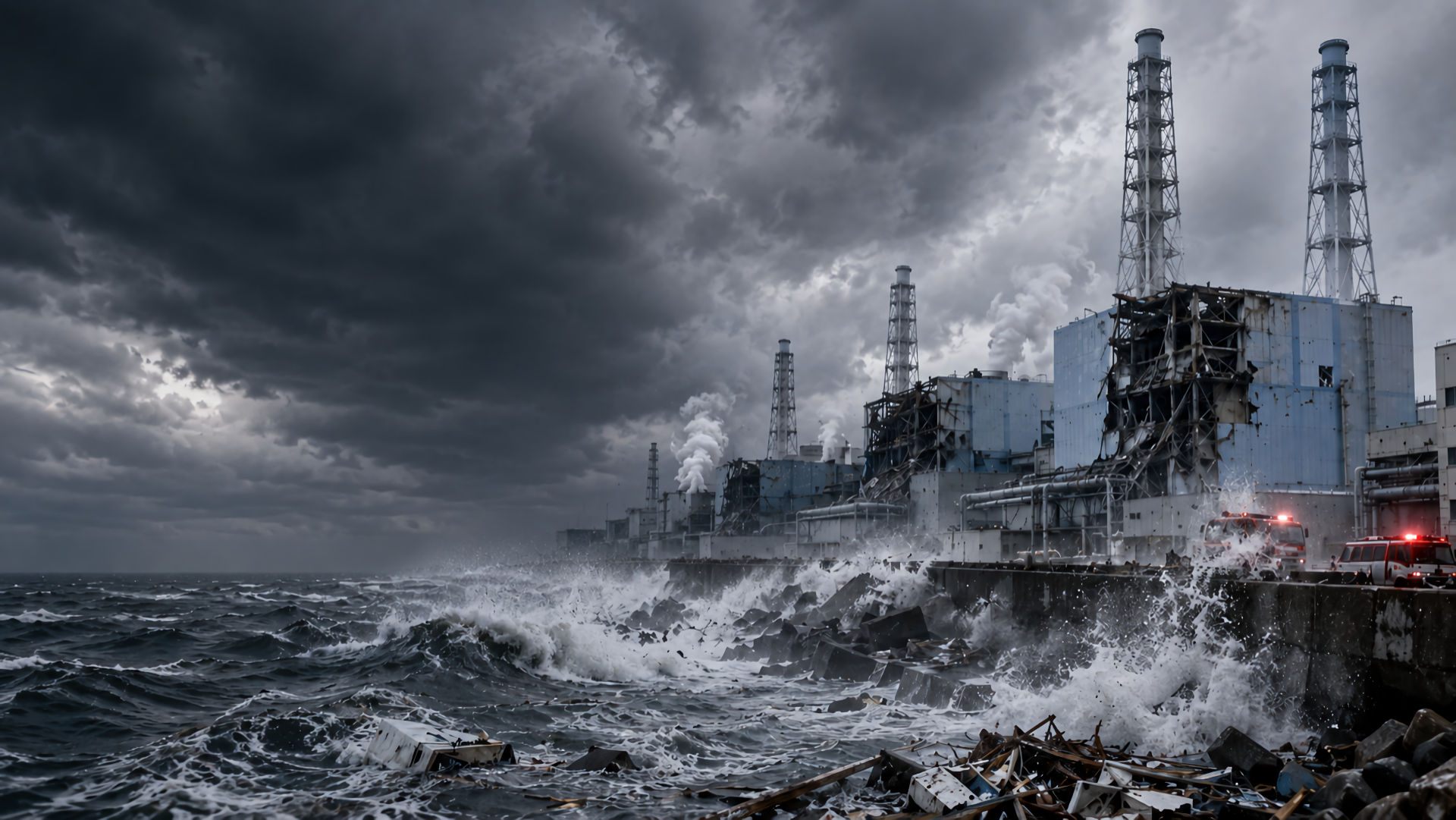
At Fukushima Daiichi, the tsunami arrived roughly fifty minutes after the earthquake. The plant had been built on the coast for practical reasons, as nuclear power stations need large quantities of water for cooling. Its seawall was designed for a tsunami of around 5.7 metres. The wave that reached the site was much higher, estimated at around 13 to 15 metres in places. It surged over the defences, flooded the lower areas of the site, and transformed a difficult emergency into a nuclear crisis.
The most damaging blow was to the plant’s electrical systems. Emergency diesel generators, electrical switchgear, and seawater pumps were flooded or disabled. The plant lost off-site power from the grid and then lost most of its on-site backup power. This condition, known as station blackout, is one of the most dangerous scenarios for a nuclear plant. Operators were left with limited battery power, damaged equipment, blocked access routes, and very little reliable information about what was happening inside the reactors.
The tsunami also made the wider response almost impossible. Roads were damaged or clogged with debris. Communication networks failed. The surrounding region was dealing with mass casualties, destroyed towns, fires, missing people, and thousands of survivors needing rescue. Fukushima Daiichi was not an isolated emergency with a clean path for support. It was a major industrial accident unfolding in the middle of a national catastrophe.
Inside the control rooms, workers tried to understand the status of the reactors. Instruments were failing, readings were uncertain, and conditions varied from unit to unit. The batteries could power some systems for a limited time, but not indefinitely. Cooling was the urgent priority. Without it, water levels inside the reactor pressure vessels would fall, exposing the fuel rods. Once exposed, the zirconium alloy cladding around the fuel could overheat and react with steam, producing hydrogen gas. That gas would soon become a serious threat of its own.
The design basis of Fukushima Daiichi had underestimated the scale of the tsunami risk. That did not mean the wave was unimaginable, only that the plant had not been adequately protected against it. In later investigations, attention would turn to warnings, safety culture, regulatory assumptions, and the relationship between industry and oversight. But in those first hours, the crisis was immediate and physical: keep the fuel covered, restore power, vent pressure, and prevent the emergency from becoming uncontrollable.
The sea had entered the plant. Now the operators had to fight a disaster they could barely see.
Power Lost, Cooling Lost, Control Slipping Away
The hours after the tsunami were a battle against heat, pressure, and time. In Units 1, 2, and 3, the reactors had shut down, but the fuel inside them was still producing decay heat. Cooling systems needed power, pumps needed electricity, and operators needed reliable instruments. Fukushima Daiichi had lost much of all three.
Unit 1 deteriorated fastest. Its emergency cooling systems were either unavailable, misunderstood, or unable to operate for long under the conditions created by the blackout. As the water level dropped inside the reactor pressure vessel, parts of the fuel became exposed. Temperatures rose sharply. The fuel rods overheated, their cladding reacted with steam, and hydrogen began to accumulate. The reactor core was being damaged, although the full extent was not yet clear to the people trying to manage the crisis from the control room.
Operators attempted to reduce pressure by venting steam from the containment. This was a dangerous but necessary step. If pressure became too high, containment structures could be damaged. Venting, however, risked releasing radioactive material and required valves to be opened in extremely difficult conditions. Some systems were not working electrically, meaning workers had to find manual alternatives. They were operating in darkness, wearing protective gear, dealing with radiation, aftershocks, poor communications, and the constant fear that the situation was getting worse faster than they could respond.
Unit 2 and Unit 3 also faced severe cooling problems. Unit 3 had a system that continued operating for longer than Unit 1’s, buying precious time, but it too eventually failed. Unit 2’s condition became increasingly uncertain, with pressure and water level readings difficult to interpret. At each unit, the central challenge was the same: without sustained cooling, the fuel would overheat and melt.
Fuel melting is one of the most feared outcomes in a nuclear accident. It does not mean a nuclear explosion, which is physically different and not possible in the same way as a bomb. It means the reactor fuel becomes so hot that it loses its structure, slumps, and can fall to the bottom of the reactor vessel. This damaged material, often called corium, is intensely radioactive and extremely difficult to locate, cool, and eventually remove.
To restore cooling, workers began injecting seawater into the reactors. This was a desperate measure because seawater corrodes equipment and effectively ruins a reactor for future use. But by then, the goal was not saving the plant. It was preventing something worse. Fire engines and improvised pumping arrangements were used in a response that looked less like normal nuclear engineering and more like emergency battlefield repair.
The situation was slipping out of the operators’ hands. They were not passive, and they were not careless. They were fighting systems damaged by forces beyond their design limits, with too little power, too little information, and too many things failing at once. The tsunami had removed the plant’s ability to cool itself. Now the reactors were beginning to reveal what that loss meant.
Explosions, Evacuations, and an Invisible Threat
On 12 March 2011, the crisis at Fukushima Daiichi became visible to the world. Hydrogen that had built up in the upper part of the Unit 1 reactor building ignited and exploded. Television footage showed the building’s outer walls and roof blown apart in a burst of dust and debris. The reactor containment itself was not destroyed, but the sight was alarming and unmistakable. A nuclear plant had exploded on live television.
The hydrogen had been produced inside the overheated reactor core. As fuel cladding reacted with steam, hydrogen gas formed and escaped into the reactor building. Once mixed with oxygen, it became explosive. Similar dangers existed at other units. On 14 March, Unit 3 suffered a much larger hydrogen explosion, sending debris high into the air. On 15 March, an explosion occurred around Unit 4, which had been offline at the time of the earthquake. Hydrogen is believed to have reached Unit 4 through shared venting systems, showing how failures could jump across parts of the plant in unexpected ways.
Unit 2 did not produce the same dramatic external blast, but it suffered a serious event around its suppression chamber, part of the containment system designed to manage pressure. By this stage, all three operating reactors, Units 1, 2, and 3, were believed to have suffered core damage. Later analysis confirmed meltdowns in all three.
As the plant deteriorated, the Japanese authorities expanded evacuation orders. Residents within a 3-kilometre radius were first told to leave, then the zone was widened to 10 kilometres, and then to 20 kilometres. Others were advised to shelter indoors. For people already traumatised by the earthquake and tsunami, the nuclear emergency created a second crisis. Families had to leave homes, farms, pets, businesses, and sometimes elderly relatives in hospitals or care facilities. Some left believing they would return soon. Many would not return for years, and some areas remained restricted long afterwards.
Radiation is frightening partly because it is invisible. It cannot be seen, heard, or smelled. People depended on official measurements, instructions, and reassurance at a time when trust was under immense strain. Radioactive iodine and caesium were among the materials released into the environment. Contamination affected land, water, crops, livestock, and public confidence. Food safety checks, exclusion zones, and decontamination work became part of daily life in the region.
Internationally, Fukushima revived arguments about nuclear power. Germany accelerated its decision to phase out nuclear energy. Other countries reviewed reactor safety, especially protection against floods, earthquakes, and long-term station blackout. The accident was eventually rated Level 7 on the International Nuclear and Radiological Event Scale, the same highest category as Chernobyl. However, the nature and scale of the two disasters were very different.
For the workers at the plant, the immediate fight was still not political or theoretical. It was practical. Keep injecting water. Reduce pressure. Avoid further explosions. Protect the spent fuel pools. Measure radiation. Clear debris. Stay alive. The disaster had moved from hidden danger to public emergency, but the hardest work was still happening inside the broken plant.
Inside the Struggle to Stabilise Fukushima Daiichi
The effort to stabilise Fukushima Daiichi became one of the most difficult emergency operations in the history of nuclear power. Workers returned again and again to areas where radiation levels could be dangerous, equipment was damaged, lighting was poor, and aftershocks continued. They became known in some media reports as the “Fukushima Fifty”, although the actual number of workers involved over time was much larger. The phrase captured something real, though: a small group of people repeatedly entered a place most others were being moved away from.
Their task was brutally simple to describe and painfully hard to achieve. The reactors and spent fuel pools had to be cooled. Water had to be injected continuously. Pressure and temperature had to be monitored. Radiation had to be measured. Damaged buildings had to be accessed without triggering new hazards. Fire engines, temporary pumps, portable generators, hoses, batteries, and improvised lines were brought in as workers tried to replace functions that the plant’s own systems could no longer perform.
One urgent concern was the spent fuel pool in Unit 4. Because Unit 4 had been offline, all its fuel had been moved into the spent fuel pool for maintenance. After the explosion damaged the reactor building, there were fears that water levels in the pool might fall, exposing fuel assemblies and releasing large amounts of radioactive material. Helicopters and water cannon were used in attempts to add water from outside, a scene that underlined the extraordinary nature of the crisis. Later inspections suggested the pool had not failed in the worst-feared way, but at the time, the uncertainty was terrifying.
Gradually, the response became more organised. External power was partly restored. More stable water injection systems were established. Nitrogen was injected into containment vessels to reduce the risk of further hydrogen explosions. Remote-controlled machines were used to survey and clear areas too dangerous for workers. Contaminated water, created as cooling water passed through damaged reactor structures, became a major problem. It accumulated in basements, trenches, tanks, and treatment systems, creating a second long-term challenge even as temperatures fell.
By December 2011, the Japanese government announced that the reactors had reached a condition known as cold shutdown. In practice, this meant temperatures had been brought under better control and further large releases had become less likely. But the term could be misleading. Fukushima Daiichi was not fixed. The cores of Units 1, 2, and 3 were badly damaged. Their melted fuel had to be located, characterised, cooled, and eventually removed. The site was stable compared with March 2011, but it was not safe in any ordinary sense.
The emergency phase had passed into a much longer phase of containment, investigation, and recovery. What had begun as a race to prevent uncontrolled overheating became a decades-long engineering problem. The plant was no longer a power station. It was a vast, damaged, radioactive worksite on the edge of the Pacific.
The Long Shadow of Contamination, Cleanup, and Trust
The Fukushima Daiichi disaster did not end when the explosions stopped or when the reactors were declared stable. Its consequences spread across years, landscapes, communities, and political debates. For the people of Fukushima Prefecture, the disaster was not only about radiation measurements. It was about evacuation, lost homes, damaged livelihoods, fractured communities, and the uncertainty of whether normal life could ever return.
Large areas around the plant were contaminated with radioactive material, especially caesium. Japanese authorities began an enormous decontamination campaign, removing topsoil, washing buildings, clearing vegetation, and storing contaminated waste in bags and temporary sites. Some towns gradually reopened. Others remained restricted, particularly in areas where radiation levels were still too high or infrastructure had collapsed. Returning home was not a simple decision. Some residents wanted to go back as soon as possible. Others had rebuilt lives elsewhere or feared the risks, especially for children.
The human toll was complex. No immediate deaths were attributed directly to radiation exposure from the accident, but the evacuation itself caused serious harm. Elderly and vulnerable people were moved under stressful conditions. Hospitals and care homes struggled. Mental health problems, stigma, social disruption, and anxiety became part of the disaster’s legacy. Fukushima showed that a nuclear accident can cause damage through fear, displacement, and institutional failure, even beyond the physical effects of radiation.
The cleanup of the plant is expected to take decades. One of the most difficult tasks is removing the melted fuel debris from Units 1, 2, and 3. Robots have been sent into containment areas to inspect conditions, but high radiation, water, rubble, and uncertainty have slowed progress. The exact location and condition of the melted fuel vary between reactors and remain technically challenging to deal with. Decommissioning Fukushima Daiichi is not one job, but thousands of linked jobs, each dependent on safety, technology, funding, and patience.
Another major issue has been contaminated water. Water is still needed to cool damaged fuel, and groundwater has entered parts of the site. Treatment systems remove many radioactive substances, but tritium is difficult to separate from water. Japan’s decision to release treated water into the Pacific, beginning in 2023, was approved by international monitoring bodies but remained controversial among local fishers, neighbouring countries, and campaigners. The argument was not only scientific. It was also about trust.
That may be Fukushima’s deepest lesson. The accident exposed weaknesses in risk planning, regulation, communication, and assumptions about rare but devastating events. Nuclear power depends on public confidence because its failures can outlast political terms, company leadership, and even generations. Fukushima Daiichi proved that advanced technology is only as strong as the culture that manages it.
The disaster began with an earthquake and a wave, but its real story is about preparation, cascading failure, human courage, and the long work of accountability. More than a decade later, Fukushima is still being cleaned, studied, debated, and remembered. The reactors are silent now, but the questions they raised are still very much alive.
The Fukushima Daiichi Nuclear Disaster FAQ
The Fukushima Daiichi Nuclear Disaster was caused by the 11 March 2011 earthquake and tsunami in Japan. The reactors shut down after the earthquake, but the tsunami flooded key electrical and cooling systems. Without reliable power, the plant could not keep three reactor cores properly cooled.
No. The explosions at Fukushima Daiichi were hydrogen explosions, not nuclear explosions. Hydrogen built up after overheated fuel cladding reacted with steam. The blasts damaged reactor buildings, but they were not the same as a nuclear weapon or nuclear detonation.
Units 1, 2, and 3 suffered core damage and meltdowns. These were the three reactors operating when the earthquake struck. Units 4, 5, and 6 were already offline, although Unit 4 was later damaged by a hydrogen explosion.
Yes. Fukushima Daiichi remains a long-term decommissioning project. The damaged reactors must be kept stable, contaminated water must be managed, and melted fuel debris still has to be located, retrieved, and safely handled. The cleanup is expected to take decades.