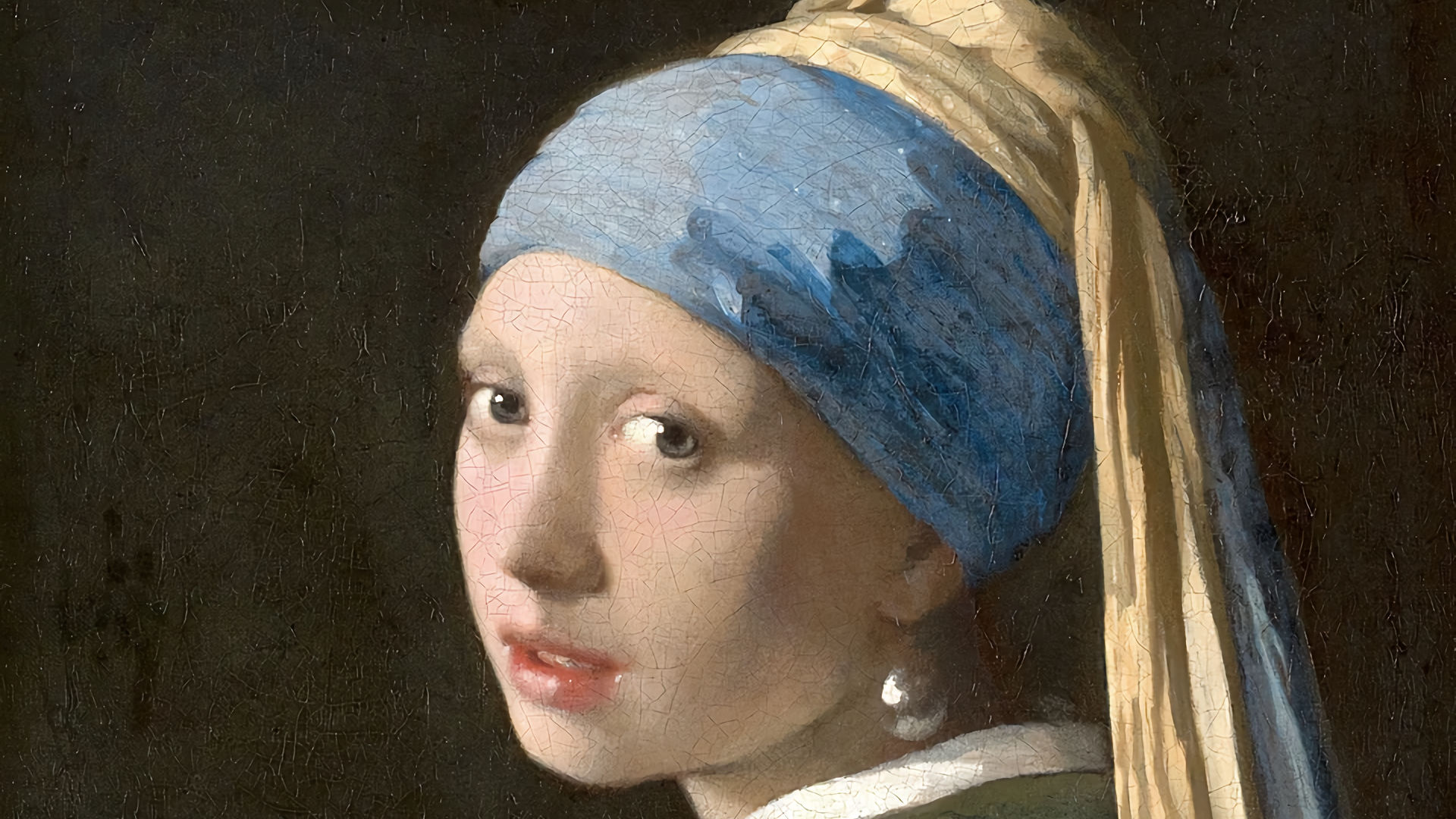
The Mystery of the Girl with a Pearl Earring
She stares at us across centuries, wide-eyed, lips slightly parted as if she is about to speak, yet caught forever in silence. Her head is turned, her gaze locked on ours with a mix of curiosity and intimacy that feels strikingly modern. Draped in a blue and yellow turban and wearing a single oversized pearl earring, she is not a queen or a saint. She is simply a girl. And we know almost nothing about her.
Painted around 1665 by Dutch artist Johannes Vermeer, Girl with a Pearl Earring has become one of the most celebrated images in art history. Often called the “Mona Lisa of the North,” this portrait is famous not just for its beauty, but for its mystery. Who was she? Why did Vermeer paint her? And how did this quiet, unassuming artwork go from being nearly forgotten to becoming a cultural icon?
To understand the mystery of this girl, we must explore the life of the man who painted her, the forgotten centuries she survived, and the powerful connection she still forges with every viewer, including you.
The Painter and His City
Johannes Vermeer lived his entire life in Delft, a small Dutch city surrounded by canals, where church bells chimed daily, and the smell of grinding pigments drifted from artists’ workshops. Delft was a centre of the Dutch Golden Age, a time of wealth built on trade, science, and exploration. Yet, despite the prosperity around him, Vermeer was never wildly successful or famous during his lifetime.
He painted slowly, incredibly slowly. Most artists completed hundreds, if not thousands, of works. Vermeer left behind only about 35 paintings. He took his time, perfecting the play of light and shadow, studying how fabrics shimmered, how human skin glowed, and how the smallest detail could tell a quiet story.
His subjects were usually domestic scenes: women reading letters, pouring milk, or quietly lost in thought. But the Girl with a Pearl Earring is different. There is no room, no props, just her. She feels like a fleeting moment captured long before cameras existed.
A Girl Without a Name
Unlike many portraits of the era, we do not know the girl’s identity. She does not wear jewellery or clothing that signals wealth or social class, except for the dramatic earring itself. That accessory might not even be a real pearl. Some scholars argue it is too large and smooth to be genuine, more likely made of polished tin or glass. Still, it catches the light like a star fallen to earth, and everyone notices it.
Her blue turban is another oddity. In the 17th century, Dutch women did not dress like that. The headwrap suggests something exotic, foreign, imagined. Art historians have therefore concluded that this painting is not a portrait but a tronie, a study of a character, an expression, a type of beauty.
So she may not be anyone specific. And yet, in her gaze, she feels more real than many who were named and recorded.
The Moment Caught Forever
Part of the mystery lies in the way the painting invites us into a moment that feels suspended. Her lips are parted as though she has just turned to look at us. Is she about to speak? Did we call her name? Did she turn because of a sound behind her?
Few paintings capture such immediacy. Most portraits of the period are formal, still, composed. This girl seems alive, startled, even, as if Vermeer has asked her to pause just one second so that he can freeze the spark in her eyes.
That spark is what gives her a presence that refuses to fade.
Light, Colour, and the Alchemy of Paint
Vermeer was a magician with light. He used expensive pigments, such as ultramarine, made by crushing rare lapis lazuli stones, to create that vivid, unforgettable blue in her turban. Her skin glows softly as if lit from within. The pearl catches just enough light to suggest weight and gleam, even if its source is unknown.
Look closely, and the details become even more impressive. The small highlight on her lower lip. The wet-looking gleam on the pearl. The shadow beneath her chin that anchors her firmly in space. These effects are not accidental. Vermeer understood the mathematics of light with near scientific precision.
And yet it does not feel calculated. It feels like a whisper.
A Life Lost in Shadows
Despite his genius, Vermeer lived a life marked by financial struggle. He had eleven surviving children, and art was not always enough to keep food on the table. When he died suddenly at 43, deeply in debt, his widow was forced to sell his paintings to survive.
His name faded from public memory. Many works were attributed to others. Some were lost entirely. The Girl with a Pearl Earring passed quietly from one owner to another, virtually unknown. For over two centuries, she waited in the dark.
Rediscovered and Reborn
The painting returned to the spotlight in 1881 when a collector purchased it for just a few guilders, a price so low it would make an art dealer faint today. After a restoration that removed layers of old varnish, her brilliance resurfaced. Her colours glowed again. Her gaze regained its youthful power.
Slowly at first, then rapidly, the art world fell in love.
By the late 20th century, she had become a global icon, reproduced on postcards, posters, book covers, and coffee mugs. Tracy Chevalier’s 1999 novel, The Girl with a Pearl Earring, imagined her backstory as a servant in Vermeer’s household. The book became a bestseller. The 2003 film followed, starring Scarlett Johansson as the enigmatic girl.
Fiction filled the gap where history stayed silent.
Who Was She? The Theories
Since no records confirm her identity, speculation has flourished. The most widely considered candidates include:
Vermeer’s eldest daughter, Maria. She was the right age and likely spent time in her father’s studio. If trust and familiarity were needed, a daughter would be the perfect model.
A household servant. This theory inspired Chevalier’s novel, and a servant might be asked to sit quietly, dressed up to represent a fictional exotic beauty.
A model from outside the home. Artists often hired models for studies like tronies. A stranger’s unfamiliarity might explain the startled look.
Each theory holds a possibility. None holds proof. And there is something almost poetic in that uncertainty. She has become every girl and no particular girl at the same time.
Mastery of Mystery
More than 350 years after her creation, she still provokes questions. Her expression is ambiguous. Is she shy or confident? Innocent or knowing? Curious or cautious? We recognise emotion without being able to name it, and that is why we cannot look away.
Vermeer painted a girl, but he captured a feeling. A human connection that bypasses language and logic.
Modern Technology Meets Old Secrets
In recent years, researchers have used cutting-edge scanning techniques to peer beneath the surface of the painting and they discovered some interesting things. For example:
- She originally had long eyelashes
- The background once included a curtain that has since faded
- The pearl was built using clever dabs of paint rather than detailed outlines.
These discoveries reveal Vermeer’s process but deepen the intrigue. Even knowing more about the brushstrokes does not solve the mystery of the girl herself. Technology can reveal the “how”. Only imagination can identify the “who.”
Final Word
The Mystery of the Girl with the Pearl Earring reminds us that not all secrets are meant to be solved. Sometimes, it is the unanswered questions that make a creation timeless. This painting is not a document of a known figure, nor a historical account of a specific moment. It is a portrait of presence, the brief spark of connection when someone turns toward you, when eyes meet, when time seems to pause.
She is anonymous and unforgettable. Silent and yet endlessly expressive. Her story is a blank page we continue to write upon. And maybe that is why we love her: each of us can look into those eyes and imagine a different tale, or because she feels like someone we almost remember meeting. Or, because the moment Vermeer captured never actually ends.
She will keep staring back at us as long as the painting survives, poised between speech and silence, history and imagination, identity and enigma.
A girl turned toward the light, forever asking a question she never needs to say aloud.
The Mystery of The Girl with a Pearl Earring FAQ
The painting was created by Dutch artist Johannes Vermeer around 1665 during the Dutch Golden Age.
Her true identity remains a mystery. Some believe she may have been Vermeer’s daughter or a maid, while others argue she was purely imaginary.
Its fame comes from the girl’s lifelike gaze, the rich use of light and shadow, and the mysterious aura surrounding her identity. It’s often called the “Mona Lisa of the North.”
The painting is on permanent display at the Mauritshuis museum in The Hague, Netherlands.