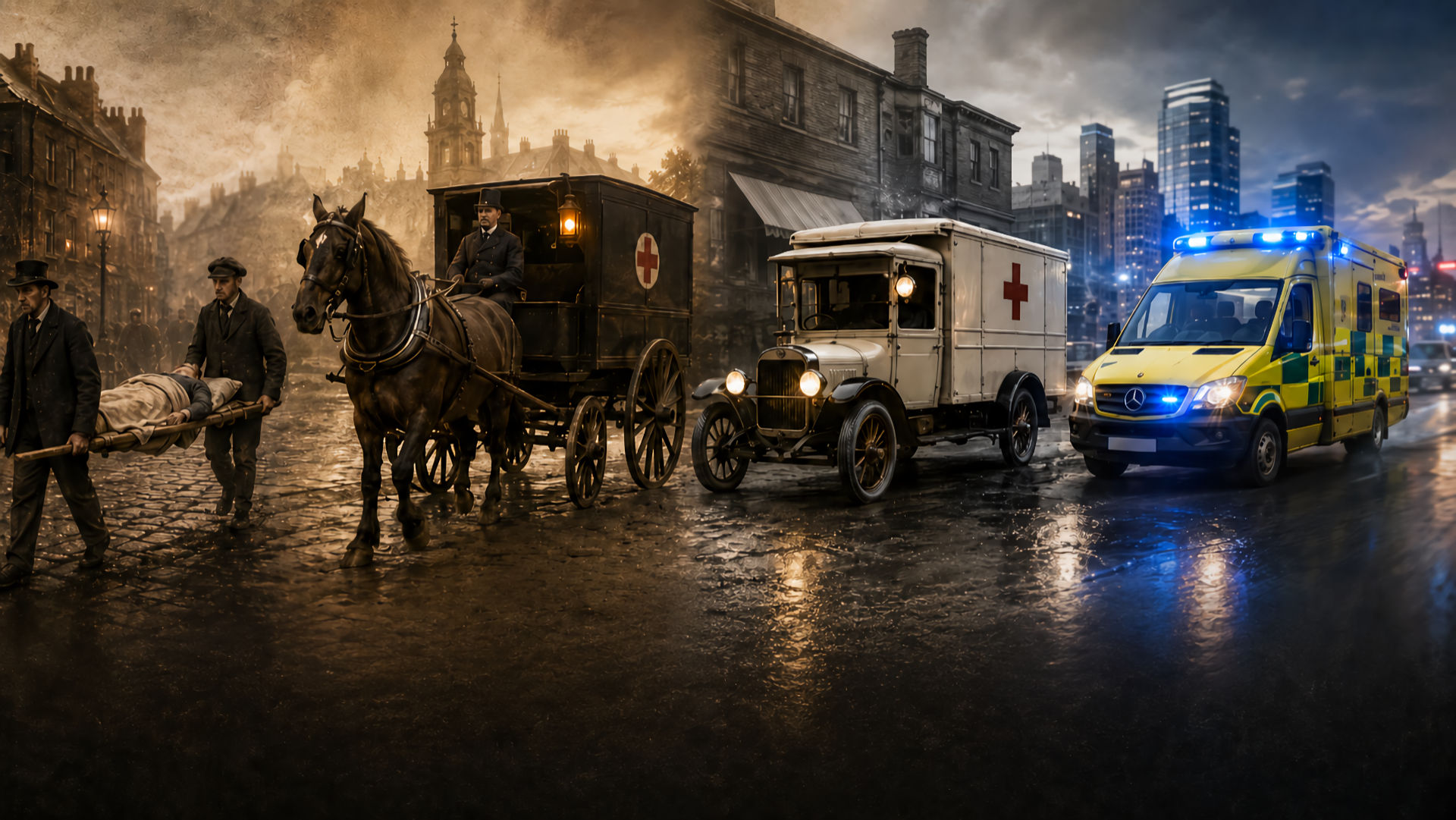
The History of the Ambulance
For most of human history, the word “ambulance” would have meant very little to anyone lying injured beside a road, wounded on a battlefield, or suddenly taken ill at home. There were healers, physicians, surgeons, monks, midwives and herbalists, but there was no organised emergency transport system that could quickly bring help to the patient or carry the patient safely to help. If someone was badly hurt, the response usually depended on family, neighbours, servants, soldiers, passers-by, or sheer luck. In a medical emergency, luck was not exactly the reassuring bit of the treatment plan.
In ancient cities, injured people might be carried on stretchers, carts, litters, or by hand. Roman armies had medical staff and field arrangements for wounded soldiers, and some large civilisations developed ways of moving the sick, especially during war. But these were not ambulances in the modern sense. They were not part of a public emergency service, and they were not designed around rapid response, trained crews, or treatment on the move. They were methods of transport, not organised rescue systems.
During the medieval period, religious institutions often became centres of care. Monasteries, hospitals and charitable orders cared for the sick, the poor, pilgrims and travellers. The Knights Hospitaller, for example, became associated with care for the sick and wounded in the context of pilgrimage and crusading. Yet even here, the main idea was still bringing people to a place of care or offering shelter once they arrived. There was little sense that trained medical help should travel urgently to the patient.
In towns and villages, people were commonly moved using whatever was available. A door might become a makeshift stretcher. A cart used for goods might become a medical vehicle for the afternoon. In wealthy households, a sedan chair or private carriage might be used. For the poor, it was often a slower, rougher and more painful journey. Broken bones, bleeding wounds and serious infections did not improve when bounced along bad roads in a farm cart, although history does have a habit of adding insult to injury with impressive commitment.
The problem was not simply transport. It was also medical knowledge, organisation and social expectation. Before modern emergency medicine, many people did not imagine that fast intervention could make the difference between life and death in the way we do today. Surgery was dangerous, infection was poorly understood, and hospitals were not always places people wanted to enter unless absolutely necessary. The ambulance could not really develop until society began to see urgent medical response as something organised, professional and necessary.
That change would begin most clearly in the chaos of war, where the need to move the wounded quickly became impossible to ignore.
War, Wheels and the First Organised Medical Transport
The history of the ambulance took a major step forward on the battlefield, which is grimly appropriate. War has often forced medical innovation, not because war is wise, but because it produces terrible problems in large numbers and demands practical answers very quickly. By the late eighteenth century, European warfare had become more mobile, more destructive and more complicated. Armies moved rapidly, artillery caused horrific injuries, and thousands of wounded soldiers could be left scattered across battlefields after the fighting had moved on.
One of the key figures in changing this was Dominique Jean Larrey, a French military surgeon who served during the French Revolutionary and Napoleonic Wars. Larrey looked at the traditional system, in which wounded soldiers might wait until after battle before receiving proper care, and saw a deadly delay. His answer was the “flying ambulance”, or ambulance volante, a light, mobile wagon designed to move quickly across the battlefield. These vehicles carried medical personnel and supplies, and they allowed wounded soldiers to be collected and treated far sooner than before.
Larrey’s idea was important because it shifted the ambulance from simple transport towards an organised emergency response. The ambulance was no longer just a cart that carried the injured away once everything had calmed down. It became part of the medical system itself, designed to reach casualties, bring help closer to danger, and move patients according to urgency. Larrey also supported triage, the sorting of wounded soldiers by medical need rather than rank or social status. That principle would become one of the foundations of modern emergency medicine.
Military medicine continued to shape ambulance development through the nineteenth century. During the American Civil War, Jonathan Letterman, medical director of the Army of the Potomac, introduced a more organised ambulance corps. Before his reforms, wounded soldiers might wait for hours or even days, and ambulance wagons could be poorly managed, misused, or unavailable when needed. Letterman created a structured system with trained stretcher bearers, dedicated ambulance wagons, clear chains of command, and field hospitals positioned to receive casualties more effectively.
The result was not perfect, but it was a dramatic improvement. Wounded soldiers could be collected more reliably, transported more quickly, and treated within a more coherent medical network. The idea that emergency transport required organisation, training and command was becoming harder to ignore. War had shown that improvisation was not enough. You could not build a life-saving system out of good intentions, random carts and hope with a hat on.
These battlefield lessons gradually influenced civilian life. Industrial cities were growing, railways and factories created new forms of injury, and urban populations were becoming larger and denser. The same basic question returned in a new setting. If speed and organisation saved soldiers, could they also save workers, travellers, mothers, children and ordinary people in the street?
From Horse-Drawn Wagons to Motorised Emergency Vehicles
By the nineteenth century, the ambulance began to move from the battlefield into civilian society. Cities were changing rapidly. Industrialisation brought crowded streets, dangerous workplaces, railway accidents, factory injuries and new pressures on hospitals. A person injured in a city might be surrounded by people, but still have no reliable way of reaching medical care quickly. The need for organised ambulance transport was becoming a public problem, not just a military one.
Early civilian ambulances were often horse-drawn vehicles operated by hospitals, charities, police forces, fire departments, or local authorities. In some places, they were simple wagons with stretchers. In others, they became more specialised, with suspension systems, space for attendants, and basic equipment. The aim was still mostly transport, but the idea of a dedicated emergency vehicle was taking root. The ambulance was becoming recognisable as a public service, even if the ride itself could still feel like being posted through the streets by horse.
Voluntary organisations played a major role. In Britain, the St John Ambulance Association, founded in 1877, helped spread first aid training and organised ambulance work. Its influence was significant because it linked emergency care with public education. Ordinary people could be trained to give immediate assistance before a doctor arrived. This was a quiet but important shift. The emergency response was no longer only about moving the patient, but also about what happened in the crucial minutes before and during that movement.
Hospitals also developed their own ambulance services. In major cities, ambulance stations and call systems began to appear, although the arrangements varied widely. Some services were free, some charged fees, and some depended on charity. Police and fire services often became involved because they were already organised, uniformed and present in the community. The ambulance was still not yet the fully professionalised medical service we know today, but it was becoming part of urban infrastructure.
The arrival of the motor vehicle changed everything. In the early twentieth century, motorised ambulances began replacing horse-drawn wagons in many cities and military services. They were faster, more reliable over longer distances, and easier to adapt for medical use. During the First World War, motor ambulances became vital in moving wounded soldiers from casualty clearing points and field stations to hospitals. They worked alongside trains, ships and stretcher bearers in a vast chain of wartime medical evacuation.
Motorisation also changed public expectations. Once people saw that patients could be moved faster, the old delays became less acceptable. Ambulances could cover larger areas, respond to incidents more quickly, and connect homes, streets, factories and hospitals in a new way. Yet despite this progress, the ambulance remained limited for much of the early twentieth century. It was often still treated as a vehicle for transport rather than a place for advanced treatment.
The next major transformation would come when medicine itself began to change, especially the understanding that what happened before arrival at hospital could decide whether a patient survived at all.
The Birth of Modern Emergency Medicine
The modern ambulance could not fully emerge until medicine recognised the importance of the pre-hospital period. For a long time, the basic assumption was that the ambulance’s job was to collect the patient and deliver them to doctors as quickly as possible. Speed mattered, but treatment mostly began at the hospital door. Over time, that idea began to look dangerously incomplete. In trauma, cardiac arrest, severe bleeding, breathing problems and shock, the minutes before hospital arrival could be decisive.
The Second World War and later conflicts accelerated this understanding. Military medicine improved evacuation systems, blood transfusion, surgical organisation, airway management and treatment of shock. Helicopters were later used in conflicts such as the Korean War and Vietnam War to evacuate casualties more quickly from difficult terrain. These developments reinforced a powerful lesson: survival improved when patients reached care quickly, but also when meaningful treatment began earlier.
Civilian medicine began to absorb these lessons. Road traffic accidents increased dramatically in the twentieth century as car ownership expanded. Industrial injuries, heart attacks and urban emergencies placed fresh demands on ambulance services. In many places, ambulances were still staffed by drivers and attendants with limited medical training. They could offer oxygen, basic first aid and transport, but not the wider range of interventions now associated with emergency care. The gap between what patients needed and what ambulances could provide became increasingly obvious.
One major turning point came in the 1960s. In the United States, the 1966 report “Accidental Death and Disability: The Neglected Disease of Modern Society” criticised the poor state of emergency care and ambulance provision. It argued that many people were dying unnecessarily because emergency systems were fragmented, undertrained and poorly equipped. The report helped push the development of emergency medical services, better training standards, emergency communication systems and more capable ambulances.
At the same time, cardiac care began to reshape ambulance thinking. In Belfast in the 1960s, pioneering work on mobile coronary care units showed that patients with heart attacks could receive life-saving care before reaching the hospital. Defibrillation, monitoring and trained response teams suggested a new model of ambulance care. The vehicle could become not only a transport, but a mobile extension of the hospital. That was a major conceptual leap, and unlike some conceptual leaps, this one came with sirens.
Emergency medicine also became a recognised speciality. Hospitals created emergency departments with doctors and nurses trained for urgent care. Ambulance services developed closer links with these departments, and dispatch systems became more sophisticated. The ambulance was now part of a chain of survival, beginning with the emergency call, continuing through first aid and ambulance response, and ending in specialist hospital treatment.
This was the point at which the ambulance stopped being mainly a ride to the hospital and started becoming a place where emergency medicine happened.
Paramedics, Sirens and the Ambulance as a Mobile Treatment Room
The rise of the paramedic transformed the ambulance more than any change in paintwork, sirens, or flashing lights ever could. A vehicle can be fast, expensive and impressively noisy, but without trained people inside it, it remains only a very dramatic van. The paramedic brought advanced skills to the patient’s side, helping turn the ambulance into a mobile treatment room and the ambulance crew into a vital part of the medical team.
Paramedic systems developed at different speeds in different countries. In the United States, pioneering services in the late 1960s and 1970s showed what trained ambulance crews could achieve. One notable example was Freedom House Ambulance Service in Pittsburgh, which trained African American residents from underserved communities to provide advanced emergency care. Its crews became highly skilled and influential, even though their contribution was not always properly recognised at the time. Their work helped demonstrate that ambulance staff could do far more than simply load patients and drive.
Television also played a surprisingly important cultural role. The American series Emergency!, first broadcast in the 1970s, introduced many viewers to the idea of paramedics performing medical procedures outside of the hospital environment. It was entertainment, certainly, but it reflected and helped popularise a real shift. Ambulance crews were becoming medical responders in their own right, equipped to assess patients, communicate with hospitals, start treatment and make urgent decisions under pressure.
In Britain, ambulance services also evolved steadily. The National Health Service brought ambulance provision into a broader public health framework, although organisation varied across regions. Over time, training improved, equipment expanded, and paramedics became an established professional group. The old image of the ambulance driver gave way to something much more complex. Modern ambulance clinicians need knowledge of trauma, cardiac care, childbirth, mental health crises, strokes, diabetes, respiratory distress and countless other emergencies. One minute might involve chest pain, the next a fall, the next a confused patient who mainly needs calm, careful assessment.
Technology also changed the inside of the ambulance. Defibrillators, oxygen systems, suction equipment, stretchers, spinal boards, splints, monitors, radios, and later, digital communication systems all became part of the emergency toolkit. Ambulances gained better layouts, improved lighting, safer patient access and more reliable equipment storage. They were designed not just to move, but to allow care to happen while moving, which is a fairly ambitious demand for any vehicle that also has to navigate traffic and the occasional driver who appears to believe sirens are merely decorative.
The role of the ambulance service expanded beyond dramatic emergencies. Crews responded to elderly patients after falls, people in mental health crisis, complications of long-term illness, social care gaps and cases where the hospital might not even be the best destination. This made ambulance work more medically complex and more socially important.
By the late twentieth century, the ambulance had become one of the most visible symbols of public healthcare: urgent, practical, trusted and under constant pressure.
Ambulances Today and the Future of Emergency Care
Today, the ambulance is far more than a vehicle with a stretcher in the back. It is part of a sophisticated emergency care system involving call handlers, dispatchers, first responders, paramedics, emergency medical technicians, nurses, doctors, air ambulances, community response teams and hospital specialists. The moment someone calls for help, a chain begins. Information is gathered, urgency is assessed, resources are allocated, and crews are sent where they are needed most. It is medicine, logistics and controlled chaos, all wearing high visibility clothing.
Modern ambulances are designed around assessment and treatment. Crews can monitor heart rhythms, give oxygen, manage airways, treat pain, control bleeding, immobilise injuries, recognise strokes, support childbirth, respond to cardiac arrest and decide whether a patient needs immediate hospital care. In many systems, paramedics can administer a range of medicines, interpret clinical signs, and communicate directly with hospitals before arrival. The ambulance is now a bridge between the scene of an emergency and the wider healthcare system.
Air ambulances have added another dimension. Helicopters and fixed-wing aircraft can reach remote locations, bypass heavy traffic, and move specialist teams quickly. They are especially important in trauma care, rural emergencies and major incidents. Yet air ambulances are not magic carpets, despite the dramatic arrival. They are expensive, weather-dependent and used where their speed or specialist capability makes a real difference. Their value lies in putting the right team in the right place quickly.
The future of ambulance care is likely to be shaped by technology, demand and difficult choices. Digital patient records, live video links, artificial intelligence-assisted dispatch, improved location tracking and remote clinical advice are already changing emergency response. Some systems are developing alternatives to hospital transport, allowing crews to treat certain patients at home, refer them to community services, or connect them with urgent care pathways. This matters because not every 999 or emergency call requires an emergency department, but every caller does need the right help.
There are also major pressures. Ageing populations, stretched hospitals, staff shortages, delayed handovers and rising demand can leave ambulance services struggling. When ambulances queue outside hospitals, they cannot respond to the next emergency. This is not just an ambulance problem; it is a whole healthcare system problem on wheels. The ambulance often reveals where wider health and social care systems are under strain.
From ancient stretchers and battlefield wagons to mobile treatment rooms and air ambulances, the history of the ambulance is really the history of society learning that time matters. It shows how transport became care, how drivers became clinicians, and how a vehicle once used simply to carry the injured became one of the most important front doors to modern medicine.
The ambulance began as a way to move people towards help. Its greatest achievement has been bringing help towards people.
The History of the Ambulance FAQ
The ambulance developed from earlier methods of moving sick and injured people, such as stretchers, carts and litters. The modern idea began to take shape when military surgeons created organised systems for collecting and treating battlefield casualties.
Dominique Jean Larrey, a French military surgeon during the Napoleonic Wars, is often credited with developing the “flying ambulance”, a fast-moving battlefield medical wagon designed to reach wounded soldiers quickly.
Motorised ambulances began appearing in the early twentieth century. They gradually replaced horse-drawn ambulances because they were faster, more reliable and better suited to urban emergency response and wartime casualty evacuation.
Paramedics transformed ambulances from simple transport vehicles into mobile treatment rooms. With advanced training and equipment, they could begin life-saving treatment before a patient reached hospital.