The Battle of Chosin Reservoir
By the autumn of 1950, the Korean War seemed, at least to many United Nations commanders, to be moving towards a dramatic and victorious ending. North Korea had invaded South Korea on 25 June 1950, driving South Korean and American forces into the desperate defensive pocket around Pusan. Then came General Douglas MacArthur’s bold amphibious landing at Inchon in September, a move that cut behind North Korean lines, helped retake Seoul, and transformed the entire war almost overnight.
What had begun as a fight to save South Korea now became something much larger. UN forces, dominated by the United States but including troops from several allied nations, pushed north across the 38th Parallel into North Korea. Their aim was no longer merely to restore the pre-war border, but to destroy the North Korean army and reunify the Korean peninsula under a friendly government. It was a vast shift in ambition, and one that carried the war towards the border of Communist China.
On paper, the situation looked promising. The North Korean People’s Army had been battered by the Inchon landing and the UN counter-offensive. Many of its units were broken, scattered, or retreating in poor order. American commanders believed that one final drive north might bring the war to an end by Christmas, which is the kind of phrase that should always make historians immediately nervous.
MacArthur was confident, perhaps dangerously so. He believed China would not intervene in a major way, despite repeated warnings from Beijing that foreign troops approaching the Yalu River would not be tolerated. Intelligence reports suggested Chinese forces were already crossing into Korea, but many senior UN commanders dismissed this as either limited support or political theatre. The idea that hundreds of thousands of Chinese troops might be moving through the mountains seemed unlikely to those who believed the war was already nearly won.
The geography of North Korea made this confidence especially risky. UN forces advanced on two main axes, divided by harsh mountain terrain. To the west, the Eighth Army moved towards the Yalu River. To the east, Major General Edward Almond’s X Corps advanced through some of the coldest and most difficult country on the peninsula. This eastern drive would bring American Marines, soldiers, and supporting units into the region around the Chosin Reservoir, known in Korean as the Changjin Reservoir.
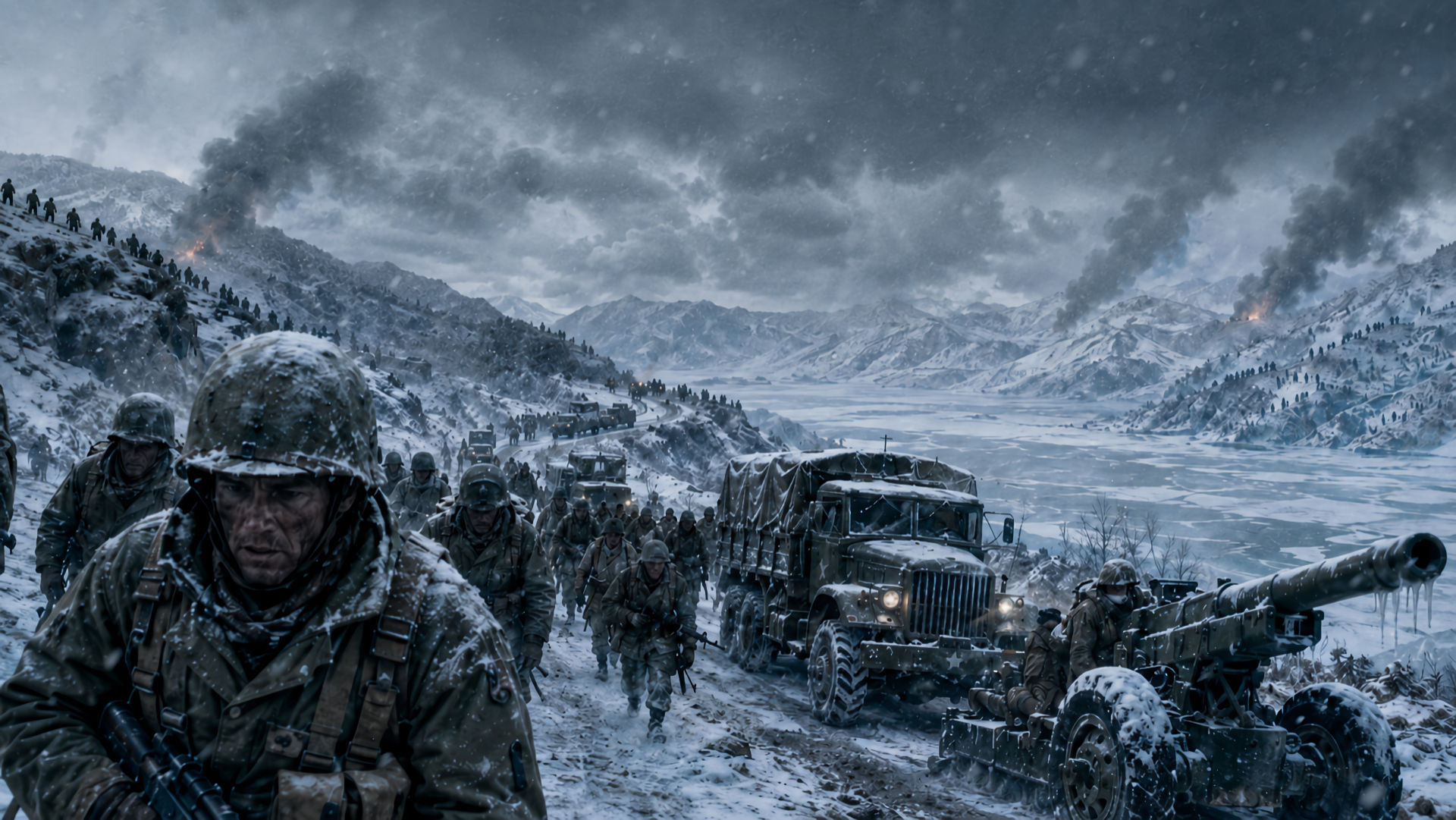
For the men moving north, the official maps showed roads, villages, and objectives. What they actually found was a frozen wilderness of steep slopes, narrow tracks, ice-covered valleys, and bitter winds that could kill as effectively as bullets. Vehicles struggled, weapons malfunctioned, and frostbite became a constant enemy. The campaign still looked like an advance, but the further the troops moved, the more they were walking into a trap.
Marching Into the Frozen Mountains
The Chosin Reservoir lay high in the mountains of north-eastern Korea, a remote artificial lake surrounded by ridges, gorges, and narrow roads that twisted through the cold terrain. In late November 1950, it was not simply cold, but brutally, punishingly cold. Temperatures plunged far below freezing, often reported around minus 30 degrees Celsius or worse. At those levels, exposed skin could freeze quickly, morphine syrettes became solid, batteries failed, and food sometimes had to be thawed before it could be eaten.
The main UN force in the area was the US 1st Marine Division, commanded by Major General Oliver P. Smith. Smith was a cautious and methodical officer, which made him an awkward subordinate for Major General Edward Almond, whose style was much more aggressive. Almond wanted rapid movement northwards, but Smith was uneasy. The roads were poor, the weather appalling, and the division was being stretched across a long, vulnerable line in a landscape that seemed designed for ambush.
This tension between ambition and caution mattered enormously. Smith did not openly disobey orders, but he slowed the advance where he could, built supply points, improved roads, and ordered the construction of an airstrip at Hagaru-ri. At the time, these preparations may have looked like unnecessary delays to commanders eager for victory. Soon, they would prove to be among the reasons the Marines survived.
The American advance was not made by Marines alone. Elements of the US Army’s 7th Infantry Division were also operating in the region, especially east of the reservoir. South Korean forces were present as well, and the wider X Corps operation included a mixture of units spread across difficult terrain. The problem was that these formations were not always close enough to support one another effectively. In country like this, distance on a map was deceptive, because a few miles of mountain road could become an eternity under fire.
As the UN troops advanced, Chinese forces were already moving into position. The Chinese People’s Volunteer Army, as Beijing called it, had entered Korea in large numbers under conditions of great secrecy. Its soldiers moved mainly at night, using the hills, forests, and poor visibility to hide their presence. They carried light equipment, endured terrible hardship, and were often short of food and heavy weapons, but they possessed discipline, numbers, and an ability to move through terrain that their opponents underestimated.
The Marines and soldiers around Chosin began to sense that something was wrong. Patrols encountered Chinese troops. Intelligence reports grew more worrying. Some attacks and probes hinted at a much larger enemy presence nearby. Yet the overall advance continued, because higher command still expected the enemy to be pushed aside rather than to launch a major offensive.
By late November, UN forces around the reservoir were dangerously extended. The Marines were positioned around places such as Yudam-ni, Hagaru-ri, and Koto-ri, with the single main road south serving as their lifeline. Army units east of the reservoir were even more exposed. The cold was worsening, the enemy was closing in, and the dream of being home by Christmas was about to freeze solid in the Korean mountains.
China Enters the Battle in Force
On the night of 27 November 1950, the illusion of a collapsing enemy vanished. Chinese forces launched a massive assault against UN positions around the Chosin Reservoir. Bugles, whistles, shouted orders, and sudden waves of infantry attacks shattered the frozen darkness. For many American troops, the enemy seemed to appear from nowhere, pouring out of hills that had looked empty only hours earlier.
The Chinese attack was part of a much larger offensive across Korea. In the west, the Eighth Army was also struck hard, forcing a retreat that would reshape the war. Around Chosin, the Chinese 9th Army Group had been assigned the task of destroying X Corps units in the reservoir area. Its soldiers had endured terrible marches and freezing conditions to reach their positions, and many suffered badly from the cold even before the battle began. Their hardship did not make them any less dangerous.
The attacks around Chosin were fierce and often confusing. Chinese units attempted to surround and isolate UN positions, cut roads, seize high ground, and overwhelm defensive perimeters by night. Their tactics relied on infiltration, surprise, and pressure from multiple directions. They did not always have the artillery or heavy weapons available to American forces, but they used the terrain and darkness with grim effectiveness.
The Marines at Yudam-ni, west of the reservoir, came under intense attack. Their position was exposed, and the Chinese sought to cut them off from Hagaru-ri, the key base to the south-east. Hagaru-ri itself was also attacked, as was Koto-ri further down the road. The battle quickly became a struggle not for ground gained, but for survival, communication, and control of the narrow route south.
East of the reservoir, elements of the US Army’s 31st Regimental Combat Team, later often remembered as Task Force Faith, faced an especially desperate situation. These Army units were spread out and vulnerable, with limited ability to support one another. Chinese forces struck them repeatedly, cutting them off and inflicting severe casualties. Their ordeal would become one of the most tragic parts of the Chosin story, and for many years it received far less public attention than the Marine breakout.
The cold made everything worse. Wounded men froze where they fell. Weapons jammed as lubricants thickened or froze. Digging foxholes into frozen ground was exhausting, sometimes almost impossible. Medical care became a battle against time, ice, and shock. Even soldiers who were not hit by enemy fire could be disabled by frostbite, exposure, or exhaustion.
Yet the Chinese assault did not simply destroy the UN force. The Marines, soldiers, and supporting units formed defensive perimeters, held key positions, and used artillery and air power whenever possible. American aircraft, when weather permitted, became crucial, striking Chinese positions and dropping supplies. The airstrip at Hagaru-ri, which Smith had insisted on preparing, became vital for evacuating wounded men and bringing in support.
The battle had now changed completely. The UN advance north was over. The men at Chosin were surrounded in freezing mountains by a determined enemy force. Their task was no longer to reach the Yalu River, but to keep their formations intact long enough to fight their way out.
The Reservoir Becomes a Trap
Once the Chinese offensive began, the Chosin Reservoir area became a series of isolated battlefields linked by one dangerous road. Yudam-ni, Hagaru-ri, Koto-ri, and the smaller positions between them were not just dots on a map, but islands of resistance in a frozen sea of enemy-held hills. The Chinese understood that if they could cut the road and seize the high ground around it, they could break the UN force into pieces. The Americans understood exactly the same thing, which made every ridge, bend, and bridge matter.
At Yudam-ni, the Marines fought under intense pressure. Chinese forces attacked repeatedly, often at night, seeking to overrun defensive positions before American artillery and aircraft could respond effectively. The fighting was close, violent, and exhausting. Units sometimes held by small margins, with officers and non-commissioned officers trying to maintain order while men battled cold, fear, and fatigue in equal measure.
The withdrawal from Yudam-ni towards Hagaru-ri became one of the central struggles of the battle. It was not a simple march down a road, because the road itself was threatened or blocked in several places. Chinese forces occupied ridgelines overlooking the route, turning movement into a running fight. The Marines had to attack southwards, clear high ground, protect vehicles, move wounded men, and keep the column from being split apart.
Meanwhile, Hagaru-ri became the key to survival. It served as a supply base, command point, and medical evacuation centre. The airstrip there allowed many wounded men to be flown out, which prevented the column from being burdened with even more casualties during the breakout. If Hagaru-ri had fallen, the entire withdrawal from Yudam-ni might have ended in disaster.
East of the reservoir, Task Force Faith endured a terrible ordeal. Cut off and under repeated assault, the soldiers attempted to break out towards Hagaru-ri after days of fighting. Their vehicles were attacked, their wounded suffered terribly, and command and control deteriorated under pressure. The task force was effectively destroyed as an organised formation, although some survivors managed to reach Marine lines. Their stand, long overshadowed, remains essential to understanding the full cost of Chosin.
The Chinese forces also suffered immensely. They had achieved surprise and placed the UN troops in grave danger, but they were fighting in the same savage cold with fewer supplies, less winter clothing, and limited medical support. Many Chinese soldiers froze to death or became combat-ineffective from exposure. Their courage and endurance were extraordinary, even when their commanders pushed them into attacks that caused heavy casualties.
For the UN troops, the battlefield became a grim calculation of movement and survival. Every wounded man needed help, every vehicle mattered, every gallon of fuel counted, and every delay gave the enemy another chance to tighten the noose. The Marines and soldiers were not simply retreating from danger, because danger was everywhere. They were trying to preserve a fighting force while moving through a landscape designed to destroy it.
By early December, the situation had narrowed to one urgent objective. The scattered UN positions had to consolidate and move south. The reservoir had become a trap, but not yet a tomb. To escape, the troops would have to turn the road to the sea into a battlefield of their own.
The Fighting Withdrawal to the Sea
The breakout from Chosin is often described as a retreat, but that word can be misleading if it suggests panic, collapse, or disorder. What took place was a fighting withdrawal, a disciplined movement under constant threat, in which UN forces attacked in order to move away. The famous line often associated with the Marines, that they were not retreating but attacking in another direction, captures the mood, if not the full misery. It was less a slogan than a survival plan with frostbite.
From Hagaru-ri, the column moved south towards Koto-ri, then onward through the mountains towards the port of Hungnam. The road was narrow and dangerous, bordered by heights from which Chinese troops could fire down on the moving force. Engineers had to repair damage, clear obstacles, and keep vehicles moving. Infantry had to seize the surrounding ridges before the convoy could pass, because a road controlled by the enemy was not a route; it was a shooting gallery.
The wounded were a constant concern. Men who could not walk had to be carried, loaded onto vehicles, or evacuated by air where possible. Medical staff worked under conditions that would have been miserable even without enemy fire. Frostbite cases multiplied, and the cold turned minor injuries into major problems. The battle was being fought not only against Chinese forces, but against time, temperature, and the limits of human endurance.
Air power played a decisive role. Marine, Navy, and Air Force aircraft attacked enemy positions, covered the columns, and helped prevent Chinese forces from massing freely. Close air support became one of the reasons the withdrawal remained possible. Yet air power could not solve everything, especially when the weather closed in or when Chinese troops were too close to friendly positions for easy targeting.
One of the most dramatic obstacles came near Funchilin Pass, where a vital bridge had been destroyed. Without a crossing, heavy vehicles and equipment could not continue south. In a remarkable logistical effort, replacement bridge sections were dropped by air and used to construct a usable crossing. It was a reminder that modern war is not only about courage under fire, but also about engineering, transport, improvisation, and the ability to solve absurdly difficult problems while people are trying to kill you.
The Chinese tried repeatedly to cut off the withdrawal, but they were also reaching the limits of their own strength. Their soldiers had fought hard, but exposure, casualties, supply shortages, and air attacks weakened their ability to finish the job. They had inflicted a severe blow, but they could not completely annihilate the UN forces around Chosin. The escaping column remained battered, but still organised and dangerous.
By the time the survivors reached the coast, they had passed through one of the harshest battles in American military history. The evacuation from Hungnam in December 1950 removed not only troops, but also large numbers of refugees fleeing the Communist advance. Ships carried soldiers, equipment, and civilians away from the collapsing north-eastern front. The campaign that had begun with confidence and talk of victory by Christmas ended with a vast evacuation from a frozen coastline.
The withdrawal did not mean the UN forces had won the battle in a conventional sense. They had been forced back, suffered heavy casualties, and abandoned the advance into northern Korea. Yet they had avoided destruction, preserved a major fighting force, and inflicted serious losses on the Chinese. In the brutal arithmetic of Chosin, survival itself became a form of victory.
Chosin’s Legacy: Survival, Sacrifice, and Myth
The Battle of the Chosin Reservoir lasted from late November into December 1950, but its significance reached far beyond those frozen weeks. It marked the moment when the Korean War changed from a campaign of rapid movement into a long, grinding conflict. Before Chosin, many UN leaders imagined the war might end with the defeat of North Korea and the reunification of the peninsula. After Chosin, it was clear that China had entered the war in force, and that any easy victory had vanished into the snow.
The cost was severe on all sides. UN forces suffered thousands of battle casualties, along with many more cases of frostbite and cold injury. The US Army units east of the reservoir were badly mauled, and the Marines emerged from the battle honoured but deeply scarred. Chinese losses were also enormous, caused by combat, air attack, exposure, and inadequate winter supplies. The battle was not a clean tale of one side’s triumph and the other’s failure, but a brutal collision between strategy, geography, weather, and human endurance.
For the United States Marine Corps, Chosin became one of its defining legends. The Marines who fought there became known as the “Chosin Few”, a phrase that reflected both pride and loss. Their story fit a powerful military tradition: surrounded, outnumbered, freezing, and still fighting their way out. It reinforced the Marine Corps’ image of toughness, cohesion, and stubborn professionalism, which is excellent branding if one overlooks the minor detail that everyone involved was having an absolutely dreadful time.
Yet the broader story belongs to more than the Marines. Army soldiers, Navy and Air Force personnel, South Korean troops, British Royal Marines attached to the US 1st Marine Division, and many support units were part of the wider campaign. Task Force Faith’s ordeal east of the reservoir deserves particular attention, because its destruction shows how unevenly suffering and recognition can be distributed after a battle. Some stories become famous quickly, while others take decades to be properly understood.
The battle also shaped Chinese military memory. For China, intervention in Korea was presented as a defence against hostile forces approaching its border. The campaign demonstrated that Chinese troops could challenge a technologically superior enemy through surprise, numbers, movement, and endurance. At the same time, Chosin exposed the terrible cost of inadequate equipment and supplies in extreme conditions. Victory, in such circumstances, was never cheap.
Strategically, Chosin helped force UN commanders to rethink the war. The objective of quickly conquering North Korea was abandoned. The conflict settled into a more defensive and positional struggle, eventually stabilising near the 38th Parallel. The war would continue until the armistice of July 1953, leaving Korea divided, heavily militarised, and still technically without a formal peace treaty.
The legacy of Chosin is therefore complicated. It was a defeat in the sense that UN forces were forced to withdraw from North Korea. It was a success in the sense that a surrounded force avoided annihilation under almost impossible conditions. It was also a warning about overconfidence, intelligence failure, and the danger of assuming an enemy will behave conveniently because your plan requires it. Above all, Chosin endures because it strips war down to its rawest elements. Men fought in darkness, cold, hunger, and fear, often with little understanding of the wider strategy that had placed them there. They relied on discipline, comradeship, training, and sheer refusal to collapse. The Battle of the Chosin Reservoir was not the tidy end to the Korean War that some had imagined. It was the frozen moment when the war became something longer, harsher, and far more uncertain.
The Battle of Chosin Reservoir FAQ
The Battle of Chosin Reservoir was a major Korean War battle fought in late 1950 in North Korea. United Nations forces, especially the US 1st Marine Division, were attacked and surrounded by large Chinese forces before carrying out a difficult fighting withdrawal.
The battle was important because it marked a major turning point in the Korean War. China’s intervention changed the course of the conflict, forcing UN forces to retreat from North Korea and transforming the war into a longer and more complex struggle.
The battle is often called “Frozen Chosin” because it was fought in extremely cold conditions. Temperatures dropped far below freezing, causing frostbite, equipment failures, frozen weapons, and terrible hardship for the soldiers involved.
The battle was fought between United Nations forces, mainly American troops including the US 1st Marine Division, and the Chinese People’s Volunteer Army. British and other UN forces were also involved in the wider Korean War campaign.
The battle is often described as a tactical withdrawal but also a remarkable feat of survival and discipline. UN forces were forced to retreat, but they avoided destruction, broke through Chinese encirclement, and evacuated from Hungnam.