The History of Glass
Glass begins with one of the oldest partnerships in human history: earth and fire. Long before anyone understood its chemistry, people had already noticed that certain minerals changed when exposed to extreme heat. Sand rich in silica, mixed with soda or plant ash and lime, could melt into a strange, glowing liquid that cooled into something hard, smooth and almost magical.
The earliest glass was probably not made deliberately in the way we imagine later craft workshops. In places where metalworking and pottery kilns reached very high temperatures, accidental glassy substances could appear as a by-product. Ancient people also encountered natural glass, such as obsidian, formed when volcanic lava cooled rapidly. Obsidian was prized for sharp tools and blades, but it was not transparent, and it was not manufactured. True glassmaking required people to learn how to control heat, ingredients and cooling, which is never easy when your technology is mostly clay, charcoal and optimism.
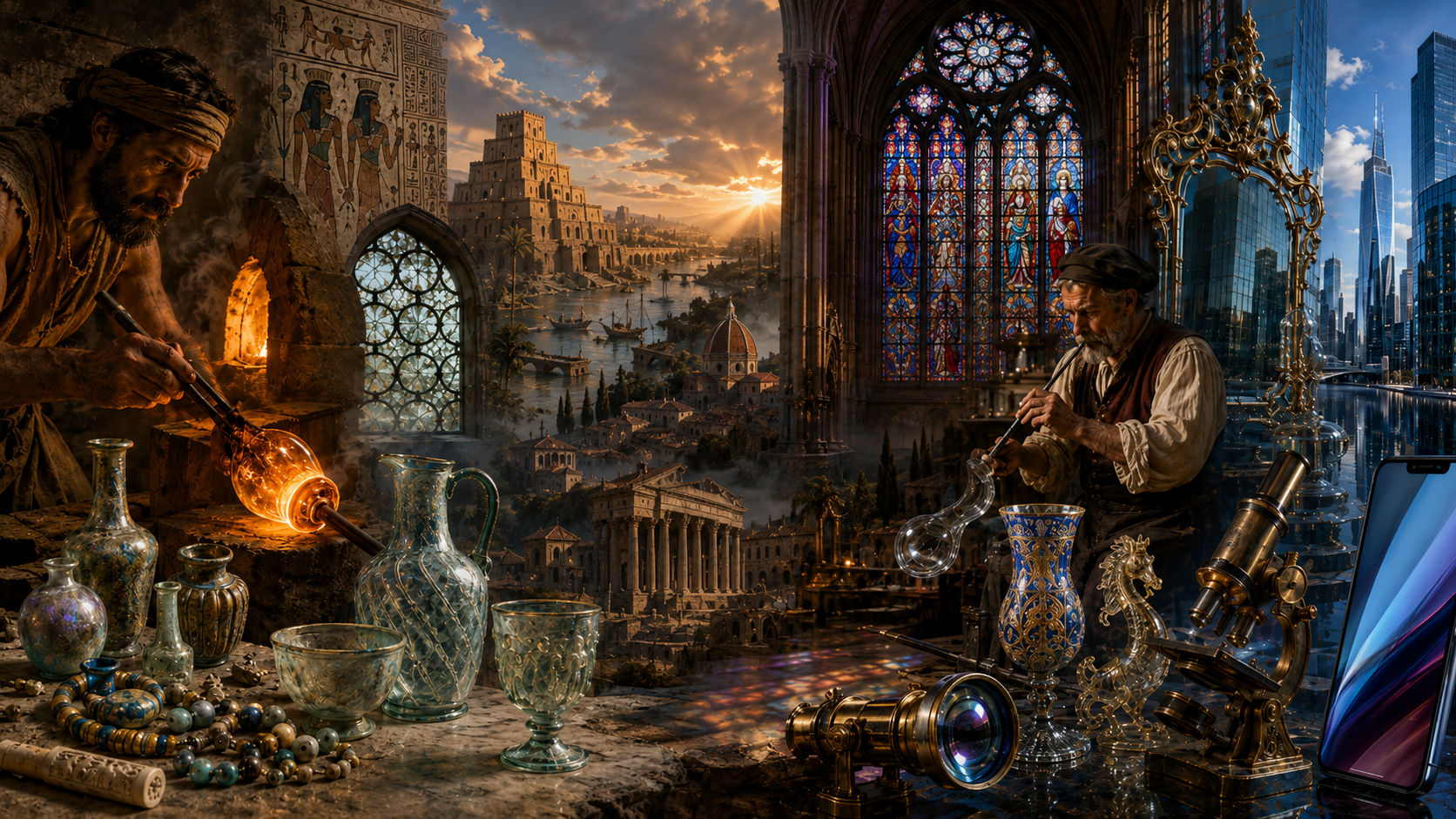
By around the third millennium BCE, glass beads and small decorative objects were being made in the ancient Near East and Egypt. These early items were not windowpanes or drinking tumblers. They were precious, colourful and often tiny, valued more like jewels than everyday materials. Blue and green glass could imitate turquoise, lapis lazuli and other expensive stones, which made it especially attractive to elites who enjoyed looking wealthy, preferably without having to explain the invoice.
At first, glass was difficult to produce and harder still to shape. The furnaces needed to reach high temperatures, and the molten material had to be worked before it cooled. Early glassmakers learned to add metallic oxides to create colour, producing deep blues, greens, yellows and reds. Because clear glass was extremely difficult to achieve, colour was not a flaw. It was part of the appeal.
This first stage of glass history is really a story of discovery becoming skill. What may have begun as a surprising accident gradually became a controlled craft. People learned that glass could be made, shaped, decorated and traded. They also learned that it carried a strange symbolic power, because it looked solid but seemed almost liquid, caught light like water, and could glow with colour like a precious stone.
Once glassmakers knew how to produce it deliberately, the material began to move from experiment to luxury. It travelled through trade networks, entered royal courts, decorated bodies and tombs, and became part of the visual language of ancient civilisation. From that point, glass was no longer just a curiosity born from sand and fire. It was becoming a treasure.
Ancient Craft, Precious Treasure: Glass in Egypt, Mesopotamia and Rome
In ancient Egypt and Mesopotamia, glass became a specialist craft associated with wealth, status and religious meaning. Workshops produced beads, inlays, amulets, small jars and decorative objects that were often placed in graves or used by the elite. The material’s brightness made it ideal for jewellery, while its ability to imitate precious stones meant it could carry both beauty and symbolic value.
Egyptian glassmakers became especially skilled at producing coloured glass. They used minerals such as copper and cobalt to create vivid blues and greens, colours associated with water, fertility, protection and divine power. Small vessels were often made using a technique called core forming, where molten glass was wound around a removable core of clay or sand. Once cooled, the core was scraped out, leaving a hollow container. It was clever, fiddly and probably caused a fair amount of muttering in ancient workshops.
These early vessels were not mass-produced household goods. A small glass perfume bottle or cosmetic container might have represented serious wealth. Glass was traded across long distances, and finished objects moved between cultures through commerce, diplomacy and conquest. In this period, glass belonged to the world of palaces, temples and tombs, not kitchen cupboards.
The great transformation came under the Romans. Around the first century BCE, glassblowing developed in the eastern Mediterranean, probably in the region of Syria and Palestine. This changed everything. Instead of slowly shaping glass around a core, craftspeople could gather molten glass on the end of a blowpipe and inflate it into a bubble. From there, they could create bottles, cups, bowls and flasks far more quickly than before.
Glassblowing made glass cheaper, more varied and more widely available. Across the Roman Empire, glass vessels became common in homes, shops, baths and burial sites. Some were plain and practical, while others were beautifully decorated. Roman glassmakers also improved techniques for producing clearer glass, although perfectly transparent glass remained difficult. The important point was not perfection, but access. Glass was moving from elite treasure towards everyday utility.
Romans also used glass in architecture, including small windowpanes in baths, villas and public buildings. These panes were not as clear as modern glass, and looking through them was probably a bit like seeing the world after a bad night’s sleep. Even so, they allowed light in while keeping the weather out, which was a major step in how people shaped indoor spaces.
After the fall of the Western Roman Empire, glassmaking did not disappear, but its centres shifted. Knowledge survived in the eastern Mediterranean, the Islamic world and parts of Europe. The ancient world had shown that glass could be decorative, useful and architectural. The next stage would reveal how it could transform buildings, worship and daily life.
Windows to a Changing World: Glass in Architecture and Daily Life
As glass became more common, one of its most important uses was not in jewellery or containers, but in windows. The idea of letting light into a building while keeping out wind and rain sounds ordinary now, but historically it was revolutionary. A wall with an opening was useful, yet it also invited cold, damp, insects and the occasional determined bird. Glass offered a compromise between shelter and sunlight.
In the early medieval period, window glass remained expensive and relatively rare. Wealthy churches, monasteries and noble households could use it, but ordinary homes often relied on shutters, oiled cloth, horn panels or simply open gaps. Glass panes were small because manufacturing large sheets was difficult. They were often joined together with lead strips, creating patterns that were partly decorative and partly practical.
Medieval churches turned this limitation into an art form. Stained glass windows became one of the great visual achievements of the Middle Ages, especially in Gothic cathedrals. Coloured glass could fill vast windows with biblical stories, saints, symbols and scenes of judgement or salvation. For largely illiterate congregations, these windows acted like illuminated storytelling screens. They also changed the atmosphere of sacred spaces, bathing stone interiors in coloured light and making theology look considerably more dramatic.
By the later medieval and early modern periods, glass began to enter domestic life more widely, though still unevenly. Windows became more common in townhouses, manor houses and public buildings. Glass vessels, bottles and drinking glasses also became part of dining, medicine and trade. Improvements in furnace technology, fuel use and manufacturing techniques allowed larger quantities to be made.
In England and other parts of Europe, window glass was still valuable enough to be treated almost like movable property. In some cases, windows could be taken out and transported when wealthy households moved. That sounds odd today, but it makes sense when glass was costly and handmade. If you had paid for decent glazing, you did not casually leave it behind for the next person to admire.
The growing availability of glass changed architecture. Larger windows altered how buildings were designed, how rooms were lit and how people experienced privacy. A house with glazed windows could feel more comfortable, more refined and more connected to the outside world. Shops could display goods. Scholars could read for longer in natural light. Painters could study changing illumination. Glass quietly reshaped daily habits.
This wider use also created demand for better, clearer and more beautiful glass. Across Europe, different regions developed their own specialities, but one place became legendary for skill, secrecy and style. That place was Venice, where glassmaking became not just an industry, but an obsession guarded almost like state intelligence.
Venice, Mirrors and Secrets: The Rise of Master Glassmakers
Venice rose as one of the great glassmaking centres of the medieval and Renaissance world. Its position as a trading power gave it access to raw materials, technical knowledge and wealthy customers. Venetian merchants connected Europe with the eastern Mediterranean and beyond, allowing ideas and goods to flow through the city’s workshops. Glass fitted perfectly into Venice’s identity: luxurious, reflective, beautiful and slightly theatrical.
By the late thirteenth century, the Venetian authorities moved glass furnaces to the island of Murano. The official reason was fire safety, since furnaces posed a serious risk in a crowded city built with plenty of timber. That was sensible enough, but Murano also made it easier to control the glassmakers themselves. Skilled artisans were valuable, and Venice wanted to protect its secrets from rival cities. In other words, Murano became part workshop, part gilded cage.
Murano glassmakers developed extraordinary techniques. They produced delicate vessels, coloured glass, enamelled decoration, filigree patterns and, most famously, cristallo. Cristallo was a clear, fine glass associated with elegance and technical mastery. It was not modern optical glass, but compared with much earlier material, it was remarkably refined. European elites loved it, which is hardly surprising. If history teaches us anything, it is that wealthy people rarely ignore a shiny status symbol.
Venetian mirrors became especially famous. Before high-quality glass mirrors, people relied on polished metal surfaces, which worked but gave imperfect reflections. Clearer glass backed with reflective metal allowed mirrors to become sharper, brighter and more desirable. A good mirror was expensive, fashionable and socially powerful. It did not just show a face. It announced taste, wealth and access to luxury.
The reputation of Venetian glass spread across Europe, but secrecy could not last forever. Craftspeople migrated, techniques leaked, and rival industries developed in France, Bohemia, England and elsewhere. Governments often encouraged glassmaking because it supported trade, architecture, science and luxury consumption. By the seventeenth and eighteenth centuries, glass was becoming part of a broader European culture of refinement, commerce and experimentation.
At the same time, changes in drinking habits, medicine and domestic display created new markets. Glass bottles became increasingly important for storing wine, spirits, medicines and perfumes. Drinking glasses became more varied and socially significant. Tableware could signal manners, class and fashion. Glass was no longer merely a window or ornament. It was part of how people performed civilisation, sometimes one delicately stemmed glass at a time.
The skills developed in decorative and practical glassmaking also prepared the way for something even more transformative. Clearer glass, better grinding techniques and improved manufacturing made it possible to bend light with precision. Once that happened, glass stopped simply decorating the world and began revealing worlds people had never seen.
Science Through the Lens: How Glass Changed Discovery
The scientific importance of glass lies in its relationship with light. Because glass can be transparent, shaped, polished and combined with other materials, it became essential for lenses, instruments and experiments. Once people learned to grind glass into precise curves, they could magnify, focus and redirect light. That changed the scale of human vision.
Spectacles appeared in Europe in the late thirteenth century, probably in Italy. Their impact was enormous. For people with ageing eyes, reading and close work became possible for longer. Scholars, scribes, merchants and craftspeople could remain productive later in life. It is easy to overlook spectacles because they are so ordinary now, but they extended careers, supported literacy and quietly helped knowledge spread. Not bad for two pieces of shaped glass balanced on a nose.
The telescope took glass into the heavens. In 1608, spectacle makers in the Netherlands were associated with the first practical telescopes, and in 1609, Galileo Galilei improved the design and turned it towards the sky. What he saw challenged older assumptions about the universe. The Moon had mountains and craters. Jupiter had moons of its own. Venus showed phases. Glass lenses helped transform astronomy from a philosophical argument into direct observation.
The microscope opened another frontier. In the seventeenth century, Robert Hooke used a microscope to examine tiny structures and published Micrographia in 1665. Antonie van Leeuwenhoek, using powerful single-lens microscopes, observed bacteria, protozoa and sperm cells. These discoveries revealed that reality extended far below the limits of ordinary sight. The world was not just bigger than people had imagined. It was smaller, stranger and busier as well.
Glass also became central to chemistry and medicine. Test tubes, flasks, beakers, retorts, thermometers, and later laboratory glassware allowed substances to be heated, mixed, observed and measured. Unlike many materials, glass resisted reaction with numerous chemicals and allowed experimenters to see what was happening inside. That transparency mattered. Science often advances when someone can watch a process closely enough to realise that their previous explanation was embarrassingly wrong.
The development of better optical glass continued into the eighteenth and nineteenth centuries. Achromatic lenses reduced colour distortion, improving telescopes and microscopes. Glass prisms helped scientists study light and spectra. Photographic lenses made cameras possible, linking glass to memory, evidence and art. Windows, bottles and mirrors had changed daily life, but lenses changed human understanding.
By the modern age, glass was no longer only a craft material. It had become an industrial, scientific and technological foundation. The next leap would come when mass production, engineering and electronics turned glass into something that could shape cities, communications and the devices people carry in their pockets.
From Skyscrapers to Smartphones: Glass in the Modern World
Modern glass is everywhere, which is why it is easy to stop noticing it. It forms windows, screens, bottles, laboratory equipment, fibre optic cables, camera lenses, solar panels and architectural walls. A material once treasured in tiny beads now covers skyscrapers and responds to fingertips. That journey from rare luxury to invisible necessity is one of the great transformations in material history.
Industrial production made glass cheaper, larger and more consistent. In the nineteenth century, glass was increasingly important in urban architecture, shopfronts, railway stations and exhibition buildings. The Crystal Palace, built for the Great Exhibition of 1851 in London, became a spectacular symbol of iron and glass construction. It showed how transparent architecture could create vast interior spaces filled with light. It also proved that Victorians, when given enough engineering confidence, would build something that looked like a greenhouse had achieved world domination.
One of the most important twentieth-century breakthroughs was the float glass process, developed by Pilkington in Britain in the 1950s. Molten glass was floated on a bath of molten tin, producing flat, smooth sheets with far less grinding and polishing. This revolutionised window production and made large, high-quality panes more affordable. Modern office towers, homes, cars and public buildings all owe something to that process.
Specialist glasses also transformed science and industry. Borosilicate glass, known for resisting thermal shock, became vital in laboratories and kitchens. Toughened and laminated safety glass improved vehicles and buildings. Glass ceramics found uses in cookware, electronics and engineering. The material was no longer one thing, but a family of technologies designed for different stresses, temperatures and purposes.
Then came the communications revolution. Fibre optic cables use thin strands of glass to transmit information as pulses of light. They carry internet traffic, phone calls and data across cities, oceans and continents. This is one of the great ironies of glass history. A material first admired because it captured light eventually became the backbone of global digital communication.
Smartphones brought glass into the most intimate space of all: the hand. Touchscreens depend on strong, thin, clear glass that can survive constant use, occasional drops and the mysterious violence of pockets containing keys. Modern strengthened glass is engineered at a chemical level, making it far tougher than ordinary window glass. It still cracks, of course, usually at the exact moment your warranty becomes emotionally unavailable.
Glass also matters in the future of energy and sustainability. Solar panels rely on protective glass surfaces, while glass packaging remains widely recyclable. At the same time, producing glass requires heat and energy, so manufacturers continue to look for cleaner processes and better recycling systems. The material’s environmental story is complicated, but its durability and recyclability give it lasting importance.
The history of glass is therefore not a simple tale of invention followed by progress. It is a story of repeated reinvention. Glass has been treasure, tool, window, mirror, lens, vessel, building skin, data highway and digital interface. It began with sand and fire, but it became one of humanity’s most versatile ways of shaping light, space and knowledge.
The History of Glass FAQ
Most traditional glass is made mainly from silica, which comes from sand. Other ingredients, such as soda ash and lime, are added to help it melt more easily and become more stable once cooled.
Glass objects were being made in parts of the ancient Near East and Egypt by around the third millennium BCE. Early glass was mostly used for beads, jewellery, small vessels and decorative items.
Roman glass was important because glassblowing made production faster, cheaper and more varied. This helped glass move from being a rare luxury item towards becoming a more common material for cups, bottles, vessels and windows.
Venetian glass, especially from Murano, became famous for its beauty, clarity and technical skill. Venetian glassmakers produced luxury vessels, mirrors and decorative objects that were admired across Europe.
Glass changed science through lenses and laboratory equipment. Telescopes, microscopes, prisms, thermometers and glassware helped people observe the universe, study tiny organisms, measure experiments and understand light.