The Battle of Blenheim
At the beginning of the eighteenth century, Europe was living with a political problem that had been building for years. King Charles II of Spain was dying without an heir, and his enormous inheritance included Spain itself, the Spanish Netherlands, parts of Italy, colonies in the Americas, and trade routes that reached across the globe. Whoever gained control of that inheritance would not simply gain territory. They would gain influence, money, ports, armies, and the ability to tilt the balance of European power.
When Charles II died in 1700, his will named Philip of Anjou as his successor. Philip was the grandson of Louis XIV of France, the most powerful monarch in Europe. Louis accepted the inheritance on Philip’s behalf, and Philip became Philip V of Spain. To French eyes, this was a dynastic triumph. To many of France’s rivals, it looked like a nightmare wrapped in legal paperwork. If France and Spain came too close together, either through direct union or close Bourbon family control, the result could be a superpower able to dominate Western Europe.
Britain, the Dutch Republic, Austria, and several German states feared that Louis XIV would use Spain’s resources to extend French power still further. The Holy Roman Emperor Leopold I had his own claim through the Habsburg line and did not intend to watch Spain pass quietly into Bourbon hands. The Dutch feared French control near their borders, while Britain feared a French and Spanish threat to trade, naval power, and the European balance. By 1701, diplomacy had given way to war, and the War of the Spanish Succession began.
The early years of the war were not reassuring for the anti-French alliance. France had experienced commanders, strong armies, and the advantage of a central position. Louis XIV also gained the support of Maximilian II Emanuel, Elector of Bavaria, whose lands gave France a dangerous route into the heart of the Holy Roman Empire. Bavaria’s alliance with France was a serious blow to Austria, because it opened a possible path towards Vienna itself. The emperor’s capital was not merely a city. It was the symbolic centre of Habsburg power.
By 1704, the situation looked extremely dangerous. French and Bavarian forces were operating in southern Germany, while Austria faced threats from other directions, including a Hungarian revolt. If Vienna fell, or if Austria was forced out of the war, the Grand Alliance might collapse. France would then be free to dominate the continent, while Britain and the Dutch would be left trying to contain a vastly stronger enemy.
This was the crisis that brought John Churchill, Duke of Marlborough, to the centre of events. Already respected as a skilled commander and diplomat, Marlborough understood that the war could not be won merely by defending the Dutch frontier. The decisive danger lay far to the south, on the Danube. To save the alliance, he would have to do something bold, risky, and deeply inconvenient for everyone who liked their generals predictable.
Marlborough’s Gamble: The March to the Danube
Marlborough’s great problem in 1704 was distance. His army was stationed in the Low Countries, where Britain and the Dutch expected him to protect the Dutch Republic from French attack. That made sense from a narrow defensive perspective, but it did little to solve the Austrian crisis. The real danger was developing hundreds of miles away in southern Germany, where the Franco-Bavarian threat to Vienna was becoming impossible to ignore.
Marlborough decided on a move that required both military nerve and political theatre. He would march his army away from the Low Countries and towards the Danube, while disguising his true intentions for as long as possible. His Dutch allies were nervous about leaving their frontier exposed, and many politicians preferred caution to adventure. Marlborough therefore had to persuade, reassure, mislead, and manoeuvre all at once. It was strategy conducted with maps, letters, marching columns, and the occasional polite diplomatic fog machine.
The march began in May 1704. Marlborough moved south-east with remarkable speed and discipline, crossing rivers, passing through friendly and neutral territories, and keeping his army together over a long and demanding route. The movement was not just physically impressive. It was psychologically disruptive. French commanders struggled to determine whether Marlborough intended to attack the Moselle, move into Germany, or threaten some other point entirely. By the time his purpose became clear, he had already changed the strategic picture.
The march to the Danube has often been remembered as one of Marlborough’s greatest achievements, even before the battle that followed. Armies in this period were difficult machines to move. They required food, forage, ammunition, wagons, horses, and constant negotiation with local authorities. Desertion, disease, and exhaustion could damage an army before it ever saw the enemy. Marlborough’s ability to move rapidly while maintaining discipline helped preserve the strength of his force for the campaign ahead.
Once in southern Germany, Marlborough linked his operations with Imperial forces. His aim was to drive Bavaria out of the war or, at the very least, prevent Franco-Bavarian armies from using it as a launching ground against Austria. On 2 July 1704, Allied forces stormed the Schellenberg heights near Donauwörth. The fighting was bloody, but the victory opened a crossing over the Danube and gave Marlborough a vital foothold in Bavaria.
The campaign then entered a harsher phase. Marlborough used devastation in Bavaria to pressure the Elector into abandoning his alliance with France. It was a brutal method, but eighteenth-century warfare often treated civilian property as a tool of strategy. The Elector refused to yield, and French reinforcements under Marshal Tallard moved to join the Bavarians and Marshal Marsin. Marlborough’s gamble had succeeded in bringing him to the decisive theatre, but now the enemy was concentrating too.
The question was no longer whether Marlborough could reach the Danube. He had done that. The question was whether he could win there before the combined French and Bavarian armies overwhelmed the Allied effort. For that, he would need cooperation with another brilliant commander, Prince Eugene of Savoy, whose arrival turned a daring campaign into a potential masterstroke.
Allies at the Edge: Marlborough, Eugene, and the Road to Blenheim
Prince Eugene of Savoy was one of the finest soldiers of his age, and his partnership with Marlborough became one of the most important military relationships of the war. Eugene had entered Imperial service after being rejected by France, which must rank as one of history’s more expensive human resources errors. He had already built a formidable reputation fighting the Ottoman Empire and France, combining personal courage with a sharp eye for battlefield realities.
Marlborough and Eugene shared a rare ability to cooperate without constantly trying to outshine each other. This was important because coalition warfare was often slow, jealous, and politically fragile. Different armies had different rulers, paymasters, interests, and priorities. Commanders could waste days arguing over precedence while the enemy helpfully did not wait for the minutes to be approved. Marlborough and Eugene avoided much of that problem because they trusted one another’s judgment and understood the scale of the crisis.
By August 1704, the Franco-Bavarian forces had gathered under Marshal Camille d’Hostun, Duke of Tallard, Marshal Ferdinand de Marsin, and Elector Maximilian Emanuel of Bavaria. Their combined army threatened to regain the initiative in southern Germany and restore the danger to Austria. Marlborough and Eugene knew that delay could be fatal. If the French and Bavarians were allowed to settle into strong positions or move against Imperial territory, the Allied campaign might lose all momentum.
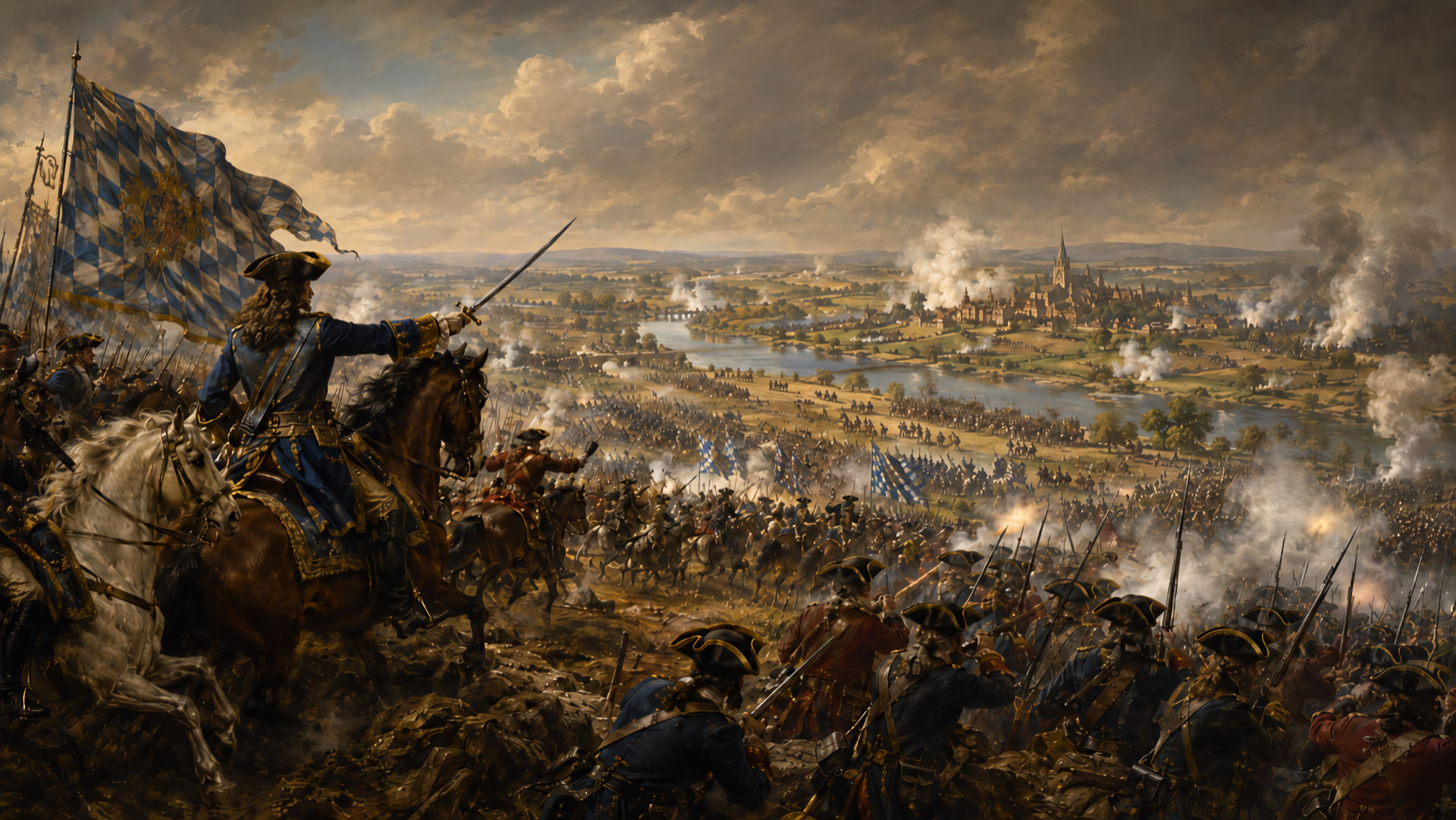
The opposing armies manoeuvred near the Danube, close to the villages of Blindheim, known in English as Blenheim, Oberglau, and Lutzingen. The area was shaped by the River Danube to the south and the smaller Nebel stream running through marshy ground in front of the Franco-Bavarian line. The terrain offered defensive advantages, especially around the villages, which could be packed with infantry and used as strongpoints. To the French and Bavarians, the position looked solid.
Marlborough and Eugene saw the danger differently. A strong defensive position could become a trap if its troops were badly distributed or if commanders misunderstood the enemy’s intentions. Tallard placed a large number of French infantry in Blenheim on his right flank, expecting the village to hold firm against Allied assault. This made the village formidable, but it also meant that many troops were crowded into a limited space, where they could not easily support the centre if the battle shifted there.
The Allied plan required careful coordination. Eugene would command on the Allied right against the Bavarians and Marsin around Lutzingen, while Marlborough would command the centre and left, facing Tallard’s French forces near Blenheim and Oberglau. The Allies would attack across difficult ground, pin the enemy flanks, and seek an opportunity to break the centre. It was a dangerous plan, because a failed crossing of the Nebel could leave Allied troops exposed and disordered.
On the morning of 13 August 1704, the armies prepared for battle. Marlborough had marched across Europe to force this moment, and Eugene had joined him to stop the Franco-Bavarian advance before it could become a strategic disaster. Across the field stood commanders who believed their position could absorb an Allied attack. Between them lay villages, smoke, marshy ground, cavalry lines, and one of the most consequential days of the eighteenth century.
The Battlefield Takes Shape: Villages, Rivers, and Dangerous Assumptions
The battlefield of Blenheim was not an empty plain where two armies politely lined up and took turns being heroic. It was a complicated landscape of villages, streams, fields, slopes, and obstacles that shaped every decision made that day. The Danube ran to the south, limiting movement on one side of the battlefield. The Nebel stream, with its marshy banks and awkward crossings, lay between the Allied army and the Franco-Bavarian line.
The Franco-Bavarian army deployed behind the Nebel, using the villages as anchors. On their right flank, beside the Danube, stood Blenheim itself. Tallard placed a powerful force of French infantry inside and around the village, turning it into a defensive fortress. In the centre, near Oberglau, French and allied troops held another key position. On the left, towards Lutzingen and the wooded hills beyond, the Bavarians and Marsin’s French troops faced Prince Eugene.
This deployment looked strong, but it contained weaknesses. Tallard’s decision to crowd so many troops into Blenheim gave him a secure right flank, but it also reduced the number of men available to support the centre. Infantry packed into streets and enclosed spaces could be hard to drive out, but they could not easily manoeuvre. If they were fixed in place by Allied attacks, they might become spectators to a disaster happening elsewhere, which is not ideal unless one has paid for theatre tickets.
The Allies had their own problems. To attack, they had to cross the Nebel under fire and form on the far side. Cavalry needed space to deploy, infantry had to advance through difficult ground, and coordination between Marlborough’s and Eugene’s wings had to survive the confusion of battle. A premature attack in one sector could be isolated. A delay in another could leave troops exposed. Marlborough’s plan depended on pressure across the line, even where the immediate objective was not a breakthrough.
Marlborough’s left attacked Blenheim not necessarily to capture it at once, but to pin down the French troops inside. This was a crucial distinction. The village had to be threatened fiercely enough that Tallard would keep reinforcing it or at least keep its garrison committed. Meanwhile, Marlborough intended to build strength in the centre, where cavalry and infantry could eventually exploit the enemy’s thinner line. The battle would not be decided simply by who held the villages, but by who used them wisely.
Eugene’s role on the right was equally demanding. He faced strong Bavarian and French forces in difficult ground near Lutzingen, and his attacks met fierce resistance. His task was to keep the enemy left engaged, preventing Marsin and the Elector from sending help to Tallard. Even without a decisive breakthrough on his side, Eugene’s persistence mattered because it stretched the Franco-Bavarian command structure and helped create the conditions Marlborough needed elsewhere.
The commanders on the French and Bavarian side believed the strength of their position would blunt the Allied attack. Their villages were fortified, their flanks seemed secure, and the Nebel appeared to be a natural barrier. Yet battlefields often punish assumptions more harshly than errors of arithmetic. Marlborough and Eugene were not trying to win everywhere at once. They were trying to hold the enemy in place, expose the centre, and strike when the defensive line began to lose its shape.
The Battle Unleashed: Pressure, Breakthrough, and Collapse
The battle began with Allied attacks against the villages and flanks. Lord Cutts led assaults against Blenheim, where French infantry resisted with determination. The fighting around the village was intense, with repeated attacks meeting heavy fire from defenders positioned behind walls, hedges, and buildings. The Allies suffered badly, but the attacks achieved an important purpose. The French troops in Blenheim remained fixed, and Tallard’s right flank became increasingly disconnected from events in the centre.
In the middle of the battlefield, Marlborough worked to bring infantry and cavalry across the Nebel. This was one of the most delicate phases of the battle. Troops crossing broken and marshy ground were vulnerable, and at several points the Allied advance looked uncertain. Near Oberglau, the fighting became especially dangerous when Allied units came under severe pressure. Marlborough had to stabilise the situation before he could launch the decisive blow.
Eugene, meanwhile, was engaged in a brutal struggle on the Allied right. His forces attacked towards Lutzingen against the Bavarians and Marsin’s French troops, but progress was slow and costly. Eugene’s men were pushed back more than once, and the fighting demanded repeated efforts to restore order and renew the attack. Yet Eugene’s pressure prevented the enemy left from disengaging and assisting Tallard. His battle was not glamorous in the simple sense, but it was essential.
As the day developed, Marlborough began to assemble a powerful cavalry force in the centre. Tallard’s centre was thinner than it should have been, partly because so many infantry were tied up in Blenheim. The Allied attacks on the villages had created exactly the situation Marlborough wanted. French strength existed, but much of it was trapped in the wrong place. The centre, where the battle could truly be decided, was vulnerable.
Marlborough launched his cavalry attack in the afternoon. Allied horsemen, supported by infantry, struck the French centre and began to drive it back. Tallard’s cavalry struggled to withstand the pressure, and the French line started to break. Once the centre gave way, the consequences were catastrophic. Parts of the French army were pushed towards the Danube, while others were cut off from retreat. Tallard himself was captured, a stunning blow to French prestige.
The situation in Blenheim then turned from strong defence into disaster. The French infantry packed into the village had held their ground, but the collapse of the centre left them isolated. Thousands of men were trapped with no practical route of escape. After attempts to resist further became hopeless, the French forces in Blenheim surrendered. What had begun as a defensive anchor had become a prison made of stone, smoke, and unfortunate planning.
By evening, the Allied victory was complete. The French and Bavarian army had suffered a crushing defeat, with huge numbers killed, wounded, captured, or scattered. Estimates vary, but French and Bavarian losses were enormous, while Allied losses, though serious, were far lower by comparison. The result was not a narrow tactical success. It was a strategic earthquake. Marlborough’s long march had ended in one of the most decisive battlefield victories of the age.
A Victory That Shook Europe: Aftermath, Reputation, and Legacy
The immediate consequence of Blenheim was the removal of the Franco-Bavarian threat to Vienna. Austria stayed in the war, the Grand Alliance held together, and Louis XIV’s hopes of forcing a decisive settlement suffered a major defeat. Bavaria was knocked out as an effective base for French operations in southern Germany, and the Elector’s ambitions collapsed with the army that had supported them. For the Habsburgs, Blenheim was not just a military relief. It was political survival.
For France, the defeat was shocking. Louis XIV’s armies had suffered reverses before, but Blenheim was different in scale and symbolism. A major French army had been smashed, one of its marshals captured, and the aura of near inevitability around French military power had been badly damaged. France remained strong, and the war would continue for years, but after Blenheim, it was clear that Louis XIV could be beaten in open battle by a well-led coalition army.
Marlborough emerged from the campaign with his reputation transformed. He had not merely won a battle. He had identified the decisive theatre, marched across Europe, coordinated a coalition, forced the enemy to fight, and then exploited their deployment with devastating precision. In Britain, his victory was celebrated as one of the greatest triumphs in the nation’s military history. Queen Anne rewarded him with the royal manor of Woodstock, where Blenheim Palace would later be built as a monument to his achievement.
Prince Eugene’s reputation also rose further. His role at Blenheim was sometimes overshadowed in British memory by Marlborough’s fame, but the battle could not have been won without him. By holding the Allied right under severe pressure, Eugene prevented the Franco-Bavarian left from rescuing Tallard’s centre. Blenheim was a coalition victory in the truest sense, built on trust between commanders who understood that personal glory was less useful than beating the enemy.
The battle also changed how European leaders viewed the war. It proved that the Grand Alliance could take the offensive and win decisively. It prevented France from dominating central Europe and gave the Allies renewed confidence. The War of the Spanish Succession would continue until the treaties of Utrecht in 1713 and Rastatt in 1714, with Philip V remaining king of Spain, but the feared union of France and Spain was prevented. Blenheim did not end the war, but it helped shape the settlement that followed.
In military history, Blenheim remains a study in operational brilliance and battlefield judgement. Marlborough’s march to the Danube showed the value of strategic mobility, while the battle itself demonstrated the danger of overcommitting troops to fixed defensive positions. The French soldiers in Blenheim fought bravely, but their placement contributed to the defeat of the army around them. Courage, as Blenheim reminds us, is not always enough when the map has quietly turned against you.
The legacy of Blenheim endured because it combined drama, consequence, and personalities of unusual calibre. It featured a continent-wide crisis, a daring march, a remarkable partnership, and a battle in which the fate of empires seemed to hang in the balance. For Britain, it became one of the great Marlborough victories. For Europe, it marked a turning point against the ambitions of Louis XIV. For students of warfare, it remains a reminder that battles are often decided long before the final charge, in the choices that place armies where history is waiting.
The Battle of Blenheim FAQ
The Battle of Blenheim was a major battle fought on 13 August 1704 during the War of the Spanish Succession. It saw Allied forces under the Duke of Marlborough and Prince Eugene of Savoy defeat a Franco-Bavarian army.
The battle was important because it stopped a serious French and Bavarian threat to Vienna, kept Austria in the war, and prevented Louis XIV’s France from gaining a dominant position in Europe.
The Allied army was led mainly by John Churchill, Duke of Marlborough, and Prince Eugene of Savoy. Their cooperation was one of the key reasons for the Allied victory.
The Grand Alliance won the Battle of Blenheim. The French and Bavarian forces suffered a heavy defeat, and the French commander Marshal Tallard was captured.
The Battle of Blenheim was part of the War of the Spanish Succession, a major European conflict fought over who should inherit the Spanish throne after the death of Charles II of Spain.