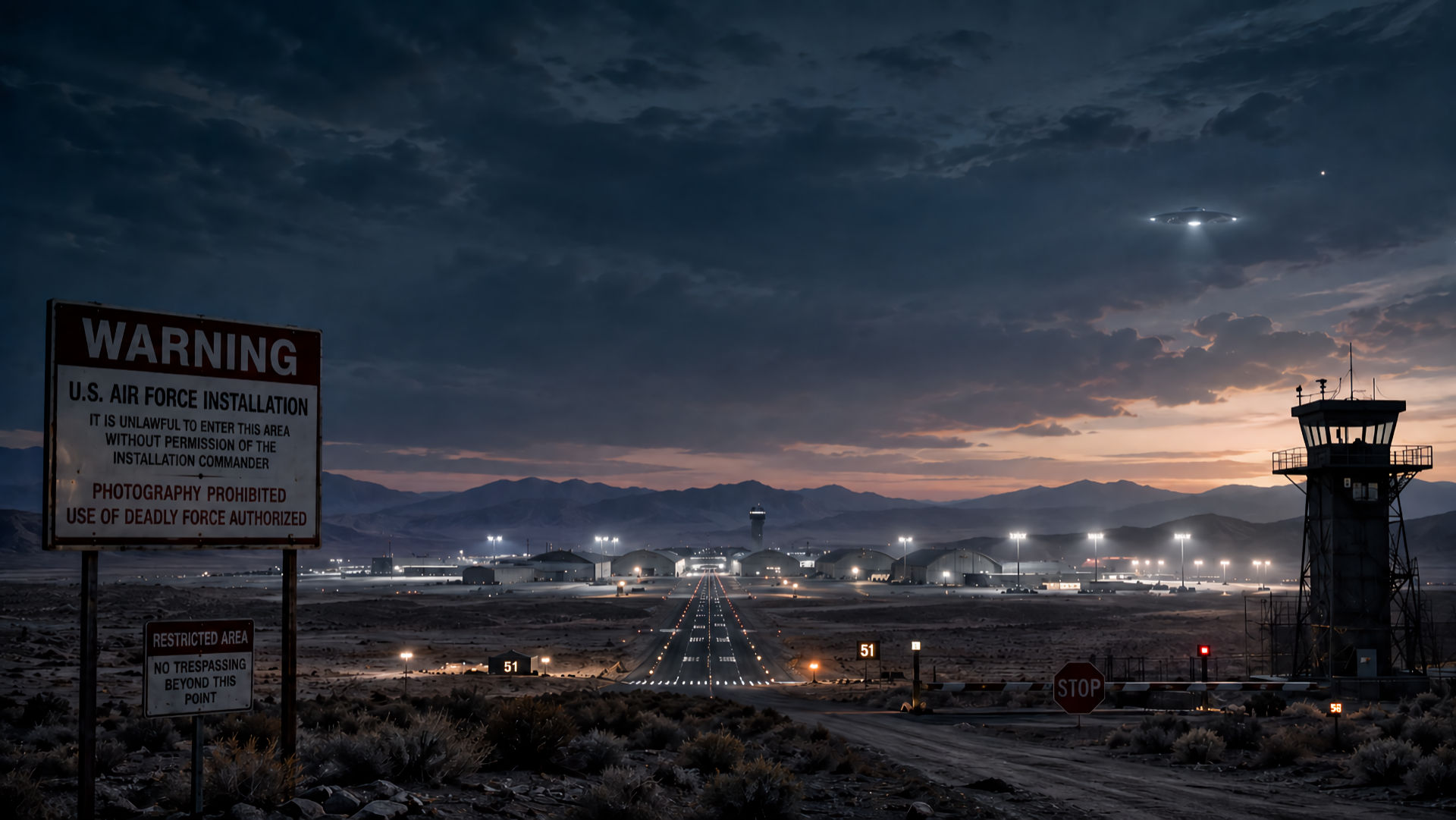
The Mystery of Area 51
Area 51 is one of the most famous places on Earth that, for many years, officially did not exist. It sits in the Nevada desert, about 80 miles north-west of Las Vegas, on the edge of a dry lakebed known as Groom Lake. To most people, that landscape looks empty, hostile, and almost deliberately unwelcoming. That is exactly why it was useful. The desert offered isolation, huge open skies, and plenty of space for aircraft that the United States government did not want anyone else to see.
The mystery begins with geography. Area 51 lies within a much larger military testing region connected to the Nevada Test and Training Range. Nearby were sites already associated with nuclear weapons testing during the Cold War, so secrecy was not exactly new to the area. Roads were restricted, maps were vague, and the surrounding desert became a buffer zone between the public and whatever was happening beyond the warning signs. Anyone driving too close would be met by armed security, cameras, sensors, and the clear impression that turning around was the healthiest life choice available.
The name “Area 51” itself came from old Atomic Energy Commission map divisions. It was not originally meant to sound mysterious, which is unfortunate for anyone hoping bureaucracy can avoid drama. A dull administrative label somehow became one of the most powerful phrases in modern conspiracy culture. Over time, “Area 51” stopped being just a place and became an idea. It became shorthand for secrecy, cover-ups, alien technology, hidden aircraft, and government silence.
Part of its power comes from the fact that it really was secret. This was not a case where an ordinary military base was dressed up by imagination alone. Aircraft were genuinely tested there. Workers genuinely travelled in and out under heavy restrictions. The government genuinely avoided public discussion of the site for decades. When officials refuse to talk about a place, people tend to fill the silence with theories. Human imagination hates a vacuum, especially one surrounded by fences and warning signs.
The desert also helped shape the legend visually. The empty roads, distant mountains, dust, heat shimmer, and sudden glimpses of restricted signs all gave Area 51 the atmosphere of a forbidden frontier. It felt less like a normal airbase and more like the edge of a secret world. That made it perfect territory for rumour. Before flying saucers entered the story, before whistle-blowers and television specials and internet raids, there was simply a remote patch of desert chosen because almost nobody could casually wander past it. The mystery began not with aliens, but with silence, distance, and a very practical Cold War problem: how to hide the future of military aviation in plain sight.
Cold War Secrets and the Birth of Groom Lake
The true story of Area 51 begins in the tense early years of the Cold War. By the 1950s, the United States and the Soviet Union were locked in a global intelligence struggle, with each side desperate to know what the other was building, planning, and hiding. Satellite reconnaissance did not yet exist in the way it later would, so high-altitude aircraft became a vital tool. The United States needed a plane that could fly higher than Soviet air defences and take photographs of military installations from the edge of the stratosphere. That need led directly to Groom Lake.
In 1955, the CIA and Lockheed’s secretive Skunk Works division selected the dry lakebed as a test site for the U-2 spy plane. The U-2 was unlike ordinary aircraft of the period. It had long glider-like wings, a lightweight body, and the ability to fly at altitudes around 70,000 feet. At that height, pilots wore pressure suits, the sky darkened above them, and the margin for error was famously narrow. The aircraft was designed not for combat, but for looking down on places that very much did not want to be looked at.
Groom Lake was ideal because it was remote, flat, and already surrounded by restricted land. Engineers could build runways and facilities without attracting too much attention, at least in theory. Workers arrived under strict secrecy, and the base quickly became associated with code names, compartmentalised information, and unusual security procedures. The U-2 programme itself was so sensitive that even many people inside government knew only fragments of the truth. Secrecy was not decorative. It was built into the entire operation.
The presence of the U-2 also helps explain some early UFO reports. Civilian aircraft in the 1950s usually flew far lower than the U-2. When airline pilots or observers saw a strange object shining in the high atmosphere, moving where no normal aircraft was expected to be, it could look otherworldly. The U-2’s reflective surface sometimes caught the sunlight long after the ground below had fallen into darkness. To someone watching from below, that could seem like an impossible machine. In a way, Area 51 did not need aliens to create UFO sightings. It had human technology advanced enough to look alien to the unprepared eye.
The U-2’s operational history soon became internationally significant. On 1 May 1960, American pilot Francis Gary Powers was shot down over the Soviet Union while flying a U-2 reconnaissance mission. The incident caused a major diplomatic crisis and exposed the scale of American spy flights. By then, Groom Lake had already proved its value as a place where secret aircraft could be developed away from public scrutiny. The base had become a hidden workshop for the Cold War sky. What began as a practical answer to espionage needs would become the foundation for decades of black projects, rumours, and one of the most persistent mysteries in modern history.
Spy Planes, Black Projects, and Official Silence
After the U-2, Groom Lake became closely associated with the next generation of secret aircraft. The Cold War did not stand still, and neither did aviation technology. If one spy plane could be built in secret, tested in the desert, and flown over hostile territory, then others could follow. Area 51 became a proving ground for aircraft that pushed speed, altitude, radar evasion, and materials engineering into new territory. The public saw almost nothing, which of course meant the imagination saw everything.
One of the most important successors was the A-12, developed by Lockheed for the CIA under the Oxcart programme. The A-12 was a sleek, black, high-speed reconnaissance aircraft capable of flying at more than Mach 3. It was related to the later SR-71 Blackbird, one of the most famous aircraft ever built. These machines looked futuristic even when viewed today, so in the 1960s, they must have seemed like visiting hardware from tomorrow. Testing them required space, secrecy, and a place where unusual shapes in the sky would not immediately become front-page news. Groom Lake fitted the job beautifully.
Other classified projects followed over the years. Area 51 has been linked to stealth aircraft testing, experimental drones, foreign aircraft exploitation, and the study of captured or acquired enemy technology. During the Cold War, understanding Soviet aircraft was a matter of survival as much as curiosity. If American engineers could examine foreign designs, test their performance, and learn their weaknesses, they could better train pilots and develop countermeasures. That sort of work demanded secrecy because admitting possession of enemy aircraft could reveal intelligence sources or diplomatic embarrassments.
The official silence around the base was intense. For decades, the United States government avoided openly acknowledging Area 51’s role. Even when aviation enthusiasts, local residents, and investigative journalists gathered evidence that something substantial existed at Groom Lake, official language remained careful, limited, or absent. The base appeared in rumours long before it appeared clearly in public government discussion. That gap between visible reality and official denial became fertile ground for suspicion. When people can see lights in the sky, hear sonic booms, and watch unmarked aircraft ferry workers from Las Vegas, being told nothing meaningful only adds seasoning to the mystery stew.
This silence was partly understandable. These projects were not harmless curiosities. They involved intelligence operations, national defence, and technologies that rival powers would have loved to understand. But secrecy has a side effect. It protects information while also creating myths around the protected space. Area 51 became a stage on which every unexplained aircraft, strange light, and classified budget line could perform. The real work there was extraordinary enough, but the absence of explanation made it seem even larger.
By the late twentieth century, Area 51 was no longer just a secret airbase. It was becoming a cultural symbol. It represented the hidden machinery of government, the suspicion that the public was being kept outside the truth, and the thrilling possibility that the most important discoveries were happening behind locked gates in the desert. The spy planes were real. The black projects were real. The silence was real. From that combination, the legend could now take flight.
Flying Saucers, Eyewitnesses, and the Growth of the Legend
The alien legend of Area 51 did not appear all at once. It grew slowly from the overlap between Cold War secrecy, UFO culture, and public distrust of official explanations. After the famous Roswell incident of 1947, stories of crashed flying saucers and recovered alien bodies became part of American folklore. Roswell itself was in New Mexico, not Nevada, but over time, many people began linking different UFO stories into one larger narrative. Area 51, with its secrecy and strange aircraft, became the perfect place to imagine where recovered alien technology might be hidden.
A major turning point came in 1989, when a man named Bob Lazar gave interviews claiming he had worked near Area 51 at a site called S-4. Lazar alleged that he had seen alien spacecraft being studied and reverse-engineered by the United States government. His claims were dramatic, controversial, and widely disputed, but they became enormously influential. For many people, Lazar’s story gave Area 51 a specific alien mythology. It was no longer merely a place where secret aircraft were tested. It became, in popular imagination, the hangar where humanity kept the impossible.
Television helped the legend spread. Programmes about UFOs, government cover-ups, and unexplained phenomena brought Area 51 into living rooms around the world. The base’s restricted perimeter became iconic. So did the nearby town of Rachel, Nevada, and the road later popularly known as the Extraterrestrial Highway. Motels, diners, signs, souvenirs, and alien-themed tourism turned the mystery into a local economy. The idea of Area 51 became both frightening and playful. It could be a sinister cover-up one moment and a fridge magnet with bug-eyed aliens the next.
Eyewitness reports played a major role in keeping the story alive. People reported unusual lights moving rapidly over the desert, aircraft performing strange manoeuvres, and glowing objects in the night sky. Some sightings may have involved classified aircraft. Others may have been misidentified conventional aircraft, atmospheric effects, military flares, or the understandable result of watching a secret test range while expecting weirdness. Expectations matter. If someone stares at the sky above the most famous secret base on Earth, every flicker has an audition for the role of alien spacecraft.
The legend also reflected a deeper mood. From the 1960s onward, public trust in government was shaken by events such as Vietnam, Watergate, and revelations about intelligence agencies. Area 51 fitted neatly into that atmosphere. If officials had concealed spy plane programmes and nuclear testing details, why not something even bigger? The logic was not always strong, but emotionally it was powerful. Secrecy in one area made secrecy in another feel plausible.
By the 1990s, Area 51 had become a fixture of pop culture. Films, television series, books, video games, and internet forums treated it as the ultimate restricted zone. Whether presented seriously or with a wink, the base stood for the tantalising idea that the truth was out there, but probably behind a fence, guarded by people with sunglasses and no sense of humour. The alien story may never have been proven, but as a myth it had already achieved lift-off.
From Denial to Declassified Documents
For decades, part of Area 51’s mystery came from the strange tension between obvious existence and official reluctance. Aviation watchers could point to satellite images, employee flights, security perimeters, and eyewitness accounts. Locals knew the place affected their region. Former workers spoke in limited ways about classified programmes. Yet official recognition remained cautious and incomplete. That changed significantly in 2013, when declassified CIA documents publicly acknowledged the Groom Lake site in connection with the U-2 programme. It was not exactly a grand opening ceremony, but for Area 51 watchers, it was a major moment.
The 2013 release mattered because it confirmed what many researchers had long argued: Area 51 had been central to secret Cold War aviation. The documents did not reveal alien bodies, underground cities, or reverse-engineered flying saucers. What they did reveal was arguably more historically important. They showed how a remote desert base had supported one of the most significant intelligence aircraft programmes of the twentieth century. The U-2 helped transform reconnaissance and shaped Cold War strategy. Area 51 was not fictional. It was a real node in the hidden infrastructure of American power.
Declassification also changed the tone of the mystery. Before official acknowledgement, the question was often whether the base existed at all in any meaningful public sense. After the acknowledgement, the question became what else had happened there and what remained classified. That distinction is important. Governments can reveal old secrets while keeping newer ones hidden. A document about the 1950s tells us something valuable, but it does not automatically open every hangar door. Area 51’s history became clearer, yet its present remained partly obscured.
The release of information also demonstrated why secrecy can outlive its original purpose. Many Cold War programmes remained hidden long after the technology involved had become outdated. Sometimes this happens because documents contain names, methods, relationships, or operational details that agencies still prefer not to expose. Sometimes it is simply the slow machinery of classification systems grinding along like a filing cabinet with trust issues. By the time material becomes public, the public imagination has often had decades to build alternative explanations.
The declassified record has strongly supported the view that many strange sightings around Area 51 were linked to advanced human aircraft. High-altitude spy planes, stealth designs, radar tests, and unusual flight patterns can all produce reports that sound extraordinary. The problem is that once the alien interpretation becomes culturally established, ordinary explanations can feel disappointingly tidy. People do not always want the mystery solved by aerodynamics and classified procurement. Sometimes they want a little cosmic drama with their paperwork.
Still, the documents did not destroy the legend. If anything, they gave it a new layer. Official acknowledgement proved that the government really had hidden major activities at Groom Lake for years. To sceptics, that confirmed the historical story of Cold War secrecy. To believers, it showed that denial could last a long time before being overturned. Area 51 had moved from rumour to documented history, but the curtain had only been lifted on part of the stage.
Why Area 51 Still Haunts the Imagination
Area 51 endures because it combines three powerful ingredients: real secrecy, advanced technology, and unanswered questions. Many mysteries collapse when the facts arrive, but Area 51 is different because the facts are themselves mysterious. The base really was used for classified aircraft. The government really did avoid open discussion for decades. Strange things really were seen in the sky above Nevada. Even without aliens, that is a strong recipe. Add flying saucers, Cold War paranoia, and a desert full of warning signs, and you have a legend with excellent staying power.
It also survives because Area 51 sits at the crossroads of two different kinds of mystery. The first is historical and practical. What aircraft were tested there? Which programmes remain unknown? How did secret aviation projects shape global politics? These are serious questions about intelligence, defence, technology, and government accountability. The second mystery is imaginative and almost mythic. Are we alone? Has contact already happened? Could the authorities hide something that world-changing? Area 51 gives those questions a physical address, which is very convenient for a mystery that would otherwise have to float around untidily.
The internet gave the legend a new life. Forums, documentaries, social media, podcasts, and video platforms allowed stories about the base to spread faster than ever. In 2019, the “Storm Area 51” meme began as an online joke but turned into a real-world cultural event, drawing attention from media, authorities, and curious visitors. Very few people had any serious intention of charging a military facility, which was wise, because being arrested in the desert is a poor substitute for meeting aliens. Yet the episode proved something important. Area 51 was no longer just a Cold War secret. It had become shared global folklore.
Part of the fascination comes from mistrust. People know governments keep secrets, especially about defence and intelligence. That is not a conspiracy theory; it is how states operate. The difficult question is where legitimate secrecy ends and unacceptable concealment begins. Area 51 sits right on that boundary in the public mind. It invites people to ask how much citizens should know, how much can be hidden in the name of security, and whether official explanations can ever fully satisfy curiosity once suspicion has taken root.
There is also something deeply human about the alien angle. Area 51 became famous during a century when humanity entered the atomic age, launched satellites, landed on the Moon, and sent probes into deep space. The idea that another civilisation might have reached us first is both thrilling and unsettling. If aliens did exist in a hangar in Nevada, it would transform religion, science, politics, and humanity’s sense of itself. No wonder the rumour refuses to die. It offers the possibility that the biggest story in history is being stored behind a locked gate. The most likely truth is that Area 51’s greatest secrets are human ones: aircraft, sensors, weapons systems, intelligence methods, and the long shadow of the Cold War. But that does not make the mystery boring. In some ways, it makes it more interesting. Area 51 shows how secrecy creates legends, how technology can look supernatural, and how silence can become louder than any official statement. The desert base may not contain alien spacecraft, but it does contain something almost as powerful: proof that hidden history can shape the imagination of the entire world.
The Mystery of Area 51 FAQ
Area 51 is a highly restricted United States military facility in the Nevada desert, near Groom Lake. It is best known for its links to classified aircraft testing, Cold War spy plane development, and decades of secrecy.
Area 51 became associated with UFOs because secret aircraft tests, unusual lights in the sky, and official silence encouraged speculation. Over time, claims about alien technology and recovered spacecraft became part of the site’s popular mythology.
For many years, the US government avoided open public discussion of the site. Declassified CIA documents later confirmed Groom Lake’s role in testing the U-2 spy plane and other secret aviation projects.
Yes. Area 51 was used during the Cold War for testing secret aircraft, including the U-2 spy plane. It has also been linked to other classified aviation and defence projects.
There is no verified evidence that aliens or alien spacecraft are stored at Area 51. The strongest documented history points to secret human technology, especially classified military aircraft and intelligence programmes.