Duke Ellington
Edward Kennedy Ellington was born on 29 April 1899 in Washington, D.C., into a family that valued refinement, confidence, and self-respect. His father, James Edward Ellington, worked in several roles, including as a butler, caterer, and blueprint maker, while his mother, Daisy Kennedy Ellington, encouraged her son to carry himself with dignity. That sense of polish stayed with him throughout his life. Long before the world called him Duke, his family had already taught him to behave as if elegance was not a costume, but a way of moving through the world.
The nickname “Duke” came early, reportedly because of his neat appearance and graceful manners. As a child, Ellington took piano lessons, though he was not immediately consumed by the instrument. Like many young people with future genius lurking suspiciously in the background, he had other interests first. He loved baseball, drawing, and the lively culture of Washington’s streets, where ragtime, dance music, church music, and popular songs drifted through everyday life.
Washington, D.C., was crucial to Ellington’s development. It was a city of sharp racial divisions, but also one with a strong Black middle class and a rich musical environment. Young Ellington grew up around educated, ambitious African Americans who built institutions, social clubs, churches, and artistic communities despite the restrictions of segregation. That combination of exclusion and excellence would shape his music deeply. He learned that art could be both entertainment and assertion, both pleasure and power.
His first serious connection with music came through ragtime piano. He became fascinated by players who could make the instrument speak with rhythm, charm, and sly sophistication. By his teenage years, he was spending time around pool halls and cafés, listening to musicians who played with a feeling that formal lessons alone could never teach. He later claimed that his first composition was “Soda Fountain Rag,” inspired by a job serving soda, which is wonderfully modest for someone who would later reshape American music. Not every legend begins with thunder. Some begin with fizzy drinks and syncopation.
Ellington attended Armstrong Manual Training School and showed promise as an artist, even winning a scholarship to study commercial art. But music steadily pulled him away from visual design. In truth, he never abandoned the instincts of a designer. He simply transferred them into sound. The way he arranged instruments, balanced colours, and created musical scenes would later reveal the eye of a painter working through the hands of a pianist.
From Local Pianist to Bandleader on the Rise
By the late 1910s, Ellington was no longer simply a young man who played piano. He was becoming a working musician, organiser, and entrepreneur. He began performing at dances, private parties, and social events around Washington, building a reputation for reliability as much as talent. This mattered because musicians had to do more than play well. They had to secure bookings, manage personalities, handle money, and keep audiences happy. Ellington learned the business of music early, which was fortunate, because genius without organisation can become a very elegant disaster.
His first band, often called Duke Ellington’s Serenaders, played for local audiences and gave him practical experience in leading musicians. He was not yet the commanding figure he would become, but the essential traits were already visible. He listened closely to individual players, understood the importance of presentation, and knew that a band needed identity as well as skill. Ellington was not interested in making every musician sound the same. He was beginning to realise that each player’s tone, phrasing, and personality could become part of the music itself.
In 1923, Ellington moved to New York City, where the possibilities were stronger, the competition sharper, and the rent presumably rude. He joined a group that became known as the Washingtonians, performing in clubs and gradually gaining attention. New York in the 1920s was alive with jazz, blues, theatre, dance crazes, and nightlife. Harlem in particular was becoming a major centre of African American culture, creativity, and intellectual energy. For a young bandleader with ambition, it was exactly the right furnace.
The early New York years were not instantly triumphant. Ellington had to build connections, adapt to club work, and find ways to make his group stand out in a crowded scene. He was helped by musicians whose sounds would become central to his emerging style, including trumpeter Bubber Miley, whose growling, blues-inflected playing gave the band an unmistakable edge. Ellington understood that Miley’s unusual tone was not a gimmick, but a voice. That insight would become one of the great principles of his career.
Instead of writing generic arrangements, Ellington began composing for the specific musicians in his orchestra. This was a quiet revolution. He treated instrumentalists almost like characters in a drama, giving them material that suited their strengths, quirks, and emotional range. The result was music that sounded personal, layered, and alive. By the mid-1920s, Ellington was no longer just another pianist hoping for attention. He was becoming a bandleader with a sound of his own, ready for the opportunity that would make him nationally famous.
Harlem, the Cotton Club, and the Birth of a National Sound
That opportunity arrived in 1927, when Duke Ellington and his orchestra became the house band at the Cotton Club in Harlem. The club was glamorous, famous, and deeply contradictory. It showcased many of the finest Black performers in America, yet its audience was largely white, and its stage shows often leaned into exoticised and racist fantasies designed for wealthy patrons. Ellington had to work within that uncomfortable reality, but he also used the platform with extraordinary skill. He took the visibility offered by the Cotton Club and turned it into a launchpad for something far greater than nightclub entertainment.
The Cotton Club years transformed Ellington’s career because the performances were broadcast on the radio. Suddenly, listeners far beyond New York could hear his orchestra. At a time when radio was becoming a powerful national medium, this exposure made Ellington’s sound familiar to households across America. The band’s music combined sophistication, rhythm, atmosphere, and drama. It was dance music, but it was also theatre for the ears. Listeners did not simply hear tunes. They heard scenes, moods, movement, and personality.
During this period, Ellington developed what was sometimes called the “jungle style,” shaped especially by Bubber Miley’s growling trumpet and Joe “Tricky Sam” Nanton’s expressive trombone. The term itself came from the language of the nightclub’s staged exoticism, but Ellington’s music was far more complex than the label suggests. Pieces such as “East St. Louis Toodle-Oo” and “Black and Tan Fantasy” used unusual instrumental effects, blues feeling, and carefully crafted textures. They sounded mysterious, modern, and unmistakably Ellingtonian. If other bands played songs, Ellington increasingly built worlds.
The Cotton Club also pushed Ellington to compose and arrange constantly. Nightclub work demanded fresh material, precise timing, and music that could support singers, dancers, comedians, and elaborate floor shows. This pressure sharpened his craft. He learned how to create atmosphere quickly, how to use contrast, and how to hold attention without sacrificing musical intelligence. He was writing for entertainment, but he was also stretching what jazz composition could do.
By the time Ellington left the Cotton Club in the early 1930s, he had achieved national recognition. He had moved from local success to radio fame, and his orchestra had become one of the most distinctive ensembles in American music. Yet the most important development was not fame itself. It was control. Ellington had discovered how to turn a band into a personal instrument, how to transform individual musicians into a collective voice, and how to make jazz sound elegant, theatrical, and emotionally rich without sanding off its edge.
Building the Ellington Orchestra and Redefining Jazz
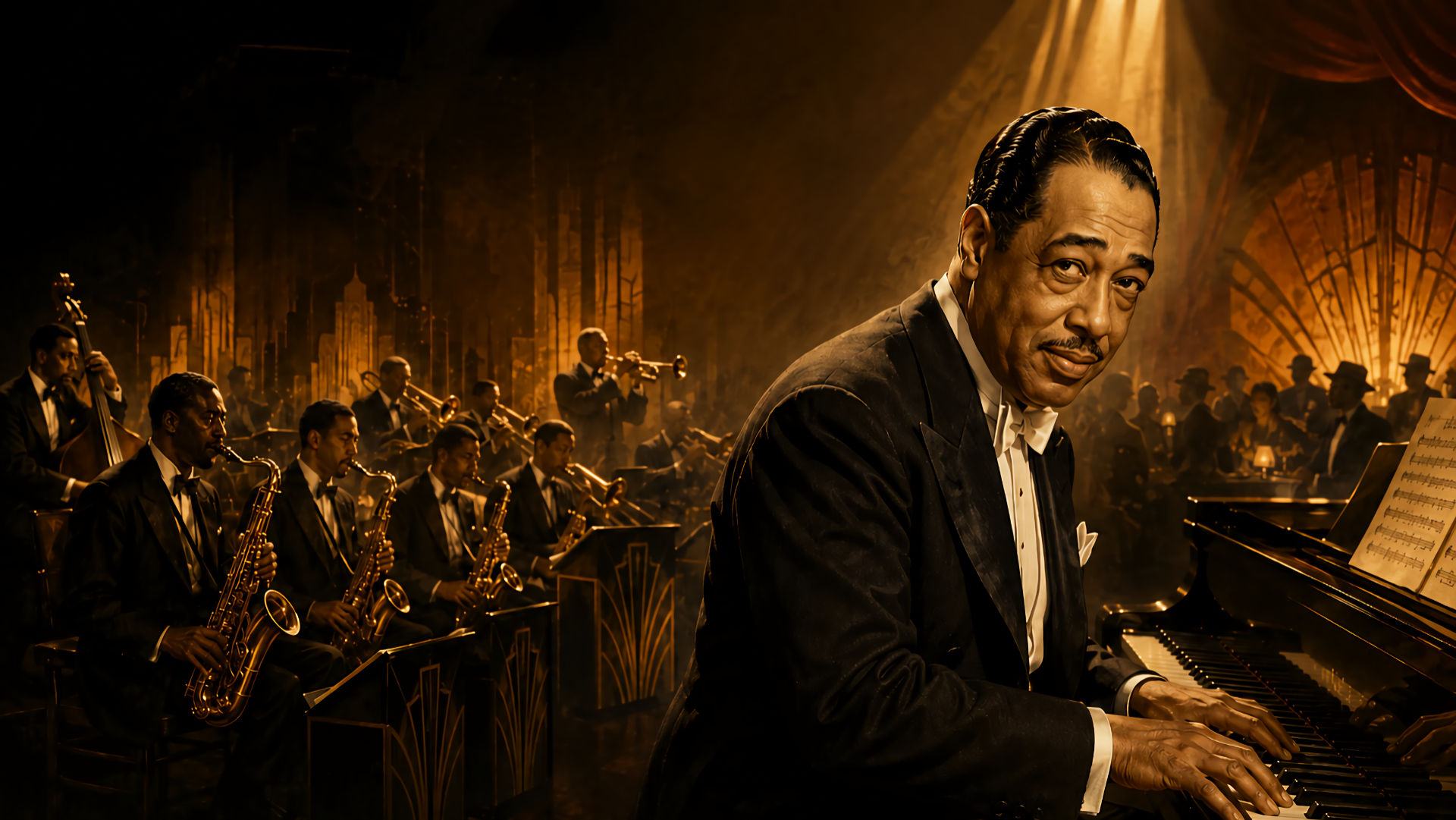
The Ellington Orchestra became one of the most remarkable musical organisations of the twentieth century because it was not simply a band. It was a living workshop. Musicians joined, stayed, developed, left, returned, and became part of a sound that was both carefully controlled and gloriously human. Ellington’s genius as a composer was inseparable from his genius as a listener. He wrote for people, not just instruments. A saxophone part for Johnny Hodges was not merely a saxophone part. It was a Johnny Hodges moment, full of warmth, curve, and lyrical beauty.
The roster of Ellington musicians became legendary. Harry Carney’s baritone saxophone gave the orchestra depth and authority. Cootie Williams brought brilliance and bite on the trumpet. Barney Bigard added clarinet elegance. Juan Tizol contributed the valve trombone sound and helped create classics such as “Caravan.” Later, players such as Ben Webster and Ray Nance added further colour. Ellington understood their strengths almost like a novelist understands characters. He knew who should speak, when they should enter, and how their voice could change the entire emotional temperature of a piece.
In the 1930s, Ellington produced a remarkable run of compositions that helped define the era. “Mood Indigo,” “Sophisticated Lady,” “Solitude,” and “It Don’t Mean a Thing (If It Ain’t Got That Swing)” showed his range, from smoky introspection to rhythmic command. The last of those titles helped popularise the word “swing” before the Swing Era fully exploded. It also contained a truth that Ellington knew instinctively. Technical polish mattered, but music needed pulse, character, and lift. Without swing, even the cleverest arrangement could sit there like a well-dressed statue.
Ellington’s orchestra toured widely, travelling through America and eventually abroad. Touring was exhausting, especially for Black musicians facing segregation, discrimination, and the indignities of life on the road. Hotels, restaurants, transport, and performance venues all reflected the racial injustices of the time. Yet Ellington maintained a public image of composure and dignity, while his orchestra demonstrated Black excellence night after night. Their success was not just artistic. It was cultural, social, and symbolic.
By the late 1930s and early 1940s, Ellington had moved beyond being a famous bandleader. He was one of America’s major composers, even if not everyone in the classical establishment was ready to admit it. His work blurred boundaries between popular music, jazz, concert music, and dramatic composition. He did not ask jazz to become respectable by imitating European forms. Instead, he showed that jazz already had its own sophistication, architecture, and emotional depth.
Beyond Swing: Suites, Symphonies, and Musical Experimentation
The arrival of Billy Strayhorn in 1939 marked one of the most important partnerships in Ellington’s career. Strayhorn was a gifted composer, arranger, and pianist whose musical intelligence complemented Ellington’s own. Their collaboration was unusually close, sometimes so seamless that listeners and even scholars have spent years untangling who contributed exactly what. Strayhorn brought harmonic subtlety, elegance, and emotional nuance, while Ellington provided vision, leadership, and an unmatched understanding of the orchestra’s voices. Together, they expanded what the Ellington sound could become.
One of Strayhorn’s most famous contributions was “Take the ‘A’ Train,” which became the orchestra’s signature tune. Bright, propulsive, and instantly memorable, it captured the energy of New York and the journey to Harlem. Yet Ellington was not content to remain within the boundaries of popular swing numbers. He increasingly pursued longer forms, using suites and extended compositions to explore history, identity, faith, place, and memory. This was ambitious work, and not always easily categorised. Ellington had a cheerful habit of ignoring musical boxes, then building a better box with velvet lining and a brass section.
In 1943, Ellington premiered “Black, Brown and Beige” at Carnegie Hall. The work was conceived as a major musical statement on African American history, from slavery through struggle and achievement. Its premiere was a bold moment. Carnegie Hall was associated with classical prestige, and Ellington brought jazz composition into that space with scale and seriousness. Critics were divided, as critics often are when someone does something important before they have agreed where to file it. But the work showed Ellington’s determination to present Black history and experience as worthy of grand artistic treatment.
Ellington continued experimenting across the following decades. He wrote suites inspired by places, people, and ideas, including “Such Sweet Thunder,” linked to Shakespeare, and “The Far East Suite,” shaped by travels in the Middle East and Asia. He also composed sacred concerts later in life, blending jazz, choral music, spirituality, and performance. These works reflected his belief that music could move through clubs, theatres, churches, and concert halls without losing its identity.
The musical world changed around him. Bebop emerged. Rock and roll arrived. Big bands became harder to maintain financially. Yet Ellington adapted without surrendering his core vision. His famous performance at the 1956 Newport Jazz Festival, especially Paul Gonsalves’s electrifying extended solo during “Diminuendo and Crescendo in Blue,” renewed public excitement around the orchestra. It proved that Ellington was not a museum piece. He was still capable of surprise, fire, and reinvention, which is terribly inconvenient for anyone trying to call a genius past his prime.
The Duke’s Legacy: Elegance, Innovation, and an American Masterpiece
Duke Ellington died on 24 May 1974, leaving behind one of the richest bodies of work in modern music. Across more than fifty years, he composed or co-composed thousands of pieces, led one of the greatest orchestras in jazz history, and changed the way musicians thought about arrangement, tone, and ensemble identity. He was not only a pianist or bandleader. He was a composer of atmosphere, a sculptor of sound, and a master of musical portraiture. His orchestra did not merely perform his ideas. It gave them faces, voices, shadows, and light.
Ellington’s importance lies partly in the sheer beauty of the music. Pieces like “Mood Indigo,” “In a Sentimental Mood,” “Sophisticated Lady,” “Caravan,” and “Solitude” remain standards because they feel both immediate and timeless. They can sound intimate in a small room, cinematic in a concert hall, and utterly natural in the hands of later jazz musicians. His melodies linger, but his textures are just as important. He knew how to combine instruments in ways that produced colours no one else quite imagined. In Ellington’s world, a muted trumpet, low reed, and sliding trombone could become a whole weather system.
His legacy also rests on his refusal to accept narrow definitions of jazz. He treated the form as capable of depth, grandeur, humour, sensuality, spirituality, and historical memory. He resisted the idea that serious music had to belong to European concert traditions. At the same time, he avoided simplistic arguments about labels. When asked about categories, he often preferred to speak of music itself. His famous phrase, “beyond category,” captured not only his taste, but his entire artistic philosophy.
Ellington also stands as a central figure in African American cultural history. He achieved international fame during an era when racism limited opportunities and distorted recognition. His dignity was not passive. It was strategic, stylish, and quietly defiant. On stage, in recordings, and through his compositions, he presented Black artistry as sophisticated, modern, and foundational to American culture. He did not need to shout to make the point. He had saxophones for that.
The story of Duke Ellington is therefore not just the story of one brilliant musician. It is the story of American music learning to hear itself more fully. From Washington parlours to Harlem nightclubs, from radio broadcasts to Carnegie Hall, from dance floors to sacred concerts, Ellington carried jazz into new spaces without stripping away its soul. His life reminds us that elegance can be radical, that discipline can produce freedom, and that a great bandleader does not simply command sound. He creates a world and invites everyone else to listen.
Duke Ellington FAQ
Duke Ellington was an American composer, pianist and bandleader who became one of the most important figures in jazz history. He led the Duke Ellington Orchestra for decades and created music that helped define big band jazz, swing and modern American composition.
Duke Ellington is best known for leading his orchestra, composing jazz standards such as Mood Indigo, Sophisticated Lady and It Don’t Mean a Thing, and helping to raise jazz to a major concert art form.
The Cotton Club gave Ellington national exposure through live performances and radio broadcasts. Although the club reflected the racial contradictions of its time, it helped bring Ellington’s orchestra to a much wider American audience.
Billy Strayhorn was a composer, arranger and pianist who became one of Ellington’s closest collaborators. He wrote Take the A Train, which became the Ellington Orchestra’s signature tune, and helped shape the later Ellington sound.
Duke Ellington remains important because he expanded what jazz could be. His music combined improvisation, composition, orchestral colour, cultural identity and emotional depth, making him one of the great composers of the twentieth century.