The Piper Alpha Disaster
Piper Alpha stood in the North Sea, around 120 miles north-east of Aberdeen, a vast steel structure rising above cold, violent water. It was not a place built for comfort, nor romance, nor anything as gentle as beauty. It was built for production. Operated by Occidental Petroleum, the platform began life as an oil-producing installation, part of the great North Sea energy boom that transformed Britain’s offshore industry in the 1970s and 1980s. To the public, platforms such as Piper Alpha were symbols of engineering success, national wealth, and technological confidence. To the men who worked there, they were also workplaces, temporary homes, and complicated machines that never truly slept. Piper Alpha began production in 1976 and was later modified so that it could process and export gas as well as oil. That change would become central to understanding why the disaster, when it came, escalated with such extraordinary violence.
Life offshore followed a demanding rhythm. Crews flew in by helicopter, worked long shifts, slept in close quarters, and lived with the constant background presence of machinery, alarms, pipes, valves, and the sea. Everything depended on procedure. A mistake in an office might cause a lost file, an angry customer, or an awkward meeting with someone from accounts. A mistake on an offshore production platform could release hydrocarbons under pressure, ignite a fire, or compromise the only safe routes out. Piper Alpha was not just a building with machinery inside it. It was a living industrial system, with oil, gas, condensate, power, water, communications, and human decision-making all interacting at once.
As the platform was adapted over time, its original design was stretched. Equipment was added, systems were changed, and the platform became more complex than the one first imagined on paper. Gas processing facilities were retrofitted into an installation that had originally been designed primarily for oil production, and those changes placed hazardous equipment close to vital areas, including the control room, electrical systems, and accommodation modules. In hindsight, this was not a minor detail. It meant that if a major explosion occurred in the wrong place, the effects could strike at the platform’s ability to manage the emergency almost immediately. The system would not merely be damaged. It could be blinded, silenced, and cut off from organised response.
Yet before 6 July 1988, Piper Alpha was not widely seen as a disaster waiting to happen. That is one of the uncomfortable truths of major industrial accidents. They often happen inside systems that have become used to danger because danger has become routine. Small compromises become normal. Workarounds become habits. Design weaknesses become accepted facts of life because yesterday was survived, and the day before that was survived too. Piper Alpha was productive, important, and familiar to those who depended on it. The trouble was that familiarity can be a poor substitute for safety, especially when the risks are hidden inside paperwork, shift handovers, and assumptions no one has recently challenged.
The North Sea Boom and the Risks Beneath the Routine
The North Sea oil industry grew with remarkable speed. It promised jobs, energy security, investment, and a new industrial frontier just beyond the coast of Scotland. By the 1980s, offshore platforms had become part of the economic landscape, even if most people rarely thought about what life on them actually involved. Production mattered enormously. Every interruption had financial consequences, and every platform was part of a wider network of fields, pipelines, terminals, and linked installations. Piper Alpha was not isolated in any meaningful sense. It sat within a web of oil and gas infrastructure, and that interconnection would later turn a platform emergency into a catastrophe fed by neighbouring systems.
The risks were not always dramatic in appearance. Much of the danger lay in routine work. Pumps needed servicing, valves needed inspection, permits had to be issued, equipment had to be isolated, and one shift had to know exactly what the previous shift had done. In an environment filled with flammable hydrocarbons, routine maintenance was not routine in the ordinary sense. It was a controlled intervention into a hazardous system. The controls were supposed to be paperwork, communication, isolation procedures, and discipline. They were supposed to ensure that no one restarted equipment that was unsafe, no one opened a system that was live, and no one assumed that a missing piece of information was unimportant.
On Piper Alpha, the permit-to-work system was one of those vital controls. In theory, it should have made clear which pieces of equipment were safe to operate and which were not. In practice, the system relied heavily on informal communication, and crucial information could be separated across different permits, different locations, and different people. That kind of weakness is dangerous precisely because it does not always look dangerous at the time. A form in the wrong place, a note not properly discussed, or a handover that assumes too much can seem small until it becomes the missing link in a fatal chain. The later analysis of Piper Alpha identified inadequate control of work, poor communication, weak shift handover, and inadequate management of change as root causes behind the disaster.
There were also broader assumptions about emergency response. Offshore platforms had evacuation plans, but plans are only as strong as the conditions they are designed to survive. Piper Alpha relied heavily on the idea that helicopters would be available for evacuation, but that assumed the helideck would remain usable. It assumed that smoke, flame, structural damage, and loss of communication would not rapidly make organised evacuation impossible. It also assumed that the platform itself could remain sufficiently functional long enough for people to gather, receive instructions, and leave in an orderly way. Those assumptions would prove tragically optimistic.
This is where the story of Piper Alpha becomes more than the story of one failed valve or one mistaken pump start. It becomes the story of a system that had accumulated vulnerability over time. The platform had been modified. Its processes had grown more complex. Its fire protection arrangements, permit systems, evacuation assumptions, and inter-platform dependencies all carried weaknesses. None of those weaknesses alone guaranteed disaster. Together, on the wrong evening, under the wrong sequence of events, they created the conditions in which a single maintenance problem could open the door to one of the worst offshore disasters in history.
6 July 1988: A Maintenance Job, a Missing Permit, and a Fatal Chain Reaction
On 6 July 1988, the day began with maintenance work. One of Piper Alpha’s condensate pumps, known as pump A, was out of service. A pressure safety valve connected with that pump had been removed for maintenance, and the open pipework had been temporarily sealed with a blind flange. This mattered enormously because the pump was not safe to restart while that valve was missing. The problem was not simply that maintenance was happening. Maintenance happens constantly in industrial settings. The problem was that the information about the pump, the missing valve, and the temporary state of the equipment was not held together clearly enough for the people who later needed it. The most probable technical trigger was a loss of containment after a pump undergoing maintenance was started in error, causing condensate to escape from a temporary blind flange assembly.
During the evening, the operating pump, pump B, tripped. The crew needed to restore condensate handling, and attention turned to pump A. Operators knew pump A had been out of commission for maintenance, but they did not appear to know that the pressure safety valve had been removed under a separate permit. That distinction was fatal. If the pump had merely been awaiting ordinary maintenance, restarting it might have seemed reasonable in an urgent operational situation. If everyone had known the valve was missing and the system was only temporarily sealed, restarting it would have been obviously dangerous. The disaster lived in the gap between those two understandings.
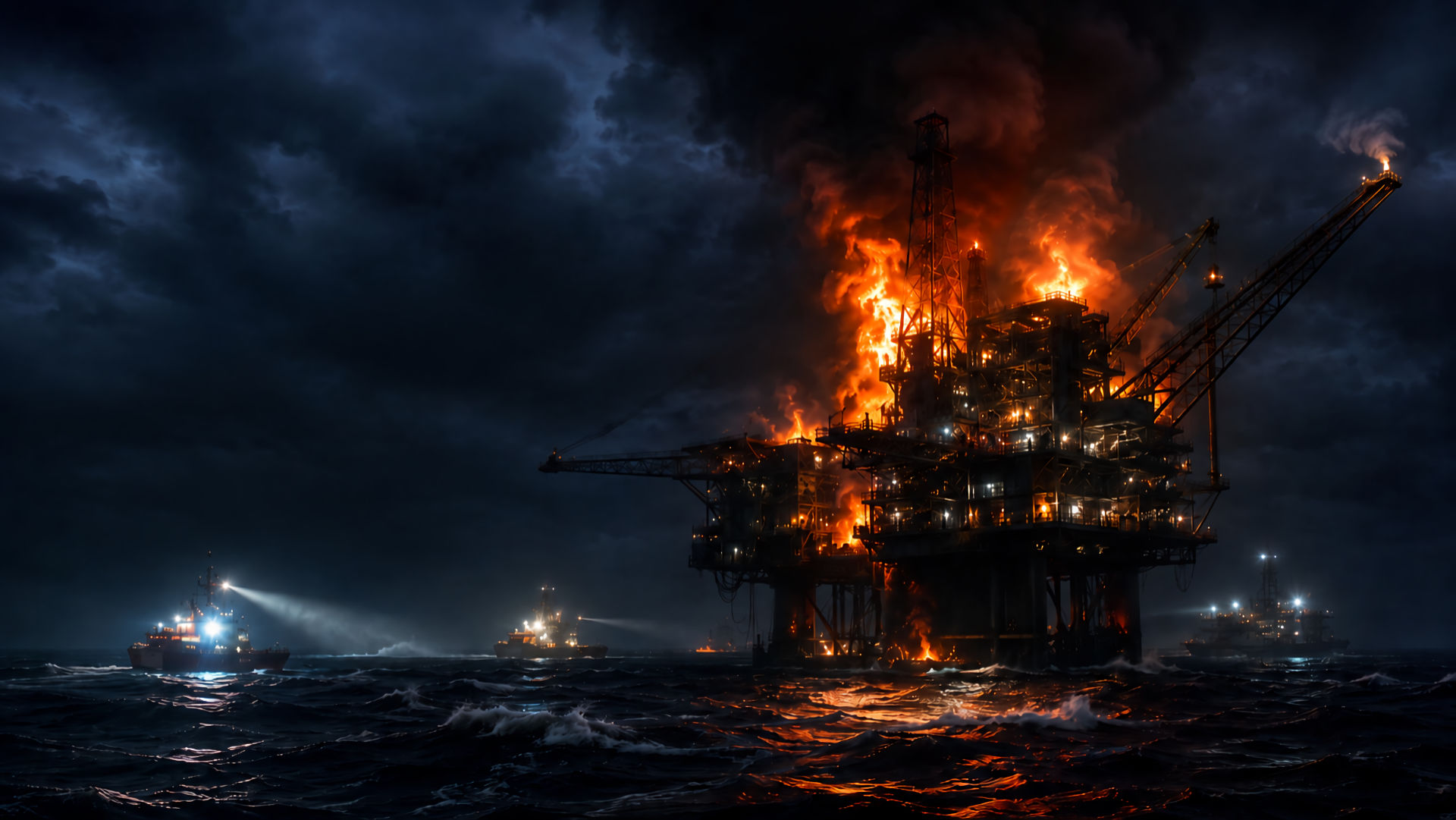
At about 21:45, pump B tripped, and soon afterwards, alarms began to sound. Gas alarms activated, compressors tripped, and the flare became larger than usual. Around 22:00, the first explosion ripped through Piper Alpha. It was not a neat cinematic blast followed by instant clarity. It was confusion, impact, noise, shock, smoke, and a sudden transformation of a working platform into a burning emergency. Men were thrown from chairs and beds. Control systems were damaged. Communications began to fail. The platform’s ability to understand and respond to its own crisis was attacked almost from the first moment.
The escaping condensate had ignited, and the first explosion quickly led to further damage. Fire spread. Pipework ruptured. Oil and gas that had once been controlled inside steel systems now fed an inferno outside them. The exact sequence involved multiple failures and escalating fires, but the essential point is chillingly simple. A platform designed to contain energy had begun releasing it uncontrollably. Once that process started, the interconnected nature of the installation became a curse. Systems meant to produce, process, and transport hydrocarbons became pathways through which the emergency could grow.
The men on Piper Alpha were not watching a disaster from a safe distance. They were inside it. Many were off duty in the accommodation block, where they might have expected to be relatively safe during an emergency. Others were at their stations, trying to understand what had happened and what to do next. In the chaos, the normal command structure was quickly overwhelmed. The control room was badly damaged, the radio room was rendered useless, and the fire was spreading faster than effective instructions could travel. A maintenance problem had become an explosion. An explosion had become a platform-wide emergency. The night was only beginning.
Explosion, Fire, and the Fight to Survive Piper Alpha
After the first explosion, Piper Alpha became a place of impossible choices. The helideck, which should have offered a route to evacuation, was quickly made unusable by smoke and fire. Lifeboats and life rafts could not be launched successfully. Men moved through darkness, smoke, heat, debris, and confusion, trying to find any route away from the flames. Some sheltered in the accommodation block, waiting for rescue or instruction that would not come in time. Others made their way down ropes or jumped into the North Sea from terrifying heights. Survival depended less on a planned evacuation than on individual decisions made under conditions no training exercise could fully imitate.
The fire protection system did not save the platform. Fire pumps had often been left in manual mode because of concerns about divers being drawn towards seawater intakes. That decision made sense in one frame of risk, especially to people who could imagine a diver being injured. It was disastrous in another. When the fire broke out, the system could not simply activate automatically as needed. Starting pumps locally became difficult or impossible because smoke, heat, and fire blocked access. Piper Alpha had fire protection equipment, but in the emergency that actually occurred, protection was not the same as availability. A safety system that cannot operate when required becomes a monument to false assurance.
Then came the escalation that made the disaster almost unstoppable. Piper Alpha was connected to other platforms by oil and gas lines. Those lines continued feeding hydrocarbons into the area even after the first explosion. At about 22:20, a high-pressure gas line connected to the Tartan platform ruptured, releasing gas at an enormous rate and creating a massive fireball. Later, other lines also ruptured, intensifying the inferno. What had begun on Piper Alpha was now being fed by the very network of production that made the platform valuable. Interconnection, usually a strength of industrial efficiency, became a mechanism of destruction.
Nearby vessels attempted rescue. The standby vessel Sandhaven and the support vessel Tharos were among those involved, but the conditions were beyond anything that could be handled smoothly. Explosions continued. Burning debris fell. Smoke obscured visibility. The heat was intense enough to weaken the structure. Tharos had firefighting capability, but delays, communication failures, power problems, and the scale of the disaster limited what could be achieved. Rescue crews showed extraordinary courage, but courage alone cannot overcome a collapsing platform, rupturing pipelines, and a night sky filled with flame.
By around 23:20, the gas line to Claymore ruptured, and the topsides of Piper Alpha were weakening badly. The accommodation module, where many men had gathered, eventually slid into the sea. All those inside died. By the early hours of 7 July, most of the platform’s topsides had been destroyed. Of the 226 people on board that night, only 61 survived, and 167 people died in total, including two members of the rescue effort. Many of the dead were lost to smoke inhalation, others to drowning or injuries, and some bodies were never recovered.
The Cullen Inquiry and the Failures Exposed
In the aftermath, the question was not simply what had exploded. It was why so many safeguards had failed, why the situation escalated so quickly, and why so many men had been unable to escape. Lord Cullen chaired the public inquiry, and it became one of the most important investigations in the history of offshore safety. One week after the disaster, Cullen was appointed to lead the inquiry, which sat for 180 days and reported in November 1990. Its work mattered because Piper Alpha could not be explained honestly as a freak event or a single unlucky mistake. The inquiry had to examine maintenance, design, management, communication, emergency planning, regulation, and safety culture.
The permit-to-work system came under intense scrutiny. Its purpose was to control hazardous work, but on Piper Alpha, it had not ensured that vital information reached the people making operational decisions. The pump maintenance and the removed pressure safety valve were covered in ways that did not make the combined danger clear enough. The wider issue was not merely paperwork quality. It was whether the organisation truly understood that paperwork was a safety-critical system. A permit hidden in the wrong office, filed under the wrong category, or poorly discussed at handover was not administrative clutter. It was a potential route to disaster.
Management of change was another major theme. Piper Alpha had been modified from an oil platform into a more complex oil and gas production facility, but the implications of those changes had not been fully controlled. Retrofitted gas compression and condensate systems created hazards in locations where the original design had not necessarily anticipated them. Fire and explosion risks were therefore different from the risks of the original platform. This is a familiar pattern in industrial disasters. Systems evolve, but the safety case in people’s heads does not always evolve with them. The platform changes physically, while assumptions remain stuck in an earlier version of reality.
Emergency response also came under severe criticism. The inability to evacuate by helicopter or lifeboat revealed that the platform’s plans had not properly accounted for a major fire that rapidly disabled key escape routes. Men were left to make their own way to the sea, sometimes by jumping from extreme heights. The accommodation block, which many believed to be a place of refuge, became a trap. The inquiry and later safety analysis highlighted the need for better temporary refuges, better evacuation planning, and emergency systems designed around credible major accident scenarios rather than optimistic assumptions.
Perhaps the deepest failure was cultural. Piper Alpha showed what happens when production, familiarity, and procedural habit gradually erode the sharpness of risk awareness. It showed that safety is not proved by the absence of yesterday’s accident. It must be actively maintained, challenged, tested, and redesigned as operations change. The Cullen Inquiry made 106 recommendations, and its findings reshaped offshore safety regulation. Yet its moral weight came from something simpler than the number of recommendations. It forced the industry to confront the fact that the men who died were not killed by one mistake alone, but by a system that had allowed too many weaknesses to line up.
How Piper Alpha Changed Offshore Safety Forever
The legacy of Piper Alpha is written in law, regulation, training, engineering, and memory. After the disaster, offshore safety in the UK moved away from a heavily prescriptive model and towards a goal-setting regime. Instead of relying mainly on fixed rules that attempted to specify every requirement, operators were required to demonstrate that they understood their major accident hazards and had effective systems to manage them. This became central to the safety case approach, where responsibility sits clearly with the operator to identify risks, justify controls, and prove that the installation can be operated safely. The change mattered because Piper Alpha had shown that compliance with rules is not enough if the rules do not capture the reality of the danger.
The disaster also changed how the industry thought about process safety. Personal safety remains important, of course, but Piper Alpha demonstrated that preventing slips, trips, minor injuries, and individual accidents is not the same as preventing catastrophic loss of containment. A platform can have hard hats, training posters, and tidy walkways while still carrying deep vulnerabilities in isolation procedures, fire protection, emergency shutdown systems, and management of change. Piper Alpha taught that major hazard industries must ask bigger questions. What could release energy uncontrollably? What barriers prevent that release? What happens if those barriers fail? How quickly can escalation occur, and can people still escape?
Permit-to-work systems were strengthened across the offshore sector. Isolation standards became more rigorous. Shift handover, communication between disciplines, and control of simultaneous operations received far more attention. Emergency response planning also changed, with greater emphasis on temporary refuge, survivability, evacuation routes, drills, and the realistic testing of assumptions. Fire and gas detection, passive fire protection, deluge systems, emergency shutdown arrangements, and pipeline isolation all became part of a harder conversation about what must function during the worst moments, not merely during normal operations. Lessons from Piper Alpha continue to be cited across hazardous industries because the underlying issues are not unique to oil and gas.
For the families of the dead, however, legacy is not an abstract regulatory improvement. It is absence. It is the empty chair, the missing father, husband, son, brother, friend, or colleague. Industrial disasters are sometimes discussed in the language of systems and failures, and that language is necessary. But it can also become cold. Piper Alpha was not just a case study. It was a human catastrophe that tore through homes and communities, especially in Scotland and in the offshore workforce. Survivors carried physical injuries, trauma, and memories of choices no one should ever have to make.
There is a danger, decades later, of treating Piper Alpha as a solved lesson. That would be the wrong lesson entirely. The point is not that offshore safety changed once and therefore the matter is closed. The point is that complex systems constantly drift unless people keep pulling them back towards discipline, clarity, and humility. Procedures decay. Organisations forget. Production pressure returns wearing a new jacket and pretending it is efficiency. Piper Alpha still matters because it reminds every high-risk industry that disaster is rarely born fully grown. It is assembled gradually from small failures, tolerated compromises, weak signals, and assumptions left untested. On the night of 6 July 1988, Piper Alpha became the deadliest offshore oil disaster in history. Its destruction exposed failures in design, communication, maintenance control, emergency planning, and safety culture. The reforms that followed were profound, but they came at a terrible price. The lasting responsibility is not simply to remember that 167 people died. It is to remember why they died, and to keep asking whether today’s systems are truly safer, or merely more confident.