The Yorkshire Ripper
By the mid-1970s, parts of northern England were already living through a period of social strain, economic uncertainty, and deep anxiety about crime. Yorkshire’s cities and towns were changing, with old industries under pressure and urban areas carrying the marks of poverty, nightlife, and neglect. It was into this landscape that a series of violent attacks against women began to unfold, at first with no clear public understanding that one man was responsible. The name that would later dominate headlines, “The Yorkshire Ripper”, had not yet taken hold. At the beginning, there were women, families, detectives, hospital staff, and communities trying to understand sudden brutality in places that had once felt familiar.
Peter Sutcliffe’s first confirmed murder took place on 30 October 1975, when Wilma McCann, a 28-year-old mother of four, was killed in Leeds. Her death was devastating in itself, but it also marked the beginning of a pattern that would terrify women across Yorkshire and beyond. Over the following years, more women were attacked and murdered in Leeds, Bradford, Huddersfield, Halifax, Manchester, and other areas. The violence was often sudden, usually at night, and frequently involved blows to the head followed by stabbing. The physical details became part of the investigation, but for the families, the important truth was simpler and harder: people they loved had gone out and never come home.
At first, police and press attention often focused heavily on whether the victims were sex workers. That framing shaped the early public response in damaging ways. Some women were indeed involved in sex work, often through poverty, coercion, or circumstance, but others were not. More importantly, none of that changed the value of their lives. Yet the language used at the time sometimes implied a hierarchy of sympathy, as though some victims represented a more shocking loss than others. That attitude would become one of the lasting moral failures associated with the case.
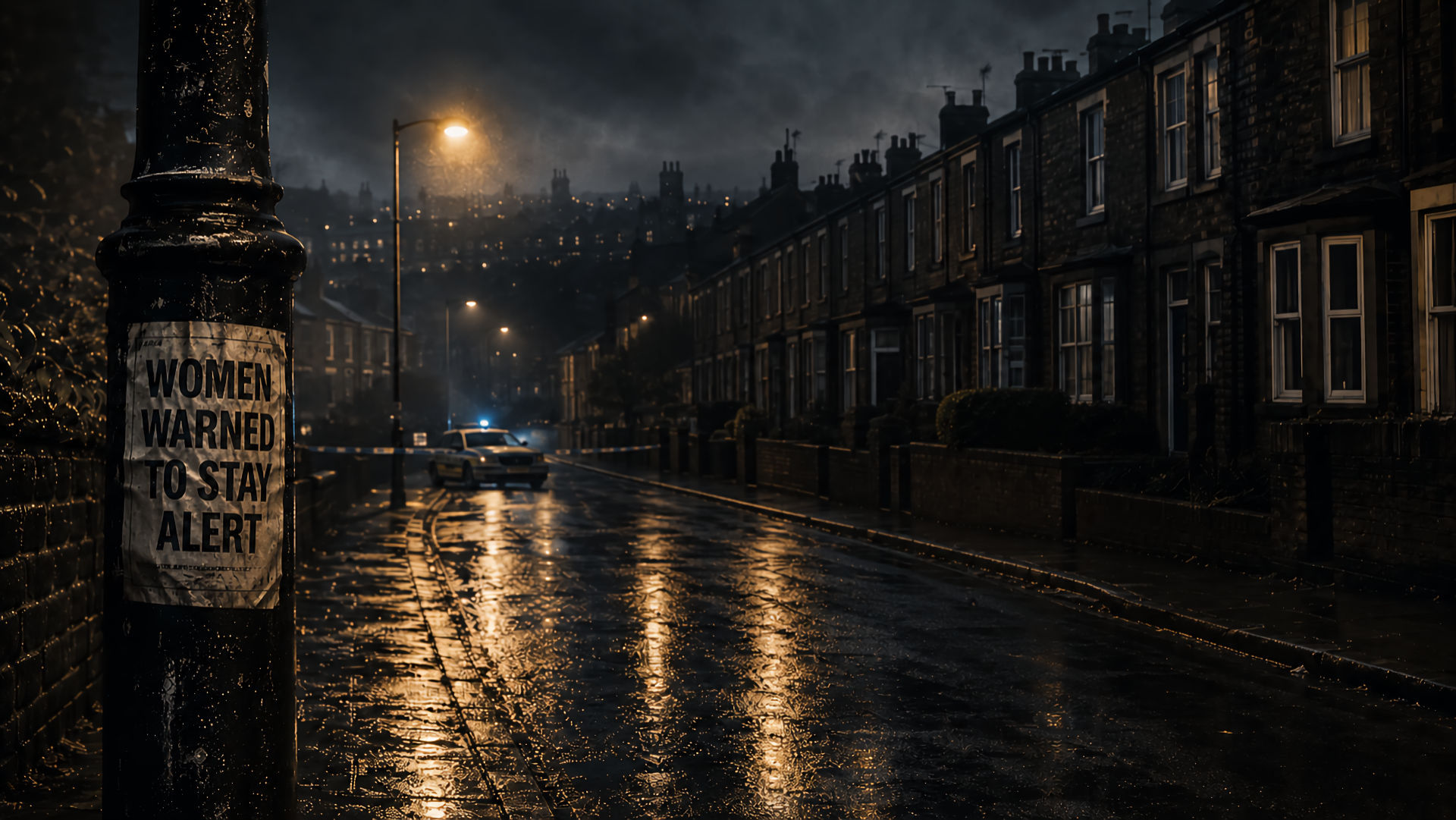
As the attacks continued, fear spread through ordinary routines. Women were warned not to go out alone after dark, to avoid certain areas, to take taxis, to travel in groups, or to stay indoors entirely. The burden of safety was placed largely on women themselves, as though the proper answer to male violence was female restriction. For many women in Yorkshire, night-time stopped being simply night-time. It became a curfew without a law, enforced by fear, rumour, headlines, and the knowledge that the killer remained free.
The early murders did not yet reveal the full scale of what was happening, but they created a grim rhythm. A woman was killed, police appealed for information, communities mourned, newspapers printed another name, and then time passed with no arrest. Each unsolved attack made the next one feel more possible. The case was no longer simply a police matter. It had become part of daily life, shaping how women moved, how families worried, and how the north of England imagined danger after dark.
A Pattern the Police Struggled to See
As more attacks were reported, investigators began to recognise connections between them, but recognition did not bring control. The killer’s methods appeared similar enough to suggest a pattern, yet the circumstances of each victim complicated the picture. Some women were attacked in red-light districts, some after social evenings, some while walking home, and some in quieter areas away from public view. The police were dealing with a predator who moved across different towns and cities, while also navigating a flood of witness statements, vehicle sightings, forensic clues, and public tips.
Between 1975 and 1980, thirteen women were murdered by Peter Sutcliffe: Wilma McCann, Emily Jackson, Irene Richardson, Patricia Atkinson, Jayne MacDonald, Jean Jordan, Yvonne Pearson, Helen Rytka, Vera Millward, Josephine Whitaker, Barbara Leach, Marguerite Walls, and Jacqueline Hill. Seven other women survived confirmed attacks. Their survival mattered enormously, not only because they lived, but because some were able to give descriptions, recall vehicles, and provide information that should have helped narrow the search. In a modern investigation, survivor testimony would be treated as central. In this case, too often, it was absorbed into a system that struggled to use what it had.
The scale of the inquiry became enormous. Police gathered mountains of paperwork, created index cards, logged names, chased leads, interviewed thousands of men, and tried to connect sightings across different jurisdictions. Yet this was an era before modern computerised major incident systems. The investigation relied heavily on manual records, handwritten notes, human memory, and filing processes that were not designed for a case of this size. Information existed, but existing is not the same as being usable. Somewhere inside the mass of material were clues that pointed towards Sutcliffe, but the system failed repeatedly to bring them together.
Sutcliffe himself was not invisible. He was interviewed by police multiple times during the investigation. His vehicle, appearance, work patterns, and presence in relevant areas all offered points of interest, yet each time he was allowed to go. That is one of the most chilling features of the case. He was not a phantom operating entirely outside the reach of law enforcement. He passed through the net again and again because the net was torn, tangled, and often aimed in the wrong direction.
Part of the problem was assumption. Investigators built ideas about who the killer was, where he came from, what kind of women he targeted, and what sort of motive he must have had. Once those assumptions hardened, they shaped how evidence was interpreted. Victims who did not fit the expected profile could be treated as exceptions. Witnesses who challenged the preferred theory could be undervalued. Leads that contradicted the dominant view could be pushed aside. The pattern was there, but it was not only a pattern of violence. It was also a pattern of missed opportunities.
By the late 1970s, the inquiry had become one of the largest criminal investigations Britain had seen. Its size, however, did not make it efficient. In fact, the bigger it became, the more vulnerable it was to overload. The police had a vast quantity of information, but not enough clarity. They had public pressure, but not enough focus. They had surviving witnesses, but not enough willingness to listen properly. And while the machinery of investigation grew heavier, Sutcliffe continued to move through the north, hiding in plain sight.
The Investigation Loses Its Way
The Yorkshire Ripper investigation is remembered not only because of Sutcliffe’s crimes, but because of the repeated failures that allowed those crimes to continue. It would be unfair to pretend that every officer involved was careless. Many worked long hours under intense pressure, chasing leads in a frightening and fast-moving case. But effort and effectiveness are not the same thing. The inquiry became a cautionary example of what happens when poor systems, flawed assumptions, institutional sexism, and tunnel vision combine.
One of the most damaging assumptions was the idea that the killer was primarily targeting sex workers. This led to a dangerous narrowing of perspective. When women who were not sex workers were murdered, the tone of public and official reaction often shifted, as though the case had crossed into a more serious category. That distinction was cruel and revealing. It suggested that violence against some women was more expected, more explainable, or less publicly shocking. The victims’ families were left to hear their loved ones discussed through labels rather than lives.
The police response also placed heavy emphasis on controlling women’s behaviour. Women were told to stay indoors, avoid walking alone, and change their routines. Campaigners objected fiercely to what felt like an unofficial curfew on women rather than an effective restriction on male violence. The Reclaim the Night marches grew from this anger, with women demanding the right to occupy public spaces without being treated as responsible for the danger posed to them. The case, therefore, became part of a wider feminist argument about policing, public safety, and whose freedom society was willing to sacrifice.
Inside the investigation, the sheer volume of material became a serious obstacle. Names, car registrations, witness statements, forensic notes, and interview records accumulated faster than they could be properly processed. The later Byford Report would criticise the handling of the inquiry and highlight the need for better indexing, communication, and computerised records. In simple terms, the police had too much information and too little ability to connect it. Sutcliffe’s name appeared in the investigation repeatedly, but the system failed to flag him with the urgency that hindsight makes painfully obvious.
Leadership also became an issue. Senior officers faced enormous public pressure, and as the murders continued, the desire for a breakthrough grew desperate. That desperation made the investigation vulnerable to certainty, even false certainty. Detectives needed a direction, and once they believed they had found one, other possibilities became harder to see. This is one of the great dangers in any complex inquiry: once a theory becomes emotionally useful, evidence can be bent around it rather than used to test it.
The result was a manhunt that looked huge from the outside but was dangerously flawed within. The public saw press conferences, appeals, posters, police activity, and headlines. Families saw delay, confusion, and more funerals. Survivors saw their accounts fail to stop him. Women saw their own lives restricted while the killer remained free. By the end of the 1970s, the investigation was not simply struggling to find Sutcliffe. It was struggling against its own mistakes.
The Hoax That Changed Everything
If the Yorkshire Ripper inquiry was already under strain, the hoax letters and tape pushed it into something worse. In 1978 and 1979, police received communications from a man claiming to be the killer. The most infamous was an audio cassette sent to Assistant Chief Constable George Oldfield. The voice on the tape had a Wearside accent, and the speaker taunted the police for failing to catch him. The message seemed dramatic, personal, and persuasive. It was also false.
The hoaxer would later be identified as John Humble, known to history as “Wearside Jack”. At the time, however, detectives treated the tape and letters as genuine. This decision had catastrophic consequences. Because the voice had a Sunderland-area accent, the investigation shifted heavily towards finding a man from the North East. Sutcliffe, who had a Yorkshire accent, did not fit that profile. In practice, the hoax did not merely waste time. It distorted the entire shape of the hunt.
The police did not simply investigate the tape as one possible lead among many. They allowed it to become a filter through which other evidence was judged. That was the real damage. A false clue became a standard of truth. Men who did not match the accent could be downgraded as suspects, even when other evidence suggested they deserved attention. Sutcliffe later benefited from this mistake because he fell outside the profile created by the hoax. He was not protected by brilliance. He was protected by investigative misdirection.
The tragedy is sharper because there were reasons to doubt the tape. Some surviving victims had described a man whose voice and manner did not fit the recording. Other evidence pointed closer to Yorkshire than to Wearside. Yet the tape had a strange psychological power. It sounded like the sort of thing the public expected from a serial killer, especially one already linked by the press to the name “Ripper”. It gave the investigation a voice, a personality, and a direction. Unfortunately, all three were counterfeit.
During the period after the hoax gained influence, Sutcliffe continued to kill. Barbara Leach was murdered in Bradford in September 1979. Marguerite Walls was murdered in Leeds in August 1980. Jacqueline Hill was murdered in Leeds in November 1980. Each death deepened the horror of the case and later intensified criticism of the investigation. The hoax did not create the police failures on its own, but it magnified them. It took an inquiry already struggling with bias and overload, then pulled it decisively away from the man it needed to catch.
Humble was not brought to justice until decades later, when DNA evidence linked him to the hoax communications. In 2006, he was jailed for perverting the course of justice. By then, the damage was long done. The hoax remains one of the most infamous acts of interference in British criminal history, not because it fooled people briefly, but because it reshaped a live murder inquiry while women were still being attacked. It showed how a lie, once believed by the right people at the wrong time, can become deadly.
Peter Sutcliffe Is Finally Caught
The end of the Yorkshire Ripper manhunt came not through a grand breakthrough, but through a routine police stop. On 2 January 1981, Peter Sutcliffe was in Sheffield with a young woman when officers checked his car and discovered that it had false number plates. He was arrested for that offence and taken into custody. At first, it was not the dramatic capture of Britain’s most wanted murderer. It was a traffic-related arrest, the kind of ordinary policing moment that can appear minor until someone looks more closely.
That closer look proved crucial. Police became suspicious, partly because Sutcliffe matched aspects of the Ripper suspect description. Officers later returned to the scene where he had been stopped and found weapons he had discarded. Once the evidence began to close around him, Sutcliffe confessed. After years of fear, false leads, public appeals, and missed opportunities, the man responsible was not a mysterious stranger from Wearside. He was a lorry driver from Bradford who had been questioned before and released.
Sutcliffe’s confession exposed the scale of what had gone wrong. He admitted responsibility for the murders and attacks, and the investigation finally connected him to years of violence across northern England. For the families of victims, the arrest brought an answer, but not peace. There is a particular cruelty in learning that the person who murdered your loved one had been within reach of the police before. Justice may begin with an arrest, but it cannot undo the years in which preventable harm continued.
In May 1981, Sutcliffe went on trial at the Old Bailey. He pleaded not guilty to murder, offering guilty pleas to manslaughter on the grounds of diminished responsibility. That argument was not accepted, and he was convicted of thirteen murders and seven attempted murders. He received twenty concurrent life sentences. The legal outcome confirmed what the public already knew: the Yorkshire Ripper was no longer a shadow in the dark. He had a name, a face, a history, and a prison number.
Yet the trial did not resolve the wider questions. How had he been missed so many times? Why had survivor testimony not carried more weight? Why had the hoax tape been allowed to dominate the inquiry? Why had victims been spoken of in ways that diminished them? These questions remained alive long after the verdict. The conviction ended Sutcliffe’s freedom, but it opened a national reckoning about policing.
Sutcliffe was later transferred to Broadmoor Hospital after being diagnosed with paranoid schizophrenia, and then eventually moved back into the prison system. He died in 2020. His death prompted renewed attention, but also renewed discomfort with the nickname that had made him infamous. Many families and commentators have argued that “The Yorkshire Ripper” gives too much mythic weight to the killer and too little attention to the women he murdered. That criticism matters. Names shape memory. In this case, the name most widely remembered is still his, not theirs.
Aftermath, Anger, and a Case That Still Haunts Britain
The Yorkshire Ripper case did not end in 1981. It continued in official reports, documentaries, campaigns, family grief, and public arguments about policing and misogyny. The Byford Report, commissioned after Sutcliffe’s conviction, examined the failures of the investigation and became a landmark in British policing history. It criticised aspects of the inquiry and contributed to changes in how major investigations were organised, recorded, and managed. One of the lessons was brutally practical: in a large inquiry, information is only useful if it can be found, connected, and acted upon.
Another lesson was cultural. The case exposed how attitudes towards women, especially sex workers, could distort justice. Some victims were treated in public discussion as though their lives required explanation before they deserved sympathy. That was not a minor flaw in language. It affected priorities, assumptions, and the way danger was understood. Modern reassessments of the case increasingly focus on the women themselves rather than on Sutcliffe’s notoriety. That shift is long overdue.
The victims were not symbols in a murder inquiry. They were daughters, mothers, sisters, friends, partners, workers, neighbours, and people with ordinary hopes interrupted by extraordinary violence. Wilma McCann had children. Emily Jackson had a family under financial pressure. Jayne MacDonald was only sixteen. Jacqueline Hill was a student. Each name opens onto a life larger than the crime that ended it. To remember the case responsibly is to resist reducing them to a list, even when a list is necessary for history.
The survivors also carried the case forward in ways that are sometimes overlooked. Women such as Marcella Claxton, who survived a brutal attack while pregnant, lived with physical and emotional consequences for decades. Survivors were not footnotes to the murder count. They were witnesses, victims, and living proof of the violence that might otherwise have been measured only in deaths. Their experiences remind us that murder statistics never capture the full damage caused by a predator.
Public memory of the case remains uneasy because it contains so many forms of failure. There was Sutcliffe’s violence. There was the hoax that misled the police. There were investigative systems that could not cope. There were sexist assumptions that shaped responses to victims. There were families left to wonder whether earlier action might have saved lives. That is why the case still haunts Britain. It is not only a story about a serial killer. It is a story about the institutions and attitudes that failed to stop him sooner.
Today, the Yorkshire Ripper case stands as a warning. It warns against tunnel vision in investigations, against treating some victims as less worthy than others, against allowing media labels to turn murderers into legends, and against placing responsibility for male violence on women’s behaviour. The most responsible way to tell the story is not to marvel at Sutcliffe, but to remember those he attacked and killed, and to ask why so many chances to stop him were lost. That is the real horror of the case. Not that evil appeared from nowhere, but that it was seen, missed, and allowed to continue.
The Yorkshire Ripper FAQ
The Yorkshire Ripper was the name given by the press to Peter Sutcliffe, a British serial killer who murdered thirteen women and attacked several others between 1975 and 1980. The nickname is now often criticised because it gives notoriety to the killer rather than centring the victims.
Peter Sutcliffe was arrested in Sheffield on 2 January 1981 after police stopped his car and discovered it had false number plates. Further investigation linked him to the Yorkshire Ripper murders, and he later confessed.
The Wearside Jack hoax involved letters and an audio tape sent to police by John Humble, who falsely claimed to be the Yorkshire Ripper. The hoax misled the investigation because police focused heavily on a suspect with a Wearside accent, while Sutcliffe was from Yorkshire.
The investigation was criticised for missed opportunities, poor handling of information, reliance on flawed assumptions, and the way some victims were treated differently because of perceptions about sex work. The later Byford Report examined serious failures in the police handling of the case.
The case still matters because it raises enduring questions about police procedure, misogyny, media language, victim treatment, and how institutions respond to violence against women. It remains one of Britain’s most infamous criminal investigations.