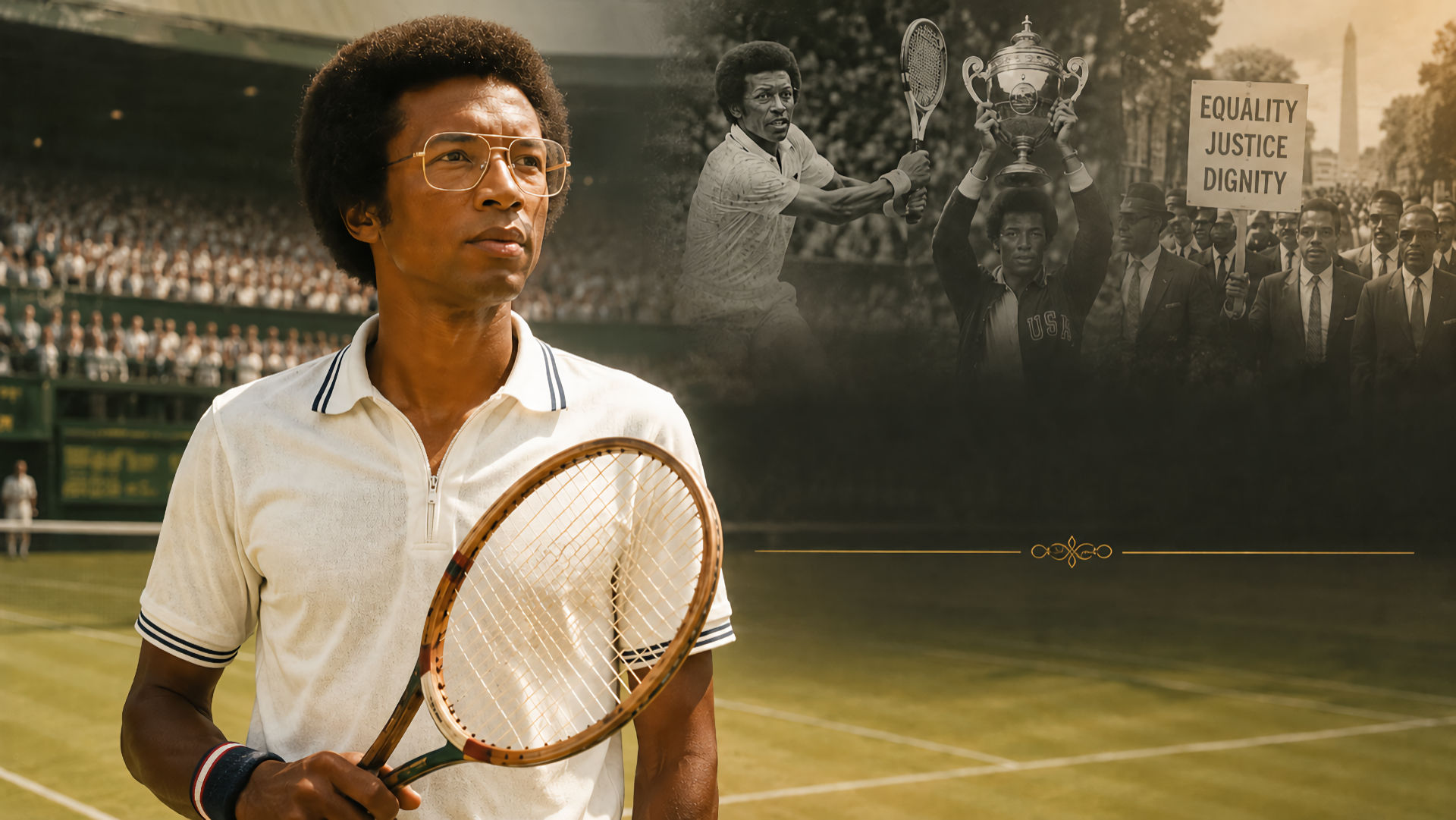
Arthur Ashe
Arthur Ashe was born on 10 July 1943 in Richmond, Virginia, a city where the lines of segregation were not just written into law, but woven into daily life. His full name was Arthur Robert Ashe Jr., and from the beginning, his childhood was shaped by both discipline and restriction. His father, Arthur Ashe Sr., worked as a caretaker and special policeman for Brook Field, a large public park that included tennis courts, a swimming pool, baseball diamonds, and playgrounds. For many children, that would have sounded like paradise. For a Black child in the American South in the 1940s and 1950s, it was also a reminder of who was allowed to use public spaces freely and who was not.
Ashe’s mother, Mattie Cordell Cunningham Ashe, died when he was still young, a loss that marked his childhood deeply. His father became the central figure in his upbringing, raising Arthur and his younger brother Johnnie with strict rules and high expectations. Ashe Sr. discouraged rough sports such as American football, partly because Arthur was small and slightly built, and partly because he wanted to protect his son from unnecessary harm. Tennis, by contrast, offered discipline, control, and focus. It was not the most obvious path for a Black boy in segregated Richmond, but it would become the route by which Ashe challenged the world.
The young Arthur first picked up a tennis racket almost by chance, living so close to the courts at Brook Field. He had natural coordination, but what stood out even more was his calmness. He was not a loud or showy child, and he did not have the physical explosiveness that people often associate with sporting prodigies. Instead, he learned quickly, watched carefully, and absorbed advice. His early promise was noticed by Dr Robert Walter Johnson, a physician from Lynchburg, Virginia, who had already helped develop the career of Althea Gibson, the first Black player to win Grand Slam titles.
Johnson became one of the most important mentors in Ashe’s life. Through his American Tennis Association programme, he trained young Black players who were excluded from many white-run clubs and tournaments. Johnson taught Ashe not only how to play, but how to behave under pressure. He insisted on sportsmanship, emotional control, precise footwork, and tactical intelligence. Ashe learned that his game would have to be sharp, but so would his character. In a world waiting to judge him more harshly than others, composure became both a tennis skill and a survival strategy.
Richmond gave Ashe his first lessons in unfairness, but it also gave him the tools to answer it. He understood early that talent alone would not be enough. He would need discipline, education, patience, and the ability to carry himself with dignity in places that had not been built to welcome him. The tennis court became more than a patch of painted lines and netting. It became the space where a quiet boy from Virginia began preparing to confront a much louder world.
Finding Freedom on the Tennis Court
As Arthur Ashe grew older, his talent became impossible to ignore, but talent did not erase the barriers around him. In Virginia, segregation limited the tournaments he could enter and the facilities where he could train. He could become very good, but he could not easily gain the match experience needed to become great. That was the strange cruelty of his early development: the better he became, the more obvious it was that Richmond could not contain his ambition. His ability had outgrown the system that surrounded him.
To develop further, Ashe needed access to competition beyond the restricted world of segregated tennis. In his teenage years, he spent time in St Louis, Missouri, where he lived with a family connected to the tennis community and attended Sumner High School. This move gave him better opportunities to compete, train, and prepare for college. It also placed him in an environment where his academic and athletic futures could be taken seriously together. Ashe was never simply a sportsman being pushed through school because he could win matches. He was intelligent, thoughtful, and increasingly aware that education would matter long after the applause faded.
His game developed around precision and intelligence rather than brute force. Ashe had a graceful serve, a calm temperament, and a willingness to think his way through matches. He was not the type of player who seemed to be fighting the court. He looked as if he were solving it. His backhand was clean, his movement efficient, and his approach to pressure unusually mature for someone so young. That maturity was partly personality, partly training, and partly the product of growing up in a world where one careless reaction could be used against him.
In 1963, Ashe earned a place at the University of California, Los Angeles, better known as UCLA. This was a major step, not just because UCLA had a strong tennis programme, but because it placed him on a national stage. He became part of a wider sporting and cultural landscape at a time when America was wrestling publicly with civil rights, race, education, and opportunity. Ashe was not marching at the front of every protest line in those years, but his presence itself carried meaning. A young Black man from segregated Virginia was now competing at one of the country’s most visible universities.
At UCLA, Ashe continued to grow as both a player and a person. He won the NCAA singles title in 1965 and helped UCLA claim the team championship. His success proved that he could compete with the best young players in the United States, but it also prepared him for something larger. College tennis gave him structure, national exposure, and confidence. It showed him that he belonged in elite competition, even when parts of the sporting world still treated him as an exception rather than an equal.
After graduating from UCLA, Ashe fulfilled his Reserve Officers’ Training Corps commitment by joining the United States Army and was stationed at the United States Military Academy at West Point. There, he worked in data processing and also served as an assistant coach for the Army men’s tennis team, remaining close to the sport while carrying out his military duties.
The tennis court gave Ashe a rare kind of freedom. Within its boundaries, he could not control the prejudices of spectators, officials, or opponents, but he could control his serve, his choices, his preparation, and his response. That mattered. Every match was a small act of self-definition. He was not merely trying to win points; he was learning how to occupy space in a world that often asked him to shrink.
Breaking Barriers in Amateur and Professional Tennis
By the mid-1960s, Arthur Ashe was no longer just a promising young player. He was becoming a national figure in American tennis, and his achievements carried historical weight whether he asked for that burden or not. In 1963, he became the first Black player selected for the United States Davis Cup team. The Davis Cup was not a minor honour. It was one of the most prestigious international team competitions in tennis, and representing the United States placed Ashe in a symbolic position at a complicated moment in American history.
His selection was important because tennis had long been associated with private clubs, social status, and racial exclusion. Ashe entered a world where tradition often wore a blazer and pretended prejudice was simply etiquette. He did not respond with public fury, at least not in the way some expected. Instead, he played with elegance, discipline, and quiet force. That calm was sometimes mistaken for passivity, but it was more deliberate than that. Ashe understood that breaking barriers required more than being allowed through a door. It required staying there, winning there, and making it harder for anyone to close the door behind him.
In 1968, Ashe achieved one of the defining victories of his career when he won the US Open. It was the first year of the Open Era, when major tournaments allowed both amateurs and professionals to compete together. Ashe, still officially an amateur because of his military obligations, defeated Tom Okker in the final. The victory made him the first Black man to win the US Open singles title. It was a moment of enormous sporting importance, but also one of historical contradiction. Ashe had won one of the biggest tournaments in the world, yet because of his amateur status, he could not accept the prize money in the same way a professional champion would.
That same year, the world around him seemed to be cracking open. Martin Luther King Jr. and Robert F. Kennedy were assassinated. Protests, war, civil rights struggles, and generational conflict dominated public life. Ashe’s triumph did not happen in a neat sporting bubble. It came during a period when questions of race, justice, patriotism, and protest were everywhere. Some expected him to speak more forcefully, and others to remain politely silent. Ashe would spend much of his life navigating that tension, refusing to be anyone’s simple symbol.
After completing his military service in 1969, Ashe joined the professional ranks and continued to compete internationally. His life became one of travel, tournaments, scrutiny, and responsibility. He was admired for his skill, but also watched as a representative of something larger than himself. That pressure can flatten a person into a headline, but Ashe resisted that. He remained thoughtful, sometimes cautious, sometimes quietly radical, and always aware that his choices had consequences beyond his own career.
Breaking barriers did not mean that everything suddenly became easier. Ashe still faced racism, exclusion, and political complexity. He was denied a visa to play in South Africa because of apartheid, a decision that helped sharpen his activism against that regime. Tennis had given him international visibility, but visibility came with obligations. Ashe was beginning to understand that he could not separate the player from the citizen. The question was no longer just how far his talent could take him. It was what he would do with the platform once he got there.
Grand Slam Glory and a Place in Sporting History
Arthur Ashe’s career reached its most famous peak at Wimbledon in 1975. By then, he was already respected as a major champion and a significant figure in tennis history, but Wimbledon carried a special aura. The tournament’s traditions, grass courts, and global prestige made it a stage unlike any other. Ashe arrived as a skilled and experienced player, but not as the favourite. Standing across from him in the final was Jimmy Connors, the defending champion, a younger, powerful, aggressive player who seemed to represent the future of the sport.
Connors hit hard, played fiercely, and thrived on intimidation. Ashe knew that trying to outmuscle him would be foolish. Instead, he built one of the most intelligent match plans in Grand Slam history. He varied the pace, used slices, disrupted rhythm, and denied Connors the clean power exchanges he wanted. It was tennis as chess, if chess involved more sweating and fewer people pretending they understand the Sicilian Defence. Ashe’s strategy was patient, subtle, and ruthless in its own quiet way. He made Connors uncomfortable, then kept him there.
Ashe won the final in four sets, becoming the first Black man to win the Wimbledon singles title. It remains one of the most celebrated victories in tennis because it combined sporting excellence with tactical brilliance and cultural significance. Ashe did not simply win because he played well. He won because he understood the match better than his opponent did. He recognised that intelligence could be a weapon, and on that day, he used it beautifully. The image of him lifting the Wimbledon trophy became one of the defining photographs of twentieth-century sport.
His Grand Slam record placed him among the greats. He won the US Open in 1968, the Australian Open in 1970, and Wimbledon in 1975. He also played a crucial role in Davis Cup victories for the United States. Yet Ashe’s greatness cannot be measured only by titles. There have been players with more trophies, longer periods of dominance, and louder public personas. Ashe’s place in history rests on something broader. He changed what people thought was possible in a sport that had not been built with players like him in mind.
The dignity with which he carried success was central to his public identity. Ashe did not behave as if victory had freed him from responsibility. If anything, success expanded the circle of issues he felt compelled to address. He spoke about race, apartheid, education, and access to opportunity. He believed tennis should not remain a closed world of private clubs and inherited privilege. He wanted young people, especially young Black players, to see that excellence could belong to them too.
By the late 1970s, Ashe had secured his place in sporting history, but his playing career was nearing its end. Heart problems forced him to retire from competitive tennis in 1980. For many athletes, retirement brings a painful loss of identity. For Ashe, it became a transition. He had been a champion on court, but the next stage of his life would ask for a different kind of courage. The trophies would remain, polished and admired, but they were no longer the centre of the story.
Illness, Activism, and a New Public Mission
Away from the court, Ashe’s personal life also took on a new shape. In 1977, he married Jeanne Moutoussamy, a talented photographer whose own work would later help preserve the more private side of Ashe’s life and legacy. The couple adopted a daughter, Camera, in 1986, giving Ashe a family life that stood in gentle contrast to the public pressure surrounding his fame, activism, and later illness. Jeanne’s photographs of Arthur and Camera would later become part of the moving book Daddy and Me, a portrait of their father-daughter relationship during the final chapter of his life.
After retiring from tennis, Arthur Ashe moved into a public life that revealed the full depth of his character. He worked as a commentator, writer, campaigner, and advocate, using his intelligence and reputation to address issues far beyond sport. He remained involved in tennis, but he refused to let tennis define the limits of his voice. He wrote about African American athletes, supported education, challenged racial injustice, and continued to speak against apartheid in South Africa. His activism was thoughtful, sometimes measured, but never empty.
Health problems had already changed the course of Ashe’s life. In 1979, he suffered a heart attack, a shocking event for a man still relatively young and known for athletic discipline. He underwent heart surgery and later required further medical treatment. During one of these procedures, he received a blood transfusion. At the time, before routine screening for HIV was fully in place, contaminated blood supplies posed a terrible hidden danger. Ashe later contracted HIV, almost certainly through a transfusion connected with his heart surgery. It was an appalling twist in a life already shaped by unfairness.
For several years, Ashe kept his diagnosis private. This was not unusual in the climate of the 1980s and early 1990s, when HIV and AIDS were surrounded by fear, misinformation, stigma, and moral judgment. Public understanding was often poor, and many people living with the virus were treated with cruelty rather than compassion. Ashe’s privacy was eventually broken when a newspaper learned of his condition. Faced with unwanted exposure, he held a press conference in 1992 and confirmed that he had AIDS. It was a moment of personal pain, but also one of public courage.
Once his condition became known, Ashe turned it into another mission. He established the Arthur Ashe Foundation for the Defeat of AIDS and worked to improve awareness, education, funding, and compassion. He did not present himself as a tragic figure waiting quietly in the wings. He used the time he had to push for better public understanding. He spoke about medical research, prevention, and the need to treat people with AIDS as human beings rather than warnings, scandals, or statistics.
His activism did not stop with AIDS awareness. In 1992, he was arrested outside the White House during a protest over the treatment of Haitian refugees. Even while seriously ill, he continued to connect his own life to wider questions of justice. This was one of the most striking things about Ashe. He did not retreat into private suffering, although he would have had every right to do so. Instead, he widened his concern. He seemed to understand that pain could either close a person down or open them further to the pain of others.
Arthur Ashe died on 6 February 1993 at the age of 49. His death came far too early, and it prompted grief across sport, civil rights circles, public health communities, and beyond. Yet the final years of his life did not diminish him. They revealed him. The same composure that had helped him survive pressure on the tennis court became moral clarity in the face of illness and stigma. He had once used a racket to challenge assumptions. In the end, he used his voice.
Arthur Ashe’s Legacy Beyond the Baseline
Arthur Ashe’s legacy is often introduced through a list of firsts, and those firsts matter. He was the first Black man to win the US Open, the first Black man to win Wimbledon, and the first Black player selected for the United States Davis Cup team. These achievements were not symbolic decorations added to an ordinary career. They were breakthroughs in a sport that had long reflected the exclusions of the societies around it. Ashe’s success forced tennis to confront its own boundaries, even if that confrontation was slower and more uncomfortable than many wanted to admit.
Yet to remember Ashe only as a barrier-breaker is to make his life smaller than it was. He was also a thinker, a writer, a historian of Black athletic achievement, and a man who believed that sport could be connected to citizenship. His three-volume work, A Hard Road to Glory, examined the history of African American athletes and helped preserve stories that had too often been overlooked. That project showed how seriously he took memory. Ashe knew that progress is fragile when people forget who struggled, who was excluded, and who made later victories possible.
In tennis, his influence can be felt in every conversation about access, representation, and responsibility. Players who came after him did not inherit a perfect sport, but they inherited one in which Ashe had already widened the path. His example mattered not because he made racism vanish, which of course he did not, but because he proved that excellence and principle could stand together. He did not ask athletes to become politicians in sportswear, forever issuing statements between serves. He showed something subtler and more demanding: that public success creates public responsibility.
His name is now attached to Arthur Ashe Stadium in New York, the largest tennis stadium in the world and the centrepiece of the US Open. There is something deeply fitting about that. The tournament he won in 1968, at a time when America was divided and burning with conflict, now honours him in its most visible arena. Every year, crowds gather there to watch new champions rise. Some know his story in detail, while others may only recognise the name. But the name itself stands as a reminder that tennis history is not only about rankings and records. It is also about who was allowed to play, who refused to be excluded, and who used victory to serve something larger.
Ashe’s life also remains powerful because it resists easy categories. He was calm but not passive. He was patriotic but willing to criticise injustice. He was ambitious but not self-absorbed. He was private, but when forced into the public glare of illness, he transformed that exposure into advocacy. These tensions make him human. They also make him more impressive, because his courage was not loud or theatrical. It was steady, deliberate, and often costly.
Arthur Ashe once said that true heroism was not the urge to surpass others at any cost, but the urge to serve others at whatever cost. That idea captures the arc of his life. He began as a boy learning tennis in segregated Richmond, found his way onto the world’s greatest courts, won titles that changed sporting history, and then used his platform to confront injustice, disease, and indifference. His story is not simply about a champion who happened to care. It is about a man who understood that winning was only the beginning. His greatest match was never just against the opponent across the net, but against the limits people tried to place on dignity, opportunity, and compassion.
Arthur Ashe FAQ
Arthur Ashe was an American tennis player, writer, and activist. He became the first Black man to win the US Open, the Australian Open, and Wimbledon singles titles, and he later used his public platform to campaign on civil rights, apartheid, education, and AIDS awareness.
Arthur Ashe was born on 10 July 1943 in Richmond, Virginia. He grew up during segregation in the American South, an experience that shaped both his tennis career and his later activism.
Arthur Ashe’s most famous tennis victory came at Wimbledon in 1975, when he defeated Jimmy Connors in the men’s singles final. He was the first Black man to win the Wimbledon singles title.
Arthur Ashe became increasingly involved in activism as his career developed. He spoke out against apartheid in South Africa, supported civil rights causes, promoted education, and later campaigned for AIDS awareness after publicly revealing his own diagnosis in 1992.
Arthur Ashe died on 6 February 1993 from AIDS-related pneumonia. He had contracted HIV through a blood transfusion linked to earlier heart surgery, before routine blood screening made transfusions safer.