The Battle of the Coral Sea
By May 1942, the Pacific War had become a map of alarming Japanese advances. Since the attack on Pearl Harbour in December 1941, Japan had pushed through Hong Kong, Malaya, Singapore, the Philippines, the Dutch East Indies, and parts of New Guinea with unnerving speed. For the Allies, especially Australia and the United States, the question was no longer whether Japan could expand, but where it would be stopped. The answer would emerge in a stretch of ocean north-east of Australia, where geography, codebreaking, and carrier aviation collided in a battle unlike anything fought at sea before.
The Japanese objective was not simply to win another naval engagement. Their wider aim was to strengthen their defensive perimeter and threaten Allied communications between Australia and the United States. Port Moresby, on the south coast of New Guinea, was central to that plan. If Japan captured it, aircraft based there could menace northern Australia and make Allied operations in the region far more difficult. Tulagi, in the southern Solomon Islands, also mattered because it could support reconnaissance aircraft and extend Japanese reach across the Coral Sea. Together, these targets formed the core of Operation MO, Japan’s plan to dominate the approaches to Australia without having to invade Australia itself.
The plan relied on speed, coordination, and the assumption that Japan still held the initiative. Japanese forces would occupy Tulagi first, then move against Port Moresby by sea. The invasion force would be covered by naval aircraft, including the light carrier Shōhō and the fleet carriers Shōkaku and Zuikaku. On paper, this gave Japan a formidable shield. In practice, it created a scattered operation in which carriers, transports, cruisers, destroyers, and reconnaissance units all had to perform perfectly across a vast ocean. That is always a polite way of saying, “plenty of things could go sideways.”
For the Allies, the stakes were obvious. Australia had already seen Darwin bombed in February 1942, and Japanese forces at Rabaul were uncomfortably close. Port Moresby was not just a dot on a map. It was a vital base, a shield for northern Australia, and a launching point for future Allied operations in New Guinea. Losing it would have forced the Allies onto the back foot at exactly the moment they were trying to recover from months of disaster.
So the road to the Coral Sea began as a Japanese offensive, but it did not unfold against a blind enemy. The Allies had one crucial advantage before the first aircraft took off. They knew enough to suspect what was coming.
Breaking the Codes: How the Allies Saw the Threat Coming
The Battle of the Coral Sea was not won by intelligence alone, but without intelligence, the Allies might not have been there in time at all. By April 1942, Allied codebreakers had made serious progress against Japanese naval communications. Signals intelligence revealed that a major Japanese move through the Coral Sea was likely, and Port Moresby appeared to be the probable target. This gave Admiral Chester W. Nimitz and other Allied commanders a precious chance to respond before Japanese transports were already ashore.
The intelligence picture was still incomplete. The Allies knew enough to act, but not enough to see every moving part clearly. They understood that Japan intended to operate in the Coral Sea, but the exact position of Japanese carrier forces remained uncertain. That uncertainty mattered because aircraft carriers were not static fortresses. They were mobile airfields, and in 1942, their ability to strike from over the horizon made them both powerful and difficult to locate. The battle would become a contest of interpretation as much as firepower.
Australia played an important intelligence and operational role. The Fleet Radio Unit Melbourne, known as FRUMEL, was jointly run by the Royal Australian Navy and the United States Naval Intelligence Service, and it provided valuable intelligence during the battle and the wider Pacific campaign. Australian coastwatchers and reconnaissance aircraft also helped track Japanese movements across the region. It was not glamorous work in the cinematic sense. No one kicks down a door in a radio intercept room. But in naval war, hearing the enemy before he sees you can be worth more than an extra gun turret.
The Allied response centred on two American aircraft carriers, USS Yorktown and USS Lexington. Yorktown’s Task Force 17 and Lexington’s Task Force 11 moved into the Coral Sea under the overall command of Rear Admiral Frank Jack Fletcher. A separate Allied cruiser force, including HMAS Australia and HMAS Hobart, came under Rear Admiral John Crace and would later be tasked with blocking the approach to Port Moresby through the Jomard Passage. This was a combined Allied effort, with American carriers forming the striking arm and Australian and American surface ships helping guard the invasion route.
Yet even with good intelligence, the Allies were not omniscient. They could anticipate the Japanese plan, but they still had to find the enemy in a huge expanse of water. Carrier warfare placed a premium on scouting, weather, radio discipline, fuel management, and luck. A commander might make the right decision based on the wrong report, or the wrong decision based on a report that seemed perfectly convincing at the time. Coral Sea would show that intelligence could bring fleets into the same theatre, but it could not remove the fog of war. It merely handed everyone a torch and invited them to stumble around in the dark more efficiently.
Carriers Without Battleships: A New Kind of Naval Battle Takes Shape
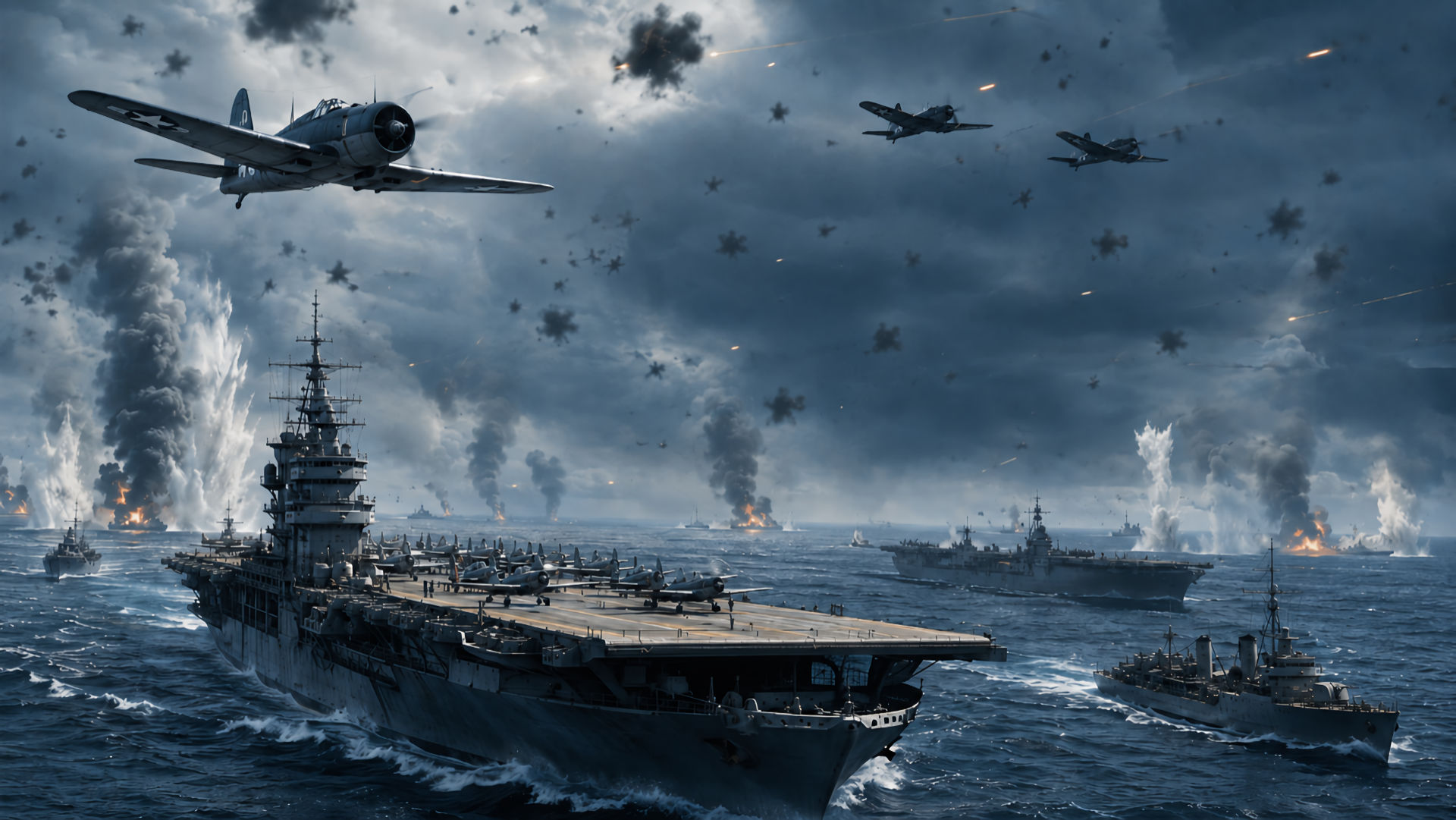
For centuries, naval battles had been decided by ships that could see one another. Even in the age of steel battleships, the central idea remained familiar: close the range, fire heavy guns, and let armour, accuracy, and nerve decide the issue. Coral Sea broke that pattern. It became the first major naval battle in which the opposing surface fleets did not directly sight or fire upon each other. The decisive blows came instead from aircraft launched by carriers, searching across hundreds of miles of ocean.
This changed the role of command. Fletcher, Takagi Takeo, and the other senior officers were not simply arranging ships into lines of battle. They were managing floating airfields. They had to decide when to launch search aircraft, when to hold back fighters for defence, when to commit strike groups, and how far they could push ships that constantly needed fuel. A carrier that had no aircraft ready at the right moment was just a large, expensive target with a very flat hat. Timing became everything.
The aircraft themselves were specialised tools. Dive bombers tried to plunge onto targets from above, torpedo bombers came in low and dangerously exposed, and fighters attempted to protect friendly strike aircraft while disrupting the enemy’s. Every sortie required coordination between pilots, aircrew, deck crews, anti-aircraft gunners, and commanders who often had only partial information. Weather could hide a carrier. A mistaken sighting could send a strike group in the wrong direction. A damaged flight deck could turn a powerful carrier into a crippled platform in minutes.
Japan entered the battle with highly skilled carrier air groups and the confidence built from earlier victories. Shōkaku and Zuikaku were modern fleet carriers, and Japanese naval aviation had already demonstrated its lethal effectiveness at Pearl Harbour and across the early Pacific campaigns. The United States, however, had carriers that had escaped destruction at Pearl Harbour and crews learning fast under pressure. Yorktown and Lexington were not invincible, but they represented the Allied ability to hit back far from land.
Meanwhile, Rear Admiral Crace’s surface force had a different task. His ships could not duel the Japanese carrier force directly, but they could block the invasion route towards Port Moresby. HMAS Australia, HMAS Hobart, USS Chicago, and accompanying destroyers were sent towards the Jomard Passage to stand between the Japanese transports and their objective. This exposed them to air attack without the same level of carrier air cover enjoyed by the main Allied force. It was a dangerous job, and in the grand tradition of dangerous jobs, it came with excellent views and absolutely no comfort.
First Strikes and False Sightings: Confusion Across the Ocean
The battle opened around Tulagi. Japanese forces landed there on 3 May 1942, aiming to establish a forward base for reconnaissance and seaplane operations. On 4 May, aircraft from USS Yorktown struck Japanese ships around Tulagi, sinking the destroyer Kikuzuki and three minesweepers, damaging other vessels, and destroying aircraft that could have supported Japanese scouting. The raid did not stop the wider Japanese operation, but it alerted the Japanese that American carriers were nearby and reduced some of their reconnaissance capacity.
From that point, the battle became a hunt. Both sides knew the enemy carriers were somewhere in the region, but “somewhere” is a deeply unhelpful word when the region is an ocean. On 5 and 6 May, opposing forces searched, manoeuvred, refuelled, and tried to interpret scattered reports. At one point, the American and Japanese carrier forces came relatively close without detecting each other. This was not a clean chess match. It was more like two people trying to play chess in separate rooms while occasionally being handed blurry photographs of the board.
On 7 May, mistaken sightings shaped the day. American aircraft believed they had found major Japanese carriers, but instead struck the light carrier Shōhō, which was supporting the invasion force. Lexington and Yorktown launched aircraft against her, and Shōhō was overwhelmed by bombs and torpedoes. Her sinking produced one of the battle’s most famous American radio messages: “Scratch one flattop.” It was a real success, and it threatened the Japanese invasion plan by removing important air cover.
At almost the same time, Japanese aircraft made their own error. A scout reported what appeared to be the main American carrier force, but the target was actually the destroyer USS Sims and the oiler USS Neosho. Japanese aircraft attacked, sinking Sims and leaving Neosho badly damaged and drifting. It was a costly blow for the Americans, especially to the men aboard those ships, but strategically it meant the main American carriers had not been found that day. In a battle where carriers were the true prize, both sides had spent major effort striking secondary targets.
Crace’s force also came under attack on 7 May while attempting to block the Japanese route towards Port Moresby. Japanese torpedo bombers attacked the Allied cruisers near the Jomard Passage, but skilful manoeuvring helped the ships avoid the torpedoes. Several Allied personnel were wounded, but the ships survived. That mattered because Crace’s presence helped maintain pressure on the invasion route, forcing Japan to consider whether its transports could continue without sufficient protection.
Lexington Lost, Shōkaku Crippled: The Battle Reaches Its Breaking Point
On 8 May, the battle finally became the carrier duel both sides had been trying to force. This time, the opposing carrier forces found each other. American aircraft from Yorktown and Lexington flew against Shōkaku and Zuikaku, while Japanese aircraft struck at the American carriers. The sea itself remained mostly empty of traditional gunnery drama. The real battle was taking place in the sky, above flight decks, through anti-aircraft fire, and in the terrifying seconds when pilots committed to bombing and torpedo runs.
The American strike hit Shōkaku hard. Bombs damaged her flight deck badly enough that she could no longer launch aircraft effectively. Zuikaku escaped physical damage by sheltering under cloud and weather, but her air group suffered losses. That distinction mattered greatly. A carrier could survive intact and still be weakened if too many trained aircrew and aircraft were gone. Carrier warfare consumed skill as well as steel, and skilled pilots were not easily replaced.
The Japanese attack on the American carriers was devastating. Yorktown was damaged but remained afloat and capable of movement. Lexington, larger and older, absorbed torpedo and bomb hits. At first, damage control seemed to have saved her. Fires were contained, aircraft were recovered, and there was hope that the ship might survive. Then petrol vapours ignited inside the carrier, triggering explosions and renewed fires. The situation became impossible. Lexington had to be abandoned and was later scuttled to prevent capture or further danger to her crew.
The loss of Lexington was a severe blow. She had been one of the United States Navy’s major fleet carriers, and hundreds of American sailors were killed. Yet the Japanese had also paid heavily. Shōhō was gone, Shōkaku was badly damaged, and Zuikaku’s air group had been depleted. Just as importantly, the Japanese invasion force heading for Port Moresby no longer had the level of air cover required to continue safely. Admiral Shigeyoshi Inoue ordered the Port Moresby operation postponed, and the seaborne invasion turned back.
That made the result complicated. In straightforward ship losses, Japan could claim a tactical success. The United States had lost Lexington, Sims, and Neosho, while Yorktown was damaged. Japan had lost Shōhō and suffered serious damage to Shōkaku, but its two fleet carriers had not been sunk. Yet wars are not scored like pub quizzes, however much admirals might secretly enjoy a laminated answer sheet. The central Japanese mission had failed. Port Moresby had not been taken by sea.
A Tactical Loss, a Strategic Win: Why Coral Sea Changed the Pacific War
The Battle of the Coral Sea ended without the simple clarity of a Trafalgar or a Tsushima. There was no enemy battle line shattered in sight of cheering crews. Instead, both sides withdrew with damage, losses, and incomplete knowledge of what they had actually achieved. In tactical terms, Japan had inflicted heavier ship losses on the Americans. In strategic terms, the Allies had stopped the seaborne invasion of Port Moresby, which was the reason the Japanese operation had been launched in the first place.
This mattered immediately. Port Moresby remained in Allied hands, preserving a vital base in New Guinea and helping protect the sea routes between Australia and the United States. Japan would later try to reach Port Moresby overland, leading to the brutal Kokoda Track campaign, but that was a much harder proposition than a successful amphibious landing. Coral Sea forced Japan away from its preferred route and disrupted the momentum that had carried its forces across the Pacific since December 1941.
The battle also had consequences beyond Port Moresby. Shōkaku’s damage and Zuikaku’s aircraft losses affected Japanese carrier strength before the Battle of Midway in June 1942. The absence or reduced effectiveness of those carriers mattered because Midway would become the decisive carrier battle of the Pacific War. Coral Sea did not guarantee victory at Midway, but it helped shape the conditions in which Midway was fought. In war, a battle can matter not only because of what it destroys, but because of what it prevents from being available next time.
For Australia, Coral Sea became a defining moment in the Pacific War. The threat to Australia in early 1942 was not imaginary, even if a full-scale invasion was unlikely. Japanese expansion threatened to isolate the country and make the South-West Pacific far more dangerous. Australian cruisers, reconnaissance aircraft, coastwatchers, and intelligence personnel all contributed to the Allied effort. The battle became a key symbol of Australian-American cooperation at a moment when Australia increasingly looked to the United States for security in the Pacific.
Most importantly, Coral Sea announced the arrival of a new age of naval warfare. Battleships had not disappeared, but the aircraft carrier had proved that it could decide events before opposing fleets ever saw one another. From this point forward, control of the air above the sea became central to control of the sea itself. Coral Sea was messy, costly, confused, and at times almost absurdly dependent on mistaken sightings and weather. In other words, it was war. But it also stopped Japan’s southward drive, protected Port Moresby, and showed that the Allied carrier forces could absorb punishment and still change the course of a campaign.
The Battle of the Coral Sea FAQ
The Battle of the Coral Sea was a naval battle fought from 4 to 8 May 1942 between Allied and Japanese forces during the Second World War. It was mainly fought by carrier-based aircraft rather than by ships directly firing on each other.
The battle was important because it helped stop Japan’s attempt to capture Port Moresby in New Guinea by sea. That mattered because Port Moresby was strategically important for the defence of Australia and the wider Allied position in the Pacific.
The result was mixed. Japan inflicted heavier ship losses on the Allies, including the sinking of USS Lexington, but the Allies achieved the more important strategic goal by stopping the Japanese advance towards Port Moresby.
It showed that aircraft carriers had become the dominant force in naval warfare. The opposing fleets never directly saw each other, which proved that future sea battles could be decided by aircraft launched from carriers over long distances.
The battle damaged Japanese carriers and aircraft strength shortly before the Battle of Midway. The absence or reduced availability of key Japanese carrier forces helped shape the situation at Midway in June 1942.