The Sandoz Chemical Spill
In the early hours of 1 November 1986, the Rhine was still one of Europe’s great working rivers. It flowed past borders, factories, towns, farms, waterworks and transport routes, carrying not only water but the shared confidence of several countries. The river had already suffered decades of industrial pollution, but it remained central to daily life, commerce and drinking water supplies across western Europe.
Near Basel, in Switzerland, the chemical industry was part of the landscape. The Schweizerhalle industrial area sat close to the river, a place where manufacturing, storage and transport were tightly packed beside one of the continent’s most important waterways. Among the facilities there was a Sandoz chemical warehouse, later identified in official accounts as Warehouse 956, storing large quantities of pesticides, solvents and other hazardous substances.
The danger was not simply that chemicals were present. Modern industrial life depends on dangerous materials being stored, moved and used safely, which is precisely why planning, separation, containment and emergency response matter so much. The disaster at Schweizerhalle would reveal a frightening truth: that the greatest threat was not only fire, but what happened when water used to fight that fire carried toxic material into the river.
Inside the warehouse were chemicals designed to kill pests, weeds and insects. Stored properly, such materials belonged within controlled industrial systems, labelled, contained and handled by trained staff. Released into a major river, however, they became a weapon against aquatic life, a spreading toxic pulse that did not respect fences, company boundaries or national borders.
The geography made the situation especially dangerous. Basel sits near the point where Switzerland, France and Germany meet, meaning that anything entering the Rhine there could quickly become an international incident. A local factory accident could become a cross-border environmental emergency before officials downstream had even fully understood what had happened.
The Rhine was not just scenery. It supplied drinking water, supported fisheries, fed wetlands, carried shipping and connected communities from Switzerland towards Germany, France and the Netherlands. A spill into such a river was never going to remain local, because the river itself was movement, and movement is exactly what turns contamination into crisis.
That is why the Sandoz spill became such a defining environmental disaster. It did not begin with a dramatic explosion that instantly announced the scale of the problem to the world. It began with a fire in a warehouse, a location that most people outside the chemical industry had never heard of, and a chain of decisions and vulnerabilities that would soon send poison downstream. The International Commission for the Protection of the Rhine later described the fire as one of the greatest human-made chemical disasters in Europe, involving a warehouse that contained around 1,200 tons of pesticides, solvents and other toxic chemicals.
The Night Schweizerhalle Caught Fire
The fire broke out in the early morning darkness, when most people nearby were asleep. Flames rose from the Sandoz warehouse at Schweizerhalle, and the scale of the blaze quickly made it more than a routine industrial emergency. Sirens sounded in the Basel area, smoke spread across the sky, and residents were told to remain indoors as authorities dealt with an incident whose chemical contents were not yet fully clear.
For firefighters, the immediate priority was obvious. A major blaze in a chemical storage facility could spread, explode or release dangerous fumes if it were not brought under control. Water was the essential tool, poured onto the burning building in enormous quantities, and in the urgency of the moment, the fire had to be attacked before it became something even worse.
The problem was that the water did not vanish once it had done its work. It mixed with the chemicals stored in the warehouse, flowed away from the fire site and entered drainage systems leading towards the Rhine. In effect, the emergency response created a second disaster, because the contaminated run-off became a moving chemical slick.
It is easy to judge that process harshly from a distance, with diagrams, reports and the comforting arrogance of hindsight. At the time, firefighters were trying to stop an industrial fire before it spread further through a hazardous site. The deeper failure lay in the lack of effective containment, because if a warehouse contains substances that can devastate a river, then the water used in a fire must also be treated as a dangerous material.
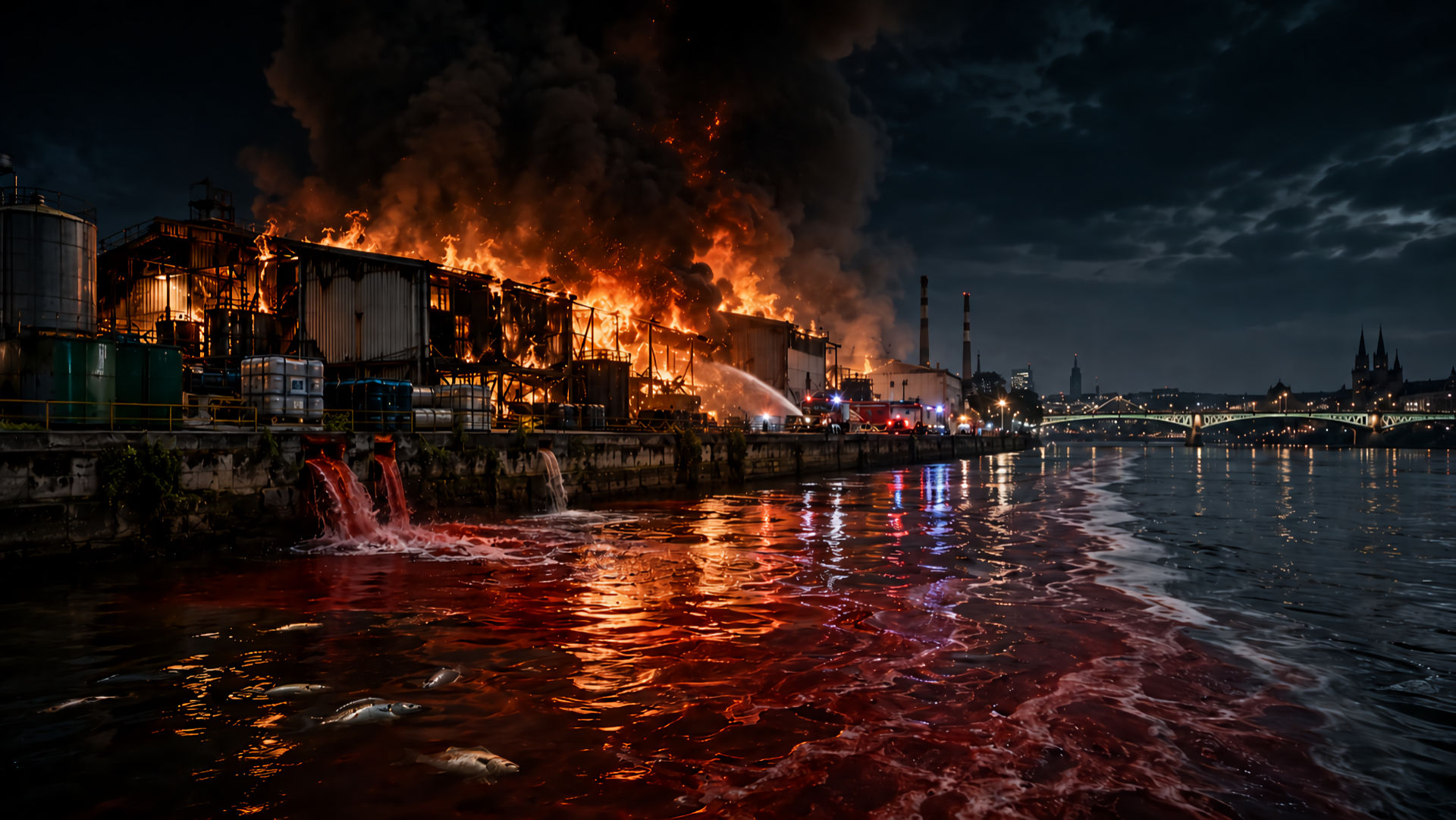
As the blaze continued, the scene became visually unforgettable. Smoke hung over Basel, the warehouse burned fiercely, and the Rhine began to change colour as contaminated water entered the river. The red appearance of the water made the catastrophe impossible to hide. Some environmental disasters are invisible at first, detectable only through instruments or delayed effects, but this one announced itself in a colour people could see.
That visibility mattered. The sight of a great European river turning red carried a symbolic force that data alone could never have achieved. It suggested injury, danger and something profoundly out of balance. For people living along the river, the question was no longer whether a factory had burned, but what that fire had done to the water that connected them.
The first hours were marked by uncertainty. Officials, water suppliers, and communities downstream needed to know what had entered the river, how toxic it was, how fast it was moving and what should be shut down. The answers came too slowly for many observers, and the delay would feed public anger in the days that followed. According to the Rhine commission’s later chronology, 10,000 to 20,000 cubic metres of firefighting water polluted with around 30 tons of pesticides and insecticides, plus 200 kilograms of mercury compounds, flowed into the Rhine.
Firefighting Water Turns into a Toxic Flood
Once contaminated water entered the Rhine, the disaster changed shape. It was no longer a burning building in Switzerland; it was a travelling pollution wave moving through a shared river system. Every kilometre downstream mattered, because the toxic mixture could affect water intakes, riverbanks, fish, invertebrates and the wider ecology that depended on the river.
The chemicals were not harmless industrial leftovers. They included pesticides and insecticides, substances created precisely because they interfere with living organisms. In a controlled agricultural or industrial context, their use is regulated and targeted. In a river, especially in such a concentrated pulse, they became indiscriminate killers of aquatic life.
This is where the word “spill” can sound too small. A spill suggests something tipped over on a floor, unpleasant perhaps, but containable with a mop and a strong sense of regret. At Schweizerhalle, the contaminated water became a toxic flood, travelling with the current and forcing communities far from the fire to respond to a disaster they had not caused.
The impact on drinking water supplies was immediate and alarming. Waterworks along the Rhine had to stop intake from the river because public health depended on not drawing contaminated water into supply systems. Some communities had to rely on alternative arrangements, including emergency drinking water distribution, which made the disaster painfully practical for people who had never seen the warehouse or worked in the chemical industry.
The pollution also exposed a communication problem. Downstream users needed rapid, precise information, but the early flow of information was criticised as inadequate. When hazardous substances move through a river, time is not a background detail; it is the difference between closing a water intake early and discovering too late that contamination has arrived.
Industrial disasters often reveal the hidden dependency of ordinary life. A glass of water, a brewery, a municipal supply, a fishery, a riverbank ecosystem, all of them can be affected by a single failure upstream. The Sandoz accident made that dependency impossible to ignore, because it showed how closely modern communities were tied to industrial risk.
The polluted water also entered the soil and groundwater around the site, creating concerns that did not end when the visible slick passed. A river can flush contamination downstream, but a site can retain pollutants in sediments, soil and groundwater for much longer. That meant the emergency had both a fast-moving public face and a slower environmental aftermath.
In the days after the fire, the disaster travelled through official channels as well as through the river. Water authorities, environmental agencies, governments and the public all demanded answers. The immediate question was how bad the damage would be, but the larger question was already forming: how could such a dangerous release have been possible in the first place? The Rhine commission reported that water intake for drinking water production was stopped between 9 and 18 November, and that around 25,000 inhabitants of one Middle Rhine town were supplied by drinking water storage trucks after riverbank filtrate supplies were halted.
The Red Rhine and the Death of River Life
The most powerful images of the Sandoz disaster were not only of the fire, but of the river after the chemicals arrived. The Rhine ran red, and dead fish appeared downstream. It was a disaster that people could see in the water, on the banks and in the stunned reaction of communities that had assumed industrial progress and environmental protection could somehow keep walking politely side by side.
The damage to river life was severe. Fish died in large numbers, and eels were especially badly hit. Smaller organisms suffered too, including the benthic life on and within the riverbed that forms part of the food web. A river is not simply water with fish in it; it is a living system of plants, animals, insects, microbes, sediments, currents and seasonal rhythms.
The death of visible fish made the disaster emotionally immediate. Chemical names can feel remote, especially when they arrive in official lists that look as though they were designed to make the human brain leave the room. Dead fish, by contrast, require no specialist training to understand. They were evidence that the river had been poisoned.
The eel losses became one of the grim symbols of the disaster. Eels are extraordinary migratory fish with complicated life cycles, and their presence in the Rhine was part of the river’s ecological identity. Reports of mass eel deaths made clear that the spill had not merely dirtied the water, it had struck at species already vulnerable to habitat change, barriers, pollution and overpressure.
There was also a psychological effect. For years, environmental campaigners had warned that industrial pollution could damage major rivers, but warnings are often easier for governments and companies to file away than corpses floating downstream. The Sandoz spill turned an abstract environmental argument into a public spectacle, and that changed the political temperature.
Not everything about the river’s recovery was as hopeless as the first scenes suggested. Rivers are dynamic systems, and the Rhine had tributaries, side channels and surviving populations that helped recolonise damaged stretches. Floods and flow also helped flush contamination, although that movement could carry pollutants further and create other concerns downstream.
That recovery should not make the disaster seem less serious. The fact that nature can sometimes heal does not excuse the wound. It is one thing for a river to recover from a shock, and quite another to treat the shock as acceptable because the river did not remain dead forever.
The Sandoz spill became a turning point because it was so visible, so dramatic, and so international. It showed that acute chemical disasters could cause immediate ecological collapse over long stretches of river, and it forced the question of prevention into the centre of European environmental policy. Eawag, the Swiss Federal Institute of Aquatic Science and Technology, later described catastrophic damage to aquatic life from toxic, red-coloured firefighting water. At the same time, the Rhine commission reported fish deaths along more than 400 kilometres, especially among eels and other species.
Downstream Shock, Public Anger, and International Pressure
The Sandoz disaster did not stop at the Swiss border, because rivers do not queue politely at customs. Once the pollution entered the Rhine, the accident became an international matter involving countries downstream and communities that had no control over the warehouse where the fire began. That made the public’s anger sharper, because people were being asked to absorb the consequences of someone else’s industrial failure.
In Germany, France and the Netherlands, officials followed the pollution wave and assessed the risk to water supplies and ecosystems. Waterworks closed intakes, public authorities issued warnings, and industries dependent on clean river water had to respond. The disruption was not theoretical, because the Rhine was woven into everyday services, from drinking water to production processes.
The political pressure grew quickly. Citizens wanted to know what had been stored, why contaminated firewater had not been contained, and why downstream warnings had not been faster or clearer. Environmental groups saw the accident as proof that voluntary industry controls and fragmented river management were not enough. Companies, meanwhile, faced a public relations disaster as well as an environmental one.
Sandoz was criticised for underestimating the storage risk and for the slowness of information. In a disaster involving dangerous chemicals, trust depends on speed and transparency. If the first question is “what is in the river?” and the answer arrives late, the public naturally begins to wonder what else is being withheld, overlooked or minimised.
The disaster also landed in a Europe already shaken by industrial and technological accidents. The Chernobyl nuclear disaster had taken place only months earlier in April 1986, and memories of the Bhopal gas tragedy in India in December 1984 were still raw. Schweizerhalle fitted into a wider fear that modern industry had grown powerful enough to harm whole populations and ecosystems when safety failed.
For river protection organisations, the accident became a brutal argument for stronger international cooperation. The Rhine did not belong to one company or one country. It crossed borders, supplied millions and carried pollution from one jurisdiction to another. That meant prevention, monitoring and emergency response had to be coordinated across the whole river basin, not patched together after each crisis.
The public anger was not merely emotional. It was also practical and justified. A river used for drinking water, ecology and industry had been turned into a carrier of pesticides and toxic compounds because dangerous substances were stored near the water without adequate emergency containment. People did not need to be scientists to understand that this was a systems failure.
What happened next mattered because the anger became policy pressure. Ministers from Rhine-bordering countries met, the International Commission for the Protection of the Rhine took on a stronger role, and the accident helped accelerate a new phase of river protection. The Rhine commission records that ministers met in November and December 1986, and that in October 1987 they adopted the Rhine Action Programme, aimed at distinctly and sustainably improving water quality.
The Disaster That Changed Chemical Safety in Europe
The Sandoz chemical spill is remembered as a catastrophe, but it is also remembered as a turning point. That does not make the disaster good; it means that the shock was so great, and the failure so public, that governments and industries were forced to change how they thought about chemical safety, monitoring and river protection.
One of the major lessons was the importance of containment. Firefighting water at hazardous industrial sites cannot be treated as ordinary water once it has mixed with chemicals. It must be held, collected and prevented from entering rivers, drains or groundwater. The Rhine commission later identified retention basins for firefighting water, safer storage of dangerous substances, alarm systems and improved warning centres as key measures after the disaster.
The Rhine Action Programme gave the recovery effort a structure. Its goals included bringing back species that had vanished, keeping the Rhine water suitable for the drinking water supply and reducing pollutants in river sediments. These targets were significant because they were not vague promises to do better at some misty point in the future. They were measurable aims, tied to international coordination.
Monitoring also improved. The disaster had shown that authorities needed better tools to detect pollutants, identify them quickly and track them as they moved through the river. In 1992, an international Rhine monitoring station at Weil am Rhein near Basel was established as a result of the accident, and later monitoring techniques became more sophisticated in detecting pollutant peaks in real time.
The river itself did recover in important ways. Eawag later noted that aquatic populations recovered relatively quickly, helped by migration from upper reaches, tributaries and side channels, as well as by the river’s natural cleansing processes. But recovery was not the same as forgetting. The visible disaster helped shift attention towards both acute accidents and chronic contamination from everyday pollutants.
There is a broader lesson here about environmental disasters. The most frightening failures are not always caused by one dramatic mistake. They often emerge from layers of normality, a warehouse in a familiar industrial zone, hazardous substances stored close to a river, emergency systems that work for fire but not for pollution, and warnings that move slower than water.
The Sandoz spill killed fish, damaged public trust and exposed weaknesses in chemical safety across borders. It also forced Europe to confront the reality that rivers are shared systems, and shared systems require shared responsibility. A company may own a warehouse, but no company owns the consequences once poison enters a river. More than anything, the disaster showed that prevention is cheaper, cleaner and less humiliating than apology. Once a river turns red and dead fish start appearing downstream, the lesson has already arrived far too late. The legacy of Schweizerhalle is not simply that the Rhine was poisoned in 1986, but that the disaster helped reshape the rules meant to stop the same thing from happening again. Eawag credits the disaster with major progress in chemical water quality monitoring, legal regulation and risk reduction in the chemical industry, while the Rhine commission records later measures on dangerous-substance storage, firefighting-water retention, warning systems and industrial plant security.
The Sandoz Chemical Spill FAQ
The Sandoz chemical spill was a major environmental disaster that happened in 1986 after a fire at a chemical warehouse near Basel, Switzerland. Contaminated firefighting water flowed into the Rhine, carrying toxic substances downstream.
The Rhine turned red because chemicals and dye-like substances from the burning warehouse entered the river with contaminated firefighting water. The colour became one of the most visible symbols of the disaster.
The Sandoz chemical spill is mainly remembered as an environmental disaster rather than a mass-casualty human disaster. Its most severe impact was on river life, especially fish and eels, along long stretches of the Rhine.
The environmental damage was caused by toxic chemicals, including pesticides and insecticides, entering the Rhine through contaminated firefighting run-off. These substances poisoned aquatic life and forced water intakes downstream to close.
The disaster became a turning point in European environmental policy and chemical safety. It highlighted the need for better containment of firefighting water, stronger monitoring, improved warning systems and international river protection.