
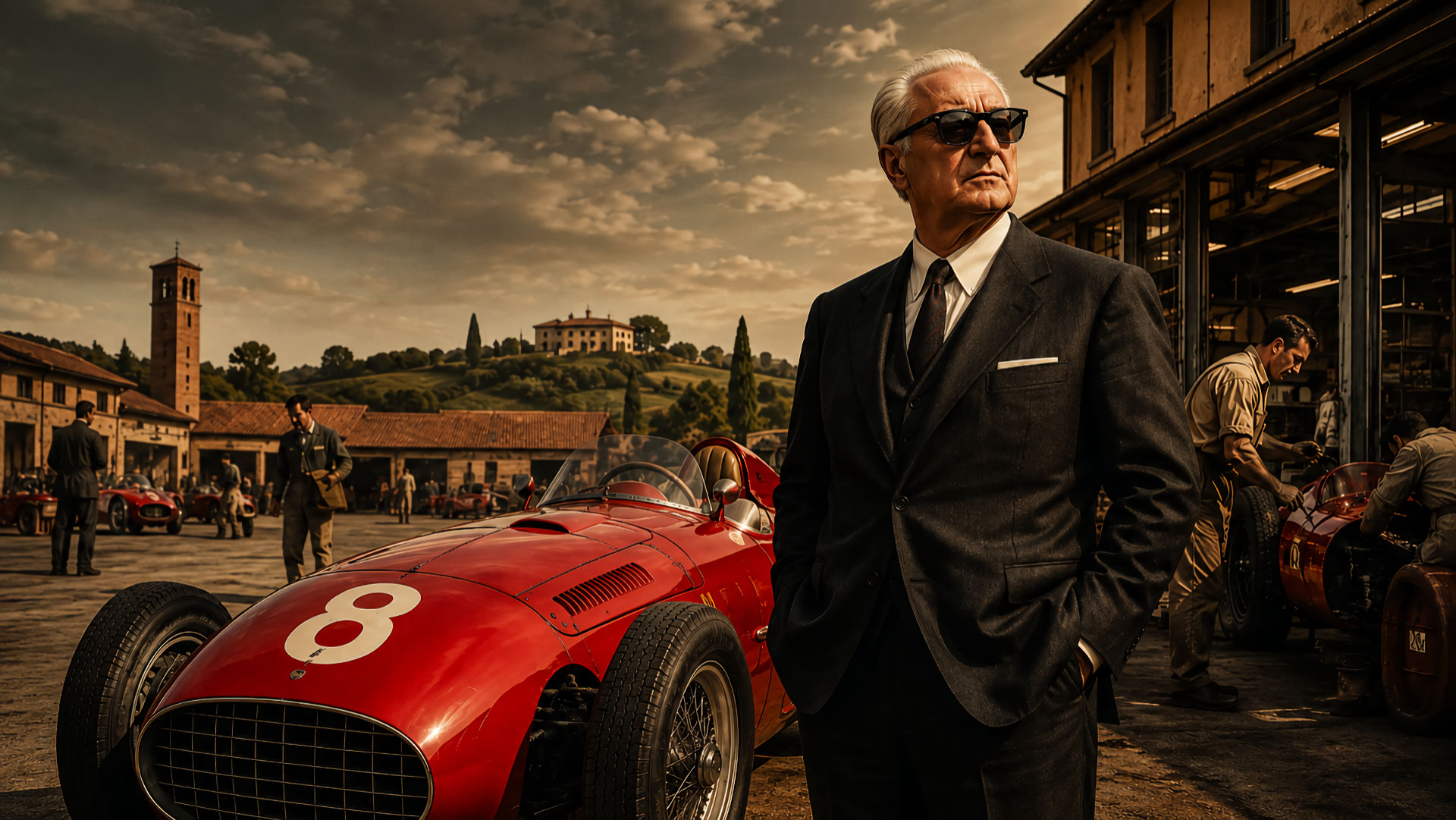
Enzo Ferrari
Enzo Anselmo Giuseppe Maria Ferrari was born in Modena, Italy, on 18 February 1898, although heavy snow reportedly delayed the official registration of his birth by two days. His father, Alfredo Ferrari, ran a small metalworking business, and young Enzo grew up close to tools, workshops, engines, and the restless mechanical energy of a country entering the modern age. Modena was not yet the spiritual home of red racing cars, roaring engines, and global luxury, but in Enzo’s childhood it already had the ingredients that would shape him: craftsmanship, ambition, pride, and a growing fascination with speed.
The moment that changed everything came in 1908, when Enzo’s father took him and his older brother Alfredo to watch motor racing near Bologna. It was not simply the noise or the danger that captivated him, but the theatre of the whole thing. Drivers were presented almost like modern knights, wrestling new machines around rough roads at terrifying speed, cheered by crowds who sensed they were watching the future arrive in goggles and dust. Enzo later remembered that day as the beginning of his obsession, although at the time it was probably less a career plan than a boy’s dream with petrol fumes attached.
His early life, however, was not a smooth road to glory. During the First World War, the Ferrari family was hit by tragedy. In 1916, both his father and his brother died during an outbreak of illness, leaving Enzo’s family emotionally and financially shaken. Enzo himself was called up for military service, but he became seriously ill and was discharged. The war left him with little money, few formal qualifications, and a future that looked alarmingly uncertain. For a young man with a taste for speed, the starting grid was not exactly lined with opportunity.
After the war, Ferrari tried to find work in the motor industry. He applied to Fiat, already one of Italy’s major car manufacturers, but was rejected. It was a humiliation he did not forget. That refusal helped forge one of the great themes of his life: if existing institutions would not open their doors, he would eventually build one of his own, preferably with a gate large enough for racing transporters and wealthy clients.
By the end of the 1910s, Enzo Ferrari was not yet a legend, or even close to becoming one. He was a grieving young man from Modena trying to turn his fascination with cars into a living. But the boy who had watched racing with wide eyes near Bologna had found his direction. The road ahead would take him into competition, but it would also reveal something more important: Enzo Ferrari’s greatest talent was not simply driving fast cars. It was understanding what fast cars could mean.
The Driver Who Found His Real Talent Elsewhere
Enzo Ferrari’s first serious steps into the motoring world came after the First World War, when he found work with Costruzioni Meccaniche Nazionali, usually known as CMN. The company converted surplus wartime vehicles for civilian use, which was not quite the glamorous racing career he may have imagined, but it put him close to cars and closer still to the world he wanted to enter. In 1919, Ferrari began competing as a driver, taking part in events such as the Parma to Poggio di Berceto hill climb and later the Targa Florio. He was brave, determined, and capable, but he was not the sort of driver who seemed destined to dominate Europe’s racing circuits by raw speed alone.
His career changed significantly in 1920, when he joined Alfa Romeo. At that time, Alfa was one of the most important names in Italian motorsport, and the association gave Ferrari access to better cars, better contacts, and a more serious competitive environment. He raced for Alfa Romeo through the 1920s, achieving some respectable results and building relationships with engineers, mechanics, wealthy enthusiasts, and fellow drivers. Those relationships mattered enormously. Ferrari was learning that racing was not just about the person holding the steering wheel, but about organisation, money, machinery, morale, and the careful management of ambition.
One of the most famous episodes from this period came in 1923, after Ferrari won a race at the Savio circuit near Ravenna. There, he met Count Enrico Baracca and Countess Paolina Baracca, the parents of Francesco Baracca, Italy’s celebrated First World War fighter ace. Baracca had painted a prancing horse on the side of his aircraft, and Countess Paolina later suggested that Ferrari use the symbol on his cars for good luck. Ferrari would eventually adopt the black prancing horse on a yellow background, yellow being the colour of Modena. It became one of the most recognisable emblems in the world, although at the time it was just a powerful symbol waiting for the right machine to carry it.
Ferrari’s personal life also moved forward during these years. In 1923, he married Laura Garello, a relationship that would become central, complicated, and often painful. Their son Alfredo, known as Dino, was born in 1932. Dino’s arrival helped persuade Enzo to step back from driving, but fatherhood was only one reason. Increasingly, Ferrari seemed more interested in shaping racing from the outside: selecting drivers, arranging cars, negotiating support, and building teams.
By the early 1930s, it was becoming clear that Enzo Ferrari’s destiny was not to be remembered as Italy’s finest racing driver. There were too many faster men for that. His true genius lay in recognising talent, feeding obsession, and building a racing operation with a personality as strong as any driver on the track. The next stage of his life would give that talent a name: Scuderia Ferrari.
Scuderia Ferrari and the Birth of a Racing Obsession
Scuderia Ferrari was founded in Modena in 1929, initially as a racing team rather than a car manufacturer. Its purpose was to prepare and run Alfa Romeo cars, especially for wealthy private drivers who wanted access to serious competition without having to manage the exhausting practical details themselves. The word “scuderia” means stable, which was fitting in more ways than one. Ferrari was gathering powerful machines, ambitious men, and a prancing horse symbol that would soon feel less like decoration and more like a declaration.
The early Scuderia Ferrari did not build road cars, and it did not yet represent the independent brand people know today. Instead, it functioned as Alfa Romeo’s racing partner and, increasingly, as its unofficial competition department. Ferrari proved to be a gifted organiser. He understood that racing success required more than mechanical brilliance. It needed discipline, secrecy, money, logistics, political instinct, and a sharp eye for human weakness. Drivers might win the applause, but Ferrari was learning how to control the conditions in which victory became possible.
During the 1930s, Scuderia Ferrari became a major force in European motorsport. It ran Alfa Romeo cars in a period when Italian racing prestige mattered deeply, both culturally and politically. Italy under Benito Mussolini promoted speed, technology, and national pride, and motorsport became part of that wider public spectacle. Ferrari was not a politician in the usual sense, but he understood power, image, and survival. He knew how to work within the realities of his time while keeping his eyes on the machinery, the drivers, and the next race.
His management style developed into something formidable. Ferrari could be charming when necessary, but he was also demanding, secretive, and emotionally guarded. He inspired loyalty in some and resentment in others. Drivers were heroes, but in Ferrari’s world they were also instruments of victory, and he was rarely sentimental when performance was at stake. This harshness would later become one of the central contradictions of his reputation. He loved racing with an almost religious intensity, but that love did not always make him gentle.
By the late 1930s, tensions with Alfa Romeo increased. Alfa wanted greater control over its racing activities, and Ferrari’s independence was becoming harder to contain. In 1937, Alfa Romeo brought its racing department more directly in-house, and Ferrari became involved with Alfa Corse. The arrangement did not last. In 1939, Ferrari left Alfa Romeo, reportedly bound by an agreement that prevented him from using the Ferrari name in connection with racing cars for several years.
That restriction could have been the end of the story, or at least a very inconvenient red flag waved in front of his ambitions. Instead, it pushed him towards independence. Enzo Ferrari had built a racing team around another company’s cars. Now, history was steering him towards the far greater gamble of building machines of his own.
War, Independence, and the First Ferrari Cars
After leaving Alfa Romeo, Enzo Ferrari created Auto Avio Costruzioni in Modena. Because of his agreement with Alfa, he could not yet put the Ferrari name on racing cars, which must have been mildly irritating for a man not exactly famous for modesty. In 1940, Auto Avio Costruzioni produced the Tipo 815, a racing car built for the Mille Miglia. It was not officially called a Ferrari, but it was an important step towards the future. The car represented Ferrari’s move from organiser to constructor, from the man behind the team to the man behind the machine.
The timing, however, could hardly have been worse. Italy entered the Second World War in 1940, and normal motor racing was pushed aside by military production, political chaos, and national crisis. Ferrari’s company shifted towards wartime manufacturing, producing machine tools and other equipment. In 1943, he moved operations from Modena to Maranello, a small town nearby. The move was partly practical, but it would prove historic. Maranello became inseparable from the Ferrari story, the place where engineering, mythology, secrecy, and noise would merge into one remarkably expensive ecosystem.
The war brought destruction to Ferrari’s new base. The factory at Maranello was bombed during Allied attacks in 1944 and again in 1945, damaging the facilities just as Ferrari was trying to prepare for a post-war future. Yet he rebuilt quickly. Italy emerged from the war battered and politically transformed, but there was also a hunger for renewal. Racing returned, and with it came an opportunity for Ferrari to build not merely a team, but a marque. This time, the cars would carry his own name.
In 1947, the first true Ferrari, the 125 S, made its debut. Designed with a 1.5 litre V12 engine associated with the engineer Gioachino Colombo, it set the tone for what Ferrari wanted his cars to be: technically ambitious, emotionally charged, and built for competition. The early results were mixed, but victory came soon enough. Ferrari famously described the first win as the beginning of a beautiful career, although his version of beauty usually involved stress, noise, and everyone else being expected to work harder.
Ferrari quickly understood that selling road cars could help fund racing. This was not because he was naturally drawn to luxury consumer culture. His heart belonged to competition, and road cars were, in part, a means of paying for it. Wealthy clients wanted beautiful, fast, exclusive machines, and Ferrari was willing to provide them if the money helped keep the racing operation alive. It was a practical arrangement wrapped in glamour.
By the late 1940s, Ferrari had become an independent manufacturer with growing credibility. In 1949, a Ferrari won the 24 Hours of Le Mans, announcing the company on one of motorsport’s greatest stages. The former Alfa Romeo man from Modena was no longer merely managing someone else’s dream. He had built his own, painted it red, and sent it roaring into history.
Triumph, Tragedy, and the Ferrari Myth
The 1950s turned Ferrari from an ambitious Italian constructor into a motorsport legend. Formula One began its modern world championship era in 1950, and Ferrari quickly became one of its defining names. In 1951, José Froilán González gave Ferrari its first Formula One World Championship Grand Prix victory at the British Grand Prix, defeating Alfa Romeo and giving Enzo a deeply symbolic triumph over his former employer. It was the sort of narrative racing people adore: engines, revenge, destiny, and just enough Italian drama to season the whole pot.
Ferrari’s first Formula One drivers’ titles followed with Alberto Ascari in 1952 and 1953. Ascari was brilliant, controlled, and fast, and his success established Ferrari as a championship force. At the same time, Ferrari was winning in sports car racing, including major endurance events such as Le Mans and the Mille Miglia. The company’s cars became objects of desire not merely because they were beautiful, but because they were proven in competition. The road cars and racing cars fed each other’s mythology. One sold the dream, the other risked lives to make the dream believable.
Yet Ferrari’s golden age was shadowed by grief. Motorsport in the 1950s and 1960s was extraordinarily dangerous, and many drivers died in racing cars. Ferrari’s teams experienced repeated tragedy, including the deaths of major figures such as Alberto Ascari in 1955, Eugenio Castellotti in 1957, Luigi Musso in 1958, Peter Collins in 1958, and Wolfgang von Trips in 1961. Not all died in Ferraris, but all belonged to the same brutal world in which speed and mortality travelled in close formation. Ferrari was accused by critics of treating drivers as expendable, like chess pieces in red overalls. That judgement may be too simple, but it reflects the hardness people saw in him.
The deepest personal blow came in 1956, when his son Dino died from muscular dystrophy at the age of just 24. Enzo was devastated. Dino had shown interest in engineering, and Ferrari later honoured him through engines and cars carrying the Dino name. From that point onward, Enzo increasingly dressed in black and became more withdrawn. The public image of “Il Commendatore” hardened into something almost operatic: the grieving patriarch, the remote commander, the man behind dark glasses watching others risk everything.
In 1957, Ferrari’s reputation suffered another severe blow after the Mille Miglia crash involving Alfonso de Portago. De Portago, his co-driver Edmund Nelson, and several spectators were killed when a Ferrari crashed near Guidizzolo. Enzo Ferrari faced legal scrutiny and was accused of responsibility, although he was eventually cleared. The crash contributed to the end of the Mille Miglia as a traditional open-road race, and it reinforced the growing sense that motor racing could no longer treat death as an unavoidable entry fee.
Through triumph and tragedy, the Ferrari myth grew stronger. Enzo Ferrari became both admired and feared, celebrated as a genius and criticised as ruthless. He built machines of astonishing beauty, but the legend was never polished smooth. It carried grief, danger, pride, and contradiction, which is probably why it endured.
The Old Man and the Prancing Horse Legacy
By the 1960s, Enzo Ferrari faced a challenge that passion alone could not solve: money. Racing was becoming more expensive, road car production was becoming more complex, and international competition was growing fiercer. Ferrari had already walked away from a proposed sale to Ford in 1963, a breakdown that helped ignite the famous Ford versus Ferrari rivalry at Le Mans. Ford responded with huge investment, and by the mid-1960s the American giant had beaten Ferrari at the race that Ferrari had once seemed to own. It was a bruising reminder that romance is lovely, but budgets also have horsepower.
In 1969, Ferrari sold a significant stake in the company to Fiat. The deal gave Ferrari financial stability while allowing Enzo to retain influence, especially over racing. For some purists, it marked the end of a fully independent era, but without outside support the company might have struggled to survive in its existing form. Ferrari was not simply a dreamer guarding a badge. He was practical enough to know when the dream needed stronger foundations, even if those foundations came with corporate paperwork attached.
In his later years, Enzo Ferrari became known as “Il Vecchio”, the Old Man. He rarely travelled to races outside Italy and increasingly ruled from Maranello, receiving reports, making decisions, and maintaining his aura of distance. His office became almost a throne room of Italian motorsport, and his presence hung over the company even when he was not physically at the circuit. He could still be difficult, still demanding, and still capable of playing drivers, engineers, and rivals against one another. The softer retirement version of Enzo Ferrari never really arrived. He was not built for garden centres and gentle hobbies.
The cars, meanwhile, became global symbols. Ferrari road cars combined racing heritage with luxury, design, and scarcity, turning the brand into something far larger than a manufacturer. It became an idea: Italian performance, beauty under pressure, danger made desirable, and a badge that suggested the owner had either excellent taste or a dangerously flexible approach to bank balances. Models such as the 250 series, the Daytona, the Testarossa, and the F40 helped carry the legend into popular culture. The F40, launched in 1987, was the last Ferrari developed during Enzo’s lifetime, and it felt like a final uncompromising statement: raw, fast, dramatic, and not especially interested in apologising.
Enzo Ferrari died on 14 August 1988 at the age of 90. In characteristically private fashion, the public announcement came only after his funeral had taken place. By then, the company he built had become one of the most famous brands in the world, but his legacy was never only about cars. It was about obsession turned into institution, grief turned into discipline, and ambition turned into a sound that still makes people turn their heads. Enzo Ferrari was not an easy man to admire without reservation. He could be cold, controlling, and unforgiving. Yet he changed motorsport, transformed Maranello, and created a symbol recognised far beyond racing. The prancing horse began as a mark of luck, borrowed from a fallen airman’s family. In Enzo Ferrari’s hands, it became something else entirely: a promise that speed, beauty, pride, and risk could be fused into one unforgettable machine.
Enzo Ferrari FAQ
Enzo Ferrari was an Italian racing driver, team manager and entrepreneur best known as the founder of Ferrari. He created Scuderia Ferrari in 1929 and later built Ferrari into one of the most famous names in motorsport and luxury car manufacturing.
Enzo Ferrari was born in Modena, Italy, in 1898. His connection with Modena and nearby Maranello became central to the Ferrari story and to the identity of the company he created.
Yes. Enzo Ferrari competed as a racing driver in the early part of his career, although he became far more influential as a team organiser, manager and founder than as a driver.
Scuderia Ferrari was founded by Enzo Ferrari in 1929. It began as a racing team and became one of the most famous names in motorsport, particularly through its long association with Formula One.
Enzo Ferrari is important because he helped shape modern motorsport and built a brand that became globally associated with speed, luxury, engineering and racing success. His influence reaches far beyond cars alone.


