
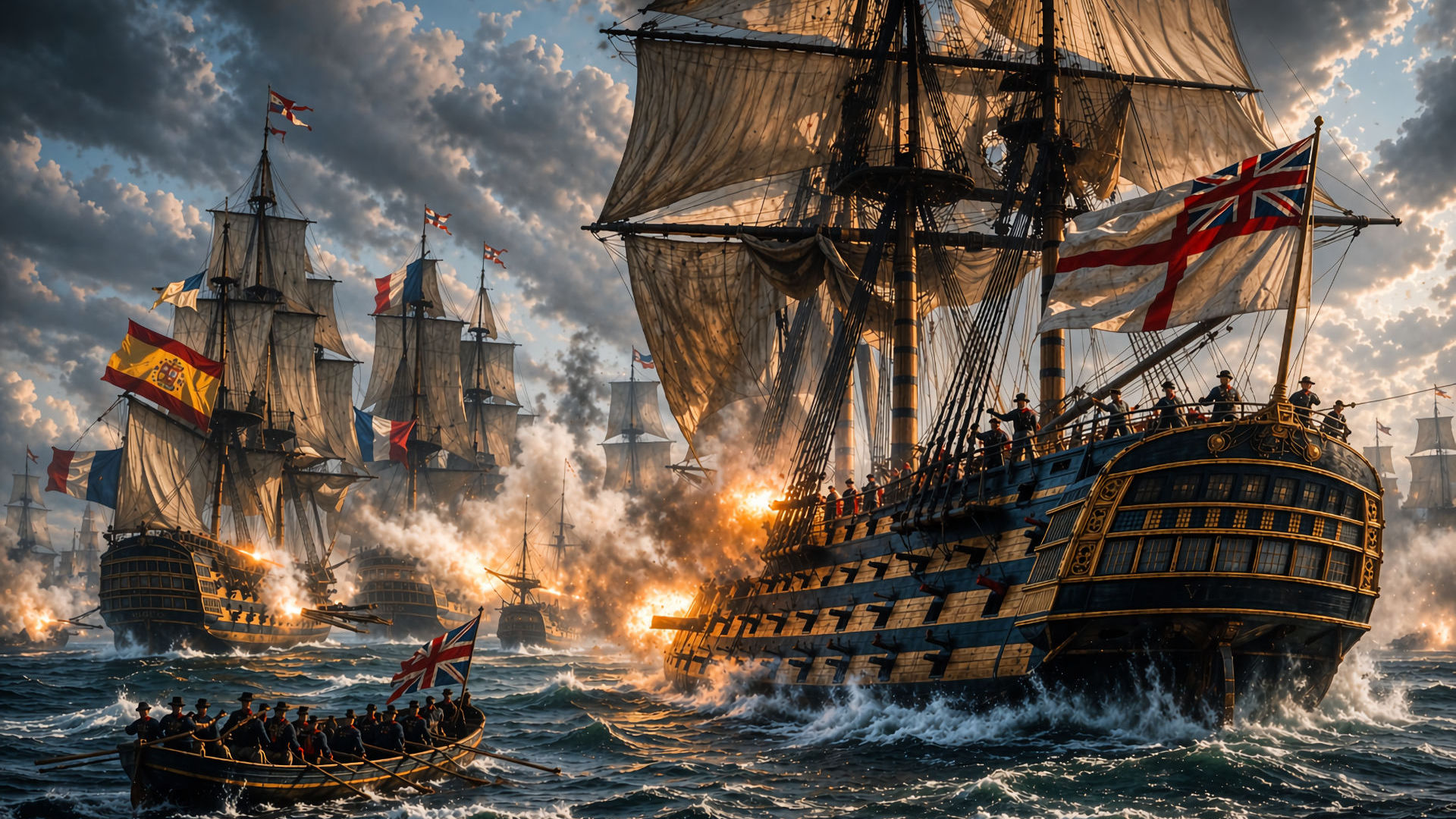
The Battle of Trafalgar
By 1805, Europe had already been reshaped by more than a decade of war born out of the French Revolution. Britain had spent years fighting Revolutionary France, and although there had been brief pauses, peace had not lasted. When Napoleon Bonaparte crowned himself Emperor of the French in December 1804, it was clear that France remained the dominant military power on the continent. On land, Napoleon’s armies were feared across Europe. At sea, however, Britain remained the great obstacle in his path. The Royal Navy was not merely a defensive shield around the British Isles. It was also the instrument that protected trade, maintained overseas connections, and prevented France from using its continental strength to strike directly across the English Channel.
Napoleon understood that Britain could not easily be defeated by diplomacy alone. He therefore considered invasion. In 1803, after the breakdown of the Peace of Amiens, he assembled what became known as the Armée d’Angleterre at Boulogne on the French coast. Thousands of troops were gathered there, together with flat-bottomed boats designed for crossing the Channel. But this plan depended on one crucial condition. The French needed temporary control of the Channel, even if only for a few days. Without that, an invasion fleet would be exposed to the Royal Navy and likely destroyed before it could land.
That requirement brought the French fleet, and its Spanish ally, into the centre of Napoleon’s strategy. France alone had not matched Britain’s naval power, but after Spain joined the war against Britain in 1804, the combined Franco-Spanish fleet looked more formidable. Napoleon’s idea was not necessarily to win outright command of the sea in the long term. That was unrealistic. Instead, he hoped to lure British fleets away from the Channel, bring together his scattered squadrons from the Mediterranean and the Atlantic, and then seize a short window in which the Channel would be clear enough for invasion.
Britain, meanwhile, knew exactly how serious the danger was. The fear of invasion was not imaginary. Volunteer units were raised across the country, coastal defences were strengthened, and the Royal Navy maintained close watch over French ports. The struggle became one of endurance and movement. British fleets blockaded enemy harbours, trying to keep French and Spanish ships bottled up. French strategy, by contrast, required bold manoeuvre, perfect timing, and cooperation between squadrons operating far apart. That was difficult enough in theory. In practice, it was even harder.
The Battle of Trafalgar emerged from this wider contest. It was not a random naval engagement or a glorious side episode. It was tied directly to the question of whether Napoleon could seriously threaten Britain itself. When the battle came in October 1805, it did more than destroy ships and kill sailors. It shattered French and Spanish hopes of challenging British naval dominance in the decisive way Napoleon needed. The battle did not end the Napoleonic Wars, and it did not stop Napoleon from winning major victories on land. But it ensured that Britain would remain beyond his reach by sea. That fact shaped the rest of the war and, in time, the future balance of power in Europe.
The Fleets Gather, Villeneuve Sails, and Nelson Gives Chase
The road to Trafalgar was not straightforward. It involved months of confusion, misdirection, and strategic frustration. Napoleon’s naval plan depended on Admiral Pierre-Charles Villeneuve, who commanded the French Mediterranean fleet based at Toulon. Villeneuve’s task was to evade the British blockade, join up with other French forces, possibly link with Spanish squadrons, and help draw British naval power away from the Channel. If all went well, the combined fleet would later return north and create the brief opening Napoleon needed for invasion. It was an ambitious plan, and like many ambitious plans, it depended on everything happening exactly on time.
Watching Toulon was Vice-Admiral Horatio Nelson, Britain’s most celebrated naval commander. Nelson had already built a formidable reputation through victories such as the Battle of the Nile in 1798 and Copenhagen in 1801. But blockading Toulon was difficult work. Weather, visibility, and distance from shore made it hard to maintain a perfectly tight watch. In March 1805, Villeneuve managed to slip out of Toulon when bad weather temporarily drove the British away from their exact station. Nelson soon realised the French had escaped and began a long pursuit across the Mediterranean and then into the Atlantic.
Villeneuve sailed first to Cádiz, where he joined Spanish ships, and then crossed the Atlantic to the Caribbean. This was part of Napoleon’s wider strategy to confuse the British and pull their fleets far from European waters. Nelson guessed that the enemy might be headed for the West Indies and followed, though the chase took time, and exact intelligence was often lacking. By the time Nelson arrived in the Caribbean, Villeneuve had already decided to return to Europe. It was a vast and exhausting naval pursuit over thousands of miles, and both sides struggled with poor communications, uncertain reports, and the sheer scale of the ocean.
On the return voyage, Villeneuve encountered a British force under Sir Robert Calder off Cape Finisterre on 22 July 1805. The resulting action was indecisive but important. Calder captured two Spanish ships, and Villeneuve failed to push on with the confidence Napoleon expected. Instead of pressing north into the Bay of Biscay to support the larger invasion design, Villeneuve eventually turned south and entered Cádiz in August. That move deeply angered Napoleon, who had counted on more energy and precision from his admiral. By then, circumstances were shifting fast on land as well, and Napoleon began to abandon the invasion scheme in favour of campaigns in central Europe against Austria and Russia.
Even so, the combined fleet at Cádiz still posed a serious threat. It included powerful ships of the line from both France and Spain, and if it escaped in strength, it might disrupt British control of the seas or support future operations. Nelson returned to duty and took command of the British fleet blockading Cádiz in September 1805. He now faced Villeneuve again, but the situation was different from the chase across the Atlantic. This time, the enemy was contained, though not harmless. Nelson used a looser style of blockade than some admirals preferred, keeping his main force out of sight over the horizon when possible so that the enemy might be tempted to sail. He wanted not merely to contain the fleet, but to bring it to battle and destroy it.
By October 1805, the stage was set. Villeneuve, under pressure and aware that he might soon be replaced, finally put to sea from Cádiz with the combined Franco-Spanish fleet. Nelson, informed by his frigates and scouts, prepared to intercept. The long pursuit was over. The decisive battle was now approaching.
The Morning of 21 October 1805, Plans, Positions, and the Approach to Battle
The Battle of Trafalgar was fought on 21 October 1805 off Cape Trafalgar, on the south-west coast of Spain. At dawn, the combined Franco-Spanish fleet was already at sea, steering generally northward after leaving Cádiz. Villeneuve commanded 33 ships of the line, with his flagship Bucentaure near the centre. The fleet included large and heavily armed Spanish first-rates such as Santísima Trinidad, one of the biggest warships in the world. Nelson commanded 27 ships of the line, fewer in number but generally better handled, better trained, and more experienced in sustained naval operations.
Traditional naval tactics of the age often involved fleets forming parallel lines and exchanging broadsides in a relatively controlled, if still deadly, contest. Nelson intended something more aggressive. He planned to attack in two columns, sailing directly at the enemy line at right angles or near to it. One column, led by Nelson in HMS Victory, would strike the centre of the combined fleet. The other, commanded by Vice-Admiral Cuthbert Collingwood in HMS Royal Sovereign, would attack further down the line toward the rear. This method was risky. As the British ships approached, they would be unable to fire many of their guns while exposing themselves to enemy broadsides. But if they succeeded in breaking the line, they could force close action, split the enemy formation, and bring their superior gunnery and seamanship to bear at short range.
Villeneuve’s fleet, by contrast, had difficulty maintaining a neat and effective line. Some ships were poorly positioned, the spacing was uneven, and the long formation curved awkwardly. Light winds did not help matters. The combined fleet had only recently left port, and not all its captains and crews were equally well prepared for a major fleet action. Some were brave and capable, but the overall cohesion of the fleet was weaker than Nelson’s. That difference in training and confidence would matter greatly once order began to collapse.
As the British closed in during the morning, Nelson made his final preparations. He dressed in full admiral’s uniform, making himself conspicuous despite the danger. Some officers thought this unwise, but Nelson had long believed that visible leadership mattered in battle. He also issued the famous signal from Victory: “England expects that every man will do his duty.” The wording was shaped in part by signal officer Lieutenant John Pasco, who helped reduce Nelson’s intended phrase into a form that could be sent more quickly by flag signal. It was not a tactical instruction. It was a moral message, meant to steady and inspire the fleet before the fighting began.
The approach itself was tense and punishing. As the British columns advanced slowly through light wind, enemy ships opened fire. Masts, sails, and rigging were hit before the British could properly reply. Victory in particular endured heavy punishment on the way in. Nelson and his officers could do little but watch the shot tear through canvas and wood as they closed the final distance. The silence aboard British ships between rounds of incoming fire must have been grimly intense. Everyone knew that the real battle would begin only once the line was broken.
By late morning, Collingwood’s Royal Sovereign reached the enemy first and plunged into action. Nelson’s column followed close behind. The moment of contact had arrived, and with it the point at which plans ended, and chaos began.
Breaking the Line, Close-Quarters Fighting, and the Turning Point at Sea
Once the British columns pierced the Franco-Spanish line, the battle became a brutal series of close-range duels rather than a neat fleet exercise. Collingwood in Royal Sovereign led the way by breaking into the enemy rear and engaging the Spanish ship Santa Ana. Royal Sovereign was heavily exposed as it entered the fight ahead of supporting ships, but Collingwood’s boldness helped throw the enemy formation into confusion from the start. Soon, British vessels behind him began arriving one by one and joined the mêlée.
Nelson’s Victory then drove into the enemy centre. As she approached, she passed under severe fire, particularly from Bucentaure and the large French Redoutable. Victory finally broke through the line astern of Bucentaure and delivered a devastating broadside into her stern. Such a raking broadside, fired lengthwise through a ship, could be catastrophic, smashing guns, timbers, and men across multiple decks. But Victory was then drawn into very close action with Redoutable, whose crew fought with fierce determination. The ships became entangled, and musketeers in the fighting tops high above the deck fired down on British officers and sailors below.
Across the battlefield, the action was fragmented and savage. British ships sought to isolate enemy vessels, engage at close range, and use faster, more accurate gunnery to overwhelm them. The Royal Navy had spent years at sea under blockade conditions, drilling crews relentlessly. British gun crews were generally faster in loading and firing than their opponents. That did not make the battle easy, but it gave them a crucial advantage once combat became chaotic and individual ship handling mattered as much as grand fleet formation.
The Franco-Spanish fleet contained ships of great power and crews that often fought bravely, especially many of the Spanish vessels, but coordination broke down. Some ships were unable to support one another effectively. Others were trapped by light winds or poor positioning. Villeneuve’s line had not been maintained with enough precision to resist Nelson’s assault. Once broken, it ceased to function as a single organised force. Instead, clusters of ships fought independently, and the British excelled in precisely that kind of hard, close battle.
One of the fiercest engagements centred on Redoutable. Her captain, Jean Jacques Étienne Lucas, resisted with exceptional courage. During the fight, a marksman in Redoutable’s rigging fired the shot that struck Nelson. The musket ball entered his left shoulder, passed through his body, and lodged in his spine. Nelson fell on Victory’s deck and was carried below. The wound was clearly mortal. Even so, the battle raged on above him, and the outcome was not yet fully settled.
Elsewhere, British ships continued pressing their advantage. Collingwood, now effectively taking on increasing responsibility as events developed, maintained pressure across the line. Enemy ships were dismasted, boarded, or battered into surrender. Some tried to escape. Others fought on stubbornly. The giant Santísima Trinidad was eventually overwhelmed after severe damage. Bucentaure was also taken. Villeneuve himself was captured. What had begun as a fleet battle was steadily becoming a comprehensive defeat for the combined fleet.
The turning point at sea came when it became clear that the Franco-Spanish line could not reform and that British ships, despite being outnumbered, had seized control of the battle’s rhythm. The enemy was no longer dictating events. Individual resistance continued, but the larger contest had swung decisively in Britain’s favour. Trafalgar was no longer merely a hard-fought engagement. It was becoming a destruction.
Nelson’s Death, Franco-Spanish Defeat, and the End of the Battle
Below decks on Victory, Nelson lay dying while the battle continued above. He remained conscious for much of his final hours and was attended by the ship’s surgeon, William Beatty, as well as officers and servants moving between the cockpit and the quarterdeck. Nelson was told of the progress of the battle as reports came down. His concern was not only for his own fate, which he understood well enough, but for the outcome of the action. He repeatedly asked how many enemy ships had struck. As more news arrived, it became clear that the British were winning decisively.
Nelson’s final hours became part of British national memory almost at once. He is widely associated with the words, “Thank God I have done my duty,” though accounts vary in detail. Like many famous deathbed quotations, the exact phrasing has been shaped by later retelling, but there is no doubt that he died knowing the battle had been won. He was forty-seven years old. His death, coming at the moment of his greatest triumph, transformed him from celebrated admiral into national legend.
The battle itself ended in a crushing defeat for the combined Franco-Spanish fleet. Of the 33 enemy ships of the line engaged, 22 were captured or destroyed in practical terms as effective fighting units. Britain lost no ships of the line in the action itself, although many were badly damaged. British casualties were heavy, with around 1,500 killed and wounded, but Franco-Spanish losses were far greater, running into several thousands killed, wounded, and captured. Precise numbers vary in different accounts, as was common in naval warfare of the period, but the scale of the defeat is beyond dispute.
Yet the end of the gunnery did not mean the danger had passed. A powerful storm followed the battle, creating a fresh crisis. Many of the captured ships were already shattered, dismasted, or flooding. Prize crews were placed aboard them, but towing or securing them in rough weather was extremely difficult. Some sank. Others had to be abandoned. A few were retaken by the enemy during the confused aftermath near the coast. The storm ensured that not every tactical success could be converted neatly into a lasting prize. Trafalgar was therefore not a tidy naval victory preserved in perfect order. It was a battle followed by wreck, exhaustion, and desperate efforts to save damaged ships in rising seas.
Villeneuve survived the battle and was taken prisoner to Britain. The defeat ended his naval career in all but name. For the Spanish navy, the loss was also severe, with experienced officers and major ships gone in a single day. For France, the result was strategically devastating. Napoleon had already begun to turn his attention fully to continental war, and only weeks after Trafalgar, he achieved a great land victory at Austerlitz on 2 December 1805. But Austerlitz did not erase what had happened off Cape Trafalgar. The sea war had taken a decisive turn.
Collingwood, now left to command after Nelson’s death, had the grim task of managing both victory and the loss of a hero. He had to handle prizes, weather, wounded men, damaged ships, and the practical problems that always followed battle. Trafalgar ended not with a theatrical curtain drop, but with the hard labour of survival. Even so, its meaning was already plain. The combined fleet had been broken, and Britain had secured one of the most important naval victories in its history.
Trafalgar’s Legacy, Naval Supremacy, and How the Battle Changed the War
The Battle of Trafalgar did not end the Napoleonic Wars, but it changed their character in a lasting way. Napoleon remained a formidable force on land for years after 1805. In fact, his victory at Austerlitz, fought just over a month after Trafalgar, showed that he was still the dominant military commander in Europe. Britain could not defeat him on land by itself, and the war would continue through shifting coalitions, campaigns in Spain and Portugal, economic warfare, and eventually the catastrophes that weakened the French Empire. But after Trafalgar, one thing became increasingly clear. Napoleon would not invade Britain.
That was Trafalgar’s greatest strategic significance. The battle destroyed any realistic chance that France and Spain could combine naval strength sufficient to clear the Channel, even briefly, in the way Napoleon had once hoped. Britain retained command of the sea in the essential sense. This did not mean every ocean was always safe or every British ship invulnerable. It meant that no rival fleet could seriously challenge the Royal Navy’s overall control for the remainder of the Napoleonic conflict. Britain could therefore continue financing coalitions, protecting trade routes, moving troops overseas, and applying pressure across the globe.
The battle also confirmed the strengths of the Royal Navy’s system. British success at Trafalgar was not just about Nelson’s brilliance, though his leadership mattered enormously. It also reflected years of blockade service, rigorous training, professional seamanship, aggressive doctrine, and an officer corps accustomed to independent action. British captains were generally expected to fight boldly once battle was joined, and Nelson’s style encouraged that spirit rather than suppressing it. Trafalgar became famous because of heroic individuals, but its deeper lesson was institutional. Britain had built a navy capable of sustained superiority.
Nelson’s personal legacy was immense. His death in victory gave Britain a martyr-hero whose memory could be used to embody courage, duty, sacrifice, and national endurance. His body was brought home to Britain and given a state funeral in January 1806. He was eventually buried in St Paul’s Cathedral. Monuments, paintings, songs, and public ceremonies helped fix Trafalgar and Nelson at the centre of British historical memory. Later, Nelson’s Column in London, completed in the 1840s, became perhaps the most visible symbol of that remembrance. The battle entered national mythology, sometimes polished and simplified, but never forgotten.
For Spain and France, Trafalgar was a bitter lesson in the limits of their naval power under wartime pressure. Their fleets could still fight, but they could no longer hope to overturn British maritime dominance in the decisive sense required to reshape the war. As the conflict continued, British power at sea allowed pressure to be applied in theatres far beyond Europe, from the Atlantic to the Mediterranean and beyond. Sea control also underpinned Britain’s role in the Peninsular War, where Wellington’s army could be supplied and supported in ways that depended heavily on naval strength. Trafalgar therefore stands as more than a famous battle with a famous death. It was a strategic watershed. It confirmed Britain as the dominant naval power of the age, protected the British Isles from invasion, and helped shape the wider course of the Napoleonic Wars. On 21 October 1805, off the coast of Spain, a few hours of violent fighting decided a question that had hung over Europe for years. Napoleon could still conquer on land, but he could not master the sea. And because he could not master the sea, he could not break Britain.
The Battle of Trafalgar FAQ
The Battle of Trafalgar was a major naval battle fought on 21 October 1805 between the British Royal Navy and the combined French and Spanish fleets during the Napoleonic Wars.
It destroyed any realistic chance of Napoleon invading Britain and confirmed British naval supremacy for the rest of the Napoleonic Wars.
The British fleet was commanded by Vice-Admiral Horatio Nelson, with Vice-Admiral Cuthbert Collingwood leading the second attacking column.
Nelson was shot by a marksman during close fighting aboard HMS Victory and died below deck after learning that the British had won the battle.
No, the war continued for years after Trafalgar, but the battle ensured that Britain remained secure from invasion and dominant at sea.


