The First Battle of Bull Run
In the summer of 1861, the American Civil War was still young enough for many people to misunderstand it completely. Fort Sumter had fallen in April, President Abraham Lincoln had called for 75,000 volunteers, and four more slaveholding states had joined the Confederacy after the crisis deepened. Yet across both North and South, there remained a dangerous belief that one decisive campaign might settle the matter before the conflict grew too large to control.
In Washington, political pressure mounted quickly. Newspapers, members of Congress, and ordinary citizens demanded action against the Confederate forces gathering in Virginia. The Union capital was uncomfortably close to Confederate territory, and the presence of an enemy army near Manassas Junction seemed both a threat and an insult. Manassas mattered because it was a railway hub, connecting routes that could move soldiers and supplies across northern Virginia. Whoever controlled it could shift troops more easily, and in a war that had barely begun, mobility already looked like power.
The Union army placed in the field was commanded by Brigadier General Irvin McDowell. He was an intelligent officer, but he had never commanded a large army in battle, and neither had many of the men beneath him. His force was full of short-term volunteers, some of whom had enlisted for only ninety days. These men had enthusiasm, but enthusiasm is not the same thing as discipline, and marching in a parade is not the same thing as fighting in a storm of musketry and artillery.
On the Confederate side, Brigadier General P. G. T. Beauregard commanded the army positioned near Manassas. He had already gained fame by leading Confederate forces during the attack on Fort Sumter, which made him something of a Southern hero before the main war had properly begun. His troops were also inexperienced, but they had the advantage of defending ground close to important rail links. Further west, in the Shenandoah Valley, another Confederate force under General Joseph E. Johnston watched Union movements closely.
The wider plan was simple in theory, which is often the first warning sign in military history. McDowell would advance from Washington, strike Beauregard’s army near Bull Run, and open the road towards Richmond, the Confederate capital. Meanwhile, Union forces in the Shenandoah Valley were supposed to keep Johnston occupied, preventing him from reinforcing Beauregard. If everything worked neatly, the Union would win a major victory and perhaps break Confederate confidence early.
But wars rarely unfold neatly, especially when the armies involved are new, nervous, and learning their trade in real time. Bull Run would not be a tidy demonstration of national resolve. It would be the moment when both sides discovered that flags, speeches, and patriotic certainty were poor substitutes for training, logistics, and battlefield control. The road to Manassas began with optimism, but it was heading straight towards a brutal education.
Marching Towards Manassas
McDowell’s army began moving out from the Washington area in mid-July 1861. The march itself quickly revealed how unready the Union force was for serious campaigning. Soldiers straggled, units moved slowly, and the simple act of getting thousands of men, horses, wagons, and guns along Virginia roads became a test of patience and organisation. Some men stopped to pick berries or refill canteens, which is charming in a countryside ramble and rather less charming when trying to surprise an enemy army.
The Union advance was aimed towards Centreville, a village north of Bull Run Creek. Bull Run was not a vast river, but it formed a natural defensive line, with crossings known as fords and bridges offering potential routes through Confederate positions. Beauregard’s troops were spread along this line, guarding likely crossing points. McDowell knew that simply charging directly at a defended position could be costly, so he looked for a way to turn the Confederate flank rather than smash straight into it.
On 18 July, before the main battle, Union forces tested the Confederate line at Blackburn’s Ford. The clash was relatively small compared with what was to come, but it mattered because it revealed the danger of attacking across Bull Run without proper coordination. The Confederates held their ground, and the Union side learned that Beauregard’s army would not be brushed aside by mere confidence. McDowell paused and reconsidered his plan.
His revised idea was to use part of his army to distract the Confederates at Stone Bridge, while a larger force made a wide flanking march to the north. This turning movement would cross Bull Run at Sudley Springs, then come down behind the Confederate left. If successful, it would force Beauregard’s army out of position and give the Union a chance to win the battle before the Confederates fully understood what was happening. On paper, it was a sound plan. On the ground, it depended on timing, discipline, and clear communication, three items not yet available in generous supply.
Meanwhile, the Confederate situation was changing. In the Shenandoah Valley, Union General Robert Patterson failed to pin down Joseph Johnston’s army effectively. Johnston was able to slip away and send troops by rail towards Manassas, one of the earliest important uses of railways to shift forces during a major battle campaign. This movement did not instantly solve every Confederate problem, but it gave Beauregard the possibility of reinforcement at the crucial moment.
The stage was now set for 21 July 1861. McDowell’s troops would begin their complicated march before dawn, hoping to outflank the Confederate left and win a decisive battlefield victory. Civilians from Washington, expecting something close to a dramatic public spectacle, travelled out with picnic baskets to watch events unfold from a safe distance. They assumed they were going to witness the beginning of the end. Instead, they were about to witness the end of the beginning.
The First Clash on the Fields of Virginia
The Battle of Bull Run began with the Union plan already under strain. McDowell’s flanking column moved slowly through unfamiliar roads in the early hours of 21 July, losing precious time before it reached Sudley Springs. Brigadier General Daniel Tyler’s division created pressure near Stone Bridge, while the main turning force under commanders including David Hunter and Samuel Heintzelman moved north and west to cross Bull Run. The movement was clever, but delay robbed it of some of its surprise.
When Union troops finally came down towards the Confederate left, they struck near Matthews Hill. The initial advantage belonged to McDowell. Confederate units under Colonel Nathan “Shanks” Evans, who had shifted troops from the Stone Bridge area after realising the danger, tried to resist the Federal advance. Evans had too few men to hold for long, but his quick response bought time, which in battle is often as valuable as territory.
The fighting around Matthews Hill grew rapidly as more troops arrived on both sides. Union soldiers pushed forward with enough force to drive the Confederates back. For a while, it looked as if McDowell’s plan might succeed despite the earlier delays. Confederate units began retreating towards Henry House Hill, a more commanding position nearby. The Union army had not won the battle, but it had gained momentum, and for inexperienced soldiers, momentum could feel very much like victory.
Yet the fighting also exposed the difficulty of controlling Civil War armies at this early stage. Smoke, noise, confusion, and similar uniforms made command extremely difficult. Some Confederate units wore blue or grey in inconsistent patterns, while some Union troops wore outfits that did not fit the neat image of blue-clad Federals and grey-clad Confederates. In the chaos, soldiers sometimes struggled to identify friend from foe until the shooting settled the question, which is a deeply inconvenient method of battlefield recognition.
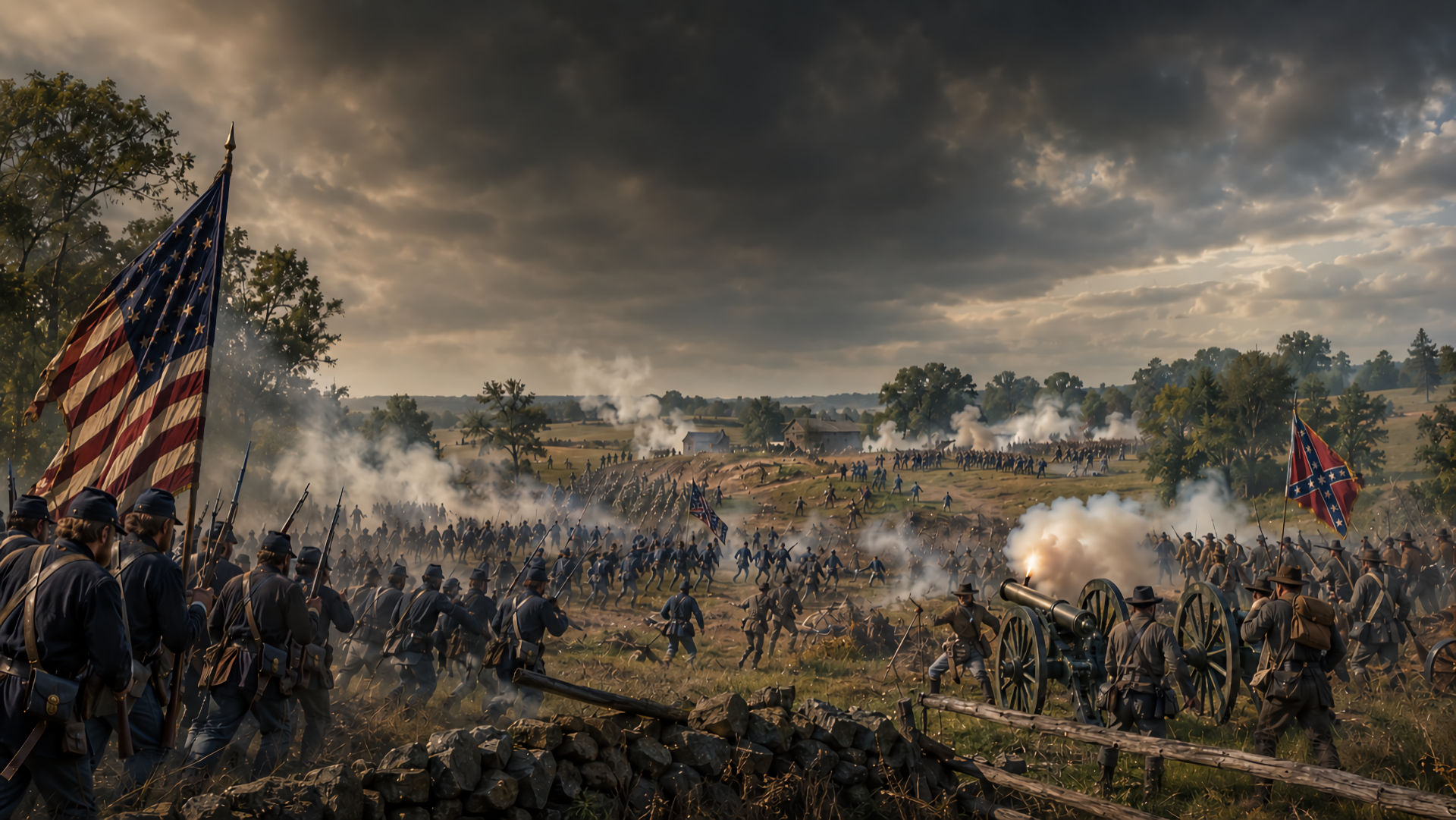
Henry House Hill became the centre of the battle. It was named for the home of Judith Henry, an elderly widow who lived there and became one of the tragic civilian casualties of the day. Union artillery, including batteries commanded by James Ricketts and Charles Griffin, moved forward to support the attack. Artillery could be devastating, but guns placed too close to enemy lines were vulnerable. As infantry lines surged and broke around the hill, these batteries became prizes in a furious contest.
By early afternoon, the battle had shifted from an outflanking manoeuvre into a hard fight for control of the high ground. Union forces had gained early success, but they had not destroyed the Confederate army. Confederate reinforcements were arriving, and the defenders were beginning to rally. The war’s first major battlefield lesson was now becoming clear. Winning the opening phase of a battle is not the same as winning the battle itself.
Stonewall Jackson and the Turning Point
As Confederate troops fell back towards Henry House Hill, one brigade under Brigadier General Thomas J. Jackson took position and helped stabilise the line. Jackson, a former professor at the Virginia Military Institute, was not yet the legendary figure he would become. At Bull Run, he was a relatively unknown officer commanding Virginia troops in a battle that seemed to be slipping away. His men formed on the hill and stood under heavy pressure while other Confederate units tried to recover from the morning’s reverses.
The famous nickname “Stonewall” came from this moment, though the exact wording and meaning remain debated. Brigadier General Barnard Bee is said to have pointed towards Jackson and declared that he stood like a stone wall, encouraging his men to rally. Whether Bee meant it as praise or frustration has been argued ever since, because history enjoys giving us iconic quotes and then immediately misplacing the receipt. What matters is that Jackson’s stand became a symbol of Confederate steadiness at a crucial moment.
The fighting for Henry House Hill was brutal and confused. Union artillery batteries advanced, withdrew, and were overrun as Confederate infantry counterattacked. At one point, confusion over uniforms contributed to disaster when Union gunners hesitated, believing approaching troops might be friendly. They were not, and the guns became trapped in the shifting struggle. Control of the batteries changed hands more than once, turning the hill into a grim tug-of-war fought with muskets, bayonets, and close-range artillery fire.
Joseph Johnston’s reinforcements, arriving from the Shenandoah, added weight to the Confederate defence and then to the counterattack. The use of rail transport did not deliver a perfectly organised Confederate machine, but it did place fresh units into the battle when McDowell’s army was becoming tired and disordered. Beauregard and Johnston both played roles in trying to coordinate the Confederate response, although command arrangements were not always smooth. Like the Union army, the Confederates were learning while under fire.
The turning point came gradually rather than through one clean, dramatic stroke. Union attacks against Henry House Hill failed to break the Confederate line. Confederate counterattacks grew stronger as fresh troops arrived and exhausted Union units lost cohesion. Once McDowell’s army stopped advancing and began reacting, the initiative shifted. In a battle fought by inexperienced troops, morale could swing dangerously fast.
By late afternoon, the Confederate line had not only survived but begun pushing the Union army back. Jackson’s stand, the defence of Henry House Hill, the arrival of reinforcements, and the exhaustion of Union attackers combined to change the shape of the day. What had begun as a promising Union offensive turned into a Confederate recovery, then into a Confederate victory in the making. The battle was not yet over, but its direction had changed.
Panic on the Road Back to Washington
The Union retreat did not begin as a complete collapse. At first, tired regiments pulled back after hours of fighting, and McDowell attempted to organise a withdrawal. But once movement to the rear began, order became increasingly difficult to maintain. Soldiers who had marched before dawn, fought through heat and smoke, and seen units torn apart around Henry House Hill were now physically exhausted and mentally shaken. Disciplined veterans can control retreat, but McDowell’s army was not yet an army of veterans.
Confederate pressure turned withdrawal into panic. Fresh Confederate units, including forces under Colonel Jubal Early and others arriving on the field, helped drive the Union right and deepen the sense that the battle had been lost. Rumours spread rapidly through the ranks, as they often do when soldiers are tired and frightened. Men who had expected a short war now found themselves running from a battlefield littered with broken equipment, abandoned guns, and wounded comrades.
The roads back towards Centreville and Washington became choked with soldiers, wagons, artillery, ambulances, and civilians. Some spectators who had travelled from Washington, expecting to watch a Union victory, suddenly found themselves caught in the retreat. Carriages blocked routes, panic spread, and the scene became infamous as the “Great Skedaddle.” It was not the most dignified phrase in military history, but it captured the mood rather well. This was not a neat withdrawal with drums beating and flags flying. It was a frightened rush away from a battlefield that had turned horrifyingly real.
One important bottleneck came near Cub Run, where a bridge and road congestion worsened the disorder. Confederate artillery fire added to the chaos, and abandoned vehicles made movement even harder. Many Union soldiers kept going until they reached the defences around Washington. Others were captured, became separated from their units, or simply collapsed from exhaustion. The army that had marched out with political hopes attached to it returned in a state of humiliation.
The Confederates, despite their victory, were not in good enough condition to pursue all the way to Washington effectively. Their own army was disorganised, tired, and bloodied. Victory did not transform them into a perfectly functioning force any more than defeat made the Union permanently helpless. The battlefield had punished both sides. The Confederates held the field, but they could not exploit the result in the decisive strategic way some Southerners hoped.
Casualty figures made the shock unmistakable. The Union suffered around 2,900 casualties, including killed, wounded, missing, and captured. The Confederates suffered close to 2,000 casualties. By later Civil War standards, these numbers would be surpassed many times, grimly and often. But in July 1861, they stunned a public still adjusting from patriotic slogans to casualty lists. Bull Run had turned war from an argument into an experience, and nobody could pretend otherwise for long.
What Bull Run Taught a Nation at War
The First Battle of Bull Run changed how Americans understood the Civil War. Before the battle, many people believed the conflict might be settled quickly by one dramatic campaign. After Bull Run, that illusion became much harder to sustain. The Union had advanced with confidence and returned in embarrassment. The Confederacy had won a morale-boosting victory, but it had not destroyed the Union army or ended the war. Both sides had gained evidence that the struggle would be longer, harder, and bloodier than expected.
For the Union, the defeat forced a serious reassessment. Irvin McDowell was replaced as commander of the main Union army, and Major General George B. McClellan was brought to Washington to organise what became the Army of the Potomac. McClellan’s strengths and weaknesses would shape the next phase of the war, but his immediate task was clear. The Union needed training, discipline, logistics, and structure. Patriotic enthusiasm had sent men into Virginia, but professional organisation would be needed to send them back.
For the Confederacy, Bull Run produced pride and confidence, perhaps too much of both. The victory seemed to prove that Southern soldiers could defeat larger Union forces. Figures such as Stonewall Jackson emerged with reputations that would only grow in later campaigns. Yet the battle also revealed Confederate weaknesses: confused command arrangements, poor coordination, uneven discipline, and an inability to turn battlefield success into strategic victory. Winning at Bull Run did not solve the Confederacy’s deeper problems of manpower, industry, and long-term resources.
The battle also showed that modern war was changing. Railways had helped move Johnston’s reinforcements to the field, hinting at how transport networks would shape campaigns. Telegraph communications, newspapers, and public opinion all influenced decision-making before and after the battle. Civilians were no longer distant from war, either physically or emotionally. The spectators who came to watch the battle learned that warfare was not a grand public performance. It was smoke, fear, confusion, and sudden death.
Bull Run also became a lesson in leadership under pressure. Plans that looked sensible on maps became fragile once delayed by roads, tired men, unclear orders, and enemy reaction. Commanders had to manage not only strategy but morale, timing, and uncertainty. Both armies entered the campaign raw, and both left with a clearer sense of what they lacked. The war would now demand generals who could move vast armies, keep them supplied, and survive the political storms that came with every success and failure. In the wider story of the Civil War, Bull Run was not the largest battle, nor the bloodiest, nor the most decisive. Its importance lies in what it revealed. It showed that neither side could simply will victory into existence. It shattered the fantasy of a quick, easy war and announced that the conflict would become a national ordeal. In July 1861, on the fields near Manassas, America received its first brutal lesson in what civil war would truly mean.
The First Battle of Bull Run FAQ
The Battle of Bull Run was the first major land battle of the American Civil War. It was fought on 21 July 1861 near Manassas, Virginia, between Union forces under Irvin McDowell and Confederate forces under P. G. T. Beauregard and Joseph E. Johnston.
The Union commonly named battles after nearby rivers or creeks, while the Confederacy often used nearby towns or railway junctions. That is why the same battle is known as Bull Run in the North and Manassas in the South.
The Confederates won the First Battle of Bull Run. Union forces initially made progress, but Confederate resistance on Henry House Hill and the arrival of reinforcements helped turn the battle into a Union retreat.
The battle shattered the belief that the Civil War would be short and easily decided. It showed both sides that the conflict would require trained armies, stronger leadership, and a much greater national commitment.
Thomas J. Jackson earned the nickname “Stonewall” during the Battle of Bull Run after his brigade held firm on Henry House Hill. The exact wording and intent of the remark are debated, but the name became one of the most famous in Civil War history.