The Battle of Flodden
On a windswept September day in 1513, amid the rolling hills and marshy fields of Northumberland, two armies met in a clash that would echo down the centuries. One was English, led not by a king but by a seasoned noble with a calm head and a solid grasp of ground conditions. The other was Scottish, commanded by a monarch who burned with martial honour and ambition, determined to secure glory for his nation and himself. When the smoke cleared and the shouting faded, the battlefield was littered with the flower of Scotland’s nobility, and a king lay dead, the last British monarch to fall in combat. This was the Battle of Flodden.
To understand how thousands of men ended up hacking each other apart in a muddy field in early autumn, one must look first across the Channel at Europe, where kings and emperors were busy turning politics into a lifelong competitive sport. England, ruled by Henry VIII, the young, athletic version who still believed in honour and chivalry rather than banquet menus, was at war with France. Naturally, nations tend to pick teams in such situations. Scotland, bound to the French by the Auld Alliance, a diplomatic pact based primarily on mutual dislike of England, decided to support their continental friends by causing trouble to the north. Henry VIII was away campaigning in France and probably far too pleased with himself to worry much about Scotland. But border raids were a long-cherished pastime between the two kingdoms, and this time Scotland planned something rather more ambitious than stealing cattle and setting someone’s shed on fire.
Their king, James IV, was a complex and compelling figure. He was educated, charismatic, and determined to act not merely as a Scottish monarch but as a European statesman. He admired the ideals of knighthood, practised chivalry, and dreamt of greatness. Yet he was also fully aware that England overshadowed his kingdom in power and wealth. Supporting France offered an excellent opportunity to strike a blow, boost Scotland’s honour, and remind England that the north had sharp teeth.
James sent Henry VIII a letter, politely explaining that since Henry had broken the peace treaty by attacking France, Scotland was obliged to get involved. Henry responded with a message filled with the sort of diplomatic rudeness that suggested newspaper editors across Europe might soon start drawing funny pictures of the two of them in armour.
Once the formalities were out of the way, war preparations began. James raised a large army, reported by chroniclers to consist of as many as 60,000 men, though modern historians tend to be sceptical of numbers lovingly inflated by patriotic scribes. Even with a more sensible estimate, the Scottish force was formidable. Among them were powerful Highland clans, seasoned Border fighters, and a well-equipped core of Lowland soldiers. James had imported modern artillery and weapons, including fearsome pikes modelled on those used by the Swiss, who at the time had the world’s top rating in the “terrifying guys on a mountain” category.
By late August, the Scottish army crossed the River Tweed into England, capturing several fortresses and scattering panic among the English population. Unfortunately for James, panic is not an effective long-term strategy for conquest. The English rallied, and a leader emerged in the form of Thomas Howard, Earl of Surrey. He was a veteran commander, loyal to Henry VIII, and more than a little motivated by the fact that his father had commanded the English forces at Bosworth Field, the battle that ended the reign of Richard III and, some might say, the Howard family’s hopes of royal favour. Surrey was determined not to let history repeat itself with English humiliation.
Surrey gathered an army from across northern England. They were fewer in number than the Scots but tough, practical, and intimately familiar with the soggy terrain where battles tended to take place. The English carried bills, long pole weapons with hooks and blades, perfect for close-quarters mayhem, and they brought along traditional longbowmen who, while no longer the unstoppable force of Agincourt fame, were still more than capable of sending a rain of misery onto approaching foes.
James, from his high position near Flodden Edge, seemed to hold every advantage. His artillery overlooked the English, and his imported pikes made his infantry look frighteningly modern. The problem was his outlook, quite literally. His army stood on high ground, but the slopes were steep and the ground below marshy. It was excellent terrain for glamorous posing, less so for charging forward in tight formation without slipping into a disastrous heap of tangled spears and wounded pride.
Surrey recognised the flaw and exploited it. He manoeuvred his army around the Scots, forcing James into a choice: stay on the hill and allow the English to descend on his flank, or come down and engage on equal terms. Chivalry and strategic impatience won out. James marched his army downhill to a lower ridge at Branxton, firmer ground, but no longer the favourable fortress he had earlier enjoyed.
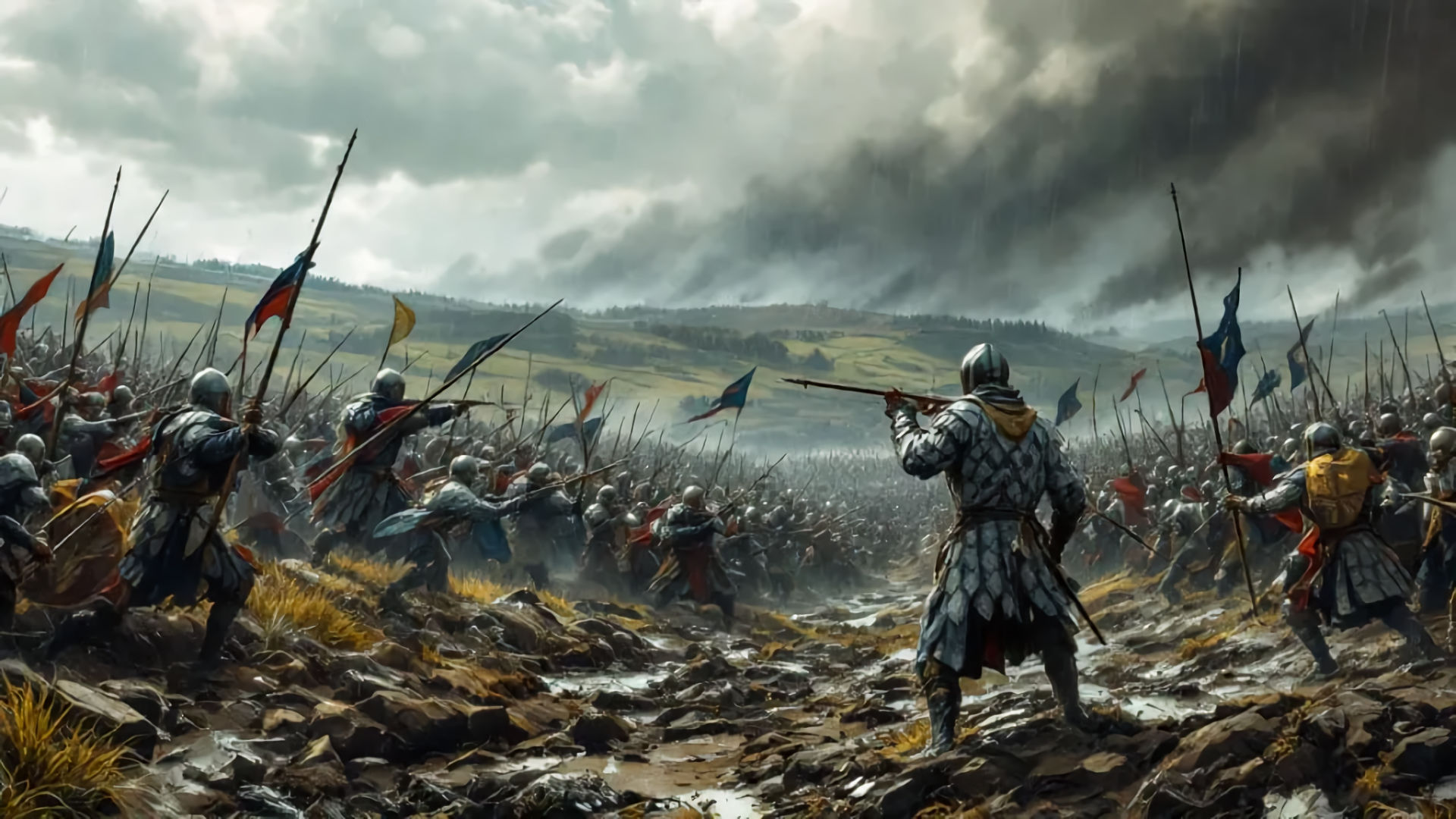
The scene that followed must have been astonishing. The Scottish pike formations advanced, teeth-like spears bristling several metres into the air. These were professional, drilled soldiers, ready to smash through the enemy with a single irresistible push. But suddenly, everything that had seemed so finely planned unravelled. The pikes, so powerful on level terrain, struggled as the regiments tried to cross the uneven, marsh-slicked land. Stumbling over wet soil and broken ground, the Scottish formations lost their unity. The English seized the moment. Skilled with their bills, they closed the gap and began hacking upward into the exposed areas beneath the pikes, targeting arms, faces, and any body part a desperate soldier might foolishly leave unprotected.
The battle devolved into brutal hand-to-hand combat, precisely the kind of chaos that turned advantage into disaster. The Scottish cannon, positioned earlier to command the high ground, were now useless. English archers, still infuriatingly effective, peppered the advancing Scots with arrows. All along the front, the Scottish army jammed together, trying to drive forward but colliding with terrain and relentlessly pressured by English steel.
James IV, unlike many sovereigns who prefer to remain safely behind encouraging messengers, was in the thick of the fighting. He wore distinctive armour and fought among his nobles, an image of heroic kingship that his supporters would celebrate for generations. Yet heroism can be, in the cruel arithmetic of battle, precisely the wrong decision. When leaders place themselves in the line of fire, they tend to get hit.
The fighting raged across the slopes. The Highlanders, fierce and fearless, engaged in ferocious individual combat. But bravery could not overcome the English advantages in terrain, organisation, and sheer tactical calm. As the Scottish front ranks were cut down, those behind them faltered. The pressure built into panic. The pike squares collapsed. One by one, the banners of Scotland toppled into the mud.
And then, at the centre of the chaos, James IV was struck down. The exact moment of his death remains debated, but one thing is clear: the king did not leave the field. He lay among his fallen soldiers, surrounded by the greatest nobles of Scotland, many of whom shared the same fate. When the English searched the battlefield, they found his body, pierced by multiple wounds. The last king of Scotland to die in battle, and the last monarch of the British Isles to be killed in the thick of combat.
The aftermath was nothing short of catastrophic for Scotland. Estimates of the dead vary wildly; chroniclers often exaggerate, especially when nationalism is involved, but thousands of Scots were slain, including much of the political leadership of the realm. Noble houses that had shaped Scotland’s destiny for generations suddenly had no heirs left capable of governing. The sense of loss was so severe that Scottish history remembers the event as Flodden Field, almost a place of mourning rather than a battlefield. The phrase “the flowers of the forest,” later used in haunting commemorations, captures the sorrow that followed: the nation’s best men cut down, leaving behind a power vacuum and a generation of widows and orphans.
England had won, decisively. But the victory was tinged with melancholy rather than triumphal gloating. Surrey wrote respectfully to Henry VIII, praising the courage of the Scottish king and his soldiers. The English king, meanwhile, was off defeating French knights and likely picturing his own glorious return. When he learned of Flodden, he gained prestige without personal effort, a diplomatic win, though perhaps an embarrassing reminder that he wasn’t the only monarch who could swing a sword.
Scotland’s throne passed to James V, a child scarcely old enough to grip a crown, let alone a sword. Governance fell to regents and relatives, each with ambitions, fears, and ideas about how to salvage Scotland’s standing in Europe. The Auld Alliance endured in theory but had failed spectacularly to protect Scotland in practice. France offered its sympathies but also asked Scotland to keep annoying England, which must have felt rather insensitive, given that the kingdom was mourning a king.
James IV’s death marked a turning point. He had been a Renaissance monarch, a patron of learning, shipbuilding, and reform. Under his rule, Scotland was gaining prestige. His marriage to Margaret Tudor, sister of Henry VIII, had linked Scotland and England through blood, a connection that would still matter a century later, when their descendant, James VI, inherited the English throne and united the crowns in 1603. That irony would not have comforted the Scots of 1513, who saw only immediate devastation.
The Battle of Flodden stands as a brutal lesson in how quickly political ambition and chivalric ideals can be swallowed by the mud of real warfare. James IV had marched into England, believing the age of gallantry would reward him. He trusted in European-style weaponry, in honour, in alliances, and perhaps in his own destiny. But warfare is never impressed by confidence alone. The English commanders understood the ground better, chose their moment carefully, and turned the Scottish king’s greatest strengths into deadly weaknesses. The battle proved that technological improvement is meaningless if one’s feet are slipping.
For Scotland, Flodden was a national trauma that shaped its politics for decades. For England, it was reassurance that the Tudors were firmly in control. Yet both countries would find themselves tied together ever more tightly in the following century, diplomatic marriages would become shared sovereignty, and the once-deadly borderlands would slowly become peaceful hills with helpful signposts explaining who lost where.
Today, the battlefield is green and quiet. Sheep graze where soldiers once died. A granite cross commemorates the fallen Scots, while a marker honours the English dead. On anniversaries, bagpipes play lamentations that drift across the valley, reminding listeners that history is not just a record of who won, but also who paid the price.
Flodden endures in Scotland’s cultural memory in a way few battles do. It is a cautionary tale about pride, bravery, and the cruel unpredictability of war. It symbolises the tragic heroism of a king who fought beside his men and never returned home. It reminds us that sometimes the decisions that feel most honourable are the ones that lead most swiftly into the abyss.
And above all, the battle remains a powerful turning point in the long and complicated relationship between two nations that spent centuries fighting and yet somehow ended up sharing a monarch, a parliament, and a great deal of television programming. Scotland mourned Flodden for generations, and perhaps, somewhere on the wind that sweeps those ancient fields, the echo of that sorrow still remains.
The Battle of Flodden FAQ
A major Anglo-Scottish battle fought on 9 September 1513 near Branxton in Northumberland, where the English army under the Earl of Surrey defeated the Scots led by King James IV.
They gave up strong positions on higher ground and advanced across broken, muddy slopes. Their long pikes struggled in close terrain, while English billmen and archers were effective at short range.
King James IV personally led the Scots. The English were commanded by Thomas Howard, Earl of Surrey, with experienced captains coordinating bills, bows and artillery.
James IV was killed along with many Scottish nobles, leaving a minority for James V and weakening Scotland diplomatically and militarily, while England gained a major strategic victory.