The Rendlesham Forest UFO Mystery
Rendlesham Forest does not look like the obvious setting for one of Britain’s most famous UFO stories. It is not a desert test range, not a secret mountain facility, and not the sort of place where cinema aliens usually choose to make their dramatic entrance. It is a stretch of Suffolk woodland near Woodbridge, a landscape of pines, tracks, heathland and coastal air, close enough to the North Sea to feel slightly exposed even on a calm day. Yet in December 1980, this quiet forest became the centre of a mystery that would be argued over for decades.
The setting matters because Rendlesham was not just any forest. Nearby were RAF Woodbridge and RAF Bentwaters, two bases then used by the United States Air Force. Britain was deep in the Cold War, and East Anglia held strategic importance. Aircraft, weapons, radar systems, security patrols and military discipline were all part of daily life. The people guarding these bases were not casual stargazers wandering home from a festive pub session. They were trained personnel working in a tense security environment where unidentified lights near a perimeter fence were not automatically treated as harmless curiosities.
That is one reason the case became so difficult to dismiss. If a farmer, a rambler or a half-asleep motorist had reported strange lights in the forest, the story might have drifted into local folklore and stayed there. Instead, some of the central witnesses were American servicemen. Their accounts were written down, passed through military channels, and eventually became part of official files. The case acquired paperwork, and paperwork has a way of giving a mystery long legs.
The timing also helped. The events unfolded around Christmas, when the country was winding down, but the bases were not. Security still had to be maintained. The forest still sat beyond the wire. The night sky was still dark, and the coastal landscape still offered plenty of things that could confuse the eye: stars, aircraft, distant lights, the sea, and the sweeping beam of Orfordness Lighthouse.
Yet the witnesses did not simply report an odd light and go back inside for a cup of something medicinal. What began as a sighting near the East Gate of RAF Woodbridge became a sequence of claims involving lights moving through trees, a possible landed object, marks on the ground, strange readings and a senior officer recording his own investigation. Before long, Rendlesham was no longer just a forest. It was a case file, a rumour, a legend, and eventually Britain’s answer to Roswell.
The story begins not with a flying saucer descending over London, but with lights in the trees and servicemen trying to decide whether something had come down outside the base.
Strange Lights Beyond the East Gate
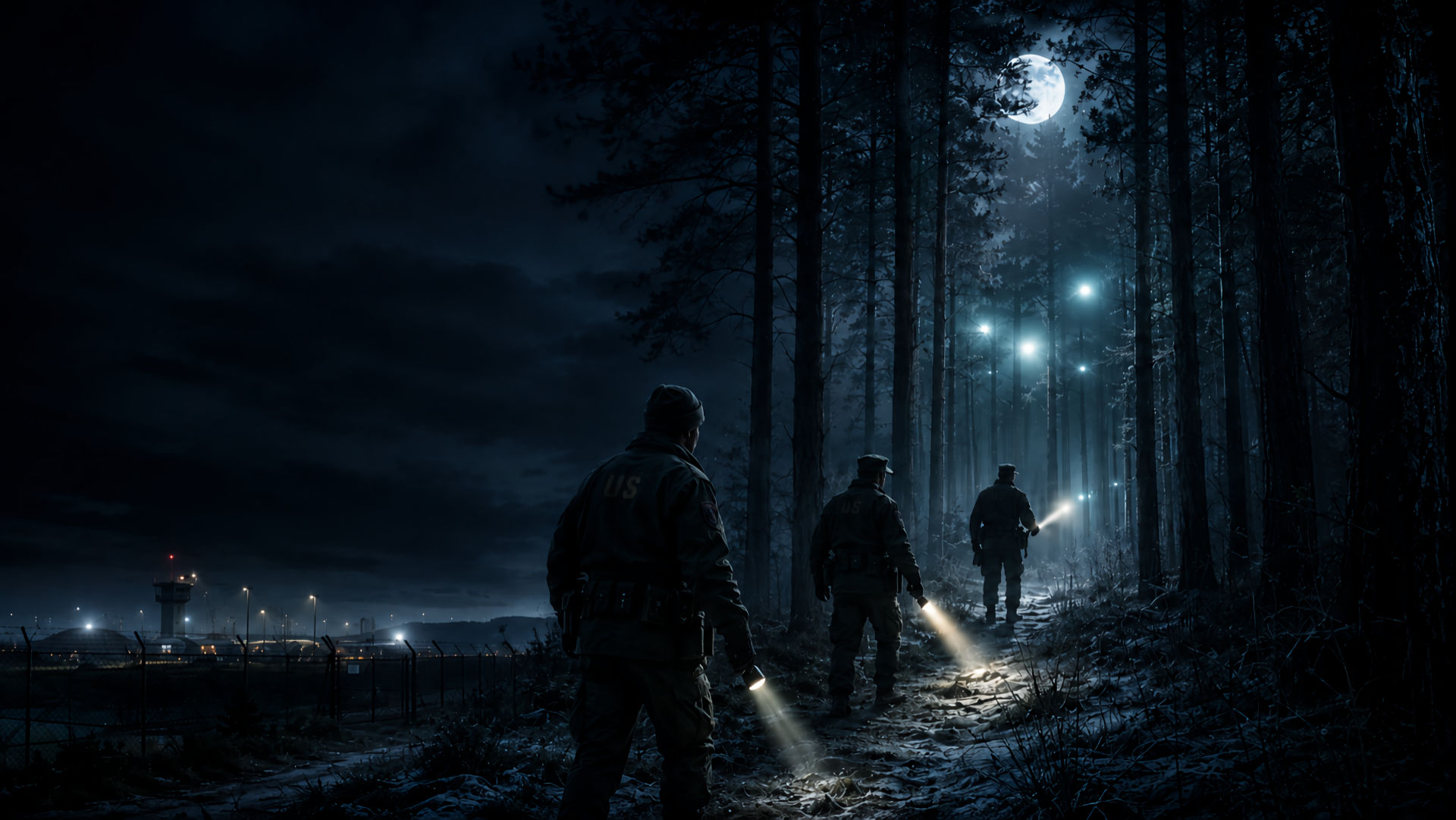
In the early hours of the incident, security personnel near RAF Woodbridge reportedly saw unusual lights beyond the base perimeter. They appeared to be in or near Rendlesham Forest, close enough to raise concern, and strange enough to suggest that something might have crashed or landed. In a military setting, that possibility could not simply be ignored. A falling aircraft, a security breach or some other emergency near an active base would demand a response.
The first reports described lights that seemed to descend into the forest. That detail is important because it gave the sighting a sense of motion and direction. A distant light on the horizon can be dismissed more easily as a lighthouse, aircraft or star. A light that seems to come down into woodland feels more urgent. It suggests impact, landing or at least proximity. For the men on duty, the question was not, “Is this interesting?” It was, “Do we need to investigate?”
A patrol was sent out. The servicemen moved into the forest, where darkness, trees and uneven ground would have made distance difficult to judge. Anyone who has walked through woodland at night knows how quickly familiar things become uncertain. A small light can appear close, then retreat. A sound can seem to come from one direction, then another. Branches break the line of sight. The imagination does not need much encouragement, and on this night it was apparently handed a megaphone.
According to accounts that later became central to the case, the men saw lights that did not behave as expected. Some descriptions speak of a glowing object, metallic appearance and coloured lights. There were also claims that animals on a nearby farm reacted noisily, adding to the atmosphere. Whether that detail was evidence, coincidence or later embroidery, it became part of the story’s texture. Rendlesham works as a mystery partly because it is so cinematic: dark woods, nervous guards, strange lights, disturbed animals and military bases just beyond the trees. Honestly, the only thing missing is a fog machine, and Suffolk in December may well have supplied one free of charge.
The servicemen later gave statements, but accounts would shift and expand over time. That is another key part of the Rendlesham puzzle. The earliest reports were more restrained than some later retellings. As years passed, certain witnesses offered fuller and more dramatic versions of what they believed had happened. Supporters argue that witnesses sometimes reveal more as pressure, trauma or classification concerns ease. Sceptics argue that memory changes, especially when a story becomes famous and repeatedly retold.
At this stage, though, the mystery was still immediate and local. Strange lights had been seen near a sensitive base. Men had gone into the trees. They believed they had encountered something unusual. The next question was whether the forest itself had been marked by whatever they saw.
The First Patrol and the Object in the Trees
The most dramatic part of the Rendlesham story concerns what the first patrol believed it encountered in the forest. Later accounts, especially those associated with Sergeant Jim Penniston and Airman John Burroughs, described a close-range experience with something more solid than a distant light. Penniston would later speak of a small craft, sometimes described as triangular, with unusual markings and a surface he claimed to have touched. This is the part of the case that pulls Rendlesham away from ordinary light-in-the-sky sightings and into the territory of alleged contact.
That distinction matters. Most UFO reports involve lights, shapes or movements seen from a distance. Rendlesham became famous because some witnesses came to claim that an object was physically present in the forest. A light in the sky can be Venus, a meteor, an aircraft or a lighthouse. A structured object on the ground is a much more extraordinary claim. It also demands much stronger evidence, which is where the case becomes both fascinating and frustrating.
After the first sighting, personnel returned to the area in daylight. They reportedly found marks or indentations on the ground, along with damage or disturbance nearby. To those inclined to believe that something had landed, these marks appeared significant. They suggested weight, contact and a physical trace. To sceptics, however, they were far less impressive. Local police and others later suggested that the marks could have had ordinary explanations, including animal activity. This is Rendlesham in miniature: the same evidence becomes either tantalising or underwhelming depending on how much weight you place on the witness accounts.
The alleged markings were not preserved as a sealed forensic scene. There was no full scientific investigation immediately after the event, no careful grid search by independent specialists, no neat chain of evidence that would satisfy a courtroom or a sceptical scientist. The forest was a working landscape, not a laboratory. People moved through it, stories moved faster, and the evidence became tangled with interpretation almost from the start.
Penniston’s later claims added another layer. He described getting close enough to inspect the object and later said he copied symbols into a notebook. In later years, he also spoke of binary code associated with the experience, a detail that has attracted both intense interest and heavy criticism. Believers see it as part of a deeper mystery. Sceptics point out that some of the most extraordinary details appeared publicly much later, which makes them harder to assess.
The difficulty is not simply that people disagree. It is that Rendlesham contains different kinds of evidence, and they do not all carry the same strength. There are military witnesses, written statements, a memo, later interviews, alleged physical traces and sceptical reconstructions. Each piece seems to point somewhere, but not always in the same direction.
By the time the first patrol’s story had settled into memory, the case already had enough fuel to burn for years. Then a senior officer went into the forest himself.
Colonel Halt, the Tape, and the Second Night
Lieutenant Colonel Charles Halt is one of the main reasons the Rendlesham case did not fade into a simple barracks rumour. Halt was the deputy base commander, a senior officer rather than an anonymous witness. When he became involved, the story gained a level of authority that most UFO cases never come close to enjoying. Even for sceptics, Halt’s role makes Rendlesham worth studying. Whatever happened, someone in a responsible military position believed there was enough going on to investigate.
Halt entered the forest with a small team after reports of strange activity continued. Crucially, he made an audio recording during part of the investigation. The so-called Halt tape became one of the most famous pieces of the case. On it, Halt and others can be heard discussing their observations, including lights, ground marks and radiation readings. The recording does not prove that an extraterrestrial craft visited Suffolk, but it does capture something valuable: the sound of trained personnel trying to make sense of events in real time.
That immediacy gives the tape its power. Written statements can be polished. Memories can drift. Interviews can be shaped by years of argument. A field recording, however, preserves confusion as it happens. Halt does not sound like a man inventing a campfire story for future documentary producers. He sounds like a man attempting to document something he considers unusual. That does not mean his interpretation was correct, but it does make the case more interesting than a simple tall tale.
The radiation readings became another controversial feature. Halt reported elevated readings around the alleged landing site, and for supporters, this suggested something physical and unusual had happened. Sceptics argue that the readings were not extraordinary, that equipment interpretation matters, and that comparisons with background levels are not always handled carefully in popular retellings. Once again, Rendlesham offers evidence that can be read in sharply different ways. A believer sees a trace. A sceptic sees a measurement turned into mythology.
Halt also reported seeing strange lights in the sky, including objects that appeared to move or beam light downward. These observations added a second phase to the incident. The mystery was no longer just about what the first patrol had seen in the trees. It now involved a senior officer, additional witnesses and lights observed during a deliberate follow-up investigation.
In January 1981, Halt wrote a memo titled “Unexplained Lights” and sent it through official channels. This memo is central to the case because it moved Rendlesham from witness memory into government paperwork. The Ministry of Defence later treated the matter as having no defence significance, but the very existence of the memo helped keep the story alive.
By now, Rendlesham had become something more complicated than a sighting. It was an official non-emergency that refused to behave as if nothing had happened.
Explanations, Doubts, and the Orfordness Lighthouse
Every strong mystery needs two forces pulling against each other. Rendlesham has them in abundance. On one side are the witnesses, the military setting, the Halt memo, the tape and the claims of physical traces. On the other are the sceptical explanations, which argue that the case can be understood without alien craft, secret technology or visitors from somewhere with very poor respect for British airspace.
The best-known sceptical explanation is not one thing, but a combination of things. The first reported lights may have been connected to a bright meteor or fireball seen over southern England. A meteor can appear dramatic, sudden and low, especially if viewed in darkness by people not expecting it. If a fireball seemed to descend towards the forest, it could have created the impression that something had come down nearby. That would explain the urgency of the first response, even if nothing actually landed.
Then there is Orfordness Lighthouse. At the time, its beam was visible from parts of the area, and sceptics argue that some of the flashing lights seen through the trees may have been the lighthouse viewed from confusing angles. In darkness, across uneven ground, with trees interrupting the line of sight, a distant flashing light can appear to move or pulse strangely. The human brain is excellent at pattern-making, occasionally too excellent for its own good. Give it a flashing light, a forest and a rumour of a crash, and it may start assembling the deluxe UFO package before anyone has asked for one.
Bright stars have also been suggested as explanations for some of the lights Halt and others saw later in the sky. Stars near the horizon can shimmer, shift colour and appear to move because of atmospheric effects and tiny movements of the observer’s eyes. To someone already primed by reports of a possible landing, a star may not feel like a star. It may feel like the next phase of an unfolding event.
These explanations are plausible, but they do not satisfy everyone. Believers argue that they reduce complex witness accounts to a tidy bundle of coincidences. They ask whether trained military personnel would really mistake a lighthouse, stars and a meteor for something extraordinary across multiple nights. Sceptics reply that training does not make anyone immune to misperception, especially at night, under stress, in unfamiliar conditions and with fragmentary information.
The Ministry of Defence position also cuts both ways. Officials concluded the incident had no defence significance, which sounds dismissive. Yet the MoD also did not provide a single definitive explanation that ended the matter. To sceptics, that simply means there was no threat and no reason to spend more resources. To believers, it leaves a gap large enough to park a flying saucer in, assuming it can find a suitable clearing.
What makes Rendlesham endure is not that one explanation defeats all others. It is that every explanation seems to leave someone unsatisfied.
Britain’s Roswell and the Mystery That Refused to Leave
Rendlesham Forest became known as Britain’s Roswell because it offered something British UFO culture had rarely possessed on such a scale: military witnesses, official documents, alleged physical traces, senior personnel, and a story that sounded just secret enough to invite suspicion. Roswell had the desert, crashed debris and rumours of recovered bodies. Rendlesham had pine trees, airbases, flashing lights and a memo. It was less cinematic in some ways, but more unsettling in others. It happened not in a remote American landscape, but in a quiet Suffolk forest within reach of ordinary villages, dog walkers and weekend cyclists.
The case grew because it could be retold from several angles. For believers, it was one of the strongest UFO incidents in British history. They could point to the credibility of witnesses, the military location, Halt’s involvement, the recording, the reported radiation readings and the official paper trail. For sceptics, it became a classic study in how misperception, memory, rumour and later embellishment can transform ordinary lights into an extraordinary legend. Each side found enough material to keep going. Rendlesham did not close. It multiplied.
The witnesses themselves became part of the continuing mystery. Some remained convinced that something extraordinary had happened. Some accounts became more elaborate with time, which made supporters and sceptics argue even harder. Were later details recovered memories, delayed disclosures, personal interpretations or signs of a story changing under the pressure of fame? That question sits at the heart of many famous mysteries. People are not recording devices. Memory is alive, and like all living things, it changes.
The forest also changed. The bases closed, the Cold War ended, and the world moved on from the atmosphere of 1980. Yet Rendlesham did not vanish into old newspaper archives. It became a destination. Visitors walk the UFO trail, stand among the trees and imagine what it might have been like to see strange lights beyond the wire. The story has become part of the landscape, layered over the real forest like a second map. There is the Rendlesham of paths and pines, and there is the Rendlesham of tapes, rumours and glowing shapes between the trees.
Perhaps that is why the mystery still works. It does not require everyone to believe aliens landed in Suffolk. It only asks a more durable question: what did those men see, and why did they interpret it the way they did? The answer may involve a meteor, a lighthouse, stars, stress and the strange theatre of night-time perception. Or it may involve something still not fully explained. Either way, Rendlesham remains one of those rare mysteries where the sensible answer and the uncanny answer keep walking through the same forest, neither quite able to shake the other off.
The Rendlesham Forest UFO Mystery FAQ
The Rendlesham Forest UFO incident was a series of reported sightings of strange lights near RAF Woodbridge and RAF Bentwaters in Suffolk in December 1980. Several United States Air Force personnel were involved, and the case later became one of Britain’s most famous UFO mysteries.
Rendlesham Forest is often called Britain’s Roswell because it involved military witnesses, official documentation and claims of unusual activity near a sensitive airbase. Like Roswell, it became a major part of UFO culture and remains widely debated.
Lieutenant Colonel Charles Halt was the deputy base commander at RAF Bentwaters. He investigated the incident after the first reports and later wrote a memo about unexplained lights. His field recording, known as the Halt tape, became one of the best-known pieces of evidence linked to the case.
Sceptical explanations include a bright meteor or fireball, the beam from Orfordness Lighthouse, bright stars, misperception in darkness and the way memory can change over time. These explanations are widely discussed, but they do not satisfy everyone who has studied the case.
The Ministry of Defence did not treat the incident as a threat to national security and concluded that it had no defence significance. However, no single official explanation has ended the debate, which is why the story remains so enduring.