The History of the Passport
Long before the passport became a small booklet tucked into a coat pocket, people still needed permission to travel. The problem was not tourism, because for most of history very few people travelled for pleasure. The problem was authority. A stranger moving through unfamiliar territory could be a merchant, pilgrim, messenger, spy, soldier, refugee, thief, or tax-dodger, and rulers wanted some way to know who had been allowed through and who had not.
One of the oldest famous examples comes from the Hebrew Bible, in the Book of Nehemiah. Nehemiah, an official serving King Artaxerxes I of Persia in the fifth century BC, asked permission to travel to Judah. The king gave him letters addressed to governors beyond the Euphrates, asking them to allow him safe passage. It was not a passport in the modern sense. It did not prove nationality, citizenship, or a right to return home. It was closer to a royal note saying, in effect, “This person travels with my permission, and causing trouble for him may cause trouble with me.”
That idea appeared in many different forms across the ancient world. Empires depended on movement. Officials, envoys, soldiers, tax collectors, messengers, and traders all had to cross boundaries, and in large states such as Persia, Rome, China, and later Islamic caliphates, travel documents or tokens could help identify those moving with official approval. The point was practical as much as political. If a ruler claimed authority over a road, a gate, a river crossing, or a province, then movement through that space became something that could be permitted, denied, taxed, or recorded.
For ordinary people, however, identity was usually local rather than national. A person belonged to a village, guild, lord, town, religious community, or household. They might be known by reputation rather than paperwork. That worked well enough when most lives were lived within walking distance of home. It worked less well when people moved through places where nobody knew their face, family, or trade.
The earliest travel documents therefore emerged from a world of personal rule. They were not about equal citizenship. They were about protection granted by someone powerful enough to make other people respect it. A sealed letter, a royal command, or an official token could turn a suspicious stranger into a recognised traveller.
That basic principle would survive for centuries. The form changed, the language changed, and the issuing authority changed, but the core idea remained surprisingly familiar. A passport began as a request for safe passage, and in medieval Europe that request became increasingly tied to kings, borders, roads, ports, and written guarantees.
Medieval Roads, Borders, and Written Guarantees
In medieval Europe, travel could be both ordinary and dangerous. Pilgrims went to shrines, students moved between universities, merchants followed trade routes, soldiers crossed frontiers, and diplomats carried messages between rulers. Yet roads were poorly policed, wars were frequent, and political authority was often patchy. A traveller might pass through the lands of several lords, towns, bishops, and princes in a single journey. Each had their own rights, tolls, suspicions, and grudges.
This is where safe-conduct documents became important. A safe conduct was a written guarantee that a person could pass through a territory without being arrested, robbed, detained, or treated as an enemy. It might protect an ambassador, a merchant caravan, a prisoner being released, or even an enemy negotiator travelling to peace talks. These documents did not make travel easy, but they made it more official. They said that the bearer was not simply wandering. They were moving under recognised authority.
In England, the story of the passport is often traced to the reign of Henry V. In 1414, during a period shaped by war with France and the need to control movement across the Channel, safe conducts were mentioned in an Act of Parliament. These early documents were not limited to English subjects. They could be issued to foreign nationals too, because the issue was not yet citizenship in the modern sense. It was permission to move through or beyond the king’s realm.
The word passport itself probably grew out of the language of passage. It may be linked to passing through a port, a gate, or a controlled point of entry. That matters, because medieval movement was often controlled at chokepoints rather than along neat national borders. Ports, bridges, city gates, mountain passes, and river crossings were places where officials could ask questions, demand payment, or refuse entry. A document authorising passage was useful precisely because movement could be interrupted.
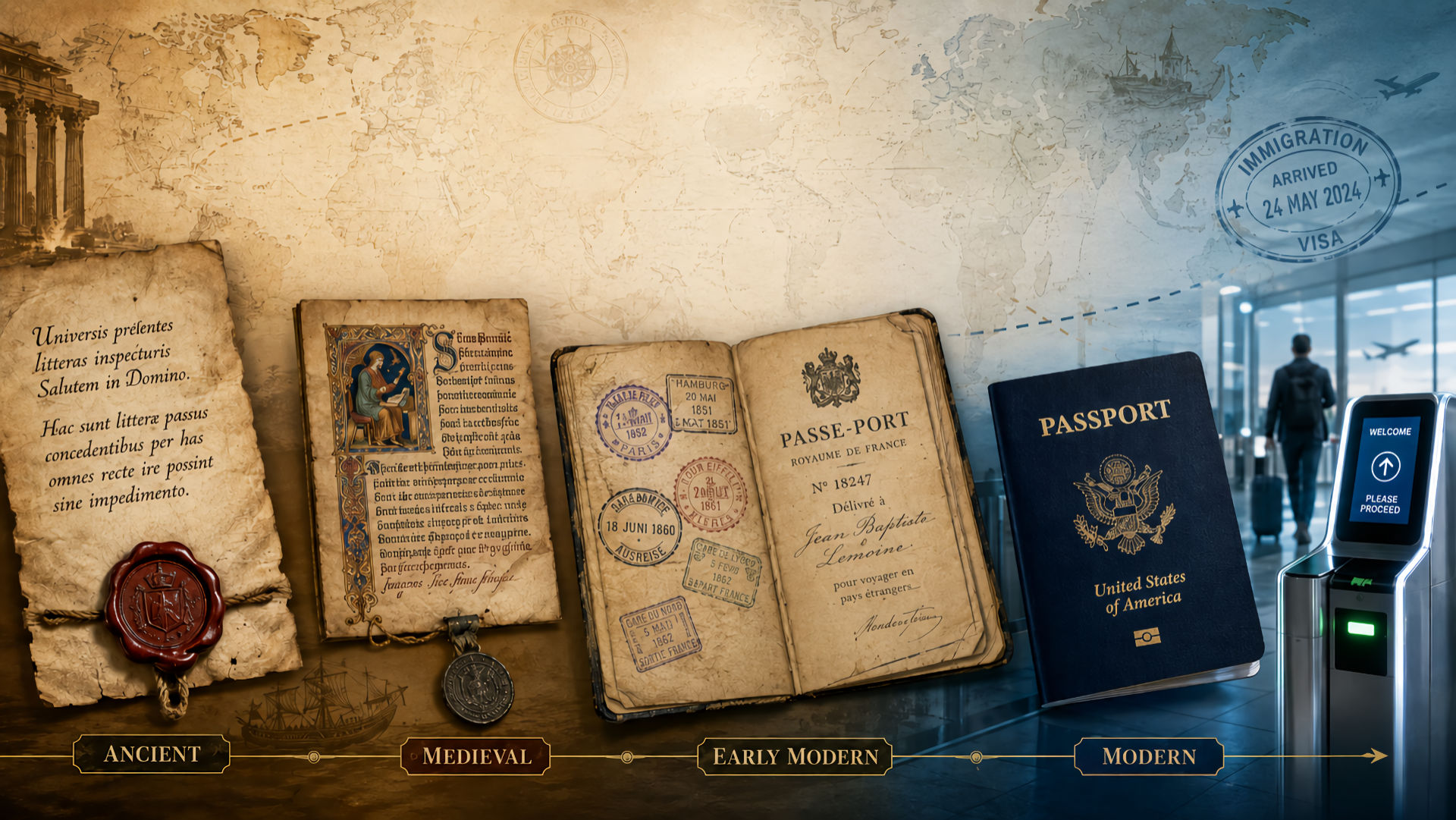
By the sixteenth century, the English Privy Council was granting passports, and the practice became more formal. Documents carried seals, signatures, and official wording. They were still far from the modern passport booklet. They usually did not include a photograph, a machine-readable line, or a neat page of personal data. They depended on handwriting, trust, status, and the authority of the person who issued them.
For the traveller, such paperwork could be a shield. For the ruler, it was a tool of control. The same document that protected movement also helped define who had permission to move. Over time, that balance between freedom and surveillance became one of the passport’s defining tensions.
As states grew stronger, that tension became sharper. The passport began to move away from the medieval world of favours, safe conducts, and royal letters, and towards something more recognisably bureaucratic: a document linking a named individual to a state.
Empires, Migration, and the Rise of Official Identity
The early modern period changed the meaning of travel. European states became more centralised, overseas empires expanded, armies grew larger, and trade stretched across oceans. Movement was no longer simply a matter of roads and local permissions. Ships carried diplomats, sailors, merchants, colonists, enslaved people, soldiers, missionaries, convicts, and migrants across vast distances. Governments increasingly wanted to know who was leaving, who was arriving, and who might be useful or dangerous.
Passports became part of that wider machinery. They were issued by monarchs, ministers, ambassadors, consuls, and other officials. In Britain, passports were once signed in the monarch’s name, but over time the Secretary of State took on the role. By the late eighteenth century, the issuing of passports had become a more regular function of government. That change might sound administrative, and it was, but it also marked a shift in power. Movement was becoming less personal and more bureaucratic.
Before photographs, identification relied on written description. A passport might record a traveller’s height, age, complexion, hair colour, eye colour, occupation, or distinguishing marks. Some descriptions were vague, some were oddly specific, and some are almost comic to modern eyes. Yet they served a serious purpose. Officials needed some way to connect a piece of paper with the body of the person holding it. In a world without digital databases, photography, or instant communication, that was not easy.
The French Revolution and the wars that followed gave passports new importance. Revolutionary governments feared enemies within and beyond their borders, while neighbouring monarchies feared revolutionaries crossing into their territories. Papers of identity, internal passports, travel permits, and border controls became tools of political security. The passport was no longer only about safe passage. It was increasingly about suspicion.
Then, during the nineteenth century, the story took a surprising turn. In parts of Europe, passport controls actually loosened. Railways, steamships, and mass tourism made travel faster and more common, and strict passport checks became difficult to enforce. Wealthy travellers could cross borders with relatively little inconvenience, while guidebooks and travel agencies helped turn international journeys into something more routine. Thomas Cook’s organised tours were part of a new travel culture in which middle-class people began to imagine foreign travel as an experience rather than a diplomatic mission.
But this freedom was uneven. Migrants, refugees, political radicals, colonial subjects, and poorer travellers were often watched far more closely. The passport could disappear for some and become more important for others. It reflected a world where movement was expanding, but not equally.
By the early twentieth century, international travel seemed to be growing more open, at least for those with money, status, and the right nationality. Then came the First World War, and the passport was transformed from an occasional convenience into a central document of modern life.
War, Suspicion, and the Birth of the Modern Passport
The First World War changed the passport more dramatically than any previous event. When war broke out in 1914, governments suddenly became far more anxious about borders, spies, enemy aliens, deserters, refugees, and military security. Movement that had once seemed inconvenient to police now seemed too dangerous to leave unchecked. The passport returned with force, and this time it came with new expectations.
In Britain, modern-style passports with a photograph and signature were introduced during the war years. These early versions were still not the neat booklets people know today. They were often folded paper documents, but they marked a crucial step. A passport was no longer just a request from one government to another. It became a document designed to prove that the person carrying it matched an official identity record.
Photographs changed everything. A written description could be subjective, but a photograph appeared to offer direct proof. Of course, early passport photographs were not always flattering or reliable. Lighting, printing, ageing, clothing, and facial hair could all cause problems. Even so, the photograph made the passport feel more personal and more fixed. It attached the state’s authority to a face.
The war also created immense displacement. Empires collapsed, borders shifted, and millions of people found themselves outside the protection of any stable government. The Russian Revolution, the breakup of the Austro-Hungarian and Ottoman Empires, and the redrawing of Europe left many people stateless or stranded. For them, the passport was not merely a travel document. It could determine whether they could flee danger, find work, cross a border, or begin again.
One of the most important responses was the Nansen passport, named after Fridtjof Nansen, the Norwegian explorer, diplomat, and League of Nations High Commissioner for Refugees. First issued in the 1920s, it provided internationally recognised travel papers for many stateless refugees. It did not solve the refugee crisis, but it offered a practical answer to a brutal problem: how could people move legally when no state would claim them as citizens?
The League of Nations also tried to bring order to passport chaos. In 1920, an international conference recommended a standard passport format, including a booklet form, defined dimensions, and pages for personal information and visas. The aim was partly convenience, but it was also about control. If passports looked more alike, officials could inspect them more quickly, and governments could trust each other’s documents more easily.
What had begun as an emergency wartime measure did not disappear after the fighting ended. Governments had discovered that passports were useful. They controlled borders, identified individuals, regulated migration, and created records. Once that machinery existed, few states were eager to dismantle it.
The modern passport was therefore born from a contradiction. It promised movement, but it also made movement conditional. It opened doors, but only after proving who you were. In the decades that followed, that proof became increasingly standardised, secure, and familiar.
Standardisation, Photographs, and the Passport Booklet
After the First World War, the passport settled into its modern shape. The booklet format became increasingly common, and the basic logic of the document became recognisable: cover, issuing country, personal details, photograph, signature, expiry date, and blank pages for stamps and visas. It looked simple, but it represented an enormous international agreement about identity, sovereignty, and trust.
Britain’s first blue passport booklet appeared in 1921. It had 32 pages and was written partly in French, long used as a language of diplomacy. That detail is a useful reminder that passports are never purely national objects. The cover may display a country’s symbols, but the document only works because other countries agree to read it, respect it, and stamp it. A passport is national in design, but international in function.
Through the mid-twentieth century, passports became increasingly normal for ordinary travellers. Air travel expanded after the Second World War, tourism grew, and migration reshaped societies. The passport moved from the world of diplomats, merchants, and wartime security into the lives of families heading on holiday, workers moving abroad, students studying overseas, and relatives crossing continents to visit one another.
At the same time, the document became harder to forge. Governments improved paper quality, printing methods, watermarks, official seals, and later laminates and security patterns. The photograph remained central, but it was joined by better typography, serial numbers, and issuing procedures. The aim was to make the passport not just recognisable, but difficult to copy.
The rise of visas also changed the passport’s role. A passport might prove identity and nationality, but it did not automatically grant entry. A visa allowed a destination country to give permission in advance, often after assessing the traveller’s purpose, finances, political status, or risk of overstaying. The passport became a platform on which other governments could record their own permissions. It was both a key and a noticeboard.
During the Cold War, passports also carried ideological weight. For citizens of liberal democracies, the ability to travel was often presented as a sign of freedom. For people living under authoritarian regimes, obtaining permission to leave could be difficult or impossible. A passport could symbolise liberty, privilege, exile, escape, or state control, depending entirely on where a person stood.
By the late twentieth century, the passport had become one of the most widely recognised objects in the world. Yet its success created a new problem. As travel numbers rose, border officials had to process more people more quickly, while still detecting fraud. Human eyes and rubber stamps were no longer enough. The passport needed to become readable not just by officials, but by machines.
That shift would move the passport from ink and paper into the digital age, where identity could be scanned, stored, compared, and checked at speed.
Biometrics, E-Gates, and the Future of Movement
The machine-readable passport was one of the biggest changes in the history of travel documents. From the late twentieth century, passports increasingly included a machine-readable zone, the two lines of letters, numbers, and chevrons usually found at the bottom of the identity page. To a person, it looks like bureaucratic alphabet soup. To a scanner, it is structured data: name, nationality, passport number, date of birth, sex, expiry date, and check digits designed to catch errors.
The International Civil Aviation Organization, known as ICAO, played a central role in developing global standards. Its Doc 9303 specifications helped make machine-readable travel documents consistent across borders. That standardisation mattered because passports had to work everywhere. A document issued in London, Tokyo, Nairobi, Ottawa, or São Paulo needed to be understood by machines and officers thousands of miles away.
Then came biometric passports, often called e-passports. These include an electronic chip containing data such as the holder’s facial image, and in some countries fingerprints or iris information. The purpose is to make the document harder to forge and to make identity checks more reliable. The face in the chip can be compared with the face at the border, while digital signatures help confirm that the chip data has not been altered.
This is what makes automated border gates possible. At an e-gate, the traveller places their passport on a scanner, looks into a camera, and waits while the system compares the document, the chip, and the person standing in front of it. When it works, the whole process feels almost magical. When it fails, everyone behind you in the queue silently decides you are the problem. Modern travel has produced few social pressures quite like failing to impress a small glass gate.
Yet the future of the passport raises serious questions. Digital identity systems may make travel faster, but they also increase the amount of personal data being collected and checked. Biometric systems depend on accuracy, security, and public trust. If a paper passport is lost, it can be cancelled and replaced. If biometric data is compromised, the issue is more complicated. You can change a passport number. You cannot easily change your face.
Passports also remain deeply unequal. Some open doors to dozens or even hundreds of destinations with little difficulty. Others bring suspicion, visa applications, extra fees, and long waits. The passport may look like a simple booklet, but it reflects global power, wealth, diplomacy, security, and citizenship. Its history began with a request for safe passage. Over time, that request became a record of identity, a symbol of nationality, a security device, and a measure of global privilege. The passport tells us where we are from, but it also tells us how the world chooses to receive us.
The History of the Passport FAQ
The idea behind passports is ancient. Early versions were safe-conduct letters that allowed a named person to travel with official protection. One famous early example appears in the Book of Nehemiah, where letters from the Persian king helped Nehemiah travel safely through foreign territories.
Modern passports developed strongly during the First World War, when governments introduced stricter border controls and identity checks. In Britain, passports with photographs and signatures became common during this period, and in 1921 the British passport booklet took a more recognisably modern form.
The Nansen passport was a travel document created in the 1920s for stateless refugees, especially after the First World War and the Russian Revolution. It was named after Fridtjof Nansen, the Norwegian explorer and diplomat who worked with the League of Nations to help displaced people travel legally.
A biometric passport, also known as an e-passport, contains an electronic chip that stores identity data such as the holder’s facial image. It helps border officials and automated e-gates compare the passport, the chip, and the person presenting it, making the document harder to forge.