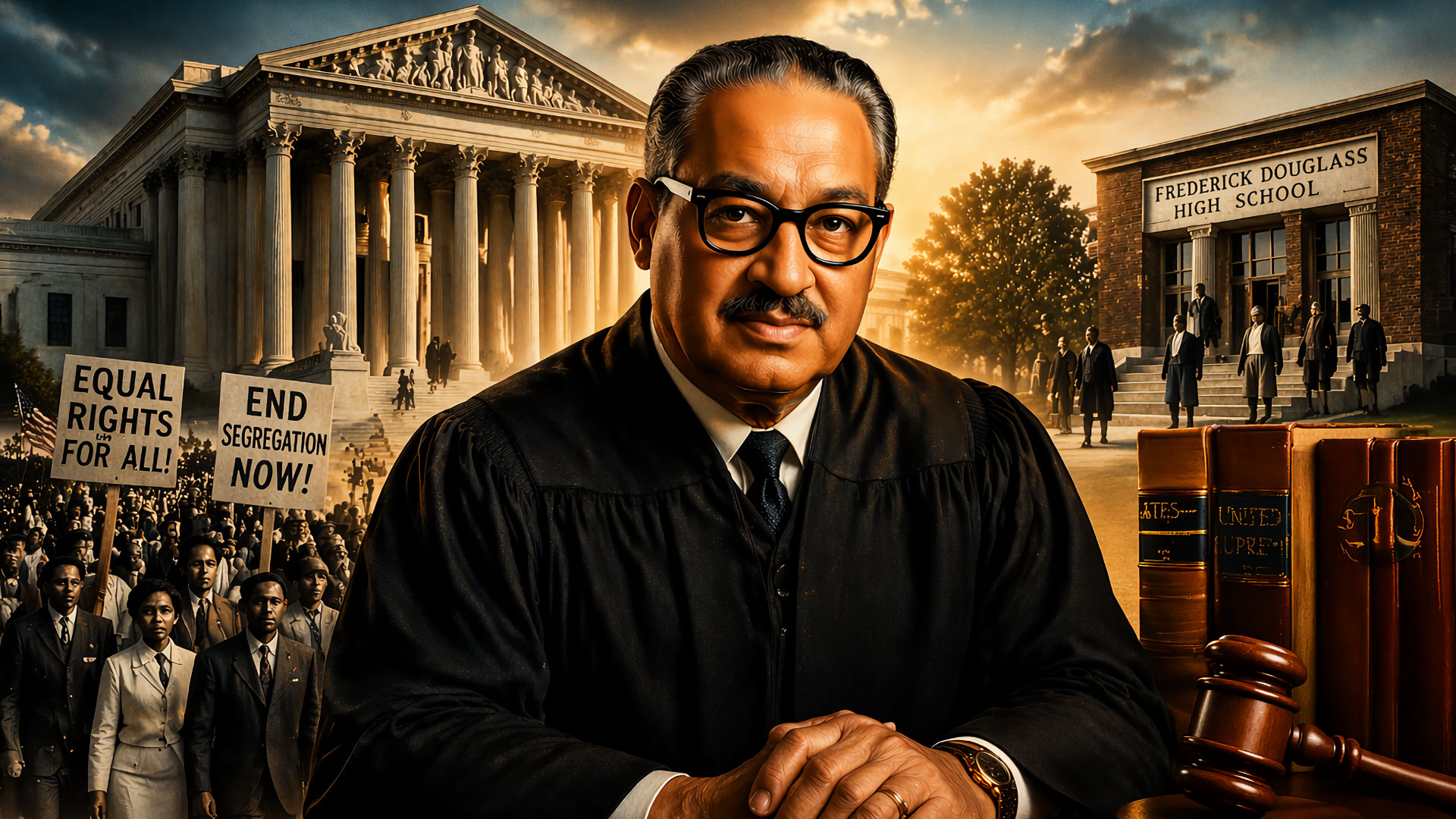
Thurgood Marshall
Thurgood Marshall was born in Baltimore, Maryland, on 2 July 1908, into a Black family that valued education, discipline and argument in equal measure. His father, William Canfield Marshall, worked as a railroad porter and later as a steward at an all-white country club. His mother, Norma Williams Marshall, was an elementary school teacher. From his mother came a respect for learning and persistence. From his father came a habit that would stay with him for life: the belief that ideas should be tested in debate, pushed hard, and defended properly. Marshall later recalled that his father would take him to watch court proceedings and challenge him to think through legal arguments for himself.
Baltimore in the early twentieth century was not the Deep South, but no one could pretend it was free of racism. Marshall grew up in a city where segregation and discrimination shaped schools, jobs, housing and public life. He attended, what became, Frederick Douglass High School, one of the best-known Black schools in Baltimore, and graduated in 1925. By then, he was already known for being clever, outspoken and occasionally mischievous. One famous story, repeated in later accounts of his life, was that punishment at school sometimes involved making him memorise parts of the United States Constitution. It was meant to discipline him. Instead, it helped plant the text in his mind.
His childhood was not simply a prelude to greatness. It was a period in which he saw the contradictions of American life up close. He lived in a nation that talked constantly about liberty while denying basic equality to millions of its own citizens. He saw what segregation meant in practical terms, not as an abstract injustice but as a system that narrowed horizons and imposed humiliations. Those early experiences gave Marshall something more important than anger alone. They gave him clarity. He came to understand that prejudice was not just a matter of bad attitudes. It was built into institutions, laws and routines. To challenge it seriously, someone would need to fight with more than speeches. They would need strategy, training and stamina.
That sense of purpose did not appear fully formed in childhood, but the ingredients were there very early. Marshall grew up in a home where self-respect mattered and where injustice was recognised for what it was. His parents did not teach passivity. They taught endurance, ambition and the habit of speaking plainly. Those qualities would later make him one of the most formidable lawyers in the country, but in Baltimore, they first appeared in a bright young man learning how to navigate a world stacked against him. Before he had argued a single great case, before he had entered Howard Law School or taken on segregation in court, Thurgood Marshall had already absorbed the lesson that would define his life: rights meant very little unless someone was prepared to enforce them.
School, Family Influence, and the Road to Howard University
After high school, Marshall went to Lincoln University in Pennsylvania, one of the leading historically Black institutions in the United States. He entered a world that broadened him intellectually and socially. Lincoln had produced major Black thinkers and leaders, and Marshall encountered fellow students who would also become nationally significant, including the poet Langston Hughes and the future president of Ghana, Kwame Nkrumah. Marshall was not yet the polished legal giant of later years. He was lively, sociable and sometimes more interested in campus life than tidy respectability. Even so, Lincoln sharpened him. It gave him a wider sense of Black intellectual life and of the possibilities available beyond the narrow limits imposed by segregation. He graduated with honours in 1930 with a bachelor’s degree in American literature and philosophy.
Just before finishing university, he married Vivian “Buster” Burey in September 1929. She would be an important part of his early adult life, standing beside him through the years when his career was still uncertain, and money was often tight. Marshall then hoped to study law at the University of Maryland, but he was denied admission because he was Black. That rejection was more than a personal insult. It showed him, in direct and unmistakable fashion, how law itself could be used as a barrier. Rather than ending his ambitions, the refusal helped define them. He enrolled instead at Howard University School of Law in Washington, DC, a decision that changed his life.
At Howard, Marshall came under the influence of Charles Hamilton Houston, the brilliant dean and legal strategist who became one of the key architects of the campaign against segregation. Houston demanded excellence. He believed Black lawyers had a special duty, not merely to succeed individually, but to use the law to dismantle racial inequality. Howard Law School under Houston was sometimes described as a kind of training ground for social transformation, and Marshall was one of its most gifted students. Houston did not simply teach doctrine. He taught method, precision and purpose. He expected arguments to be rigorous, evidence-based and aimed at systemic change. Marshall absorbed all of it.
Marshall graduated first in his class from Howard in 1933. By that point, the route of his life had become much clearer. The boy from Baltimore, shaped by debate at home and injustice in daily life, had now been trained by one of the most important legal minds in Black America. He had also experienced, in his own education, the very discrimination he would later challenge in court, meaning that Marshall’s legal philosophy did not emerge from theory alone. It was rooted in lived experience, disciplined by professional training and sharpened by the example of Houston. The next stage of his life would involve turning that preparation into action, first in private practice and then in the larger civil rights struggle.
Building a Legal Career and Joining the Fight for Civil Rights
After law school, Marshall returned to Baltimore and began practising law. These were not glamorous years. He was building a career in a deeply unequal society during the Great Depression, representing clients in ordinary matters while also trying to establish himself professionally. Yet even in these early years, the line between private law practice and civil rights work was never very firm. Marshall had been trained to see law as an instrument of change, and Baltimore provided no shortage of examples of racial exclusion that demanded challenge. He soon began working with the NAACP, and his partnership with Charles Hamilton Houston brought him into some of the most significant legal contests of the era.
One of the first major victories came in Murray v. Pearson in 1936, when Marshall and Houston successfully challenged the University of Maryland Law School’s refusal to admit a Black applicant. The institution that had once excluded Marshall became the target of a case that undermined the legal basis for doing so. It was an early sign of the strategy that would define his civil rights career. Marshall and his colleagues did not begin by demanding everything at once in one dramatic flourish. They built carefully, attacking the inequalities within the so-called “separate but equal” framework and forcing courts to confront the dishonesty of segregationist systems. Step by step, the law’s contradictions were exposed.
In 1938, Marshall became special counsel to the NAACP, and in 1940, he became the founding director-counsel of the NAACP Legal Defense and Educational Fund. This role transformed him from a promising lawyer into a national figure. He travelled extensively, often under dangerous conditions, working on cases involving voting rights, education, criminal justice and equal protection. He faced hostility not only in courtrooms but also on the road. Representing Black clients in the Jim Crow era could be physically dangerous, especially in the South. Marshall knew that legal briefs alone would not protect him from racism backed by local power and mob sentiment. Yet he persisted, developing a reputation as a lawyer who combined exacting legal skill with toughness, wit, and absolute refusal to be intimidated.
By the 1940s and early 1950s, Marshall had become one of the central figures in the legal assault on segregation. He argued case after case before the Supreme Court, winning the large majority of them and steadily building precedents that weakened the foundations of Jim Crow. The campaign covered graduate education, public schools, voting rights and unequal criminal procedures. It also relied on teamwork. Lawyers such as Constance Baker Motley and others at the Legal Defense Fund were crucial to this effort. Marshall was the most visible figure, but he was not working alone. What made him exceptional was his ability to bring together legal doctrine, public purpose and courtroom force. He was not merely reacting to injustice. He was helping design the legal strategy that would eventually break it open.
Taking on Segregation, from Local Cases to Brown v. Board of Education
The assault on segregation reached its most famous stage in the school cases that culminated in Brown v. Board of Education. Marshall understood that public education sat at the heart of American citizenship. If a child was told by law that they must attend a separate school because of race, the state was not merely organising classrooms. It was teaching inequality. Before Brown, Marshall and the Legal Defense Fund had already built a long chain of victories in education cases, particularly in graduate and professional education, exposing the lie that separate facilities could ever be genuinely equal. These cases were part of a deliberate legal progression, not isolated skirmishes.
Brown brought together cases from Kansas, South Carolina, Virginia, Delaware and the District of Columbia. Marshall argued on behalf of the plaintiffs before the Supreme Court, drawing on constitutional principles, precedent and social science evidence, including the well-known doll studies by Kenneth and Mamie Clark. The central point was devastatingly simple. Segregation in public education violated the Equal Protection Clause of the Fourteenth Amendment because separation imposed inferiority by law. On 17 May 1954, the Court unanimously agreed. The decision declared that separate educational facilities are inherently unequal, overturning the legal logic that had justified racial separation since Plessy v. Ferguson in 1896. It was one of the most important constitutional rulings in American history.
Brown did not magically end segregation overnight, and Marshall knew it would not. The ruling was a breakthrough, but implementation was slow, contested, and often openly resisted. Southern politicians and school systems fought to delay or evade integration. There was a second Brown ruling in 1955 dealing with implementation, and the struggle continued in communities across the country. Marshall remained deeply involved in these efforts, including battles related to school desegregation in places such as Little Rock. The legal victory had to be defended in the real world, where local authorities could frustrate change through delay, intimidation or token compliance. Brown was a turning point, but not the end of the road.
This period also brought personal change. Marshall’s first wife, Vivian Burey, died of cancer in 1955 after roughly twenty-five years of marriage. Later that same year, on 17 December 1955, he married Cecilia “Cissy” Suyat, who had worked with the Legal Defense Fund during the Brown era. Their marriage would last for the rest of his life, and they had two sons, Thurgood Marshall Jr. and John W. Marshall. So while Brown often dominates accounts of these years, Marshall’s life was not lived solely in appellate briefs and constitutional principle. He was also dealing with loss, remarriage and family responsibilities, all while carrying a legal workload that would have exhausted most people twice over.
From the NAACP to the Federal Bench and the Solicitor General’s Office
By the start of the 1960s, Marshall was already one of the best-known lawyers in the United States. His victories had helped reshape constitutional law, and presidents could hardly pretend not to notice. In 1961, President John F. Kennedy gave him a recess appointment to the United States Court of Appeals for the Second Circuit in New York. The appointment was significant in itself, but the path to confirmation showed that Marshall’s rise still threatened many political interests. Southern senators opposed him fiercely, and the confirmation process dragged on until September 1962. Even after Brown, even after years of distinguished Supreme Court advocacy, a Black lawyer identified so strongly with civil rights still faced determined resistance from the political establishment.
On the Second Circuit, Marshall served as a federal judge from 1961 to 1965. Although his judicial record there is sometimes overshadowed by what came before and after, it mattered greatly. He was no longer just the outside advocate challenging the system. He had become part of the federal judiciary itself. He wrote opinions, handled appeals and demonstrated that the courtroom fighter could also be a disciplined and capable judge. The move from advocate to judge required adjustment. A judge cannot choose cases or pursue a cause in the same way a civil rights litigator can. But Marshall’s years on the bench helped prepare him for the still larger national role that was coming.
In 1965, President Lyndon B. Johnson appointed Marshall Solicitor General of the United States, making him the first Black person to hold that office. As Solicitor General, he once again argued before the Supreme Court, this time on behalf of the federal government. He was highly successful, winning the great majority of the cases he handled in that role. The appointment also marked another stage in his public identity. Marshall had spent decades pushing the federal government to live up to the Constitution. Now he was one of its senior legal representatives. That shift did not mean abandoning principle. It meant carrying his authority into the highest levels of government.
These years completed Marshall’s transformation from civil rights advocate to national statesman of the law. He had grown up under segregation, been denied admission to a white law school, built a civil rights practice under pressure, and then entered the federal judiciary and executive branch at the highest levels. His family moved with him through these changes, including the move to the Washington area during the Johnson years. By the mid-1960s, the question was no longer whether Marshall was qualified for the nation’s top institutions. The real question was how long it would take those institutions to acknowledge what was already obvious. The answer came in 1967, when Johnson chose him for the Supreme Court.
Becoming a Supreme Court Justice and Defining a Historic Legacy
On 13 June 1967, President Lyndon B. Johnson nominated Thurgood Marshall to the Supreme Court of the United States. Johnson called it the right thing to do, at the right time, with the right man, in the right place. The nomination was historic, but it was not symbolic in any empty sense. Marshall was not being elevated as a gesture. He had spent decades proving himself one of the most consequential lawyers in the country. After contentious hearings, the Senate confirmed him on 30 August 1967, and he took his seat when the Court opened its new term on 2 October. He became the first Black justice in the Court’s history.
Marshall served on the Supreme Court for nearly twenty-four years, from 1967 until his retirement in 1991. During that time, he became known for strong positions on civil rights, equal protection, criminal procedure, privacy and the death penalty. He consistently opposed capital punishment and often defended the rights of the accused and the marginalised. He also supported affirmative action and challenged discrimination based not only on race but on sex as well. Over time, as the Court became more conservative, Marshall increasingly found himself in dissent. Yet his dissents were not marginal complaints. They were moral and constitutional statements, often written with force and clarity, preserving an alternative vision of justice within the law.
Marshall retired in 1991 because of declining health. By then, he had become an institution in his own right, admired by many and resented by some, but impossible to ignore. He died in Washington, DC, on 24 January 1993 at the age of 84. His later legacy extended through family as well as law. His wife, Cecilia, survived him for many years and remained closely connected to the history of the Legal Defense Fund and the Supreme Court community. Their sons, Thurgood Marshall Jr. and John W. Marshall, both built notable public careers of their own. The private life that had so often been pushed into the background of public memory did not disappear when the opinions ended. It continued in family, memory and public service.
What, then, was Thurgood Marshall’s true legacy? It was not only that he won Brown v. Board of Education, though that alone would have secured his place in history. It was that he helped turn the Constitution into a weapon against the racial caste system that had long hidden behind legal language and respectable procedure. He understood better than most that injustice could look very tidy on paper. He spent his life proving that the law could be used to expose and defeat it. From Baltimore schoolboy to Supreme Court justice, his life forms a complete biography in the deepest sense: not merely a record of offices held, but the story of a man whose personal experience, legal brilliance and relentless courage altered the meaning of American citizenship.
Thurgood Marshall FAQ
Thurgood Marshall was an American lawyer, civil rights advocate and judge who became the first Black justice on the United States Supreme Court in 1967.
He is best known for arguing the Brown v. Board of Education case before the US Supreme Court and helping bring an end to legal racial segregation in American public schools.
Thurgood Marshall was born in Baltimore, Maryland, on 2 July 1908.
Yes, he served as a justice of the United States Supreme Court from 1967 until his retirement in 1991.
He is important because he used the law to challenge segregation and racial discrimination, helping to reshape American civil rights and constitutional history.