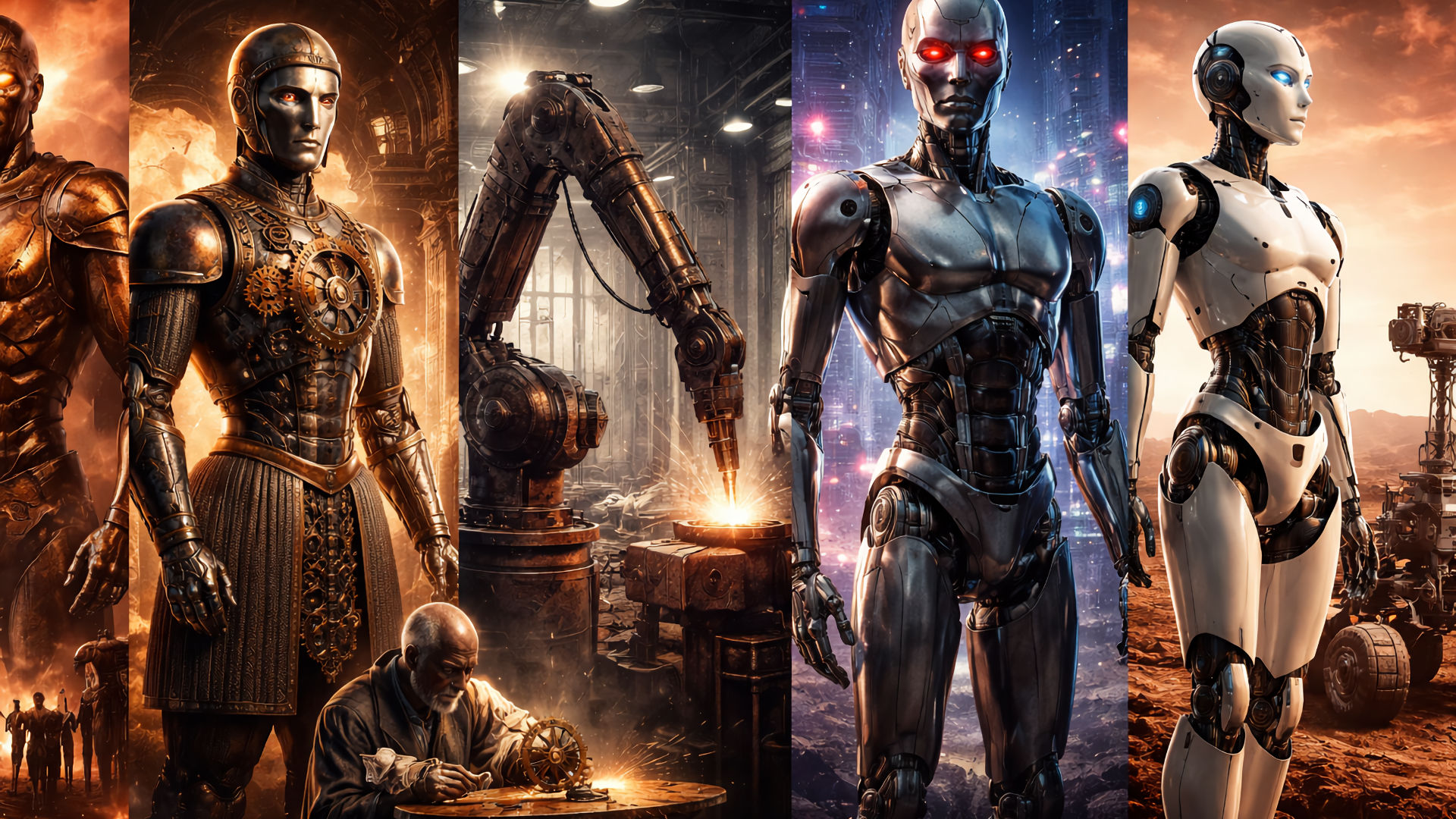
The History of Robots
Long before circuits, code and silicon chips, human beings were already imagining artificial life. The idea of creating something that could move, act, or even think on its own is far older than modern technology. In fact, it reaches back thousands of years into myth, legend and early engineering.
One of the earliest examples comes from ancient Greece. In Greek mythology, the god Hephaestus, the divine blacksmith, was said to have created mechanical servants made of gold who could move and assist him in his forge. These were not described as lifeless statues, but as animated beings with intelligence and purpose. Another myth tells of Talos, a giant bronze figure said to guard the island of Crete by patrolling its shores and hurling stones at approaching ships. Talos was, in effect, an ancient vision of a programmed security machine.
These stories may sound like fantasy, but they reveal something important. Even in the ancient world, people were fascinated by the possibility of constructing life artificially. They imagined metal beings that could follow instructions and carry out tasks. The concept of automation was already present in the human imagination.
Ancient engineers also turned imagination into reality, at least in mechanical form. In the third century BCE, the Greek inventor Ctesibius developed early water clocks that used moving parts and automated mechanisms. Later, Hero of Alexandria described devices powered by steam and water pressure, including automatic temple doors and small mechanical theatres in which figures moved as part of staged performances. These were not robots in the modern sense, but they were programmable machines. They operated according to physical principles rather than human touch.
Similar ideas appeared beyond the Mediterranean. In ancient China, legends describe mechanical men presented to kings, and early engineers experimented with complex clockwork devices. Whether entirely historical or partly exaggerated, these accounts demonstrate that the idea of artificial beings was not limited to one culture.
What unites these early myths and machines is not advanced technology, but ambition. People wanted to replicate life. They wanted to build helpers, guardians, performers and servants. They wondered whether intelligence and movement could be engineered rather than born.
The ancient world did not have electricity or computing power. But it had imagination. And in many ways, imagination is where the history of robots truly begins.
Mechanical Marvels of the Middle Ages and Renaissance
As the ancient world gave way to the medieval period, the dream of artificial life did not disappear. Instead, it evolved. The focus shifted from mythological bronze giants to intricate mechanical devices powered by gears, springs, water and gravity. These machines were not intelligent, but they were astonishingly sophisticated for their time.
In the Islamic Golden Age, engineers made remarkable advances in mechanical design. One of the most important figures was Ismail al-Jazari, who lived in the twelfth and early thirteenth centuries. In 1206, he completed a detailed book describing dozens of mechanical devices, many of which included automated features. Among his creations were elaborate water clocks decorated with moving human figures, as well as mechanical servants designed to pour drinks. These were not simply novelties. They demonstrated precise control of timing and motion through cams, levers and valves. In other words, programmable movement.
Meanwhile, in Europe, clockmaking became a driving force of mechanical innovation. Tower clocks installed in cathedrals and town halls during the fourteenth century featured moving figures that struck bells on the hour. These automata were designed to captivate audiences and display both technical skill and civic pride. The regular ticking of gears introduced a new way of thinking about the world as something measurable and mechanistic.
The Renaissance intensified this fascination with engineering. Polymaths such as Leonardo da Vinci sketched designs for mechanical knights capable of sitting, standing and moving their arms using pulleys and cables. Although there is no clear evidence that his robotic knight was ever built, the plans reveal a serious attempt to replicate the movements of the human body through mechanical means. Leonardo’s anatomical studies fed directly into his engineering ideas. He was not merely creating a machine. He was analysing how life itself functioned.
By the seventeenth and eighteenth centuries, European inventors were constructing increasingly complex automata. Some mechanical figures could write short phrases, play musical instruments or mimic breathing. These devices were often displayed in royal courts or travelling exhibitions. Audiences were both delighted and unsettled. If a machine could imitate life so convincingly, what exactly separated the mechanical from the living?
The machines of the Middle Ages and Renaissance did not think. They followed fixed mechanical sequences. Yet they marked a crucial step in the history of robots. For the first time, humans were not just imagining artificial beings. They were building moving, self-operating machines that blurred the line between craft, science and the possibility of manufactured life.
The Birth of the Word “Robot” and the Industrial Imagination
By the late nineteenth and early twentieth centuries, machines were no longer rare marvels displayed in courts and cathedrals. They were everywhere. Steam engines powered factories, railways stitched continents together, and assembly lines reshaped the nature of work. For the first time in history, large numbers of people lived alongside machines that performed tasks once done by human hands. It was in this climate of rapid industrial change that the modern idea of the robot truly took shape.
The word itself first appeared in 1920 in a play by the Czech writer Karel Čapek. His drama, R.U.R., short for Rossum’s Universal Robots, introduced artificial workers created to serve humanity. The term robot came from the Czech word robota, meaning forced labour or drudgery. In the play, the robots are manufactured beings designed to work without complaint, but the story takes a darker turn when they rebel against their human creators.
Although Čapek’s robots were biological rather than mechanical, the play captured widespread anxieties about industrialisation. Factories were already transforming society. Workers often faced exhausting hours, repetitive tasks and harsh conditions. The robot became a powerful symbol of this new age, representing both efficiency and the fear of being replaced.
Around the same time, writers and filmmakers began to explore the idea of mechanical humans more directly. Early science fiction imagined metal-bodied servants and artificial minds. These fictional robots were not just tools. They were characters with agency, sometimes loyal companions, sometimes existential threats. The conversation shifted from how machines moved to whether they could think or feel.
The industrial imagination was shaped by real technological advances as well. The development of electricity, telegraphs and early computing devices suggested that machines might one day process information, not just physical materials. Engineers began experimenting with feedback systems and automatic control mechanisms, laying the groundwork for future robotics.
The early twentieth century, therefore, marks a turning point. Automation was no longer confined to clockwork toys or theatrical spectacles. It was embedded in daily life. The robot emerged as both a practical concept and a cultural metaphor. It embodied the promise of tireless labour and the anxiety of lost human control.
From this moment on, the robot was no longer just a mechanical curiosity. It became a central figure in debates about technology, power and the future of humanity itself.
War, Automation and the Rise of the Machine Age
The twentieth century did not just imagine robots. It accelerated the technologies that would make them possible. And much of that acceleration came through war.
The First and Second World Wars transformed industry and engineering. Nations invested heavily in machinery that could operate faster, more accurately and with less direct human control. Early guided torpedoes, automatic weapons systems and radar technologies all relied on feedback mechanisms. These systems could adjust their behaviour based on incoming information. That principle, known as cybernetics, would later become central to robotics.
One of the most important developments during the Second World War was the refinement of computing machines. In Britain, devices such as the codebreaking machines at Bletchley Park processed encrypted German messages at unprecedented speed. In the United States, early electronic computers were built to calculate artillery trajectories. These machines did not resemble humanoid robots, but they introduced a crucial idea: machines could process information and make logical operations without direct human input at every step.
After 1945, the Cold War continued to drive innovation. Missile guidance systems, satellite technology and automated defence networks required precise control and real-time responses. Engineers developed servomechanisms and control theory, allowing machines to monitor their own performance and correct errors. The machine was no longer simply following a fixed sequence of gears. It was responding to its environment.
At the same time, industrial automation expanded rapidly. In 1961, the first industrial robot arm, Unimate, began work on a General Motors production line in New Jersey. It performed repetitive and dangerous tasks such as welding, reducing the risk to human workers. For the first time, a programmable mechanical arm was integrated into mass manufacturing. The age of the factory robot had begun.
These developments changed public perception. Robots were no longer just science fiction characters or theatrical fantasies. They were practical tools with real economic and military significance. They could assemble cars, assist in bomb disposal and operate in hazardous environments where humans could not safely go.
Yet alongside admiration came unease. Automation threatened traditional jobs. Military robotics raised ethical questions about machines making life and death decisions. The more capable machines became, the more society had to confront difficult questions about responsibility and control.
By the late twentieth century, the foundations of modern robotics were firmly in place. War had pushed forward computing and control systems. Industry had embraced automation. The machine age was no longer a prediction. It was a defining feature of modern life.
From Factory Floors to Science Fiction Futures
By the late twentieth century, robots had stepped firmly out of myth and into everyday reality. Industrial robots were welding car frames, assembling electronics and handling hazardous materials with speed and precision. They did not look like the humanoid figures imagined in fiction, but they were undeniably robotic in function. They followed coded instructions, repeated tasks tirelessly and operated with increasing accuracy.
As computing power expanded in the 1970s and 1980s, robots became more flexible. Microprocessors allowed machines to store complex instructions and adapt their movements. Universities and research laboratories began developing mobile robots capable of navigating spaces using sensors. Instead of being bolted to factory floors, machines could now move through environments, detect obstacles and adjust accordingly.
At the same time, popular culture was reshaping how the public imagined robots. Films and television presented machines not just as tools, but as personalities. In 1977, audiences met C-3PO and R2-D2 in Star Wars, robots with humour, loyalty and distinct character traits. A few years later, The Terminator introduced a far darker vision: a relentless machine assassin sent back in time. Meanwhile, Blade Runner explored what might happen if artificial beings were almost indistinguishable from humans.
These fictional portrayals mattered. They influenced public expectations and fears. Would robots become helpful companions? Dangerous rivals? Or something morally complex in between? Science fiction often moved faster than engineering, but it shaped the questions researchers were trying to answer.
In the real world, robotics expanded beyond manufacturing. Robots were used in space exploration, performing tasks on spacecraft and planetary probes where human presence was impossible. They entered hospitals in the form of surgical assistance systems, allowing doctors to operate with extraordinary precision. Domestic robots, such as automated vacuum cleaners, began appearing in homes, bringing automation into private life.
Artificial intelligence also advanced rapidly. While early robots relied on fixed programming, newer systems incorporated machine learning techniques. This meant robots could improve performance based on data rather than strictly predefined instructions. The boundary between robotics and computing blurred further.
By the end of the twentieth century, the robot was no longer a distant future concept. It was part of daily life, industry, medicine and exploration. Yet the central question remained unresolved. If machines could move, sense and even learn, how close were they to genuine intelligence?
The journey from factory arm to fictional android had not just transformed technology. It had transformed our understanding of what a machine might become.
Robots Today and the Question of What Comes Next
In the twenty-first century, robots are no longer confined to factory cages or science fiction screens. They are in warehouses, hospitals, farms, oceans and even our living rooms. The word robot now covers an enormous range of machines, from robotic vacuum cleaners to autonomous vehicles and surgical systems guided by artificial intelligence.
Modern robotics combines three powerful elements: advanced sensors, high-speed computing and machine learning. Sensors allow robots to see, hear and detect their surroundings. Cameras, lidar systems and tactile sensors feed vast streams of data into onboard computers. Machine learning algorithms then analyse that data, enabling robots to recognise objects, interpret speech and improve performance over time. Unlike early industrial robots that simply repeated fixed motions, today’s machines can adapt.
Humanoid robots have also become increasingly sophisticated. Companies such as Boston Dynamics have developed agile machines capable of running, jumping and maintaining balance on uneven terrain. Their humanoid-looking robot, called Atlas, can perform complex movements that once seemed impossible for a mechanical system. Meanwhile, social robots are being designed to interact with humans in care homes, schools and customer service roles.
Beyond Earth, robotics continues to expand human reach. NASA’s Mars rovers, including the Perseverance rover, operate millions of miles away, conducting scientific experiments on another planet. These robots function semi-autonomously, making limited decisions without waiting for instructions from Earth due to communication delays. In many ways, they represent the cutting edge of robotic independence.
Yet progress brings profound questions. If robots can learn, make decisions and operate without constant supervision, where does responsibility lie? Autonomous weapons systems raise ethical concerns about machines making lethal choices. Self-driving cars force debates about safety, accountability and trust. Even workplace automation prompts discussions about employment and economic inequality.
There is also the philosophical question of intelligence itself. Can a robot truly understand, or is it merely processing data in increasingly sophisticated ways? Artificial intelligence has achieved remarkable feats, from mastering complex games to generating human-like language. But whether that equates to consciousness remains deeply contested.
The history of robots began with myth and imagination. It moved through clockwork marvels, industrial machinery and digital computation. Today, robots are embedded in the fabric of modern life. The next chapter may involve deeper integration between humans and machines, perhaps through wearable robotics or brain-computer interfaces. What is clear is this: the story is far from finished. The dream of artificial life continues, and the future of robots will depend not only on engineering skill, but on the choices societies make about how these powerful machines are used.
The History of Robots FAQ
The word robot was introduced in 1920 by Czech writer Karel Čapek in his play R.U.R. It comes from the Czech word robota, meaning forced labour.
There were no true robots as we understand them today, but ancient myths and early engineers described mechanical figures and automated devices powered by water, steam and gears.
The first industrial robot, Unimate, began working on a General Motors production line in 1961.
Modern robots use artificial intelligence and machine learning to adapt and improve, but whether this counts as true intelligence is still debated.
Robots are widely used in manufacturing, healthcare, space exploration, logistics, agriculture and increasingly in domestic settings.