The Mystery of the Hexham Heads
In the summer of 1971, a routine bit of gardening in the market town of Hexham took an unexpected turn. While digging a hole for fence posts in his back garden, a local man named John Lydon struck something solid. What emerged from the soil was not rubble or buried refuse, but a small carved stone head. Then another.
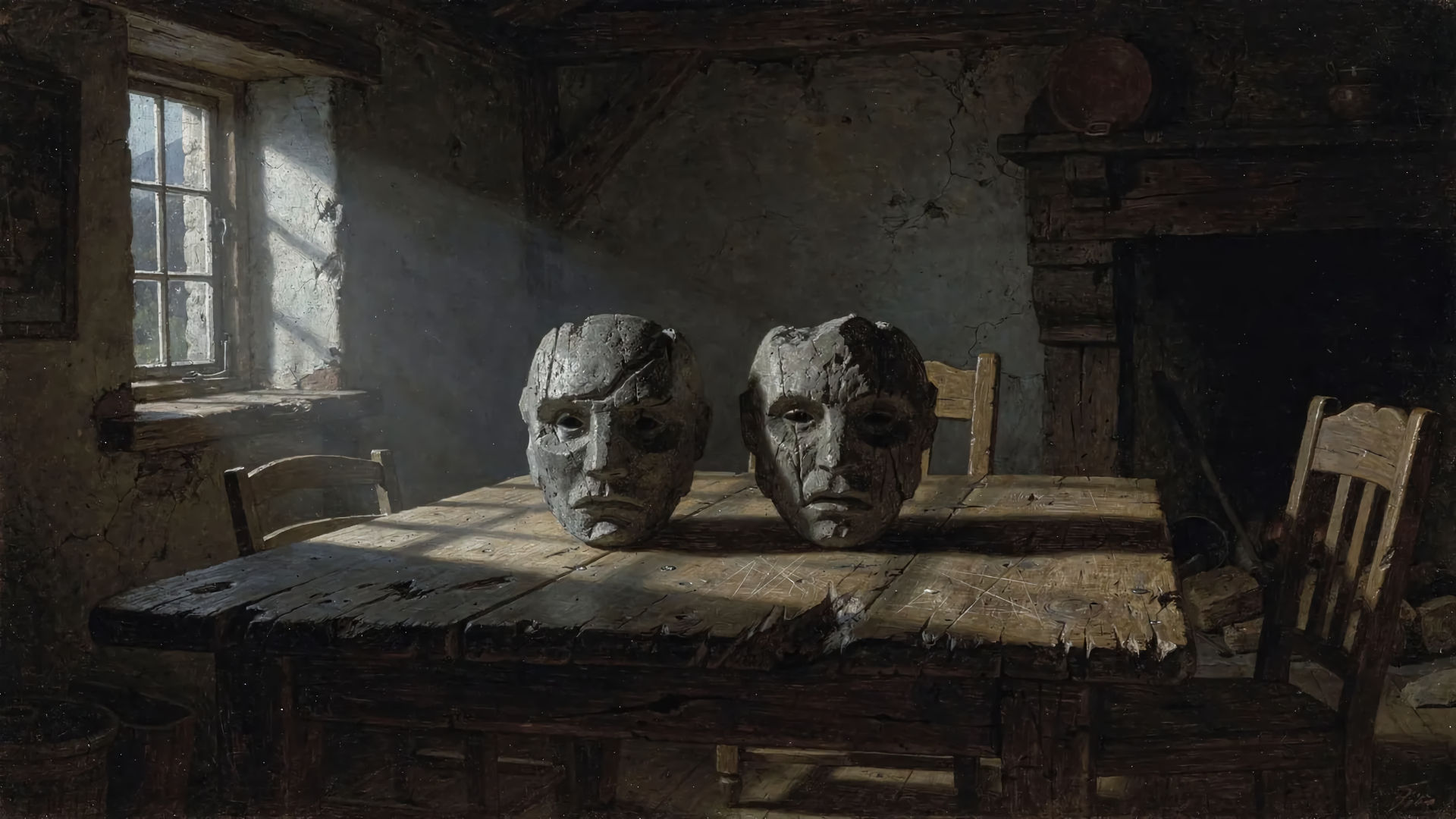
At first glance, the objects were unimpressive. They were small, crudely worked, and made from sandstone; they did not resemble museum-quality artefacts. Their faces were squat and exaggerated, with hollowed eyes, flattened noses, and deeply incised mouths. One appeared vaguely male, the other female. They were clearly old, but not obviously ancient, and there was nothing about them that immediately suggested danger, mystery, or significance.
Lydon treated the discovery with mild curiosity rather than alarm. The heads were cleaned, examined briefly, and kept. No authorities were contacted. No archaeologists summoned. This was not particularly unusual. British gardens have a habit of producing fragments of the past, from Roman tiles to medieval pottery, and most turn out to be historically interesting but emotionally inert.
At this stage, there was no curse, no haunting, and no sense of unease. The heads were simply objects, disconnected from any known context. There was no burial pit, no accompanying artefacts, no markings to indicate ritual use. They had not been carefully placed. They had simply been there, buried and forgotten.
What made the find quietly intriguing was its location. Hexham sits in a landscape layered with history. Roman roads, forts, and settlements run through the region, and the medieval abbey dominates the town’s skyline. Almost any object pulled from the ground could plausibly be linked to some earlier chapter of occupation. The heads might have been decorative fragments, garden ornaments, or amateur carvings discarded long ago.
Lydon showed the heads to friends and neighbours. Opinions varied, but most agreed on one thing. They were odd, but not extraordinary. There was no immediate attempt to attribute them to any specific culture or period. Without a story, they were just stones shaped like faces.
That absence of meaning is crucial. The Hexham Heads did not announce themselves as mysterious. They acquired their reputation later, slowly and indirectly. At the moment of discovery, there was no sense that anything had been disturbed. No warning bells rang. No lines had been crossed.
The trouble, when it came, did not begin in the garden. It started after the heads were brought indoors, handled, discussed, and quietly allowed into daily life. Only then did they begin to demand attention.
Two Stone Heads and an Ancient Curse
Once the stone heads were brought into the house, they stopped being garden curiosities and started attracting interpretation. Friends who examined them more closely began to speculate about their origin. The rough workmanship, the stylised facial features, and the pairing of male and female forms suggested something older than a Victorian ornament. The idea slowly took hold that these were not decorative at all, but ritual objects.
Local folklore offered a ready-made framework. Northumberland is rich in stories of Celtic practices, Roman occupation, and pre-Christian belief systems that favoured symbolic representation over realism. Stone heads, in particular, carried uncomfortable associations. Across Iron Age Britain, severed heads were believed to hold spiritual power, acting as vessels for protection, prophecy, or control. The suggestion emerged that these carvings might be linked to such traditions, perhaps buried deliberately to contain or neutralise whatever force they represented.
This was the point where the story took a decisive turn. Someone suggested the heads might be cursed.
The idea did not arrive fully formed. It surfaced in half-joking comments, uneasy silences, and the kind of speculation that flourishes when objects refuse to sit comfortably in their surroundings. The heads did not look like art meant to be admired. Their expressions were not serene or decorative. They stared. They intruded. Once that thought was voiced, it became difficult to unsee.
The heads were moved from room to room, handled, examined, and discussed. Visitors reacted unpredictably. Some laughed them off. Others felt unsettled without being able to explain why. The lack of certainty about their age or purpose allowed imagination to fill the gaps. Without provenance, anything was possible.
Crucially, this phase of the story still involved no extraordinary events. Nothing had moved. No sounds were heard. No dreams were disturbed. What changed was perception. The heads were no longer inert. They were now charged with meaning, and meaning has consequences.
Speculation hardened into belief through repetition. Each retelling emphasised different details. The heads became older, more powerful, more deliberately buried. The absence of evidence was not seen as a problem, but as confirmation. Ancient curses, after all, are not meant to come with documentation.
By the time the idea of a curse was taken seriously, the ground had already shifted. The heads were no longer objects to be explained. They were presences to be managed. How they were stored, where they were placed, and who handled them all began to matter.
That change in attitude set the conditions for what came next. Once people start expecting an object to cause harm, every unexplained noise, every bad dream, every moment of unease acquires a new possible source. The stage was set, not by the heads themselves, but by the story now attached to them.
Poltergeists, Nightmares, and Growing Fear
The first disturbances were easy to dismiss. A door found open. A strange noise in the night. Objects not quite where they had been left. In isolation, none of it suggested anything extraordinary. But once the stone heads had acquired a reputation, coincidence became harder to separate from cause.
People in the house began reporting vivid, unsettling dreams. These were not abstract nightmares, but detailed and recurring images involving pursuit, pressure, and watching eyes. Sleep became fractured. Anxiety lingered into the day. The heads, now blamed for the unease, were moved again, wrapped, and shut away, only for the disturbances to continue. Each attempt to neutralise them seemed to confirm their influence rather than diminish it.
Physical phenomena followed. Objects fell without apparent reason. Scratching sounds were reported from empty rooms. At one point, a heavy piece of furniture was said to have shifted position overnight. Visitors who knew nothing of the heads commented on the atmosphere of the house, describing it as oppressive or tense. Those who did know arrived primed to expect trouble, and rarely left reassured.
What gave the situation momentum was consistency. Reports came from different people at different times, yet followed similar patterns. Dreams echoed one another. Sounds were described in the same terms. Fear spread not through a single dramatic event, but through accumulation. Each minor incident reinforced the last, forming a pattern that felt intentional.
The heads themselves became focal points. When kept together, disturbances were said to intensify. When separated, the unease did not disappear, but changed character. This behaviour, interpreted as deliberate, suggested agency. The idea that the objects could respond to human action marked a psychological threshold. They were no longer being reacted to. They were, in some sense, reacting back.
At this stage, the story left the realm of folklore and entered something more unsettling. Poltergeist activity, by definition, resists clear explanation. It thrives on ambiguity, feeding on emotional tension and uncertainty. Whether the phenomena were physical, psychological, or social no longer mattered to those experiencing them. What mattered was the growing sense of loss of control.
Fear began shaping behaviour. The heads were avoided, then monitored, then discussed obsessively. Everyday household routines altered around them. Conversation narrowed. Every creak was suspect. Every silence loaded.
This escalation marked a turning point. The situation had progressed beyond curiosity and belief. It now demanded intervention. If the heads were responsible, then understanding their nature became urgent. Explanation, scientific or otherwise, was no longer an academic interest. It was a necessity.
Experts, Experiments, and Shifting Explanations
As reports surrounding the Hexham Heads grew harder to ignore, the focus shifted from experience to explanation. Whatever was happening could no longer be managed through moving objects around a house or trading theories among friends. The situation demanded outside judgment, preferably from people trained to separate genuine phenomena from suggestion, coincidence, or fear.
The heads were examined by archaeologists and historians, including specialists connected with the British Museum. Initial assessments were cautious and deflating. The carvings did not resemble authenticated Iron Age ritual objects. The workmanship appeared inconsistent, the style crude rather than symbolic, and the weathering uneven. No clear evidence placed them in deep antiquity. At best, they were thought to be relatively recent folk carvings, possibly no older than the 19th century.
This conclusion clashed sharply with the experiences reported around them.
To bridge that gap, the investigation widened. Psychologists were consulted. Theories of suggestion, expectation, and group reinforcement were raised. Once an object is believed to be dangerous, every anomaly becomes meaningful. Dreams intensify. Anxiety spreads. Normal household noises acquire intent. In this reading, the heads were catalysts rather than causes, focusing existing stress into a coherent narrative.
But even this explanation did not settle the matter. Some incidents were reported by individuals unaware of the heads’ reputation. Others occurred after the objects had been removed from the home. Attempts to isolate psychological influence produced mixed results, undermining the idea that expectation alone explained everything.
Laboratory testing added another layer of uncertainty. Scientific analysis suggested the stone was local and unremarkable. Tool marks hinted at modern implements rather than ancient ones. Radiocarbon dating was impossible, as stone contains no organic material. The tests narrowed possibilities without closing the case.
As expert opinions accumulated, something interesting happened. The phenomenon weakened. Reports became less frequent. The atmosphere lightened. Whether through reassurance, exhaustion, or the simple passage of time, the sense of menace faded. This shift raised an uncomfortable possibility. If expert scrutiny diminished the effects, what did that say about their origin?
By the end of this phase, no single explanation had triumphed. Archaeology dismissed antiquity. Psychology explained some, but not all, experiences. Science offered limits, not answers. The heads were no longer terrifying, but they were not fully neutralised either.
What remained was a tension between evidence and memory. The experts had spoken, but their conclusions did not erase what people believed they had lived through. And that unresolved gap left room for one final question. If the heads were not ancient and not supernatural, then why had they caused such lasting disturbance at all?
Hoax, Folklore, or Something Stranger Still?
With expert analysis stripping the Hexham Heads of ancient credentials and the reported phenomena fading into memory, attention turned to an explanation that felt both disappointing and unavoidable. The possibility that the entire episode had been built on a hoax. Not necessarily a malicious one, but a slow, accidental construction shaped by assumption, fear, and storytelling.
The idea that the heads were relatively modern carvings raised an obvious question. Who made them, and why were they buried? One theory suggested they were created as amateur folk art, perhaps inspired by local history or superstition, then discarded when their purpose or appeal faded. Another proposed that they were planted deliberately, either as a joke or as part of a private ritual that lost its meaning over time. Neither explanation required malice. Only human oddness.
Yet the hoax explanation struggled with one uncomfortable detail. The reactions to the heads appeared genuine. People were not performing fear. They were losing sleep, altering behaviour, and reporting experiences that felt real to them at the time. Even if the objects themselves were harmless, the response they provoked was not easily dismissed.
This led some researchers to frame the Hexham Heads as a case study in folklore creation rather than deception. A modern legend forming in real time. An ambiguous object appears, meaning is assigned, fear follows, and events are interpreted through that lens until the story sustains itself. In this reading, no one needed to lie. Belief did the work.
But that still leaves a residue of discomfort. Not all reported experiences fit neatly into expectation. Some occurred before the heads’ reputation was fully formed. Others were shared independently, without prompting. These inconsistencies keep the case from settling cleanly into the category of mass suggestion.
What emerges instead is a hybrid explanation. The heads themselves were likely mundane. The events around them were likely shaped by psychology and environment. But the intensity of the experience, and the speed with which it escalated, suggest something more complex than simple imagination. Fear is not passive. Once activated, it reshapes perception, memory, and interpretation in powerful ways.
The Hexham Heads may not represent ancient curses or supernatural forces, but they expose something equally unsettling. How easily meaning attaches itself to objects. How quickly narrative overrides evidence. And how thin the line can be between curiosity and conviction.
By this point in the story, the heads had lost their power to frighten, but not their ability to provoke unease. They no longer demanded belief. They demanded reflection. And that lingering ambiguity ensured the mystery was not quite finished yet.
Why the Hexham Heads Refuse to Stay Buried
Long after the disturbances faded and the experts moved on, the Hexham Heads retained an uneasy grip on the imagination. Not because they defied explanation, but because every explanation felt incomplete. Each answer closed one door while leaving another ajar, and it is in that unresolved space that the story continues to live.
The heads themselves are unremarkable objects. Crude carvings in local stone, lacking the craftsmanship or provenance that usually sustains historical importance. Yet their impact far outweighed their physical substance. For a time, they altered behaviour, unsettled homes, and reshaped relationships. That imbalance between cause and effect is what keeps the case alive.
Unlike many paranormal stories, the Hexham Heads did not end with a dramatic exposure or a definitive debunking. No moment of revelation allowed everyone involved to agree on what had really happened. Instead, the experience slowly dissolved, leaving behind conflicting memories and interpretations. Those who lived through it remember something powerful. Those who study it later see something fragile and human.
The case also sits awkwardly between disciplines. Archaeology offers context but not comfort. Psychology explains mechanisms but not emotions. Folklore identifies patterns but cannot strip them of meaning. Each field illuminates part of the story while leaving the core untouched. The heads resist being pinned to a single category.
Perhaps that is why the Hexham Heads continue to surface in books, documentaries, and late-night conversations. They represent a modern mystery that unfolded in plain sight, involving ordinary people, familiar places, and no obvious villains. There is no distance to hide behind. No medieval monks or ancient rituals to blame. Just a handful of objects and the stories we told about them.
In the end, the Hexham Heads matter not because they prove anything supernatural, but because they reveal something uncomfortable about certainty. They show how quickly meaning can be assigned, how easily fear can spread, and how difficult it is to disentangle experience from explanation once belief takes hold entirely. The heads were buried, unearthed, examined, and dismissed. And yet the story refuses to settle. It lingers because it asks a question with no clean answer. Not whether the Hexham Heads were cursed, but why we were so ready to believe they might be.
The Mystery of the Hexham Heads FAQ
They are two carved stone heads discovered in a garden in Hexham, England, in 1971.
People who lived with the heads reported nightmares, disturbances, and poltergeist-like activity.
Expert analysis suggested they were likely modern carvings rather than ancient ritual objects.
Psychological explanations such as suggestion and expectation were proposed, but did not fully satisfy all witnesses.
Because the experiences felt real to those involved, and no single explanation accounts for every detail.