
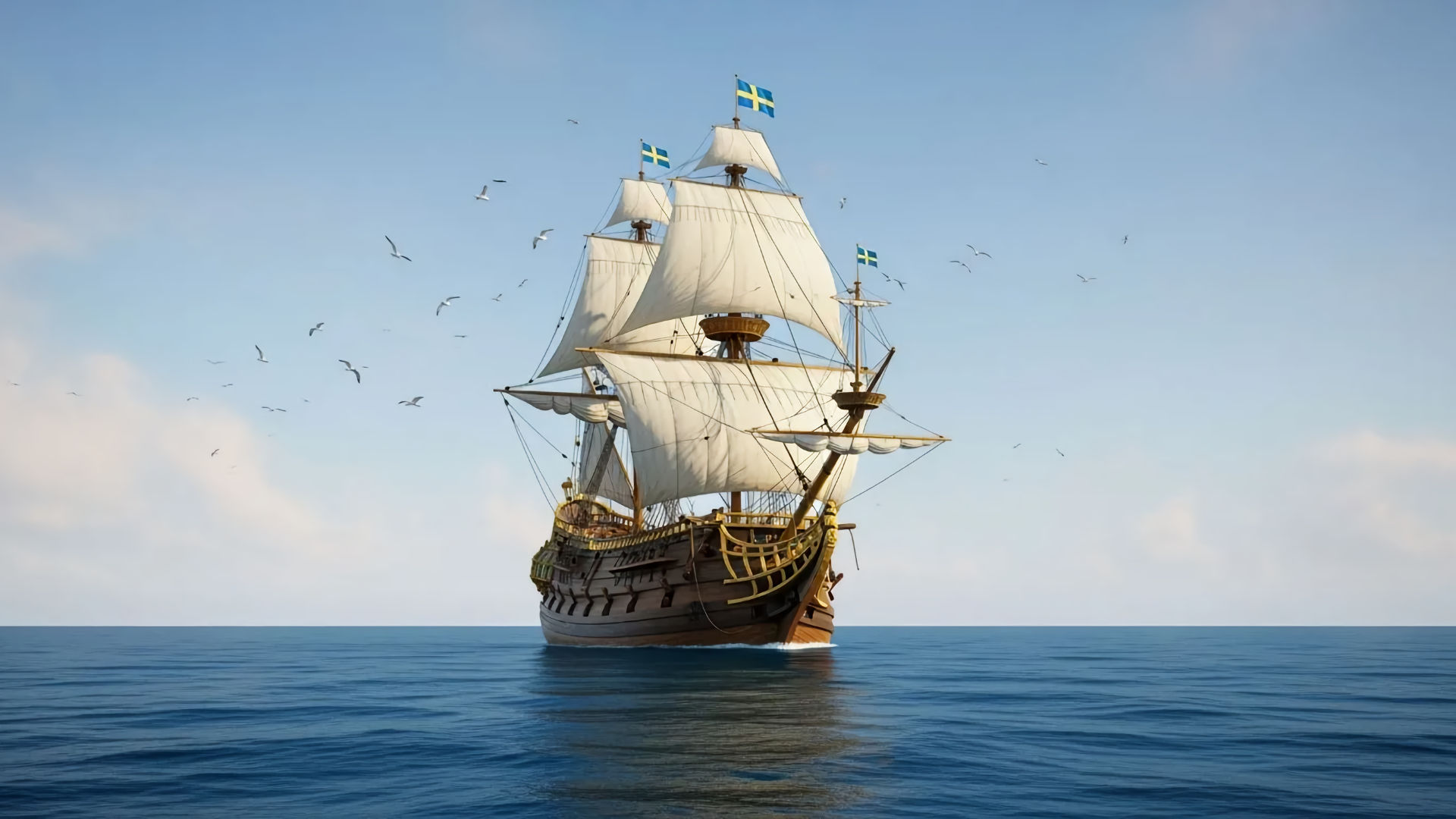
The Vasa Shipwreck
On a calm August morning in 1628, the people of Stockholm gathered along the waterfront to witness a moment of national pride. Sweden’s most ambitious warship, the Vasa, was about to set sail on her maiden voyage. Lavishly decorated, heavily armed, and designed to project the growing power of the Swedish Empire, the ship was intended to dominate the Baltic Sea and intimidate Sweden’s rivals. Instead, she became one of the most famous maritime disasters in history. Within minutes of leaving the harbour, the Vasa heeled over, took on water, and sank in full view of the crowd. What followed was not just a shipwreck, but a centuries-long story of political pressure, engineering failure, human pride, and ultimately, extraordinary preservation.
The Age of Ambition
The Vasa was born in an era of intense rivalry. Early seventeenth-century Europe was shaped by near constant warfare, shifting alliances, and the rise of powerful centralised states. Sweden, under King Gustavus Adolphus, was transforming itself from a regional power into a dominant military force. Control of the Baltic Sea was essential for trade, troop movement, and political influence. Warships were not merely tools of combat; they were floating symbols of authority and prestige.
Gustavus Adolphus wanted a fleet that would reflect Sweden’s growing status. The Vasa was to be the flagship, larger and more heavily armed than anything Sweden had built before. She was designed to carry two full gun decks, an ambitious feature at a time when most warships carried only one. This decision alone would push the limits of contemporary naval engineering.
Design and Construction
Construction of the Vasa began in 1626 at the royal shipyard in Stockholm. The master shipbuilder was Henrik Hybertsson, an experienced craftsman originally from the Netherlands, a region renowned for its shipbuilding expertise. However, Hybertsson was working under intense pressure. The king demanded rapid progress, frequent design changes, and ever greater firepower.
One of the fundamental challenges was the lack of standardised engineering practices. Shipbuilding in the seventeenth century relied heavily on tradition, rule of thumb, and experience rather than mathematical calculations. There were no blueprints in the modern sense. Dimensions were often adjusted mid-construction based on judgement rather than analysis.
As the Vasa took shape, her problems quietly accumulated. The hull was relatively narrow for a ship carrying two heavy gun decks. The upper works were tall and heavily ornamented, raising the ship’s centre of gravity. The bronze cannons themselves were enormous and numerous, adding further weight above the waterline. Meanwhile, internal ballast was limited, as too much would reduce the ship’s freeboard and compromise her ability to fight.
Conflicting Orders and Fatal Compromises
The Vasa was not built according to a single, stable vision. During construction, the king issued new instructions, including demands for additional armament. Hybertsson fell ill and later died before the ship was completed, leaving responsibility to his assistant, Hein Jacobsson. Jacobsson inherited a project already burdened with design flaws, but lacked the authority to challenge royal demands.
At some point, the ship was built wider on one side than the other, likely due to the use of different measuring systems by different crews. This asymmetry further destabilised the vessel. Despite these issues, no one dared halt construction or openly question the design. In a rigid hierarchical society, defying the king’s wishes could have severe consequences.
Testing and Ignored Warnings
Before the launch, concerns about the Vasa’s stability were quietly acknowledged. A simple test was conducted in which thirty sailors ran back and forth across the deck to see how much the ship rolled. After just a few passes, the test was stopped because the motion was so violent that it risked capsizing the ship at the dock. The results were alarming, but no corrective action followed.
There was no established authority responsible for safety certification. Responsibility was diffuse, spread across shipbuilders, naval officers, and administrators, all of whom assumed someone else would intervene if the ship were truly unsafe. The absence of clear accountability allowed the warning signs to be ignored.
The Maiden Voyage
On 10 August 1628, the Vasa was ready to sail. She was fully rigged, her gun ports open to display her impressive armament, and her decks crowded with crew and guests. A light breeze filled her sails as she was towed out of the harbour and then allowed to proceed under her own power.
Moments after leaving the quay, a gust of wind caused the ship to heel to port. She righted herself briefly, only to be struck by another gust. This time, water poured through the open gun ports on the lower deck. The weight of the water pulled the ship further over. Within minutes, the Vasa sank to the bottom of Stockholm harbour, settling upright in the mud. Around thirty people lost their lives, a small number by the standards of maritime disasters, but shocking given the short duration of the voyage.
Immediate Aftermath
The sinking of the Vasa was a public humiliation. It had occurred in full view of onlookers, foreign diplomats, and representatives of the crown. Questions were asked immediately. How could the king’s prized warship sink on its first outing in such mild conditions?
An inquiry was launched, but it quickly reached an impasse. Witnesses admitted the ship was unstable, but no one accepted responsibility. The shipbuilders blamed the design requirements imposed upon them. Naval officers claimed they had followed orders. The king, away fighting in Poland, was not questioned directly. Without a clear understanding of the underlying physics, the investigation concluded without assigning blame.
The wreck was left where it lay, partially salvaged in the years that followed. Cannons were recovered, but the hull itself remained submerged, slowly sinking deeper into the harbour mud.
Centuries Beneath the Water
For over three hundred years, the Vasa lay largely forgotten. Remarkably, the brackish waters of the Baltic Sea proved ideal for preservation. Unlike saltier oceans, the Baltic lacks shipworm, a marine organism that destroys wooden hulls. The cold, low-oxygen environment further slowed decay. As a result, the Vasa remained astonishingly intact.
Interest in the wreck resurfaced in the twentieth century. Advances in marine archaeology and a growing appreciation for historical preservation sparked renewed efforts to locate and recover significant shipwrecks. The Vasa, long known to be somewhere in Stockholm harbour, became a prime candidate.
Rediscovery and Recovery
In the 1950s, Swedish engineer and amateur archaeologist Anders Franzén led the search for the Vasa. After years of painstaking work, he located the wreck in 1956. The ship lay upright, buried in mud but structurally sound.
Raising the Vasa was a monumental task. Engineers tunnelled beneath the hull and threaded steel cables through the seabed. Over a series of lifts, the ship was gradually raised and moved to shallower water. In 1961, more than three centuries after she sank, the Vasa broke the surface once again.
The recovery was celebrated worldwide. It was one of the most successful ship salvage operations ever undertaken, and the condition of the vessel stunned experts. Approximately 98 per cent of the original structure had survived.
Preservation Challenges
Bringing the Vasa out of the water was only the beginning. Centuries of submersion had replaced much of the wood’s internal structure with water. If allowed to dry naturally, the ship would have warped and cracked beyond repair. Preservation required a delicate and prolonged process.
For nearly two decades, the Vasa was sprayed with polyethylene glycol, a synthetic wax that slowly replaced the water within the wood and stabilised its structure. The process was expensive, time-consuming, and unprecedented on this scale. Even today, preservation efforts continue as scientists monitor the ship for chemical reactions within the wood that could cause long-term damage.
A Window into the Past
The Vasa offers an unparalleled glimpse into seventeenth-century life. The ship is richly decorated with hundreds of carved sculptures, many originally painted in vivid colours. These carvings depict kings, warriors, gods, lions, and grotesque figures, all intended to convey power and divine favour.
Inside the ship, archaeologists recovered thousands of artefacts, including tools, clothing, coins, weapons, and personal belongings. These objects provide insight into the daily lives of sailors and officers, revealing details about diet, social hierarchy, and working conditions aboard a warship of the era.
Understanding the Failure
Modern analysis has confirmed what seventeenth-century builders could not fully grasp. The Vasa was top-heavy, with insufficient ballast and a dangerously high centre of gravity. Her hull was too narrow for her height and armament. In engineering terms, she lacked stability margin.
Computer simulations and scale models have shown that even modest winds could generate forces capable of capsizing the ship. The disaster was not caused by a single error but by a chain of decisions driven by ambition, pressure, and incomplete understanding.
Political Pressure and Human Factors
The story of the Vasa is as much about people as it is about physics. King Gustavus Adolphus was not reckless, but he was demanding and deeply invested in the symbolism of military power. His subordinates were reluctant to challenge his vision, even when they suspected problems.
The absence of a culture that encouraged questioning authority proved fatal. No one felt empowered to say no. The result was a ship that looked magnificent but was fundamentally unsafe. The Vasa illustrates how organisational and cultural factors can be just as dangerous as technical ones.
Legacy and Lessons
The Vasa shipwreck has become a cornerstone case study in engineering ethics, project management, and risk assessment. It demonstrates the dangers of scope creep, unclear accountability, and ignoring warning signs. It also highlights the importance of testing, standardisation, and open communication.
Unlike many disasters, the Vasa’s story did not end in obscurity. Instead, it became a source of knowledge and reflection. Engineers across disciplines study the case to understand how complex systems fail and how similar mistakes can be avoided.
The Vasa Today
Today, the Vasa is housed in a purpose-built museum in Stockholm, where millions of visitors come each year to see the ship. Standing before her towering hull, it is difficult not to feel awe at both her beauty and her folly. She is a reminder that human ambition can produce wonders, but also spectacular failures.
The museum does more than display a wreck. It tells a story of science evolving through failure, of history preserved by chance, and of lessons learned too late for some but invaluable for those who followed.
Final Word
The Vasa shipwreck is one of history’s most compelling disasters precisely because it combines grandeur with catastrophe. A ship built to project invincibility sank almost immediately, undone by forces its creators did not fully understand and pressures they could not resist. Yet from that failure emerged centuries of insight, culminating in one of the world’s most significant archaeological recoveries.
The Vasa never fought a battle, never crossed the open sea, and never fulfilled her intended purpose. Instead, she achieved something far more enduring. She became a teacher. Her silent timbers speak of ambition unchecked by understanding, of warning signs ignored, and of the extraordinary value of learning from failure. In that sense, the Vasa did not merely sink. She entered history, where she continues to warn, educate, and fascinate the world.
The Vasa Shipwreck FAQ
The ship was top heavy, poorly balanced, and lacked sufficient ballast, causing it to capsize in a light wind.
Only a few minutes. It travelled roughly 1,300 metres before taking on water and sinking.
Around thirty people lost their lives.
The Baltic Sea preserved the ship unusually well, allowing it to be recovered as a unique historical artefact.
The ship is displayed at the Vasa Museum in Stockholm, Sweden.


