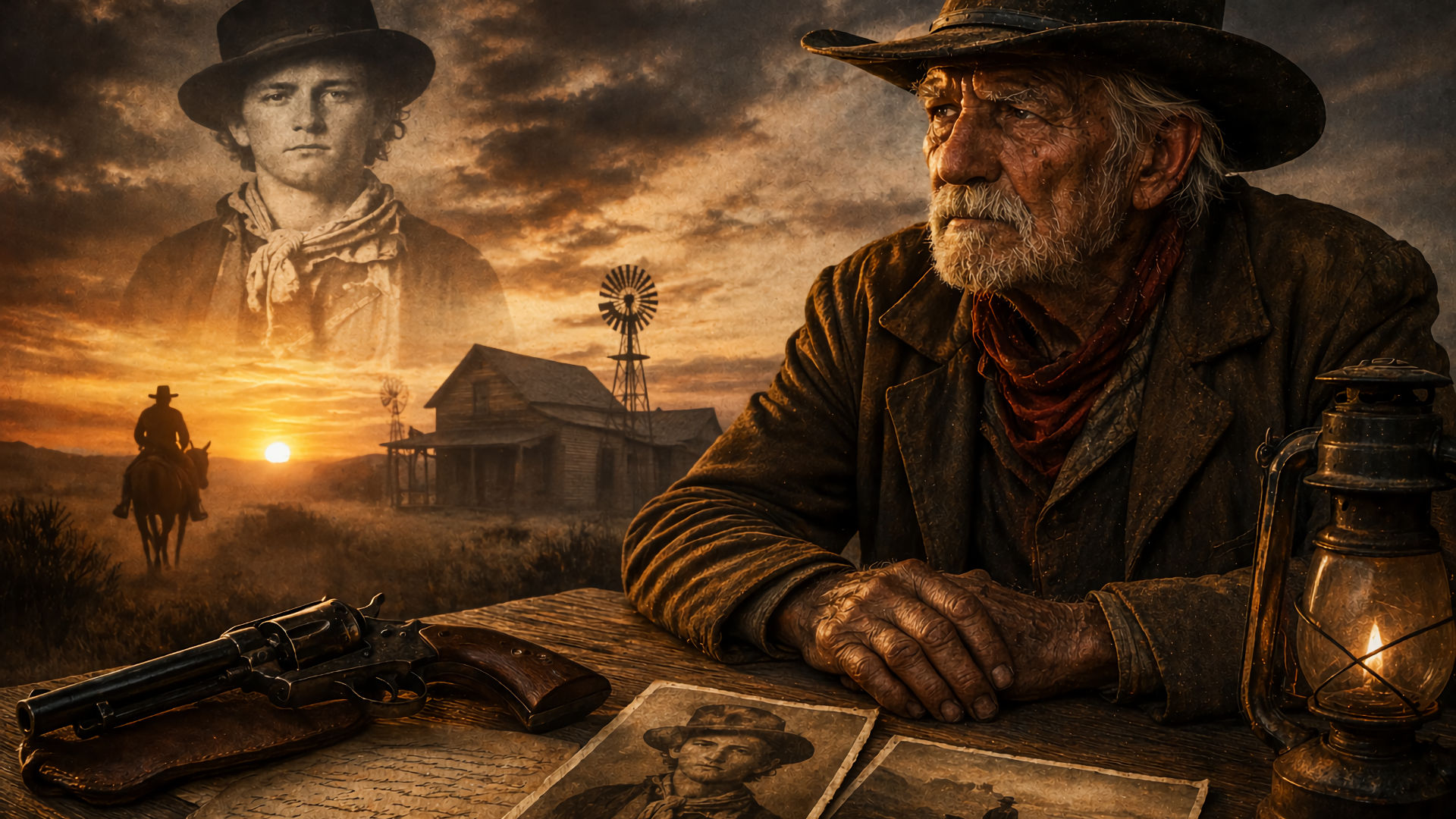
The Mystery of Brushy Bill Roberts
Before there was Brushy Bill Roberts, there was Billy the Kid, one of the most famous and disputed figures of the American West. The man most often identified as Billy was born Henry McCarty, though he also used names such as William H. Bonney. Much about his childhood remains uncertain, but historians broadly agree that he was born in New York in 1859, moved west with his family, lost his mother while still young, and drifted into theft, cattle rustling, and frontier violence in New Mexico Territory. By the late 1870s, he had become entangled in the Lincoln County War, a brutal conflict that mixed business rivalry, local politics, revenge, and gunfire in almost equal measure.
Billy’s legend grew because his life sat neatly at the intersection of fact and theatre. He was young, quick, hard to catch, and already notorious while still alive. He was linked to the killing of Sheriff William Brady; he escaped from custody after killing two deputies in April 1881, and he made even his enemies look dramatic simply by forcing them to chase him. The accepted historical account says that Sheriff Pat Garrett finally caught up with him on the night of 14 July 1881 at Pete Maxwell’s ranch in Fort Sumner, New Mexico, and shot him dead. That account, repeated for generations, turned a living outlaw into a finished story. Billy the Kid was buried at Fort Sumner, and for most historians, that should have been the end of the matter.
Yet Billy the Kid never settled comfortably into the grave assigned to him. Even during the nineteenth century, stories spread that he had survived, that Garrett had shot the wrong man, or that the body had been identified too quickly in poor conditions. Such rumours were helped by the fact that frontier record-keeping was not always neat, by the theatrical quality of Garrett’s own published account, and by the simple truth that famous outlaws rarely stay politely dead in the popular imagination. When a figure becomes part criminal, part folk hero, people start looking for loopholes in the official ending.
That restless uncertainty created the perfect conditions for a later claimant. If Billy had died young and obscure, nobody would have cared. But because he had become a Western icon, any old man with a scar, a story, and the right kind of stare could attract attention. That is the world into which Brushy Bill Roberts stepped, not as a random eccentric, but as a man inserting himself into one of the best-known unfinished arguments in American frontier history. The mystery of Brushy Bill begins, then, not in Texas in 1950, but in the long shadow cast by a death that many people wanted either to doubt or to rewrite.
An Old Man in Texas Steps Forward
The man later known to the wider public as Brushy Bill Roberts was living in Texas when his astonishing claim began to gather serious attention. According to later accounts, probate investigator William V. Morrison started hearing rumours in 1948 that Billy the Kid had not died at Fort Sumner after all. Morrison followed those rumours to old Lincoln County War figures and then, through a chain of contacts that included Joe Hines and J. Frank Dalton, was directed toward an elderly Texan named Ollie Roberts in Hamilton County. Morrison wrote to him, met him, and became convinced that he had found the most famous outlaw in the West living under an assumed identity.
Roberts did not initially emerge like a man trying to build a circus around himself. In Morrison’s telling, he was wary, reluctant, and uneasy about publicity. That hesitation helped his cause with believers because frauds are expected to be loud, while truth-tellers in old Western tales are often portrayed as modest men reluctantly dragged into the light. Roberts claimed that he had lived quietly for decades and had no grand ambition except to settle unfinished business before he died. That unfinished business was crucial. He was not merely saying, “I am Billy the Kid.” He was saying, “I am Billy the Kid, and I was promised a pardon that I never received.”
This was what transformed a tall tale into a public controversy. Billy the Kid had genuinely written to Governor Lew Wallace during the Lincoln County troubles, and Wallace had indeed discussed arrangements under which Billy might testify and expect leniency. The historical record shows there was real contact between the outlaw and the governor, and that no pardon was ultimately granted. That gave Roberts’s story a hook strong enough to catch journalists, officials, and romantics alike. He was not inventing an entirely new drama. He was attaching himself to a real unresolved grievance from the 1870s and asking twentieth-century authorities to acknowledge it.
By the time Roberts was taken seriously enough to seek a hearing, the case had become equal parts history, publicity, and performance. Reporters loved it because it had everything: an aged claimant, an outlaw legend, a possible government betrayal, and the irresistible possibility that official history had got it wrong. Supporters loved it because it seemed to revive the Wild West in living memory. Sceptics loved it because obvious nonsense is often as entertaining as truth. Brushy Bill Roberts had not yet proved anything, but he had already done something harder in a way. He had forced people to reopen a story most assumed had closed in 1881.
Brushy Bill’s Story and the Pardon He Wanted
Roberts’s central claim was simple enough to repeat and complicated enough to argue about forever. He said he was Billy the Kid and that he had survived the supposed killing by Pat Garrett. In the version promoted by Morrison, the official story of Billy’s death was either mistaken or deliberately false, allowing the outlaw to disappear and live under another name for decades. Roberts then framed his reappearance not as a publicity stunt but as a legal and moral matter. Before his death, he wanted recognition and the pardon he believed had been promised in the days of Governor Lew Wallace.
The pardon claim gave Roberts an apparently respectable reason to surface so late in life. He was not, at least in theory, trying to cash in on dime novel fame. He was trying to finish a bargain left unresolved since the Lincoln County War. Billy the Kid had written to Wallace saying that he no longer wished to fight and hoped for protection. Wallace did engage with him during efforts to calm the violence, but the expected pardon never came, and Billy returned to outlaw life. Roberts’s supporters used that history as the foundation for their case, arguing that an old injustice had survived alongside the old outlaw.
In November 1950, Roberts was granted a hearing with New Mexico Governor Thomas J. Mabry. It should have been the dramatic climax of his campaign. Instead, it became one of the main reasons historians remain doubtful. Contemporary descriptions and later retellings agree that Roberts struggled under questioning. He was asked about names, places, events, and details that the real Billy the Kid would presumably have known without effort. According to accounts of the hearing, he faltered, gave uncertain answers, and failed to persuade the governor or many of the observers present. Mabry’s verdict was blunt. He said he would take no action because he did not believe Roberts was Billy the Kid.
That moment is one of the most telling parts of the entire mystery. Believers can argue about old newspapers, missing records, bad identifications, and the unreliability of frontier testimony. It is much harder to explain away the fact that when Roberts was placed before a governor and questioned on the very identity he claimed, he failed to convince the room. True believers suggest age, illness, nerves, and the pressure of spectacle undermined him. Sceptics counter that the simplest answer is usually the right one; an old man with a colourful story could not sustain it under examination. Either way, the Mabry hearing turned Brushy Bill from a private claimant into a public historical puzzle, and it ensured that the pardon he wanted would remain forever out of reach.
Witnesses, Scars, and the Search for Proof
What kept the Brushy Bill story alive was that it was never based on one claim alone. Morrison worked hard to gather supporting material, and some of that material sounded persuasive at first glance. Roberts reportedly displayed scars that believers said matched wounds associated with Billy the Kid’s violent life. Morrison also collected affidavits from elderly men who claimed to have known Billy and who said they believed Roberts was the same person. In a mystery like this, such details are pure fuel. They do not settle the case, but they make it much harder for the story to die quietly.
Supporters also leaned heavily on the gaps and ambiguities in the historical record. The circumstances of Billy’s death at Fort Sumner were dramatic but not perfect from an evidential point of view. It was dark, events moved quickly, and later retellings varied. That allowed believers to argue that Garrett had either shot the wrong man or passed off another body as Billy’s. If one starts from the assumption that the official account contains serious errors, then Roberts’s claim begins to look less absurd. A mystery needs room to breathe, and the legend of Billy the Kid had plenty of that room built into it already.
There were also stories about resemblance. Aged photographs of Roberts were compared to the famous tintype of Billy the Kid, and later enthusiasts pointed to image analysis that they believed supported a close match. This sort of evidence has obvious dramatic appeal because people love the idea that a machine or a photograph can do what memory cannot. But resemblance is not identity, and any photographic comparison is only as convincing as its methods, assumptions, and controls. Even the friendliest reading of such comparisons would show, at most, that Roberts looked somewhat like Billy the Kid, not that he certainly was him.
This is why the evidential pile around Brushy Bill has always looked more impressive from a distance than up close. Scars can be interpreted. Affidavits from very old witnesses can be sincere and still mistaken. Resemblance can be suggestive and still misleading. Small remembered details can sound authentic because they are authentic, or because they have been borrowed from stories already in circulation. Morrison believed he had found the truth. Others believed they had found a man stepping into a ready-made legend with just enough plausible detail to keep doubters busy for decades. The proof never fully arrived, but the fragments were intriguing enough to keep the argument on its horse and riding.
Why Most Historians Rejected the Claim
For all the romance surrounding Brushy Bill Roberts, the mainstream historical view remains clear. Most historians do not accept that Roberts was Billy the Kid. The reasons are not merely snobbish dislike of a good story. They rest on the weakness of Roberts’s performance when challenged, the contradictions in his biographical trail, and the difficulty of making his life line up with what is known of Billy’s. In historical work, colourful possibilities are not enough. A claim has to survive sustained contact with dates, records, and context. Roberts’s did not do that convincingly.
One of the most damaging issues was Roberts’s documented age and background. As Oxford American notes, sceptics pointed to conflicts between the birthdate on Roberts’s draft card and other records. At the same time, census returns traced him through Texas in ways that fit Ollie Roberts more comfortably than a vanished New Mexico outlaw reborn under a false name. The same reporting also noted the absence of documentary evidence connecting Roberts to the name William H. Bonney, except through his own claims. This does not merely create a gap. It creates a pattern in which the official paper trail follows one man while the dramatic story insists he was another all along. Historians usually side with the paper trail unless a very strong reason emerges not to.
There were also practical objections. Billy the Kid was known to be literate and to have written to Lew Wallace. Roberts, according to long-standing criticism of his case, did not fit comfortably with that profile. His command of historical detail also seemed uneven in the worst possible way, sometimes vivid in anecdote, then vague when pressed on basic matters that should have been second nature. This is often where myth-making reveals itself. The storyteller remembers the good bits, the bits with smoke, horses, betrayals, and scars, but struggles when asked to produce the dull little details that actual life leaves behind like muddy footprints.
In the end, the historical consensus is not that every question around Billy the Kid has been solved with perfect elegance. Rather, it is that Roberts did not provide a better answer than the accepted one. Pat Garrett’s account may not be beyond criticism, and the West was never a paradise of tidy evidence. But when Roberts was measured against what can actually be documented, he came up short. Historians are not required to disprove every dramatic alternative beyond all doubt. They are only required to ask which explanation is best supported. So far, the answer remains the old one: Billy the Kid died in Fort Sumner in July 1881, and Brushy Bill Roberts was almost certainly not him.
How the Brushy Bill Mystery Refused to Die
If the evidence is weak, why does the mystery persist? Part of the answer is that Brushy Bill Roberts arrived at exactly the right moment. He surfaced late enough that most direct witnesses were gone or very old, but early enough that newspapers, local memory, and Wild West mythology could still feed each other. He also offered a version of the story that people badly wanted to hear. The famous outlaw had not died young in a dark room. He had outlived his enemies, slipped away from history, and returned in old age asking only for justice. That is not just a claim. It is a perfect Western ending, and that is precisely why it remains so stubbornly attractive.
There is also something uniquely durable about mysteries built from partial evidence rather than total invention. Brushy Bill’s claim was not absurd in the way a flying saucer over Fort Sumner would be absurd. It touched real people, real letters, real grievances, real names, and real historical blind spots. That gave later books, documentaries, museums, and enthusiasts enough material to keep asking the question. Hico, Texas, embraced the legend, and the story became part tourism, part folklore, part local identity. Once a community adopts a mystery, the mystery gains shelter and a gift shop, which is usually a sign it has no intention of leaving.
Another reason the case lingers is that it exposes how history and legend constantly wrestle with each other. Billy the Kid was already a myth while he was still alive, and Brushy Bill stepped into that myth rather than into a purely factual record. Even people who reject his claim often admit that there are odd corners to the story, unprovable details, contested memories, and stubborn regional loyalties. The evidence does not show Roberts to be Billy the Kid, yet it also does not allow a fully confident explanation of why he claimed to be him. That unresolved human motive keeps the case interesting even when the identity question seems largely settled. So the mystery of Brushy Bill Roberts survives not because historians are secretly convinced, but because legend is stronger than neat closure. The official answer is still the most persuasive one. Roberts almost certainly was not Billy the Kid. Yet his story continues to ride alongside the accepted history like a second horse on the trail, never quite overtaking it, never quite dropping away.
The Mystery of Brushy Bill Roberts FAQ
Brushy Bill Roberts was an elderly Texan who claimed late in life that he was really Billy the Kid, the outlaw officially said to have been killed in 1881.
No. His claim attracted attention and supporters, but most historians have rejected it because the evidence was weak and inconsistent.
He said he had been promised one years earlier in connection with Billy the Kid’s dealings with Governor Lew Wallace and wanted that promise honoured before he died.
The story survives because Billy the Kid remains a legendary figure, and the idea that he escaped death makes for a powerful and very marketable frontier mystery.
The strongest argument is that when he was questioned publicly about his identity, he failed to convince officials, and the documentary evidence does not support his story.