The Battle of Yorktown
By 1781, the American War of Independence had dragged on for six exhausting years. The early drama of Lexington, Concord, Saratoga, and the winter at Valley Forge had given way to a longer, harsher contest in which Britain still held major advantages in money, ships, and professional soldiers. Yet the war had changed shape. The British shifted much of their effort to the South, hoping to rally Loyalist support in Georgia, the Carolinas, and Virginia. Instead of crushing the rebellion, that strategy stretched British forces across a wide landscape and left their armies dependent on long supply lines and naval support. By the summer of 1781, the war’s decisive point was no longer simply where the biggest army stood, but where one could be isolated and trapped.
Lieutenant General Charles Cornwallis had campaigned aggressively through the South, winning battles but not securing lasting control. After fighting in the Carolinas, he moved into Virginia, where British forces operated under shifting instructions and uncertain strategic purpose. Cornwallis eventually established himself at Yorktown, a small port on the York River. On paper, it offered useful advantages. It had access to the Chesapeake, a deep-water anchorage, and a position that could support communication with the Royal Navy. It also sat on a peninsula, which seemed defensible so long as British sea power remained reliable. What looked like a useful base, however, would soon become a cage.
Across from the British, George Washington still hoped for a grand blow against New York City, the main British stronghold in North America. But he was also realistic enough to seize an opportunity when one appeared. His French ally, the Comte de Rochambeau, shared that practical streak. The two commanders had spent months trying to coordinate their armies with French naval power, knowing that only a combined land-and-sea operation could bring about a truly decisive result. That chance emerged when Admiral de Grasse signalled that his fleet would sail to the Chesapeake rather than New York. In that moment, strategy snapped into focus. If Cornwallis could be pinned in Virginia and denied rescue by sea, his whole army might be lost.
Yorktown mattered because it offered something rare in thes war: the possibility not merely of beating the British in battle, but of forcing a surrender large enough to shake the British government and public. Washington understood that destroying or capturing a major British army would have far greater political effect than another hard-fought but indecisive clash. Yorktown was not chosen because it was famous or symbolically grand. It became the decisive target because British decisions, French naval movement, and Allied coordination made it the one place where the war might actually be brought to a breaking point. The road to Yorktown was not inevitable, but once the opportunity appeared, the Allied commanders recognised it with remarkable speed.
Cornwallis Moves into a Trap
Cornwallis did not march into Yorktown believing he was doomed. Like many British commanders in America, he expected the Royal Navy to remain the ultimate guarantee of survival. Sea power allowed Britain to move troops, evacuate danger, reinforce threatened positions, and sustain coastal bases that would otherwise be vulnerable. In Virginia, Cornwallis had spent months manoeuvring against American forces led in part by the Marquis de Lafayette, whose smaller army shadowed him, harassed him, and avoided being crushed outright. Cornwallis grew frustrated by the elusive campaign. He could win local advantages, but he could not seem to bring the Americans to a conclusive defeat.
His orders from senior British command were also less than crystal clear, which is a polite historical way of saying they were messy. Sir Henry Clinton, based in New York, wanted useful positions in the Chesapeake but also worried constantly about the defence of New York itself. Cornwallis was instructed to establish a base that could support naval operations, damage American logistics, and remain defensible. Yorktown and nearby Gloucester Point seemed to satisfy those demands. The position offered river access and a chance to fortify. Cornwallis therefore set his troops to work constructing earthworks, redoubts, batteries, and defensive lines. He was not blundering blindly. He was making a logical decision based on the assumption that British naval superiority would remain intact.
That assumption proved fatal. Yorktown sat on ground that could be surrounded from the landward side if a large enemy army arrived. Worse still, a force trapped on a peninsula needed an open water escape route. If hostile fleets controlled the bay, the British position could quickly become precarious. Cornwallis may have understood the risks, but he likely did not expect the Americans and French to move with enough speed, secrecy, and coordination to exploit them. He also may have believed that Clinton would support him more directly, or that the navy would appear in time. British command suffered from delay, hesitation, and divided priorities at exactly the moment the Allies were becoming more unified.
As the summer of 1781 turned towards autumn, Cornwallis’s army became increasingly exposed. Lafayette kept watch in Virginia, preventing easy movement and relaying developments. Meanwhile, news travelled that the French fleet was headed for the Chesapeake and that Washington’s main army might be moving south. By then, what had looked like a firm operating base was becoming a dangerous commitment. Cornwallis was a capable and seasoned commander, but at Yorktown he was placed at the end of a chain of assumptions that all depended on timing. Once the French navy arrived first and the Allied army closed in, his fortifications ceased to be the walls of a stronghold and became the sides of a box.
Washington and Rochambeau March South
The march to Yorktown was one of the most impressive feats of the entire war, not because it was flashy, but because it required discipline, deception, and cooperation on a grand scale. Washington and Rochambeau had originally considered a strike on New York, and British commanders remained highly sensitive to any threat against that city. The Allied leaders used this to their advantage. During August 1781, they masked their true intentions and began moving south in a way that did not immediately reveal the scale or destination of the operation. The success of the campaign depended on convincing the British, for as long as possible, that New York remained the likely target.
This was no small redeployment. Thousands of American and French troops had to move over considerable distance, coordinated across different languages, systems, and command cultures. Rochambeau’s French army, which had arrived in Rhode Island in 1780, now proved its worth as a disciplined and reliable partner. Washington, who had once struggled with shortages, short enlistments, and uneven militia performance, now commanded a force that could undertake a serious strategic march in concert with allies. Supplies, siege artillery, wagons, river crossings, and routes all had to be managed carefully. Armies do not simply appear outside an enemy position by narrative magic. Someone always has to sort the boots, the bread, and the cannonballs.
The movement south began in earnest after Washington received confirmation on 14 August 1781 that de Grasse was heading for the Chesapeake. On 19 August, the Allied army secretly began its southward march. Meanwhile, additional French naval support under de Barras sailed from Newport carrying heavy siege guns and supplies. This synchronisation was crucial. A siege could not be improvised with enthusiasm alone. It required artillery, engineering capability, trench work, and enough men to seal off escape routes while steadily tightening the ring. Washington and Rochambeau were not racing south for a dramatic set-piece battle. They were assembling the tools for methodical destruction.
The march also carried symbolic weight. For years, the revolution had depended on endurance, improvisation, and survival. Now the American cause was visibly operating as part of a major international coalition. French soldiers marched beside Americans not as distant benefactors, but as comrades in a shared campaign. Washington’s prestige rose because he demonstrated flexibility and judgement, abandoning the New York scheme when a better opportunity appeared. Rochambeau’s prestige rose because he helped make the Allied army work as a coherent force rather than two national armies awkwardly pretending to be friends at a formal dinner. By the time they reached Virginia in late September, the trap was no longer theoretical. Cornwallis would soon face not a scattered rebellion, but a combined army ready to besiege him in earnest.
The Fleet That Closed the Door
If Yorktown has a single turning point, it may well be found not in the trenches but on the water. The campaign only worked because French naval power transformed the strategic situation. Admiral François Joseph Paul, Comte de Grasse, sailed from the Caribbean to the Chesapeake with a formidable fleet and additional troops. His arrival at the mouth of the bay at the end of August 1781 immediately altered the balance. Control of the Chesapeake would determine whether Cornwallis could be reinforced or evacuated. Without that control, all British confidence in Yorktown’s position became fragile.
The crucial naval clash came on 5 September 1781 in the Battle of the Capes, also known as the Battle of the Chesapeake. A British fleet under Admiral Thomas Graves attempted to enter the bay and challenge the French. The battle was not a melodramatic annihilation in the style of later naval legends, but its strategic effect was immense. The French prevented the British from gaining command of the Chesapeake, and that was enough. In campaign terms, de Grasse did precisely what Washington and Rochambeau needed. He shut the door and kept it shut. Cornwallis, sitting at Yorktown, now faced the nightmare of every army on a peninsula: the sea was no longer a line of rescue but a wall.
Naval success also enabled the safe arrival of further French support, including siege materiel and reinforcements. De Barras’s squadron, carrying heavy guns and equipment, made it into the Chesapeake, strengthening the coming siege. This mattered because field armies could menace an enemy, but proper siege artillery could dismantle defences. Cornwallis’s works might have held longer against a less prepared opponent. Against an Allied force with engineering skill, naval support, and a growing artillery park, time was running in the wrong direction. Every day the French navy held the bay increased the pressure on the British garrison.
The fleet’s role at Yorktown is sometimes overshadowed by the image of soldiers marching and trenches creeping forward, but without de Grasse the campaign might have failed altogether. Washington himself had long understood that the war could not be won decisively without naval help. At Yorktown, that principle was proven beyond argument. The French army was vital, the American army was vital, and the cooperation between them was vital, but the fleet made the whole design possible. The Battle of Yorktown was therefore not merely a land battle fought at a town in Virginia. It was a joint operation in the truest sense, and the French navy supplied the decisive element that converted pressure into entrapment. Cornwallis was not simply surrounded. He was sealed in.
Siege, Bombardment, and the Breaking Point
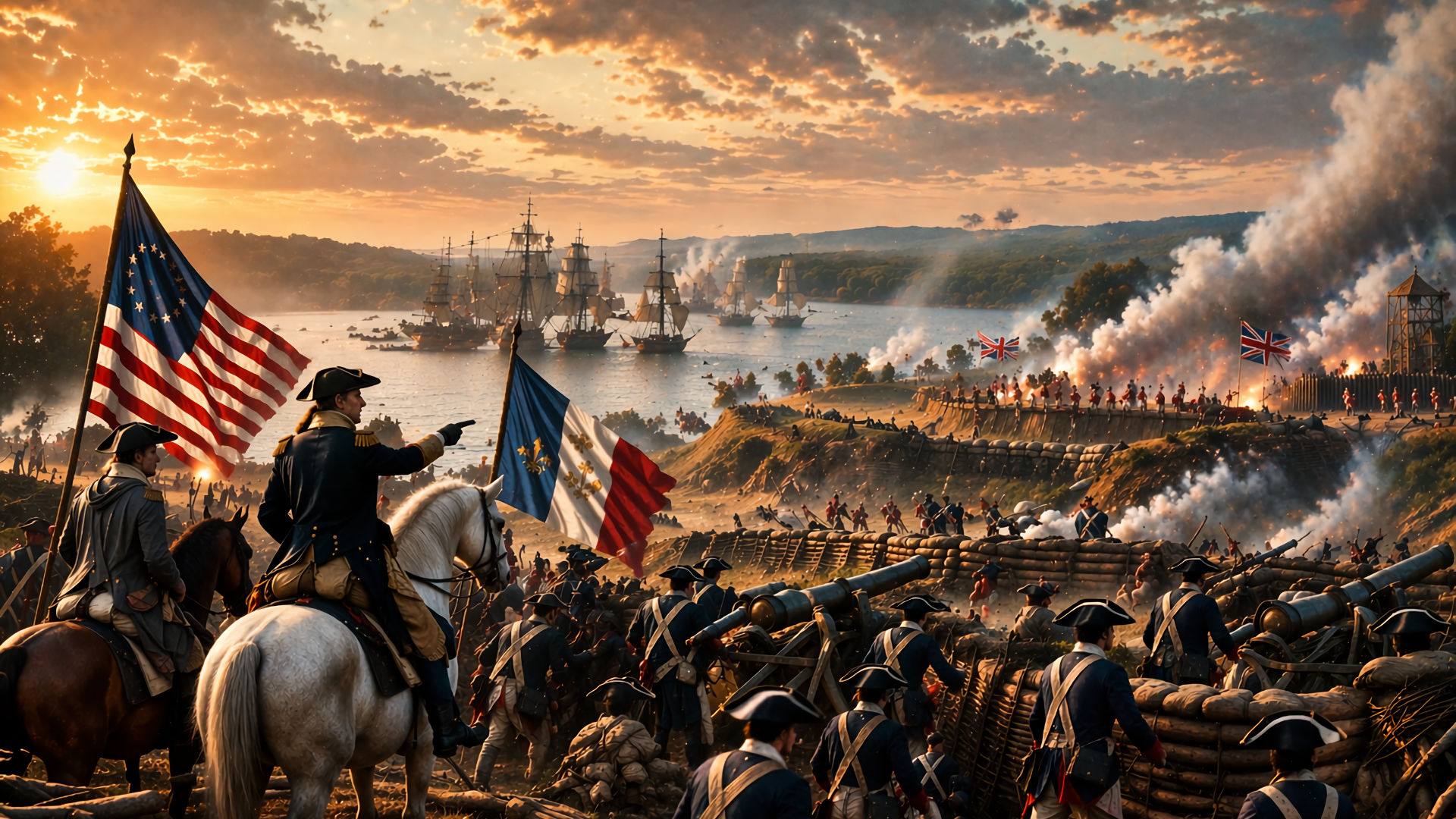
The formal siege began on 28 September 1781 when Allied forces moved into position around Yorktown. Cornwallis commanded roughly 7,000 to 8,000 men, while the Franco-American army opposing him was substantially larger. Rather than launching a reckless frontal assault, Washington and Rochambeau conducted a classic siege. They advanced methodically, digging parallel trenches, placing artillery, and tightening their grip. This was deliberate, technical warfare, shaped as much by engineers as by infantry officers. It lacked the romantic messiness of a charge, but it was brutally effective. Once the guns were in place, the British lines came under sustained bombardment.
The first parallel, a trench line running roughly parallel to the British defences, allowed the besiegers to mount artillery and edge closer under cover. Soon a second parallel was needed, but its construction was blocked by two advanced British redoubts, numbered 9 and 10. These outworks had to be taken before the siege could continue efficiently. On the night of 14 October 1781, the Allies attacked them in coordinated assaults. Redoubt 10 fell to American light infantry under Alexander Hamilton, while French troops stormed Redoubt 9. The attacks were sharp, dangerous, and successful. They have become some of the most famous episodes of the campaign, but their real importance lies in what they enabled. Once those positions were seized, the second parallel could be completed and the British inner line brought under even heavier fire.
Inside Yorktown, conditions deteriorated rapidly. British guns were knocked out, defences crumbled, and casualties mounted. Cornwallis still looked for openings. At one point he attempted to evacuate some troops across the York River to Gloucester Point, perhaps to break out, but bad weather disrupted the effort. That failed escape attempt underlined the reality of the British position. The noose was tightening, and even desperate options were slipping away. With no effective relief from the sea, no secure line of retreat, and Allied artillery tearing into his works, Cornwallis had fewer and fewer choices. Courage was not the issue. Geometry was.
By 17 October, a British drummer appeared with a white flag, signalling a request for negotiations. The siege had lasted less than three weeks, but it had achieved its objective completely. Yorktown was not won by a single glorious moment. It was won by planning, engineering, artillery, naval control, and the relentless reduction of Cornwallis’s options. The bombardment broke the British position physically, while the encirclement broke it strategically. Once the redoubts fell and relief failed to materialise, surrender became not a matter of honour lost, but of military reality acknowledged.
Surrender at Yorktown and the War’s Last Turning Point
The articles of capitulation were agreed, and on 19 October 1781 the British army formally surrendered at Yorktown. Cornwallis did not attend the ceremony in person, citing illness, and sent Brigadier General Charles O’Hara in his place. The symbolism of the event mattered enormously. A major British field army had laid down its arms before a combined American and French force. For the Americans, it was the clearest possible proof that independence was no fantasy. For the French, it was a vindication of their intervention. For Britain, it was a military and political shock from which the war effort in North America never truly recovered.
Yorktown did not instantly end the war in a legal sense. Fighting continued in scattered forms, and the Treaty of Paris would not be signed until 1783. Yet Yorktown effectively ended major military operations in the American theatre. The surrender transformed the political climate in London, where support for continuing the war weakened sharply. A war that had already proved expensive and frustrating now seemed unlikely to produce victory at acceptable cost. The loss of Cornwallis’s army made it much harder for British leaders to imagine restoring control over the colonies by force. In that sense, Yorktown was not merely a battlefield success. It was the point at which military defeat ripened into political inevitability.
The battle also left a lasting legacy in how it demonstrated the nature of American victory. Independence was not won by the Americans alone, nor was it handed to them by France. It emerged from a coalition in which American endurance, French money, French soldiers, French sailors, and Allied strategic cooperation all mattered. Washington’s leadership was central, but so was Rochambeau’s professionalism and de Grasse’s naval decision-making. Yorktown therefore stands as a lesson in alliance warfare. Success came when diplomacy, logistics, land operations, and sea power all pointed in the same direction. That sort of coordination is difficult in any century, and in 1781 it was extraordinary. The Battle of Yorktown effectively brought the story of the American War of Independence full circle. A rebellion that began with militia and protest ended with an international siege that captured one of Britain’s finest armies. The final image is not merely one of surrender, but of strategic convergence. Cornwallis at Yorktown was beaten by more than cannon fire. He was beaten by timing, alliance, geography, and the sudden collapse of British assumptions about control. That is why Yorktown remains one of the most important battles in modern history. It did not just win a campaign. It changed the future of an empire, confirmed the birth of a nation, and proved that the struggle for American independence had crossed the line from resistance to victory.
The Battle of Yorktown FAQ
The Battle of Yorktown was the decisive 1781 siege in Virginia in which American and French forces trapped and forced the surrender of British General Charles Cornwallis.
Yorktown was important because it effectively ended major fighting in the American War of Independence and convinced many in Britain that the war could no longer be won.
The Allied campaign was led by George Washington and the French commander Comte de Rochambeau, with vital naval support from Admiral de Grasse.
The French provided troops, artillery, money, and, most importantly, naval power. Their fleet blocked British rescue by sea and made Cornwallis’s surrender far more likely.
Not officially. Fighting continued for a time, but Yorktown ended the last major campaign and set the stage for peace negotiations that led to the Treaty of Paris in 1783.