The Murder of Ricky McCormick
On 30 June 1999, the partially decomposed body of 41-year-old Ricky McCormick was found in a field near West Alton in St. Charles County, Missouri. The discovery was strange from the outset. McCormick did not own a car, the area was remote, and investigators could not easily explain why he had ended up there. Officers identified him through fingerprints, and one more unsettling detail quickly stood out. No one had reported him missing.
That first puzzle led straight into several more. Early reporting indicated that authorities could not determine a clear cause of death, even though the circumstances made the case look suspicious. McCormick had last been seen alive only days earlier, and yet he was found some distance from the places he was known to frequent. In later years, the FBI publicly described the case more firmly, stating that he had been murdered and dumped in the field, which shows how investigators’ view of the death hardened over time, even though the precise mechanism of death was never publicly pinned down.
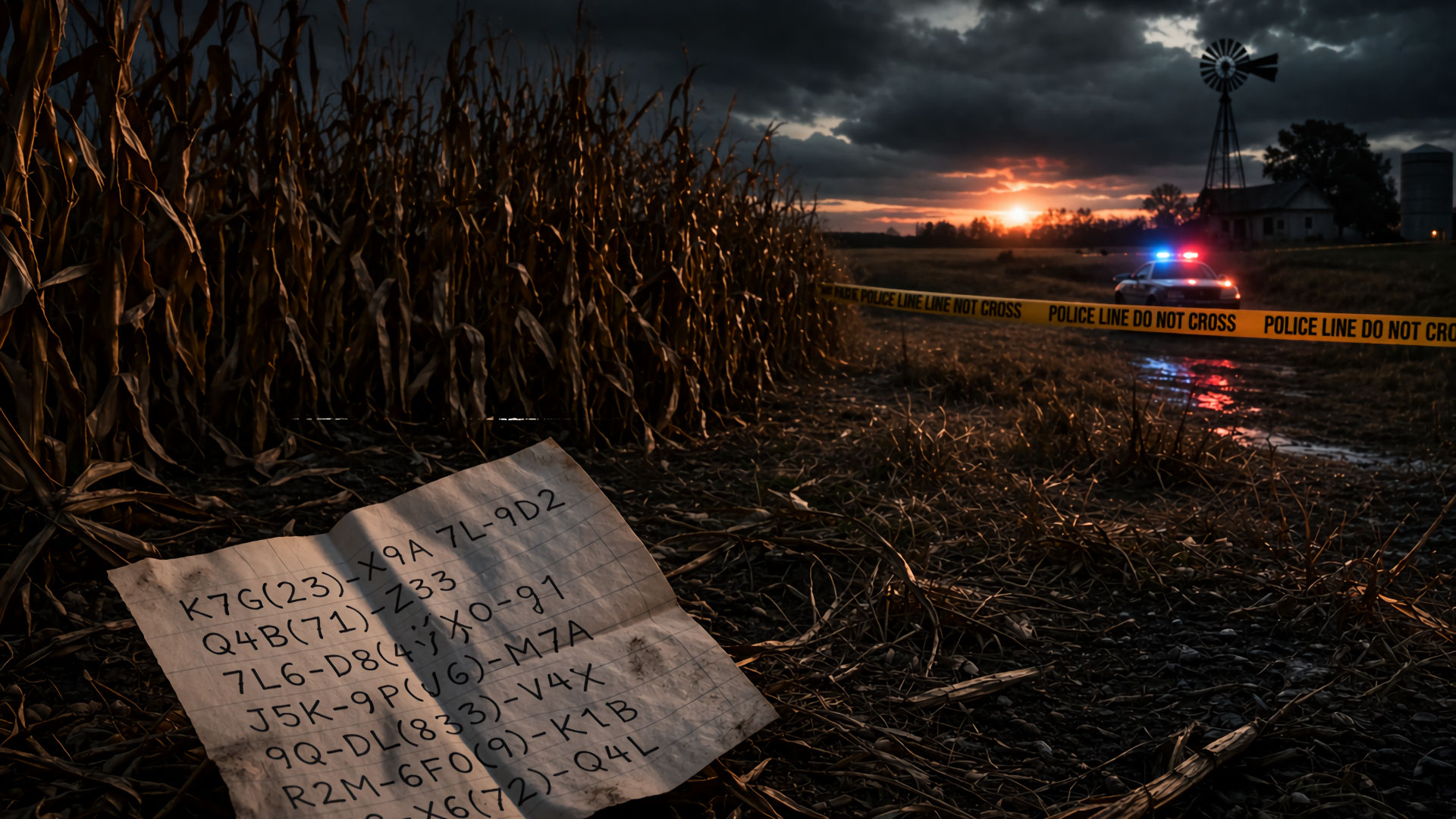
The case might have remained a grim but local mystery were it not for what was found in McCormick’s pockets. Among his belongings were two handwritten notes filled with strings of capital letters, numbers, dashes and parentheses. They did not look like ordinary reminders or scraps of paper. They looked like code, or at least something close enough to code to make investigators sit up straight. That discovery changed the entire shape of the case. Instead of being only a question of how Ricky McCormick died, it became a question of what he knew, where he had been, and whether the key to the whole affair had been riding around in his pocket all along.
What makes this opening chapter especially compelling is its mixture of clarity and fog. We know the date the body was found. We know where it was found. We know that there were notes. But from there, the ground turns muddy very quickly. Who put McCormick in that field, if he did not get there himself? Why was he carrying material that even experienced codebreakers could not read? And why did a man who had not been reported missing end up at the centre of one of the FBI’s most famous unsolved cypher cases? Before the notes can be understood, the man himself has to come into focus. That means stepping back from the field and asking a simpler question that turns out not to be simple at all: who was Ricky McCormick?
Who Was Ricky McCormick?
Ricky McCormick was not the sort of victim whose life came neatly packaged for investigators. He had lived at multiple addresses around the St. Louis area and, according to reporting on the case, sometimes stayed with his elderly mother. He had left school early, struggled with chronic health problems involving his heart and lungs, and at the time of his death was unemployed and receiving disability payments. He also had a criminal record, details that inevitably shaped how people saw him, fairly or unfairly. In unsolved cases like this, biography can become destiny in the public imagination, and McCormick’s background made him easy for some to file away as troubled, marginal, and therefore somehow less knowable.
Yet that same background may be exactly why the case became so difficult. McCormick appears to have moved through a world of informal contacts, shifting routines, and vulnerable circumstances. He was not a banker with a diary full of appointments. He was not someone leaving behind an office trail, travel receipts, and a tidy list of contacts. That made reconstructing his movements harder and his associations murkier. At least one major point of disagreement also emerged about his literacy and habits. The FBI later said that, according to family members, McCormick had used encrypted notes since boyhood and may have had his own secret system. His family, however, forcefully pushed back on that idea, telling the Riverfront Times that he could barely write and certainly did not compose coded messages in any meaningful sense.
That disagreement matters because it cuts to the heart of the case. If McCormick really did have a private shorthand known only to him, the notes in his pocket could have been intensely personal and practical, perhaps directions, names, times or reminders. If, on the other hand, he was barely literate and only scribbled disconnected marks, then the so-called code may have been misunderstood from the start, or perhaps written by someone else entirely. That is not a small distinction. It changes whether the notes are the victim’s voice, a killer’s clue, or a red herring in paper form.
So the portrait of Ricky McCormick that emerges is unstable in exactly the worst way for investigators. He was vulnerable, but perhaps streetwise. He was unwell, but still moving around the city. He may have written in a private shorthand, or he may barely have written at all. Every statement about him seems to arrive with its own opposite attached. That uncertainty does not stop with his character. It runs directly into the next crucial issue, his final known movements. To understand how he reached that field, investigators first had to work backwards through the last days of his life, and that timeline has proved nearly as slippery as the coded notes themselves.
The Last Known Days
The timeline of Ricky McCormick’s final days is one of the most frustrating parts of the case because it is both short and incomplete. Reporting from the time said he was last seen alive on 25 June 1999, when he went for a check-up at Forest Park Hospital in St. Louis. Other later accounts have suggested he may also have been seen after that, including around a petrol station, but the broad picture remains the same. He was known to be alive only a few days before his body was found, and somewhere within that narrow window, his trail breaks apart.
That gap is where the case starts to feel maddening. A man with health problems, limited means, and no car somehow ended up in a remote area near West Alton. The field where he was found was not a place people casually drift into on foot while out for a pleasant wander and a packet of crisps. Investigators had to consider whether he had gone there voluntarily, been given a lift, or been taken there against his will. Because no one had reported him missing, there was no immediate missing-person urgency to create a detailed public timeline in those first critical days. By the time the body was found, decomposition had already narrowed the forensic options.
The FBI later said investigators believed the notes in McCormick’s pockets had been written within three days of his death. If that assessment is right, then the papers were not some old scraps he had been carrying for weeks. They were recent, and probably relevant. That does not prove they contained a confession, a meeting place, or the identity of a killer. It does, however, suggest that the notes belonged to the final act of his life, not to some forgotten errand from months earlier. This is why the notes loom so large in every retelling of the case. They are not just weird objects. They are tied to the timeline itself.
Even so, the last known days remain shadowy because there is so little to triangulate them with. No clear public account has ever settled exactly whom he met, where he travelled, or why he ended up in that specific location. If there was a planned meeting, the person on the other side of it has never been publicly identified. If McCormick was acting as a courier, messenger, or go-between, that role remains unproven. And if the notes were his own private shorthand, they have not yielded enough to rebuild his route. The timeline, then, does not lead cleanly to an answer. It leads straight to the two pieces of paper that turned a local homicide into an international code-breaking curiosity. To understand why the case still grips people, you have to look at those notes and ask the question that has kept cryptanalysts busy for years: what exactly are we looking at?
The Notes No One Could Read
The two notes found in Ricky McCormick’s pockets are the reason this case escaped the gravity of ordinary cold-case obscurity. They contain more than 30 lines of characters made up of capital letters, numbers, dashes, and bracketed groupings. To the untrained eye, they resemble either a very bad shopping list or the frantic workings of a typewriter having a personal crisis. To trained eyes, they appeared structured enough to merit serious analysis. That was enough for the material to be passed to the FBI’s Cryptanalysis and Racketeering Records Unit, the CRRU, a specialised unit that deals with manual code-breaking rather than digital encryption.
The FBI’s own released documents show how seriously the material was treated. An examination dated March 2002 stated that the notations on the submitted documents had characteristics indicating the presence of an encrypted message, but that all efforts to decrypt it had been unsuccessful. A later FBI laboratory report dated December 2010 likewise said that all attempts to decipher the symbols had failed. So this was not one bored detective squinting at a scrap of paper and declaring it spooky. Multiple FBI examinations, separated by years, concluded that the material was at least plausibly encoded and had resisted every method then applied to it.
In March 2011, the FBI took the unusual step of appealing to the public for help. The Bureau said that solving the code might reveal McCormick’s whereabouts before his death and could help solve the homicide. It also explained that investigators believed the notes had been written within three days of his death. The public release transformed the case. Suddenly, amateur cryptographers, puzzle enthusiasts, journalists and armchair sleuths all had a crack at the same baffling strings of characters. The result was a flood of theories and almost no consensus. Some thought the notes were a personal shorthand. Others argued they were gibberish mistaken for code. Some proposed routes, names, and places. None of it produced a verified solution.
The notes, therefore, sit in a strange evidential category. They are too distinctive to ignore, too stubborn to understand, and too central to the case to dismiss as meaningless without risking a terrible mistake. If they are real code, then they may contain the strongest clue in the case. If they are not, then decades of attention have clustered around the wrong object. Either way, they pushed the investigation into territory far beyond routine homicide work. Once the public saw the notes, the case stopped being only about a dead man in a field. It became about interpretation, credibility and competing theories, and that is where the investigation began to splinter into possibilities rather than progress.
Suspects, Theories, and Dead Ends
Because the notes have never been solved, theories about Ricky McCormick’s murder have multiplied to fill the silence. One possibility is that the notes were practical, perhaps directions, names, times or meeting points, and that McCormick was involved in some exchange shortly before his death. Another is that he was carrying a message for someone else, which would explain why the writing might look too sophisticated for a man his family described as barely literate. Some observers have suggested drug-related connections, while others have pointed to the possibility that McCormick simply moved among dangerous people and became vulnerable to violence without there being any grand coded conspiracy behind it.
The problem is that every one of those theories runs into the same brick wall. There has never been a publicly confirmed suspect, motive, or explanation for why McCormick was in that field. Even the notes, the one feature that makes the case distinctive, refuse to settle the matter. If they are directions, they are directions no one can read. If they are personal shorthand, nobody close to McCormick has explained them. If they were written by someone else, investigators have never publicly named that person. The most frustrating feature of the case is not merely that it lacks an answer. It is that each apparent clue gives birth to two or three mutually incompatible interpretations.
Family testimony has also complicated rather than simplified the picture. The FBI publicly suggested that McCormick had used encrypted notes since childhood, but relatives later said they had never known him to write in code and doubted he had the capacity to create the papers found in his pockets. That conflict leaves investigators with an awkward choice. Either the family misunderstood what McCormick was doing for years, or official assumptions about the notes overstated his abilities. Neither option is comfortable. Both matter because they shape the direction of every theory built on top of them. If the foundation is shaky, the whole elegant tower of speculation starts wobbling like a pub table with one short leg.
What remains, then, is a file full of dead ends. The body was found, but the route to the field is unknown. The notes were recovered, but not decoded. The victim’s life can be sketched, but not fully mapped. The FBI examined the material more than once and asked the public for help. Yet, no breakthrough followed. Cases like this often turn on one tiny clarification, one witness remembered too late, one name recognised by the right person. Until that happens, the investigation remains suspended between homicide and puzzle. That unresolved state is exactly why the case still feels so haunting more than two decades later.
Why the Case Still Haunts Investigators
The murder of Ricky McCormick endures because it sits at the intersection of two kinds of mystery. On one level, it is a conventional unsolved homicide. A man was found dead in an isolated place, apparently far from where he would normally have been, and the person responsible has never been identified. On another level, it is a communication mystery, a case in which the victim appears to have carried a message that survives him but still refuses to speak. Those two layers reinforce each other. If the homicide were solved, the notes might suddenly make sense. If the notes were solved, the homicide might finally move. Until then, each half keeps the other alive.
The case also haunts because it exposes the limits of expertise. The FBI’s code specialists examined the notes and could not break them. The American Cryptogram Association also assisted without producing a solution. Public appeals brought in fresh eyes and plenty of ideas, but not the one idea that could be verified and acted upon. That failure gives the case an unnerving edge. People take a peculiar comfort in believing that, somewhere in the system, there is always a sharper mind, a better lab, a final authority. Ricky McCormick’s notes mock that belief. They sit there like a locked door with the key possibly visible on the other side of the glass.
There is also the human element. McCormick was not a celebrity victim, and there was no global media frenzy in 1999. Yet his death has become one of the most discussed cold cases of its kind because of the papers in his pocket and the unresolved question of who he really was in those final days. Was he a vulnerable man caught up in something beyond him? Was he carrying information he did not understand? Did he create the notes himself, or did someone else place them in his pocket? These questions persist because none of the available answers feels solid enough to rest on. In the end, the case remains haunting not because it is theatrical, but because it is unfinished in such an exact and irritating way. There is a body, but not a clear cause. There is a clue, but not a reading. There is a victim, but not a settled story of his last movements. For investigators, that is the worst sort of open file, one that keeps suggesting it is solvable while stubbornly refusing to yield. For everyone else, it is the kind of mystery that lingers because it feels as though the answer may already exist, trapped in those cramped lines of letters and numbers, waiting for someone to look at them from exactly the right angle.
The Murder of Ricky McCormick FAQ
Ricky McCormick was a 41-year-old man from the St. Louis area whose body was found in a field in St. Charles County, Missouri, in June 1999.
The case became widely known because two handwritten notes filled with strange letters, numbers, and symbols were found in his pocket, and the FBI was unable to decode them.
No. His death remains unsolved, and the coded notes continue to be one of the most unusual features of the case.
Yes. In 2011, the FBI publicly released the notes in the hope that someone might be able to decipher them and provide a breakthrough in the case.
Investigators believed the notes may have been written shortly before Ricky McCormick’s death, which means they could relate directly to his last movements or the circumstances of the murder.