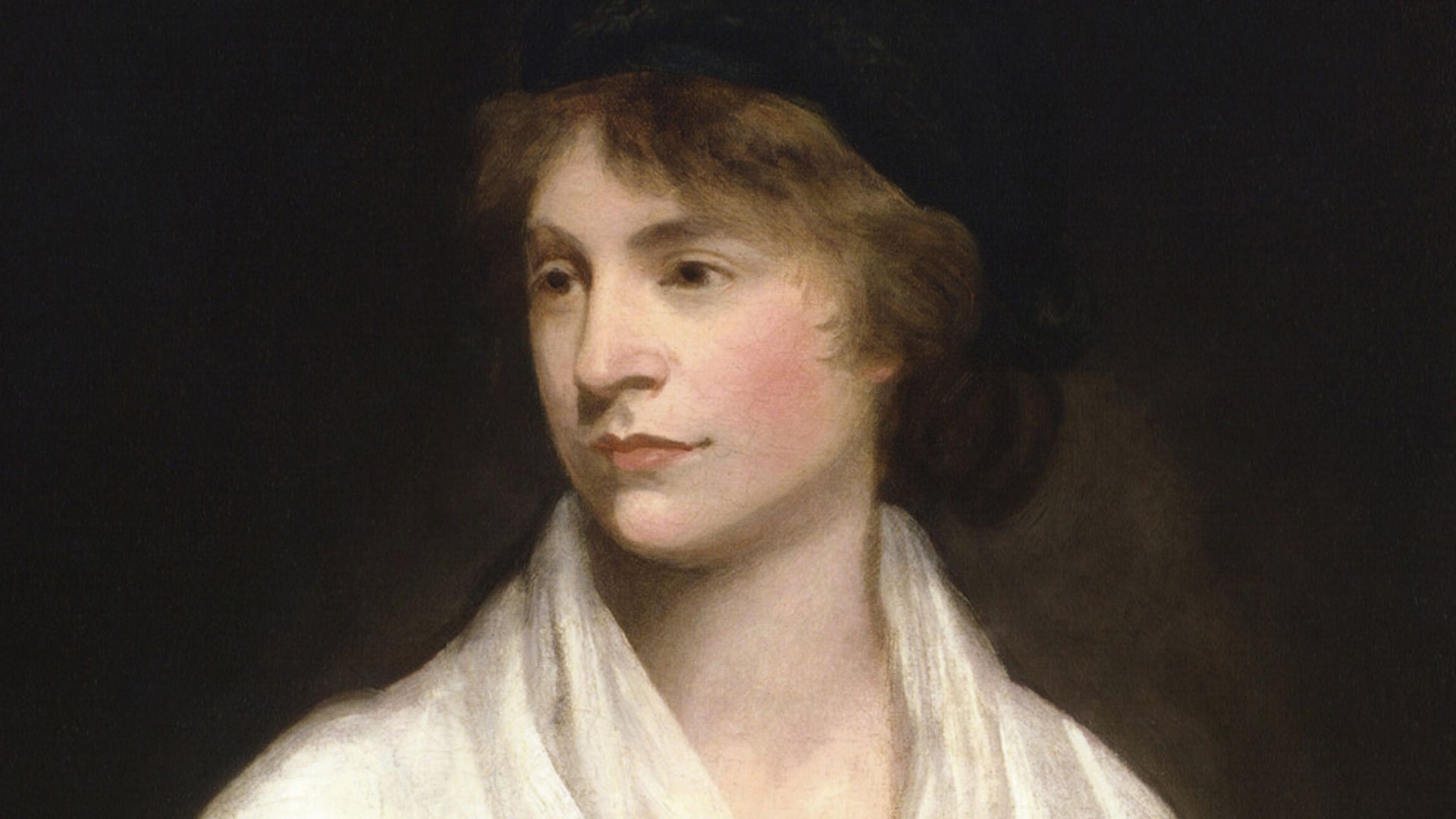
Mary Wollstonecraft
Mary Wollstonecraft was born on 27 April 1759 in Spitalfields, London, an area known at the time for its mix of skilled trades, religious dissenters, and precarious respectability. She was the second of seven children born to Edward John Wollstonecraft and Elizabeth Dixon. On paper, the family appeared comfortably middle-class. In reality, stability was a rare visitor. Her father had inherited a modest fortune, but poor financial decisions and heavy drinking steadily eroded it, dragging the family through a series of moves across England in search of cheaper living and new beginnings.
Mary’s childhood was shaped as much by what she witnessed at home as by what she lacked outside it. Her father was frequently violent towards her mother, and Mary is known to have intervened physically on more than one occasion, placing herself between her parents during assaults. These experiences left a deep impression. Long before she began writing about women’s rights, authority, and injustice, she had observed power exercised brutally and without accountability inside her own household.
Formal education for girls in mid-eighteenth-century England was limited, and Mary’s schooling was patchy at best. She attended day schools intermittently, but there was no sustained academic programme. What she did receive instead was an early lesson in self-reliance. She read widely when books were available, taught herself through observation and conversation, and developed a strong belief that intellect was not confined by gender, only by opportunity.
A crucial turning point in her early life came through friendship rather than family. As a teenager, Mary formed a close bond with Fanny Blood, a young woman from a more cultured and intellectually engaged household. Through the Blood family, Mary was exposed to new ideas about education, independence, and emotional companionship. The relationship offered her a glimpse of a different model of domestic life, one based on mutual respect rather than fear. It also reinforced her growing frustration with the narrow futures offered to women of her class.
By the late 1770s, Mary had begun to articulate, at least privately, a sense that women’s dependence was neither natural nor inevitable. Her early experiences had taught her that economic vulnerability and lack of education left women dangerously exposed, whether to violent fathers, unreliable husbands, or social disgrace. These were not abstract observations. They were conclusions drawn from lived experience.
When she left the family home in her late teens to seek work and independence, she carried with her the emotional weight of a turbulent upbringing and a fierce determination to shape her own life. The roots of her later radicalism lay firmly in these formative years, forged not in theory but in survival.
Self-Education, Work, and the Fight for Independence
By the late 1770s, Mary Wollstonecraft was determined to escape the instability and dependence that had defined her childhood. For an unmarried woman with no fortune, the options were limited and rarely dignified. Respectable work for women largely meant service, teaching, or becoming a companion, roles that demanded obedience rather than ambition. Mary tried them anyway, not because she accepted their limits, but because she needed to survive.
Her first significant period of independence came when she worked as a lady’s companion in Bath. The position offered security, but little intellectual satisfaction. She quickly became disillusioned with the performative politeness and social hierarchies of polite society, where women were expected to flatter, entertain, and quietly endure. The experience confirmed her suspicion that dependence, even when comfortable, came at the cost of self-respect.
Teaching offered a more promising path. In the early 1780s, Mary, alongside her sisters and her close friend Fanny Blood, attempted to run a small school in Newington Green, then a village just north of London. Although the venture was financially fragile, the location proved intellectually rich. Newington Green was home to a community of religious dissenters and radical thinkers who valued education, debate, and moral independence. Here, Mary encountered ideas that challenged traditional authority and reinforced her belief in reason, personal virtue, and self-improvement.
During this period, she became increasingly serious about her own education. Largely self-taught, she read philosophy, history, and literature with intensity and purpose. Reading was not a leisure activity for her, but a form of resistance, a way to claim intellectual territory denied to women by custom and convention. She also began writing in earnest, drafting reflections on education, morality, and the condition of women, though publication was still beyond her reach.
The collapse of the Newington Green school following Fanny Blood’s declining health and eventual death was a devastating blow. Fanny’s illness and passing in 1785 affected Mary profoundly, emotionally and financially. It marked the end of one of the few periods in her early life that combined friendship, purpose, and independence. Forced once again to find work, she briefly served as a governess in Ireland, an experience that further sharpened her critique of class, privilege, and female confinement.
By the mid 1780s, Mary had learned a hard lesson. Without independent income or education, women were trapped in cycles of dependence that stunted both moral and intellectual growth. These years of trial, failure, and self-instruction laid the groundwork for her transformation from struggling teacher to professional writer. She had not yet found her public voice, but she had found her subject, and it was rooted firmly in lived experience rather than abstract theory.
London, Professional Writing, and Radical Circles
In 1787, Mary Wollstonecraft made a decisive move to London that would alter the course of her life. Determined to earn her living by writing, an almost unheard-of ambition for a woman without wealth or patronage, she entered the city’s vibrant but unforgiving literary world. London was crowded with printers, publishers, coffee houses, and political debate, and for the first time, Mary placed herself directly at the centre of it.
Her breakthrough came through the radical publisher Joseph Johnson, who recognised her intelligence and seriousness of purpose. Johnson offered her paid work translating, reviewing, and writing for his Analytical Review, a progressive journal that engaged with philosophy, politics, science, and literature from across Europe. This was more than employment. It was entry into a community. Through Johnson’s circle, Mary encountered reformers, scientists, dissenting ministers, and political radicals who questioned monarchy, religious authority, and inherited privilege.
For the first time, she was treated as an intellectual equal rather than a dependent. She attended dinners where ideas mattered more than gender, and conversation ranged from education and morality to the unfolding political crisis in France. This environment sharpened her thinking and gave her the confidence to write with authority rather than apology. Importantly, she was paid for her work, making her one of the first women in Britain to support herself primarily through writing.
In 1787, she published her first book, Thoughts on the Education of Daughters. The work drew directly from her experiences as a teacher and governess, arguing that girls should be educated to be rational, self-disciplined, and capable of independence rather than trained solely for marriage. While modest in tone compared to her later writings, it established her central concern: that women’s moral and intellectual weakness was the result of poor education, not nature.
As revolutionary ideas spread across Europe, Mary’s writing became more politically engaged. In 1790, she published A Vindication of the Rights of Men, a direct response to Edmund Burke’s critique of the French Revolution. Writing quickly and passionately, she defended republican ideals and attacked inherited authority, aristocracy, and social inequality. The pamphlet brought her public attention and controversy, marking her emergence as a serious political thinker rather than a minor educational writer.
By 1791, Mary Wollstonecraft had secured something she had long sought, intellectual independence. She was no longer writing from the margins of society, but participating in its most urgent debates. These years in London transformed her from a struggling survivor into a confident public voice, setting the stage for the work that would define her place in history.
Revolution, Vindication, and the Case for Women’s Rights
By the early 1790s, Mary Wollstonecraft had moved from participating in political debate to reshaping it. The French Revolution was no longer a distant event but a defining crisis for Europe, provoking fierce arguments in Britain about authority, rights, and the nature of society itself. Wollstonecraft watched these debates closely and responded with increasing urgency, convinced that discussions of liberty were meaningless if they excluded half the population.
In 1792, she published the work that would secure her place in intellectual history, A Vindication of the Rights of Woman. Written rapidly but with remarkable clarity, the book argued that women were not naturally inferior to men but had been made so by lack of education and enforced dependence. Wollstonecraft did not ask for special treatment. She demanded equal access to education, the opportunity for meaningful work, and the chance to develop reason and virtue on the same terms as men.
Her argument was radical not because it celebrated women’s difference, but because it rejected it. She insisted that women were rational beings first and social ornaments second. Marriage, she argued, should be a partnership between equals, not a system that rewarded female obedience and punished independence. These ideas challenged deeply entrenched assumptions about gender, family, and social order, and they provoked immediate backlash. Critics accused her of undermining morality, religion, and domestic life itself.
Rather than retreat, Wollstonecraft pushed further. In 1792, she travelled to revolutionary France, determined to witness events firsthand. Paris was in turmoil, with the monarchy overthrown and political violence escalating. Living as a foreigner and a woman during this period was dangerous, but she remained committed to observing the revolution beyond romantic idealism. Her experiences informed An Historical and Moral View of the Origin and Progress of the French Revolution, published in 1794, which combined sympathy for revolutionary ideals with growing unease about the descent into terror.
During her time in France, Wollstonecraft’s political thinking matured. She continued to believe in liberty and equality, but she became increasingly aware of how easily ideals could be corrupted by power, fear, and factionalism. Her writing from this period reflects a tension between hope and disillusionment, grounded in direct observation rather than abstract theory.
These years marked the height of her intellectual output and public visibility. Wollstonecraft was no longer simply responding to the world around her. She was actively shaping the terms of debate, insisting that any serious discussion of rights, reason, or progress must include women not as symbols, but as citizens.
Love, Loss, and the Personal Cost of Independence
While Mary Wollstonecraft was arguing publicly for reason, equality, and moral independence, her private life was far messier and far more painful. The contrast between her intellectual confidence and her emotional vulnerability during the 1790s is one of the most striking aspects of her biography, and it came at a considerable personal cost.
During her time in revolutionary France, Wollstonecraft entered into a relationship with the American merchant and diplomat Gilbert Imlay. Unwilling to marry and sceptical of the legal and moral constraints marriage placed on women, she chose instead to live with him openly, a decision that defied social convention and exposed her to scandal. In 1794, she gave birth to their daughter, Fanny Imlay. For a time, Wollstonecraft hoped she had found a partnership that matched her ideals, one based on affection and mutual respect rather than legal dependency.
The reality proved harsher. Imlay grew distant and ultimately abandoned her, leaving Wollstonecraft to support herself and her child emotionally and financially. His rejection was devastating. Already sensitive to instability and betrayal from her earlier life, she fell into deep despair. In 1795, she attempted suicide twice, once by overdose and later by throwing herself into the River Thames. Both attempts failed, but they reveal the extent of her emotional crisis during this period.
Despite her suffering, Wollstonecraft continued to write. In an effort to salvage her relationship and support herself, she travelled to Scandinavia on Imlay’s behalf to conduct business matters. The journey produced one of her most personal and introspective works, Letters Written During a Short Residence in Sweden, Norway, and Denmark. Blending travel writing, philosophy, and emotional reflection, the book revealed a more vulnerable voice than her political writings, grappling openly with loneliness, disappointment, and the search for meaning.
After finally severing ties with Imlay, Wollstonecraft returned to London and gradually re-entered intellectual life. There, she formed a relationship with the philosopher William Godwin, a man whose ideas about reason, equality, and social reform closely aligned with her own. Their partnership developed cautiously, shaped by shared respect rather than idealism. When Wollstonecraft became pregnant again, the couple married in 1797, a pragmatic decision motivated by concern for legal protections rather than a rejection of her principles.
For a brief period, Wollstonecraft experienced a sense of personal stability that had long eluded her. It would not last. Complications following the birth of her second daughter, Mary, would soon bring her life to an abrupt end. But in these final years, she had demonstrated that her commitment to independence extended beyond theory, even when it exacted a heavy emotional price.
Death, Scandal, and a Reputation Rewritten
Mary Wollstonecraft died on 10 September 1797 in London, following complications after the birth of her second daughter, Mary, on 30 August. The cause was puerperal fever, commonly known as childbed fever, a common and often fatal bacterial infection in an era before antiseptic medicine. Her death, at the age of only 38, cut short a life that had only recently achieved a measure of personal stability and recognition.
In the immediate aftermath, Wollstonecraft was mourned privately by those who knew her as a formidable intellect and a deeply feeling individual. Publicly, however, her reputation was about to suffer. In 1798, her husband, the philosopher William Godwin, published Memoirs of the Author of A Vindication of the Rights of Woman. Intended as a tribute grounded in honesty and respect, the book detailed Wollstonecraft’s unconventional relationships, her illegitimate child, and her suicide attempts. Godwin believed truth mattered more than reputation. Society did not agree.
The reaction was swift and brutal. In a Britain already nervous about revolution and radicalism, Wollstonecraft was recast as a warning rather than a pioneer. Her ideas were dismissed as dangerous, her personal life held up as evidence of moral failure, and her work quietly sidelined. For much of the nineteenth century, her name became synonymous with excess and impropriety rather than intellectual courage. Even sympathetic readers often treated her as an eccentric outlier rather than a serious philosopher.
Yet her ideas did not disappear. They survived quietly, resurfacing whenever debates about education, women’s rights, and social equality gained momentum. By the late nineteenth and early twentieth centuries, early feminist thinkers began to reclaim Wollstonecraft as a foundational figure. Her insistence that women were rational beings shaped by education, not nature, proved remarkably durable. Long before the language of gender equality became common, she had articulated its core principles with clarity and force.
Her legacy was also carried forward in unexpected ways. Her daughter, Mary Shelley, would go on to write Frankenstein, one of the most enduring works of English literature. While very different in form and subject, Shelley’s novel reflects many of the themes her mother wrestled with: responsibility, creation, power, and the consequences of neglect.
Today, Mary Wollstonecraft is recognised as one of the most important thinkers of the eighteenth century. Not because she was flawless, but because she was fearless. She lived her principles in a world determined to punish women who did so, and she paid for that courage with both suffering and obscurity. Her reputation, once tarnished by scandal, now rests where it belongs, on ideas that helped lay the groundwork for modern feminism and continue to provoke, challenge, and inspire.
Mary Wollstonecraft FAQ
Mary Wollstonecraft was a British writer and philosopher born in 1759, best known for arguing that women deserved the same education and rational development as men.
She is most famous for writing A Vindication of the Rights of Woman, one of the earliest major works advocating women’s equality.
Yes. She married philosopher William Godwin shortly before her death, primarily for legal reasons rather than ideological change.
She died in 1797 from puerperal fever following complications after childbirth.
Her ideas laid the foundations for modern feminist thought and continue to influence discussions about education, equality, and human rights.