The Lake Nyos Disaster
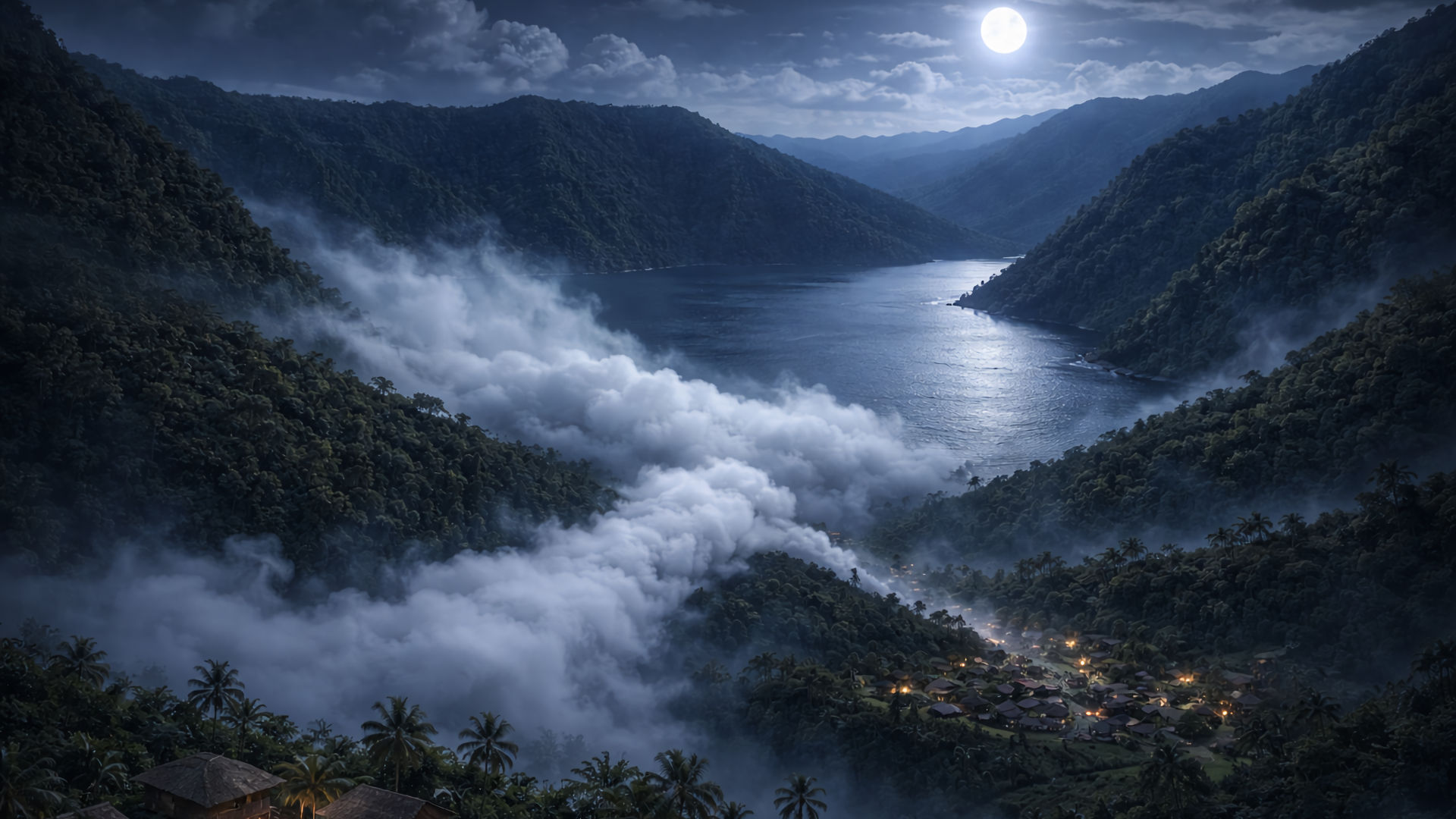
In the remote highlands of northwestern Cameroon, near the border with Nigeria, lies a small volcanic lake surrounded by steep hills and quiet farmland. To most outsiders, Lake Nyos once seemed like an unremarkable place. The lake itself was only about two kilometres wide, sitting in a deep volcanic crater formed long ago by explosive geological forces. Its waters were dark, calm, and often shrouded in mist in the cool mountain air. For the villagers who lived nearby, it was simply part of the landscape, as familiar as the surrounding forests and fields.
The region around Lake Nyos was home to small farming communities made up largely of subsistence farmers and cattle herders. Families in villages such as Nyos, Cha, and Subum relied on the fertile volcanic soil to grow crops including maise, cassava, and plantains. Herds of cattle grazed across the green hillsides, while narrow dirt paths connected scattered homes and small settlements. Life in this part of Cameroon moved at a steady and predictable rhythm shaped by farming seasons, local markets, and the daily needs of village life.
Although Lake Nyos appeared peaceful, its origin hinted at a far more dramatic past. The lake was created inside a volcanic crater known as a maar, formed when underground magma met groundwater in a violent explosion thousands of years earlier. The surrounding landscape was part of a region known as the Cameroon Volcanic Line, a chain of volcanic features stretching from the Gulf of Guinea deep into Central Africa. Many of these volcanoes had long been dormant, giving the impression that the land had settled into quiet stability.
What few people realised, however, was that Lake Nyos was anything but ordinary. Deep beneath the lake’s surface, invisible geological processes were slowly building a hidden danger. Carbon dioxide gas from magma deep underground was seeping upward through cracks in the earth and dissolving into the lake’s cold bottom waters. Because the lake was very deep, reaching around 200 metres in places, the gas remained trapped under immense pressure. Over time, the lower layers of the lake became saturated with dissolved carbon dioxide, much like a sealed bottle of carbonated drink.
This unusual condition created a delicate and potentially dangerous balance within the lake. Under normal circumstances, the heavy layers of gas-rich water remained undisturbed at the bottom, held in place by the cooler, lighter water above them. The lake looked calm from the surface, and there was nothing obvious to warn the nearby villagers that anything unusual was happening beneath the water.
For years, life continued peacefully around Lake Nyos. Farmers tended their fields, cattle grazed on the slopes, and children played near the lakeshore. Yet beneath the surface of that quiet crater lake, a deadly natural trap was slowly forming, waiting for the moment when the balance would finally break.
The Night the Air Turned Deadly
On the evening of 21 August 1986, the villages surrounding Lake Nyos settled into the quiet routine of another ordinary night. Families finished their evening meals, livestock were gathered in for the night, and the cool mountain air began to settle across the hills. In rural communities where electricity was scarce, darkness came quickly. Oil lamps flickered inside homes while the sounds of insects and distant cattle filled the still air. Nothing about the evening suggested that anything unusual was about to happen.
Shortly after 9 p.m., however, something extraordinary occurred at the lake itself. Witnesses later described hearing a deep rumbling sound coming from the direction of Lake Nyos. Some compared it to distant thunder, while others said it resembled the roar of a landslide or explosion. In reality, a massive release of gas had suddenly erupted from the depths of the lake.
For reasons that scientists still debate, the delicate balance inside Lake Nyos had been disturbed. The gas-rich water trapped at the bottom of the lake suddenly began to rise toward the surface. As the pressure decreased, the dissolved carbon dioxide rapidly came out of solution, much like the fizz that erupts when a shaken bottle of soda is opened. This created a powerful chain reaction in which rising gas forced more deep water upward, releasing even more carbon dioxide in an unstoppable surge.
Within minutes, an enormous cloud of carbon dioxide burst from the lake and spilled over the surrounding landscape. The gas itself was colourless and odourless, making it impossible to detect through sight or smell. But it was also heavier than air, meaning it flowed downhill like an invisible flood. The cloud spread rapidly through valleys and across nearby villages, silently displacing the oxygen people and animals needed to breathe.
Many of the victims never knew what was happening. As the dense gas swept through homes and pastures, people simply lost consciousness where they stood or slept. Entire families were overcome in their houses. Livestock collapsed in fields. Even insects and birds were affected in the areas where the gas concentrated most heavily. The event happened so quickly and so silently that there was little chance for anyone to escape.
The cloud of carbon dioxide continued moving through the surrounding valleys for several kilometres. By the time the gas began to disperse and the normal air slowly returned, hundreds of people had already died. Villages that had been full of life only hours earlier had fallen eerily silent.
In the darkness of that August night, a disaster had unfolded unlike almost any other in recorded history. There had been no flames, no floodwaters, and no violent storm. Instead, an invisible cloud of suffocating gas had swept through the highland communities around Lake Nyos, leaving devastation in its wake before anyone fully understood what had happened.
A Disaster Without Fire, Flood, or Warning
When morning arrived on 22 August 1986, the full scale of the tragedy around Lake Nyos began to reveal itself. Survivors who slowly regained consciousness stepped outside their homes into an eerie and unsettling silence. Villages that had been alive with activity the night before now seemed abandoned. There were no sounds of livestock, no voices from neighbours, and no movement along the dirt paths that connected the small settlements scattered through the hills.
The first thing many survivors noticed was the stillness of the animals. Cattle lay motionless in the fields, goats and chickens were scattered across village compounds, and even wild animals had collapsed where they stood. In some areas, entire herds had died together. The sight was deeply unsettling because there were no obvious injuries and no signs of disease or violence. Everything simply appeared to have fallen where it had been moments before.
People soon discovered that the same fate had struck their families and neighbours. In homes throughout the region, victims were found lying in beds, sitting in chairs, or collapsed in doorways. Many appeared as though they had fallen asleep and never awakened. In some cases, entire households had been lost overnight. The lack of any visible destruction made the scene even more disturbing. There were no burned buildings, no collapsed houses, and no flood damage to explain what had happened.
Some survivors had strange and frightening memories of the night before. A few recalled hearing a loud noise from the direction of the lake. Others described waking suddenly with a choking sensation or an overwhelming feeling of weakness before losing consciousness. Those who survived were often left disoriented and confused, unsure why they had lived while so many around them had died.
News of the disaster slowly began to reach local authorities as survivors made their way to nearby towns seeking help. Medical workers and government officials soon travelled to the area, but what they encountered was baffling. The landscape showed no signs of a conventional natural disaster. There had been no earthquake strong enough to cause widespread destruction, no volcanic eruption sending lava across the land, and no toxic spill that could easily explain the mass deaths of people and animals.
By the time investigators began counting the victims, the scale of the tragedy had become clear. More than 1,700 people had died in the villages surrounding Lake Nyos, along with thousands of livestock. Entire communities had been devastated in a single night. Yet the cause remained a mystery.
The absence of visible damage made the Lake Nyos disaster particularly difficult to understand. It did not resemble the kinds of catastrophes most people associate with natural disasters. There were no dramatic images of collapsed buildings or raging floodwaters. Instead, there was only silence and stillness across the hills, as though life itself had simply been switched off.
For scientists and investigators, the challenge was now clear. Somewhere within the quiet crater lake nearby lay the explanation for one of the strangest and most deadly natural disasters ever recorded.
Scientists Uncover the Killer Beneath the Water
As news of the disaster spread beyond the remote highlands of Cameroon, scientists and investigators from around the world began arriving to examine the scene. At first, the cause of the tragedy remained deeply puzzling. There had been no signs of volcanic lava, no toxic chemicals, and no infectious disease that could explain why more than 1,700 people and thousands of animals had died so suddenly. The strange pattern of the deaths suggested something unusual had occurred, but the exact mechanism was still unclear.
One important clue came from the condition of the survivors. Many reported that they had collapsed without warning during the night, often waking hours later with headaches, confusion, or breathing difficulties. Doctors also noticed that victims showed no signs of burns, trauma, or poisoning from known substances. The evidence suggested that people had died from a lack of oxygen rather than from a conventional toxin.
Investigators soon turned their attention toward Lake Nyos itself. Early reports from survivors mentioned a loud rumbling sound coming from the lake before people lost consciousness. When scientists began studying the lake, they discovered something remarkable. The water near the surface looked disturbed, and the normally dark lake had taken on an unusual reddish-brown colour. This change was caused by deep water, rich in dissolved minerals, rising to the surface.
Further testing revealed the key piece of the puzzle. The lake contained enormous amounts of dissolved carbon dioxide trapped in its deepest layers. This gas had slowly accumulated over many years as volcanic activity beneath the region released carbon dioxide into underground water systems feeding the lake. Because the lake was deep and stable, the gas remained dissolved under high pressure at the bottom.
Researchers soon realised that Lake Nyos had experienced a rare event known as a limnic eruption. In this type of disaster, large quantities of dissolved gas suddenly burst out of a lake in a violent release. When the gas-rich water from the bottom begins to rise, the pressure drops, and the carbon dioxide rapidly bubbles out. This creates a powerful chain reaction that drives more gas upward, releasing huge volumes of suffocating carbon dioxide into the air.
Scientists estimated that the Lake Nyos eruption had released hundreds of thousands of tonnes of carbon dioxide in a matter of minutes. Because the gas is heavier than normal air, it flowed across the surrounding valleys like an invisible wave. The gas displaced breathable oxygen as it moved, causing people and animals to lose consciousness and suffocate.
The discovery of this mechanism explained many of the strange details observed in the aftermath. The absence of physical destruction made sense because carbon dioxide leaves no visible damage behind. The pattern of deaths in valleys and low-lying areas also matched the behaviour of a heavy gas cloud moving downhill.
By the late 1980s, researchers had finally solved the mystery. The tragedy at Lake Nyos had not been caused by fire, lava, or water, but by an enormous release of gas hidden beneath the calm surface of the lake. What appeared to be a peaceful crater lake had in fact been a natural pressure chamber, silently storing a deadly threat beneath its waters.
Engineering a Solution to a Silent Threat
Once scientists understood what had happened at Lake Nyos, a new and urgent question emerged. If the disaster had been caused by a sudden release of gas trapped beneath the lake, could it happen again? The answer, unfortunately, was yes. Researchers soon discovered that carbon dioxide was still continuing to seep into the lake from deep underground sources linked to the region’s volcanic geology. This meant that, over time, the lake could once again become dangerously saturated with gas.
The possibility of another limnic eruption was deeply alarming. Thousands of people still lived in communities surrounding Lake Nyos and in neighbouring valleys that could easily be reached by another cloud of heavy carbon dioxide. In addition, scientists realised that Lake Nyos was not the only lake in the region capable of producing such a disaster. Nearby Lake Monoun had already experienced a smaller but similar gas release in 1984 that killed 37 people, although the cause had not been fully understood at the time.
To prevent another catastrophe, researchers began searching for ways to safely remove the gas accumulating at the bottom of Lake Nyos. The challenge was enormous. The lake was deep, remote, and difficult to access, and the gas was stored under immense pressure beneath hundreds of metres of water. Any attempt to disturb the system in the wrong way could potentially trigger another dangerous release.
Engineers eventually developed an innovative but surprisingly simple solution. The plan involved installing long pipes that extended from the bottom of the lake to the surface. Once water from the gas-rich lower layers was pumped upward through the pipe, the pressure would drop, and the dissolved carbon dioxide would begin to escape as bubbles. This bubbling water would then continue rising naturally, creating a self-sustaining flow that slowly released gas in a controlled and steady way.
The first of these degassing pipes was installed in Lake Nyos in 2001. As it began operating, observers could see a dramatic fountain of water and gas shooting high into the air above the lake’s surface. While the sight looked spectacular, it represented a carefully managed process that was gradually reducing the dangerous buildup of carbon dioxide below.
Over the following years, additional pipes were installed to increase the rate at which gas could be safely removed. Scientists carefully monitored the lake’s chemistry and gas levels, ensuring that the pressure at the bottom continued to decrease. Each year of operation reduced the likelihood of another uncontrolled eruption.
The engineering effort at Lake Nyos became one of the most unusual disaster prevention projects ever undertaken. Instead of building dams or reinforcing structures, scientists had to safely “vent” an entire lake, slowly releasing a deadly gas that had accumulated over decades.
Although the danger has not been completely eliminated, the degassing system has significantly reduced the threat. What once hid silently beneath the waters of Lake Nyos is now being carefully managed, turning the site of one of the world’s strangest natural disasters into a place of ongoing scientific vigilance.
The Legacy of Lake Nyos and the Lessons Learned
The disaster at Lake Nyos left a deep and lasting scar on the communities of northwestern Cameroon. Entire villages were devastated, with families losing parents, children, and neighbours in a single night. In the weeks that followed the tragedy, survivors were relocated to safer areas by the Cameroonian government and international aid organisations. Many people were moved into newly constructed resettlement camps several kilometres away from the lake, where the risk of another gas release was believed to be lower.
Life in these resettlement communities was not always easy. The displaced villagers had lost not only their loved ones but also their homes, farmland, and livestock. For people whose lives had been closely tied to the fertile land around Lake Nyos, the relocation meant rebuilding their livelihoods from scratch. Some families eventually returned to areas closer to their former homes despite the lingering concerns about the lake’s safety.
For scientists and disaster researchers, the Lake Nyos tragedy became an important turning point in understanding a little-known natural hazard. Before 1986, very few scientists had considered the possibility that a lake could suddenly release enormous quantities of suffocating gas. The event demonstrated that certain volcanic lakes around the world could act as natural traps for carbon dioxide, storing the gas under pressure until a sudden disturbance triggered its release.
Following the disaster, researchers began studying other lakes with similar geological characteristics. Several lakes in Africa, including Lake Kivu on the border of Rwanda and the Democratic Republic of the Congo, were identified as containing large quantities of dissolved gases. Although Lake Kivu is much larger and behaves differently from Lake Nyos, its gas content has drawn significant scientific attention because millions of people live along its shores.
The Lake Nyos disaster also highlighted the importance of international scientific cooperation in responding to unusual natural threats. Teams of geologists, chemists, engineers, and disaster specialists worked together to investigate the event and develop the degassing technology that now reduces the danger. Their work demonstrated how scientific research and engineering solutions can sometimes prevent rare but devastating natural events from occurring again.
Today, Lake Nyos remains a place of careful monitoring. The degassing pipes continue releasing carbon dioxide from the lake’s depths, slowly reducing the pressure that once built up beneath the surface. Scientists regularly measure gas levels and study the lake’s stability to ensure the system remains safe. Nearly four decades later, the story of Lake Nyos still stands as one of the most unusual natural disasters ever recorded. It reminds us that even the quietest landscapes can hide powerful forces beneath the surface, and that understanding those hidden dangers is essential to protecting the people who live nearby.
The Lake Nyos Disaster FAQ
The disaster was caused by a sudden release of carbon dioxide from the bottom of Lake Nyos, a deep volcanic crater lake in Cameroon. The gas had built up under pressure for years before erupting in a rare event known as a limnic eruption.
More than 1,700 people died when the gas cloud spread through nearby villages on 21 August 1986. Thousands of animals also died.
Carbon dioxide is heavier than air and can displace oxygen. When the gas cloud flowed through valleys around the lake, people and animals suffocated because the breathable oxygen in the air was replaced.
After the disaster, engineers installed special degassing pipes in the lake to slowly release the trapped carbon dioxide. These systems significantly reduce the risk of another sudden gas release.
Yes. Some volcanic lakes can store large amounts of dissolved gas. Lake Kivu in Central Africa contains significant quantities of carbon dioxide and methane and is carefully monitored by scientists.