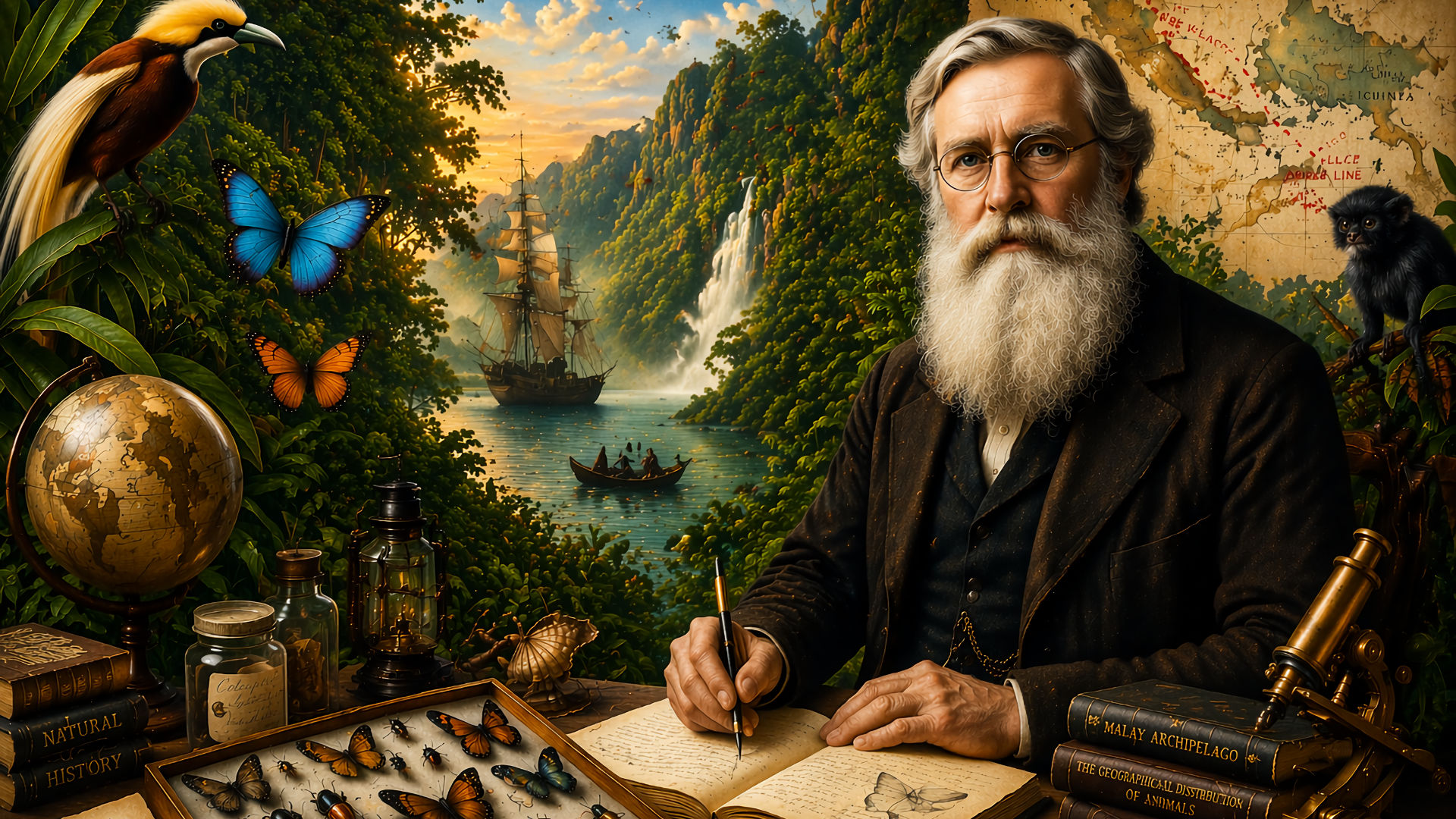
Alfred Russel Wallace
Alfred Russel Wallace was born on 8 January 1823 at Llanbadoc, near Usk in Monmouthshire, which is now part of Wales. He was the eighth of nine children born to Thomas Vere Wallace and Mary Anne Greenell Wallace. Although the family could claim respectable roots, their finances were far less impressive than the family story. His father had trained in law but did not build a successful career from it, and a series of poor financial decisions left the household slipping steadily down the social scale.
When Alfred was still a small child, the family moved to Hertford in England, where his mother had family connections and where Alfred could at least receive some schooling, even if it was limited. Wallace attended Hertford Grammar School, but his formal education was short and far from grand. Elite universities or expensive tutors did not shape him. Instead, he was one of those nineteenth-century figures who built himself largely through observation, reading, and determination, which is a polite way of saying he had to make do with what was available.
By the time Wallace reached the age of fourteen, the family’s money problems had become too serious to ignore. He had to leave school in 1837, not because he lacked ability, but because there was no realistic path to a longer education. He went to London to live with his older brother John, and this change exposed him to a wider world. In London, he continued teaching himself, reading widely and attending lectures when he could. He therefore developed habits that would stay with him for life: curiosity, independence, and a willingness to learn outside formal institutions.
Soon after, Wallace began working with his older brother William, who was a land surveyor. This was practical work, but it turned out to be an ideal education for a future field naturalist. Surveying meant travelling, measuring land, observing landscapes, and spending long periods outdoors. It trained his eye to notice terrain, boundaries, and variation in the natural world. Before he ever sailed to the Amazon or the Malay Archipelago, Wallace was already learning how to read the land closely and patiently. The boy who had left school early was beginning to acquire the habits that would one day help him change science.
Surveying Britain and Discovering a Taste for Science
By the early 1840s, Alfred Russel Wallace was no longer simply a boy forced out of school by family finances. He was earning a living, travelling through parts of Wales and western England, and learning how to observe the world with unusual care. Working as an apprentice to his elder brother William, Wallace spent years involved in land surveying. The work was technical and practical, requiring him to measure fields, map boundaries, and understand the shape of the countryside in detail. It also kept him outdoors for long stretches, and that mattered more than any classroom. While moving through rural landscapes, he developed an increasing interest in wild plants and the natural world around him, beginning the habit of collecting specimens that would later define his life.
This period also exposed Wallace to ideas well beyond surveying. As a teenager in London, and then later as a young working man, he read widely whenever he had the chance. He attended lectures at the London Mechanics’ Institute and encountered the radical political and social ideas of writers such as Thomas Paine and Robert Owen. Those influences helped shape Wallace into more than a collector of beetles and birds. They encouraged him to think about society, progress, and the place of human beings in nature, questions that would remain with him throughout his career. Even before he became famous for evolutionary thought, Wallace was forming the habit of linking science to bigger issues.
A turning point came in 1844 when Wallace took a post at the Collegiate School in Leicester, where he taught drawing, mapmaking, and surveying. Leicester proved far more important than the modest title of the job suggests. In the town library, Wallace encountered major scientific works that widened his horizons, including Charles Lyell’s Principles of Geology, Thomas Robert Malthus’s Essay on the Principle of Population, and Charles Darwin’s Voyage of the Beagle. These books gave him new ways to think about change over time, the struggle for existence, and the geographical distribution of life. He was still teaching for wages, but intellectually he was beginning to drift towards natural history.
Leicester also brought Wallace into contact with one of the most important people in his early life, Henry Walter Bates. Bates was a young entomologist from Leicester with a serious interest in insects, and the two men met through the local library and natural history circles. Their friendship quickly deepened into shared scientific enthusiasm. Bates encouraged Wallace to collect insects, and Wallace took to it with the same energy he had already shown in botany and field observation. This partnership gave Wallace both a friend and a model, someone equally fascinated by the living world and equally willing to pursue knowledge outside elite academic institutions.
When his brother William died in 1845, Alfred left Leicester and returned to Neath to help deal with family business matters, later taking work connected with civil engineering and railway surveying in the Vale of Neath. Yet by then, something had changed. Surveying was no longer just employment. It had become the bridge to a larger ambition. Through books, fieldwork, and friendship with Bates, Wallace was moving steadily towards the decision that would transform his life: to leave Britain altogether and seek answers in the tropics.
Into the Amazon, Chasing Species and Survival
By the late 1840s, Alfred Russel Wallace had begun to think far beyond Britain. His reading, his field experience, and his friendship with Henry Walter Bates had pushed him towards a bold plan: travel to the tropics, collect natural history specimens, sell enough of them to finance the journey, and at the same time investigate the deeper question of how species originated. In 1847, Wallace wrote to Bates proposing exactly that kind of expedition. The idea was not a gentleman’s grand tour. It was a working scientific venture, risky, physically demanding, and dependent on the success of the specimens they could gather and send home.
Wallace and Bates sailed for Brazil in 1848 and arrived at Pará, near the mouth of the Amazon, on 28 May that year. Once there, they began exploring the region and collecting intensively, especially insects, birds, and other animal specimens that could be studied and sold in Britain. The Amazon offered exactly the sort of natural variety Wallace wanted to examine. Species seemed to differ from place to place, river to river, and habitat to habitat, and this geographical patterning began to sharpen his thinking. He was no longer reading about exotic life from a library shelf in Leicester. He was seeing biodiversity at full volume, with the rainforest providing more evidence than any lecture hall ever could.
After an initial period together, Wallace and Bates separated to cover more ground independently. Wallace travelled widely in the Amazon basin, including journeys on the Rio Negro and other waterways, while continuing to collect and record what he saw. These years were productive but difficult. Travel in the region meant heat, insects, uncertain transport, tropical illness, and long stretches of isolation. Wallace nevertheless built up substantial collections and notes, gaining the sort of first-hand experience that would later underpin his scientific reputation. The Amazon expedition is sometimes overshadowed by his later years in the Malay Archipelago, but it was here that he first tested himself as an explorer-naturalist on a grand scale.
However, the expedition ended in disaster. In 1852, Wallace set sail for Britain, carrying with him the results of four years of work. During the homeward voyage, however, his ship caught fire in the Atlantic. Wallace and the crew escaped in a lifeboat and were later rescued, but most of his Amazon collections were lost. Years of specimens, records, and discoveries vanished with the ship. It was a crushing blow, the sort that might have finished a less determined man. Instead, Wallace survived, returned to England, and began rebuilding from what little had already been sent back earlier. The Amazon had nearly taken everything from him, but it had also made him into the kind of scientist who was not going to stop.
The Malay Archipelago and the Birth of a Big Idea
In 1854, only two years after losing much of his Amazon work in the Atlantic, Alfred Russel Wallace set out again, this time for Southeast Asia. He would remain in what was then known as the Malay Archipelago until 1862, travelling through present-day Singapore, Malaysia, Indonesia, and New Guinea. This second great expedition was even more ambitious than the first. Over eight years, Wallace visited numerous islands, collected on a huge scale, and built up one of the most important bodies of field evidence in nineteenth-century natural history. By the end of the journey, he had sent back well over 100,000 specimens, including insects, birds, shells, and mammals, many of them new to science.
What made the Malay Archipelago so important was not just the number of specimens Wallace gathered, but the patterns he began to notice. Island by island, species seemed to change in ways that suggested historical connection, separation, and adaptation. In 1855, while in Sarawak on Borneo, Wallace wrote a paper usually called the “Sarawak Law” paper, arguing that every species comes into existence close in time and place to a related pre-existing species. He had not yet identified the full mechanism behind that process, but he was clearly moving towards an evolutionary explanation. The paper made a strong impression on leading scientific figures, including Charles Lyell, because it showed that Wallace was thinking at a very high theoretical level as well as collecting in the field.
The decisive breakthrough came in 1858. While in the Moluccas, Wallace was struck by the idea of natural selection, the process by which better-adapted varieties survive and reproduce while others disappear. He wrote out his argument in an essay and sent it to Charles Darwin, asking for his opinion. The essay is commonly associated with Ternate, Wallace’s base in the region, though later evidence suggests he may actually have drafted it while on nearby Gilolo, now called Halmahera. Either way, the result was extraordinary. Wallace had independently arrived at the central mechanism of evolution.
Darwin, who had been working privately on similar ideas for years, was shocked by how closely Wallace’s essay matched his own thinking. With the involvement of Lyell and Joseph Dalton Hooker, writings by both men were presented together at a meeting of the Linnean Society of London on 1 July 1858. Wallace was still overseas and had no direct role in the event, but his place in the history of evolutionary biology was secured. The young surveyor from Wales had become, from the far side of the world, one of the co-discoverers of natural selection.
Evolution, Fame, and Life in Darwin’s Shadow
When Alfred Russel Wallace returned to Britain in 1862, he was no longer an obscure collector wandering through tropical forests. He came back with a formidable scientific reputation, an enormous body of specimens, and first-hand knowledge of geographical distribution that helped establish him as a pioneer of biogeography. His travels in the Malay Archipelago had not only strengthened the case for evolution, but they had also helped reveal how physical barriers shaped the spread of species. One of the clearest examples was the faunal boundary later called the Wallace Line, marking a striking division between Asian and Australasian animal life. Wallace had become a major scientific figure in his own right, even if history would often place him in the footnotes beneath Darwin’s larger portrait.
In the years that followed, Wallace wrote prolifically and spoke publicly in support of evolution by natural selection. He was one of Darwin’s strongest allies at a time when the theory still faced scepticism and hostility. Darwin’s On the Origin of Species appeared in 1859, just a year after the joint Darwin-Wallace paper had been read at the Linnean Society, and Darwin’s book quickly became the defining statement of evolutionary theory. Wallace never launched a bitter public feud over priority. Instead, he consistently acknowledged Darwin’s greater labour in assembling the wider argument, even though Wallace had independently identified natural selection for himself. It was a generous position, though one that also helped cement the pattern by which Darwin became the household name while Wallace became the distinguished almost-ran in popular memory.
That does not mean Wallace faded into silence. In 1869, he published The Malay Archipelago, a vivid and influential account of his travels, and in 1876, he produced The Geographical Distribution of Animals, a major work that strengthened his reputation as one of the leading naturalists of the age. He also remained active within scientific institutions, later becoming a Fellow of the Linnean Society in 1872. Yet even as his standing remained high, Darwin’s fame towered over Victorian science. Wallace was admired, respected, and widely read, but he was still often presented as the man who arrived at the same destination just after Darwin had already built the house and put his name on the gate.
Even so, Wallace’s importance was real and lasting. He was not merely Darwin’s echo. He was a co-discoverer of natural selection, a foundational thinker in biogeography, and a field naturalist of extraordinary endurance and insight. By the later nineteenth century, he had secured both scientific respect and public recognition, even while living with the awkward reality that one of the biggest ideas in history would forever be associated more strongly with someone else. Science can be cruel that way. It hands out immortality, but not always in equal portions.
Beyond Natural Selection, Wallace’s Later Life and Lasting Legacy
In his later decades, Alfred Russel Wallace refused to become a quiet Victorian grand old man who merely polished his reputation and nodded sagely at younger scientists. Instead, he remained intellectually restless, writing on science, society, politics, and the future of humanity. He married Annie Mitten in 1866, and the couple had three children, Herbert, Violet, and William. Family life gave him greater personal stability, but it did not make him any less energetic in public debate. Wallace continued publishing major works, lecturing, and involving himself in some of the most controversial questions of his age.
Some of those views enhanced his reputation, while others puzzled or frustrated fellow scientists. Wallace became an outspoken campaigner on social issues, especially land reform, and in 1881, he was elected the first president of the Land Nationalisation Society. He criticised economic inequality and argued that land should serve the public good rather than enrich large private owners. He also opposed eugenics, which set him apart from a number of prominent thinkers of the period. In that sense, Wallace was not just a naturalist with a butterfly net. He was also a public intellectual with a stubborn streak and a willingness to make enemies.
At the same time, Wallace’s commitment to spiritualism complicated his standing in the scientific world. He believed that some aspects of human consciousness could not be fully explained by material processes alone, and he argued that natural selection did not entirely account for the higher mental faculties of human beings. That position strained his relationship with some scientific allies and gave critics an easy way to dismiss parts of his work. Yet it would be unfair to treat this as the end of his scientific importance. Wallace remained a major figure in biogeography, ecology, and evolutionary thought, and his wider legacy continued to grow. Recognition did come, even if it never quite matched Darwin’s towering fame. Wallace received many honours during his lifetime, including the Order of Merit in 1908, one of Britain’s highest distinctions. When he died on 7 November 1913 at Broadstone in Dorset, he was widely respected as one of the great naturalists of the nineteenth century. Today, he is remembered not simply as the man who almost shared Darwin’s level of fame, but as a remarkable thinker in his own right: explorer, co-discoverer of natural selection, pioneer of biogeography, social critic, and one of the most original scientific minds of his century. Darwin may have taken the larger slice of posterity, but Wallace was never just the side dish.
Alfred Russel Wallace FAQ
Alfred Russel Wallace was a British naturalist, explorer, and writer best known for independently developing the idea of natural selection.
He is famous for co-discovering the theory of evolution by natural selection and for his important work in biogeography and natural history.
The Wallace Line is a faunal boundary identified by Wallace that separates the animal life of Asia from that of Australasia in parts of Southeast Asia.
Wallace sent Darwin an essay in 1858 outlining natural selection. Their ideas were presented jointly at the Linnean Society, though Darwin became the more famous name.
Wallace remains important because his work helped transform biology, deepen understanding of species distribution, and expand the scientific study of evolution.