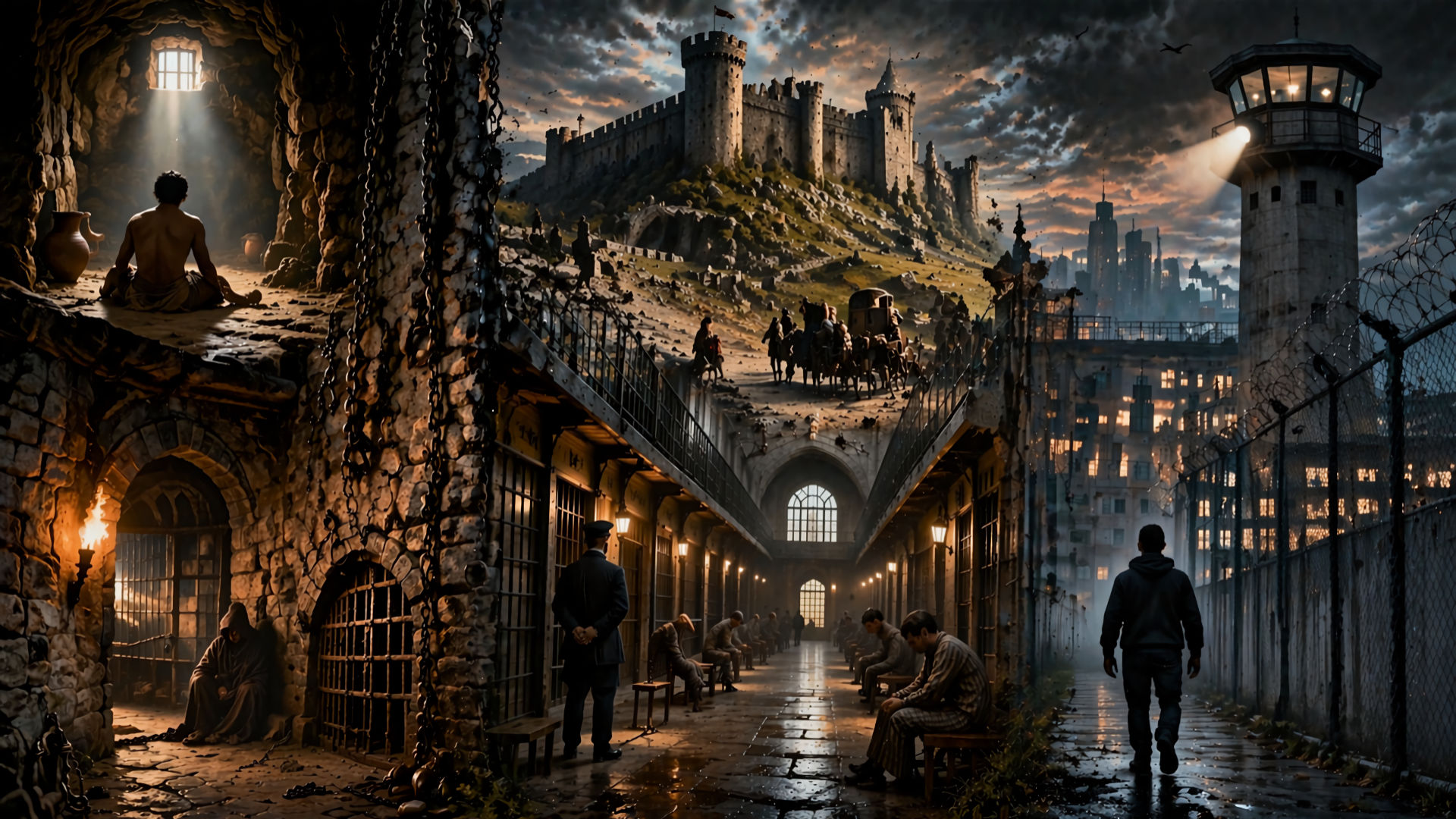
The History of Prisons
For much of human history, imprisonment was not the main punishment for crime. In the ancient world, societies were often less interested in locking people away for long periods and more concerned with delivering swift, public, and practical justice. Punishments were designed to deter others, restore order, repay a victim, or remove a perceived threat from the community. In many places, that meant fines, flogging, mutilation, enslavement, exile, or execution rather than months or years spent behind bars.
Early legal systems make this clear. The Code of Hammurabi, issued in Babylon around 1754 BC, listed a wide range of penalties based on status, injury, and property loss, but long-term imprisonment was not central to the system. Justice was often based on retaliation, compensation, or physical punishment. Ancient Egypt also used forced labour, beatings, and execution, while temporary holding cells existed mainly to detain suspects or debtors before trial or sentence. The prison, in other words, was usually a waiting room for punishment, not the punishment itself.
This pattern appeared in many ancient civilisations. In classical Greece, penalties for crime often included fines, exile, loss of civic rights, or death. Athens, for example, had places of detention, but these were not usually intended as institutions for rehabilitation or lengthy confinement. The same was true in Rome. Roman authorities maintained jails, including the famous Carcer in Rome, but these spaces were primarily used to hold the accused, political prisoners, or condemned individuals before execution or another sentence. Roman law was highly developed, but it still did not treat imprisonment as the standard answer to criminal behaviour.
One reason was practical. Keeping prisoners for long periods was expensive. Someone had to guard them, feed them, and house them, and most early states lacked either the resources or the desire to build entire systems around long-term confinement. Punishment that was immediate and visible was cheaper and, in the eyes of rulers, often more effective. Public beatings, branding, or exile made an example of the offender without placing a long-term burden on the authorities.
Another important factor was the idea of justice itself. In many early societies, crime was seen not simply as breaking a law, but as damaging a victim, a family, or the wider social order. The response, therefore, focused on repayment, shame, or removal rather than reflection and reform. The notion that a person could be shut away for years to be corrected developed much later. Before prisons became places of punishment in their own right, they were mostly places of custody, fear, and uncertainty, standing at the edge of a far older and harsher system of justice.
Dungeons, Debtors, and Cells: Prison in the Ancient and Medieval World
As societies became more organised, places of confinement became more visible and more varied. However, prisons still did not usually function as the main punishment in the way they do today. Instead, the ancient and medieval worlds used a patchwork of holding cells, castle dungeons, city gaols, military lockups, and debtors’ prisons, each serving a different purpose. These places reflected local power structures, legal traditions, and social divisions, and they were often brutal, unhealthy, and deeply unequal.
In the Roman world, prisons remained primarily places of detention rather than long-term correction. The Carcer, or Mamertine Prison in Rome, was one of the best-known examples. It was a grim holding place for enemies of the state, accused criminals, and those awaiting execution. Conditions were harsh, with little concern for comfort or reform. Across the empire, confinement could also be used against political troublemakers, rebellious soldiers, or enslaved people, but Roman authorities generally preferred punishments that were direct and visible, including flogging, forced labour, exile, or death. The prison cell was still more a staging post than a final destination.
After the fall of the Western Roman Empire in the fifth century, legal systems across Europe became more fragmented. Local lords, bishops, kings, and town authorities all exercised power in different ways, and imprisonment took on a wider range of forms. Medieval castles often contained dungeons or secure chambers for captives, rebels, and hostages. Monasteries and church authorities could also confine individuals, particularly clergy or those accused of religious offences. In many cases, however, people were held only until a fine was paid, a ransom arranged, a trial completed, or a more severe punishment delivered.
One of the clearest examples of imprisonment becoming more routine was the debtor’s prison. In medieval and later early modern towns, a person who failed to repay money could be locked up until the debt was settled. This created an obvious absurdity: someone unable to pay was placed in a position where earning money became even harder. Yet debtor imprisonment persisted for centuries because it served the interests of creditors and reinforced the idea that financial obligation was a matter of moral as well as legal responsibility. Poverty and criminality often sat uneasily close together.
Conditions inside these prisons were usually appalling. Cleanliness was minimal, food was often inadequate, disease spread easily, and prisoners frequently depended on relatives, charities, or even bribes to improve their chances of survival. Wealthier inmates might pay for better rooms, bedding, or food, while the poor were left in filth and danger. The prison system already reflected a truth that would endure for centuries: confinement was never experienced equally.
By the late medieval period, imprisonment was becoming more common, especially in growing towns where authorities needed more regular ways to control disorder. Even so, prisons remained inconsistent, local, and largely unreformed. They were still not yet part of a single coherent penal philosophy. That change would come later, when European states began to imagine confinement not just as a temporary measure, but as a punishment designed to reshape behaviour itself.
Locking People Away on Purpose: The Rise of the Modern Prison
The idea of prison as a punishment in its own right began to take shape between the sixteenth and eighteenth centuries, as European states grew stronger, cities became more crowded, and governments looked for new ways to manage disorder. This marked a major change in the history of justice. Instead of using confinement mainly to hold people before trial or execution, authorities increasingly began to imprison offenders for fixed periods as a sentence. The prison was no longer simply a waiting room for punishment. It was becoming the punishment itself.
Several forces drove this shift. Urban growth brought rising concern about vagrancy, petty theft, prostitution, and public disorder. In England and elsewhere, lawmakers worried about large numbers of poor people moving through towns without stable work or clear social ties. From the sixteenth century onward, institutions such as houses of correction were established to deal with those seen as idle, unruly, or morally suspect. One of the earliest and most influential examples was Bridewell Palace in London, which was turned into a house of correction in the 1550s. There, prisoners could be confined, whipped, and put to work. The aim was not simply to punish crime, but to discipline behaviour and enforce social order.
This was an important development because it linked imprisonment with labour, routine, and moral reform. People were not just being removed from society. They were meant to be corrected through hard work, religious instruction, and strict supervision. Similar institutions appeared in other parts of Europe. In the Dutch Republic, workhouses and houses of correction emerged in the late sixteenth and early seventeenth centuries. These institutions reflected a growing belief that the poor, the criminal, and the disorderly could be reshaped through confinement and discipline. The walls of the prison were now being used to contain bodies and to mould character.
By the eighteenth century, these ideas were becoming more influential in legal thought. Enlightenment thinkers criticised older punishments as arbitrary, cruel, and ineffective. Public executions and mutilations could appear barbaric, while transportation or corporal punishment did little to create a predictable, rational system of justice. Reformers such as Cesare Beccaria argued that punishment should be proportionate, lawful, and aimed at prevention rather than revenge. Although Beccaria was not calling for the modern prison in every detail, his ideas helped create an atmosphere in which confinement seemed a more civilised and manageable alternative.
At the same time, practical pressures encouraged prison expansion. Transportation, long used by Britain to send convicts to America and later Australia, was not always sufficient or politically straightforward. States needed domestic systems capable of holding growing numbers of offenders. This encouraged investment in prisons as permanent institutions. By the late eighteenth century, confinement had begun to move from the margins of justice to its centre.
The rise of the modern prison was therefore not the result of a single invention or reform. It emerged from changing ideas about poverty, crime, discipline, and state power. Governments increasingly believed that people could be controlled, punished, and perhaps improved by being separated from society and subjected to routine. Once that principle took hold, the prison ceased to be a temporary container and became a central tool of modern government.
Reform or Ruin: Victorian Ideas About Discipline, Labour, and Morality
By the nineteenth century, the prison had become a far more recognisable institution, and debates about what it was supposed to achieve grew sharper. The Victorian era, especially in Britain, was a crucial period in the development of modern imprisonment. This was the age in which prisons were expanded, standardised, inspected, and increasingly shaped by official theories of discipline and reform. Yet it was also a period full of contradictions. Many reformers spoke of moral improvement, but the methods used inside prisons were often harsh, isolating, and psychologically destructive. The prison was presented as a machine for correction, but it could easily become a factory for misery.
One of the most important influences on prison reform came slightly before the Victorian period, with the work of John Howard. After serving as High Sheriff of Bedfordshire in the 1770s, Howard investigated prison conditions across Britain and published The State of the Prisons in 1777. He found filthy buildings, corrupt jailers, disease, extortion, and shocking neglect. Prisoners were often expected to pay fees to secure release, even after their sentence had ended. Howard argued for cleaner conditions, better ventilation, regular inspections, and a more orderly system. His work helped turn prisons into a subject of national concern rather than local neglect.
Another major figure was Elizabeth Fry, who began visiting Newgate Prison in London in the early nineteenth century. Fry focused particularly on women prisoners and children, many of whom were held in appalling conditions. She pushed for greater cleanliness, education, religious teaching, and basic human decency. Fry believed prisoners could be morally improved, especially if they were treated with structure rather than chaos. Her work made prison reform part of a broader Victorian concern with morality, self-control, and respectable behaviour.
At the same time, officials were developing stricter systems of discipline. Two rival models became especially influential. The separate system kept prisoners isolated from one another for much of the day, with the idea that silence, reflection, and prayer would encourage repentance. Pentonville Prison, opened in London in 1842, became its most famous British example. Prisoners wore masks when moved, remained in individual cells, and had minimal contact with others. The silent system, associated more strongly with some American prisons, allowed prisoners to work together but forbade talking. Both systems were intended to impose order and prevent prisons from becoming schools of crime, where experienced offenders trained the inexperienced.
Labour was also central to Victorian prison life. Hard, repetitive, and often pointless work was seen as morally useful. Prisoners might pick oakum, turn cranks, or walk treadwheels for hours. This was not always productive labour in any economic sense. Often it was deliberately monotonous, designed to instil obedience and break resistance. To Victorian reformers, discipline and routine were not side issues. They were the very heart of the prison’s purpose.
Yet the system had serious flaws. Isolation could damage mental health, pointless labour could degrade rather than improve, and strict regimes often confused suffering with reform. Victorian prisons helped define the modern penal system, but they also revealed a lasting problem: the line between correction and cruelty was often alarmingly thin.
Inside the Walls: Overcrowding, Violence, and the Reality of Prison Life
By the late nineteenth and twentieth centuries, prisons had become established parts of state justice systems across much of the world, but the reality inside them often looked very different from the ideals described by reformers, lawmakers, and officials. Governments might speak of order, discipline, and rehabilitation, yet prison life was frequently shaped by overcrowding, disease, boredom, fear, and violence. The modern prison promised control, but in practice, it often produced instability and human suffering on a large scale.
One of the most persistent problems was overcrowding. As prison sentences became more common and legal systems expanded, prisons regularly held more people than they were designed for. Cells built for one person might hold two or three, while dormitory spaces could become noisy, tense, and unsanitary. Overcrowding strained every part of prison life. Food, medical care, sanitation, exercise time, and staff supervision all suffered when institutions were filled beyond capacity. In such environments, even minor disputes could escalate quickly, and any official claim that prison would encourage reflection or reform became harder to sustain.
Violence was another enduring feature of life behind bars. This violence came from several directions. Prisoners could be assaulted by fellow inmates, targeted because they were weak, young, poor, inexperienced, or simply in the wrong place at the wrong time. Gangs and informal hierarchies emerged in many prison systems, especially where staff control was weak or inconsistent. At the same time, violence could also come from prison authorities. In different periods and countries, beatings, excessive force, degrading punishments, and institutional brutality were used to maintain order or extract obedience. Even where formal rules banned such conduct, abuse could remain hidden behind prison walls.
Disease and poor health also shaped the prison experience. In earlier centuries, gaol fever (a form of epidemic typhus), tuberculosis, and other infectious diseases spread easily in crowded and badly ventilated conditions. Later reforms improved sanitation in some places, but health inequalities remained severe. Mental health was an especially serious issue. Isolation, uncertainty, fear, and the stress of confinement could worsen existing conditions or create new ones. Solitary confinement, once defended as a route to reflection, was increasingly criticised for causing psychological harm. By the twentieth century, many prisons housed large numbers of people struggling with mental illness, addiction, or trauma, yet support was often limited.
Daily life in prison could also be defined by monotony. Time was tightly structured, but that did not make it meaningful. Repetition, idleness, and loss of personal control could wear people down just as effectively as physical hardship. Many former prisoners described prison as a place where identity narrowed, hope weakened, and survival depended on reading the moods of other inmates and staff. Official routines might keep the institution running, but they did not necessarily make it humane.
These realities exposed a central tension in prison history. If prisons were supposed to produce safer, better, more disciplined citizens, why did so many of them foster despair, resentment, and damage instead? By the late twentieth century, this question was becoming harder to ignore, and it would shape growing debates about rehabilitation, rights, and whether imprisonment was achieving the goals it claimed to serve.
The Future of Confinement: Rehabilitation, Human Rights, and What Prison Should Be
By the late twentieth and early twenty-first centuries, debates about prisons had moved beyond architecture, discipline, and labour to something more fundamental: what are prisons actually for? For centuries, imprisonment had been justified in different ways, as punishment, deterrence, incapacitation, moral correction, or social control. Yet modern critics and reformers increasingly argued that many prison systems were failing on their own terms. If prisons were meant to reduce crime, reform offenders, and protect society, then high reoffending rates, overcrowding, violence, and poor mental health outcomes suggested a system in deep trouble. The future of confinement, therefore, became not simply a question of how prisons should operate, but whether they should occupy such a central place in justice at all.
One major development was the growing influence of human rights law and international scrutiny. After the Second World War, new legal frameworks placed greater emphasis on the treatment of prisoners as human beings with basic rights, even while deprived of liberty. Over time, institutions such as the United Nations and the European Court of Human Rights helped establish standards around sanitation, medical care, family contact, legal access, and protection from torture or degrading treatment. These developments did not end abuse, but they changed the terms of debate. A prison sentence was increasingly understood as the loss of liberty, not the loss of all dignity or protection.
At the same time, many governments began placing greater emphasis on rehabilitation. This did not mean abandoning punishment, but it did mean recognising that most prisoners would eventually return to society. Education programmes, vocational training, addiction treatment, psychological support, and resettlement planning were all promoted as ways to reduce reoffending. In some countries, especially in parts of northern Europe, prisons were redesigned to feel less like instruments of humiliation and more like controlled environments for personal change. Norway became one of the most discussed examples, with facilities such as Halden Prison drawing attention for their emphasis on normality, staff-prisoner relationships, and preparation for life after release. Supporters argued that such systems were not soft, but practical. If prison made people worse, society would pay the price later.
Yet punishment remained politically powerful. In many countries, especially during the late twentieth century, fears about crime led to tougher sentencing, longer prison terms, and the expansion of incarceration on a massive scale. The United States became the clearest example of this trend, with prison populations rising dramatically from the 1970s onward. Critics pointed to racial inequality, mandatory sentencing laws, profit incentives in parts of the prison system, and the imprisonment of large numbers of non-violent offenders. Similar concerns appeared elsewhere, even where prison systems were smaller. The question was no longer just how prisons should work, but whether societies had become too dependent on them.
That has led to growing interest in alternatives. Community sentences, restorative justice, diversion programmes, electronic monitoring, and mental health treatment outside prison have all been presented as ways to reduce harm while still holding people accountable. None offers a simple answer, and there will likely always be some offenders whom societies believe must be confined for public safety. Even so, the long history of prisons shows that confinement has never been a fixed or inevitable idea. It has changed repeatedly according to political beliefs, social fears, and changing notions of justice.
The future of prisons will therefore depend on what societies decide justice really means. If prison remains primarily a place of punishment and exclusion, its old problems may continue in new forms. If it is treated as a place where safety, accountability, and rehabilitation must coexist, then the history of prisons may still have another chapter to write.
The History of Prisons FAQ
No. In many ancient and medieval societies, prisons were mainly used to hold people before trial, punishment, or execution. Fines, exile, corporal punishment, and death were often more common than long prison sentences.
This began to change between the sixteenth and eighteenth centuries, when houses of correction and similar institutions started to use confinement, labour, and discipline as a sentence rather than just temporary detention.
Two of the best-known reformers were John Howard and Elizabeth Fry. Howard exposed appalling prison conditions in the eighteenth century, while Fry worked to improve the treatment of women and children in prison during the nineteenth century.
Victorian prisons were meant to punish, discipline, and reform. Officials believed that silence, isolation, routine, religion, and hard labour could correct criminal behaviour, though these methods were often severe and damaging.
Prisons remain controversial because many systems struggle with overcrowding, violence, poor mental health support, and high reoffending rates. This has led to debate over whether prisons should focus more on punishment, rehabilitation, or alternatives to custody.