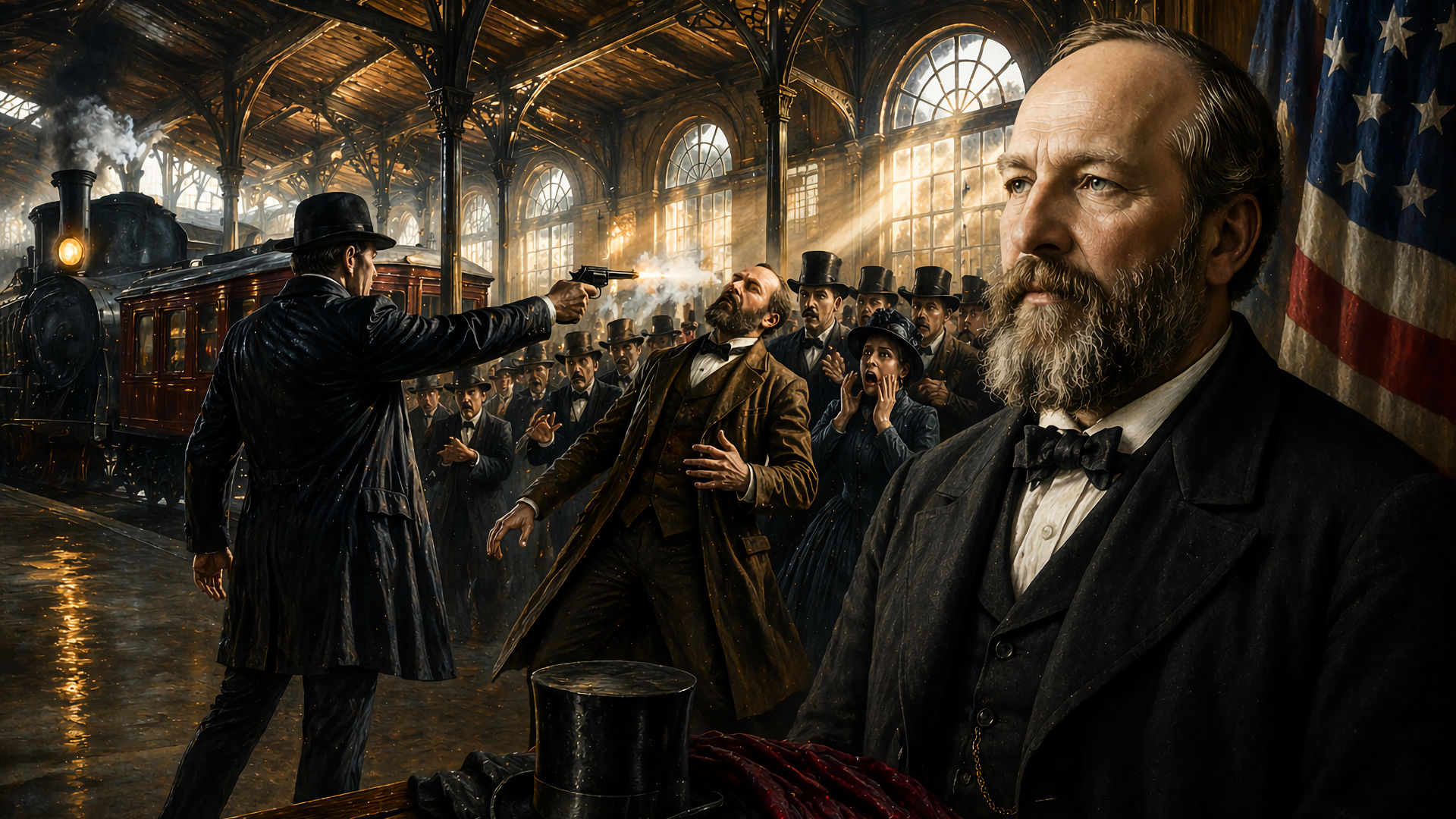
The Assassination of James A. Garfield
James Abram Garfield was born on 19 November 1831 in Orange Township, Ohio, into circumstances that gave little hint he would one day become President of the United States. His father died when James was still a baby, leaving his mother, Eliza, to raise the family in difficult financial conditions. Garfield grew up knowing hard work from an early age. He chopped wood, worked on farms, and briefly laboured on the Ohio canals, where he imagined a more adventurous life than the one he had known in rural poverty. Yet for all the physical work that shaped his childhood, it was his sharp mind that would become his true route out of hardship.
Education changed everything for Garfield. He attended the Western Reserve Eclectic Institute, later known as Hiram College, where he excelled as a student and eventually joined the faculty. From there, he continued his studies at Williams College in Massachusetts, graduating in 1856. He was widely admired for his intelligence, his powerful memory, and his skill as an orator. Garfield did not come from a wealthy or politically connected family, but he possessed the kind of disciplined ambition that could carry a man far in nineteenth-century America. Before entering national politics, he worked as a teacher, college president, minister, and lawyer, building a reputation as a serious, capable, and thoughtful public figure.
When the United States descended into civil war, Garfield threw himself into the Union cause. He helped raise troops for Ohio and served with distinction in the Union Army, eventually becoming a major general. His military career was not the longest of the war, but it strengthened his public standing and gave him credibility at a time when military service carried enormous political weight. During the war, he was elected to Congress, though he remained in uniform for a time before taking his seat in the House of Representatives. There he would remain for nearly two decades, becoming one of the Republican Party’s more respected figures. Garfield was known as an able legislator, a gifted speaker, and a man who could engage seriously with complex issues, from finance to education to Reconstruction.
Even so, Garfield was not the obvious choice for the presidency in 1880. The Republican Party was deeply divided, and the leading candidates at the convention were Ulysses S. Grant, James G. Blaine, and John Sherman. Garfield attended the convention in support of Sherman, not as an active candidate for himself. But after ballot after ballot failed to produce a winner, delegates began looking for a compromise. Garfield emerged as the man who could bridge the party’s warring factions, and on the thirty-sixth ballot, he secured the nomination. It was one of the more dramatic convention turnarounds in American political history.
He went on to win the election, though by a relatively narrow margin, and entered office in March 1881. Garfield brought with him both intelligence and independence. He was not a placeholder, and he was not merely a party compromise occupying the office until someone stronger came along. He had ideas of his own, and he intended to govern as President rather than as a servant of party bosses. That determination would matter far more than anyone realised. Garfield had climbed from poverty to the presidency through force of will and intellect, but he was stepping into an office surrounded by fierce political resentment. The story of his murder cannot be understood without first understanding the world he had entered.
A Divided Party and a Dangerous Political Climate
By the time Garfield became President, American politics had developed a deeply unhealthy dependence on patronage. Government jobs were not always treated as positions to be filled by the most capable candidates. Instead, many were distributed as rewards for loyalty, campaign work, or factional support. This was known as the spoils system, and by 1881, it had become one of the most toxic features of national political life. The Republican Party, Garfield’s own party, was sharply divided over how far that system should continue. On one side stood the Stalwarts, who defended patronage and machine politics. On the other were reformers, who wanted a more professional and merit-based civil service.
Garfield was not a radical reformer in every sense, but he was determined not to surrender presidential authority to the party machine. That quickly brought him into conflict with powerful men, especially New York senator Roscoe Conkling, a leading Stalwart. One of the major flashpoints involved the appointment of William H. Robertson to the influential position of Collector of the Port of New York. To most ordinary people, that might sound like an administrative matter of modest interest. In the political world of the time, it was dynamite. The New York Custom House was a centre of patronage, jobs, and money, and Conkling expected to control it or at least heavily influence who did.
Garfield refused to bow to that pressure. He pushed Robertson’s nomination through despite opposition from Conkling and his allies. The dispute escalated dramatically when Conkling and fellow New York senator Thomas Platt resigned from the Senate, apparently expecting to be triumphantly re-elected by the state legislature. Instead, the move backfired and weakened their position. Garfield’s willingness to stand his ground suggested that his presidency, though only just underway, might reshape the balance of power within his party. It also deepened the atmosphere of grievance and fury around the White House.
That was the wider political setting in which Charles Julius Guiteau emerged as a threat. Guiteau was not a major politician, not a respected activist, and certainly not a serious diplomat waiting unfairly for his due. He was a failed lawyer, failed preacher, failed lecturer, and drifter who had convinced himself he had played a meaningful role in Garfield’s election victory. During the 1880 campaign, he had written a speech in support of the Republican ticket, first for Grant and later revised for Garfield after the nomination changed. In Guiteau’s mind, this made him a political contributor of real importance. In reality, his role had been negligible.
Guiteau came to believe that he deserved a government appointment, preferably a consulship in Paris. He haunted offices, demanded interviews, and presented his claims with a mixture of self-pity, persistence, and complete detachment from how absurd he sounded. His requests were ignored or rejected, as they would have been for almost anyone with so little to recommend him. But the political culture around him had already normalised the idea that campaign support should be rewarded with office. In a less corrupt system, Guiteau might still have been unstable, but he might not have found such a clear structure for his grievance. He was a dangerous man in a dangerous political environment.
As the weeks passed, Guiteau’s disappointment curdled into rage. He convinced himself not only that Garfield had wronged him, but that the President’s death would actually benefit the country. In his fantasy, Garfield’s removal would unite the Republican Party behind Vice President Chester A. Arthur. The logic was deranged, but it drew energy from the bitter factional struggle already raging inside the party. By the summer of 1881, Guiteau no longer saw himself as a rejected office seeker. He saw himself as the man chosen to solve a political problem with a gun.
Charles Guiteau: Delusion, Resentment, and Obsession
Charles Julius Guiteau was born in 1841 in Freeport, Illinois, and much of his life before the assassination seemed to follow a single miserable pattern. He would enter a field with grand confidence, fail, blame others, and then reinvent himself for another attempt. He studied law but struggled badly in practice. He tried preaching and public speaking, but lacked the discipline and credibility to build any real following. He spent time with the Oneida Community, the utopian religious group in New York, but fell out with them as well. Wherever he went, he seemed to bring the same blend of vanity, instability, and self-delusion. He imagined himself important long before anyone else had seen the slightest evidence of it.
People who knew Guiteau often found him odd, self-absorbed, and erratic. He could be persuasive in short bursts, particularly when speaking about his own supposed talents, but the impression rarely lasted. He was unreliable, often in debt, and prone to behaviour that made others uneasy. Over time, the gap between his view of himself and the reality of his life became immense. He did not merely think he deserved success. He thought success was being unfairly withheld from him by people too blind or too corrupt to recognise his greatness.
During the 1880 presidential campaign, Guiteau seized on an opportunity to attach himself to Republican politics. He wrote a speech called Grant against Hancock, supporting Ulysses S. Grant against Democratic candidate Winfield Scott Hancock. When Garfield secured the Republican nomination instead, Guiteau simply adapted the speech into Garfield against Hancock. He had some copies printed and circulated them, convincing himself that he had materially helped elect Garfield to the presidency. There was little evidence that the speech had any significant influence at all, but for Guiteau it became the foundation of a fantasy in which he had rendered a major political service.
Once Garfield entered office, Guiteau began pressing for a reward. He wanted an appointment as consul in Paris, and later entertained the possibility of Vienna. He repeatedly visited government buildings, sought out officials, and insisted that his claim be recognised. These efforts produced nothing but irritation and dismissal. Yet each rebuff made him more certain that an injustice had been done. He lacked the capacity, or perhaps the willingness, to see himself as others saw him. Instead of concluding that he was unqualified, he concluded that Garfield’s administration was betraying him.
What followed was a collapse into homicidal obsession. Guiteau began to frame Garfield’s removal as both politically necessary and divinely sanctioned. He imagined himself acting in the service of God and the Republican Party. He convinced himself that Chester A. Arthur would make a better president and that the party would be healed if Garfield were out of the way. Those ideas were not grounded in reality, but they were enough for a man already living in a private world of grievance and grandiosity.
He purchased a revolver and selected one with an ivory handle because he thought it would look impressive after the assassination, perhaps even in a museum. It was the sort of detail that would sound like dark satire if it were not entirely real. He then began following Garfield’s movements through newspaper reports, seeking the right opportunity. At one point, he considered shooting the President at church, but decided against it because Garfield would be accompanied by his wife. That moment is sometimes presented as a sign of lingering conscience. It is better understood as evidence of method. Guiteau was not wavering. He was planning.
By early July, he knew the President was preparing to travel. Garfield was due to leave Washington by train, and the information was public. In an age before organised presidential security, the station would offer easy access and plenty of confusion. Guiteau now had a weapon, a fantasy of purpose, and a setting in which he believed he could make history. He had failed in everything else. In his own mind, he was about to succeed at last.
The Shooting at the Baltimore and Potomac Railroad Station
On the morning of 2 July 1881, President Garfield arrived at the Baltimore and Potomac Railroad Station in Washington, D.C., to begin a summer journey that was meant to combine public duty with much-needed rest. He planned to travel first to Williams College, where he was due to speak, and then continue on to join his family for a holiday. With him that morning were two of his sons, James and Harry, along with Secretary of State James G. Blaine. Secretary of War Robert Todd Lincoln was also present to see the President off. It was an ordinary official departure by the standards of the day, and that was precisely the problem. There was no modern security cordon, no armed protective detail, and no assumption that a president was walking into serious danger.
Charles Guiteau had made use of the public nature of Garfield’s schedule and was waiting at the station. Guiteau concealed himself near the ladies’ waiting room and at the opportune moment, stepped forward from behind the President and fired two shots. The first grazed Garfield’s arm. The second struck him in the back and lodged deep inside his body. Garfield cried out and collapsed. The scene was one of instant shock. Moments before, the station had been full of the usual movement and noise of rail travel. Suddenly, it became the site of a national emergency.
Blaine rushed to Garfield’s side in horror. Lincoln, whose own father had been murdered sixteen years earlier, found himself once again close to a presidential assassination. Witnesses struggled to understand what had happened. Guiteau, meanwhile, was quickly seized. He did not run far, and he did not appear especially interested in disappearing. He had prepared himself not as a fugitive, but as a man who expected his act to be recognised. As he was taken into custody, he reportedly declared, “I am a Stalwart of the Stalwarts. Arthur is President now.” With those words, he tied his crime, at least in the public imagination, to the Republican factional battles already consuming Washington.
Garfield was initially carried upstairs within the station and then transported back to the White House on a mattress. The immediate question was whether the wound was survivable. At first, there was reason to hope. The President was still conscious and had not died at once, as Abraham Lincoln had after being shot in 1865. Yet from the earliest moments, the medical response was flawed. Doctors began probing the wound with unsterilised fingers and instruments in an effort to find the bullet. Their intentions were serious, but their methods were perilous.
Outside the White House, news spread with astonishing speed through the telegraph network. Across the country, Americans waited anxiously for updates. Garfield had been President for only a few months, but the attack stunned the nation. There was fear, outrage, and confusion. Was this the act of one unstable man, or the beginning of something larger? Was the President likely to recover, or had the country already entered another constitutional crisis? For the moment, no one knew.
The shooting itself was over in seconds, but the real ordeal had only just begun. Garfield was alive, wounded, and in pain. Guiteau was under arrest and eager to explain himself. The nation held its breath. What followed was not a swift death or a quick resolution, but a long and tragic decline that would become one of the most haunting chapters in presidential history.
Eighty Days of Suffering: Garfield’s Fight for Survival
Germ theory was gaining acceptance in parts of the medical world by 1881, but antiseptic practices were still unevenly applied in the United States. Garfield became the victim not only of an assassin’s bullet, but of a medical culture that had not yet fully caught up with scientific reality, resulting in doctors repeatedly probing his wound in an effort to find the bullet without taking any measures to prevent infection.
The President endured an agonising summer. He suffered fever, weakness, and pain as doctors searched unsuccessfully for the bullet and attempted to manage his worsening condition. At the White House, special arrangements were made for his care. His bedroom became the centre of national attention, with bulletins issued regularly to an anxious public. Newspapers carried every report, and people across the country followed his condition almost day by day. It was a strange and terrible spectacle. The President was neither dead nor recovering. He was trapped in a limbo of suffering, and the nation was trapped there with him.
At times, there were signs that seemed encouraging. Garfield remained mentally alert for much of the ordeal, and on better days, he was able to speak with those around him. But the improvement never lasted. Abscesses formed, infection spread, and his body steadily weakened. One of the more famous episodes of the summer involved Alexander Graham Bell, who tried to use an early metal detector to locate the bullet. The effort failed, partly because the device was limited and partly because Garfield had been placed on a bed with metal springs that interfered with the reading. It was an ingenious attempt, but it could not rescue a situation already made grim by weeks of damaging treatment.
As Washington’s summer heat became oppressive, doctors decided to move Garfield to the New Jersey shore in the hope that sea air and a quieter environment might aid his recovery. In September, he was transported to Elberon, New Jersey, on a specially arranged train. For a while, the move inspired fresh optimism. But by then, Garfield had been weakened too severely. The wound itself had done grave harm, but the infections and complications had done even more.
On 19 September 1881, after seventy-nine days of suffering, James A. Garfield died. He was forty-nine years old. The immediate cause of death was recorded as internal bleeding, but the broader truth was impossible to ignore. Garfield had lingered for weeks because the bullet had not destroyed a vital organ at once. Many later medical historians concluded that with cleaner treatment and more modern care, he might well have survived. That judgment has haunted the story ever since.
Garfield’s death struck the country with immense force. Americans had watched him decline in public, and the long wait had made the final loss feel all the heavier. His presidency had lasted only a matter of months, yet his death overshadowed everything else. He became, in the public memory, both a murdered president and a symbol of needless suffering. The crime that had begun at a Washington railway station now moved into its final phase. The country had buried its President. It still had to judge his killer.
Death, Trial, and the Legacy of a Presidential Assassination
After Garfield’s death, the focus turned to Charles Guiteau and the question of responsibility. There was little doubt that he had fired the shots. The real issue was whether he would be judged legally sane enough to hang. His trial began in late 1881 and quickly became one of the most extraordinary courtroom spectacles of the era. Guiteau behaved chaotically throughout the proceedings. He interrupted lawyers, insulted the court, argued with witnesses, and delivered rambling statements in his own defence. He insisted that he had acted under divine inspiration and claimed that Garfield’s doctors, not he, were the true cause of death.
There was a grim irony in that defence. In one sense, Guiteau had identified a painful truth. Garfield’s medical care had almost certainly worsened his chances of survival. But that did not absolve the man who had shot him. The prosecution argued that Guiteau had carefully planned the crime, obtained the weapon, stalked the President, and carried out the attack with full intent to kill. His behaviour after the shooting also suggested not confusion, but self-importance. He expected history to notice him, and it did, though not in the way he imagined.
The insanity issue dominated much of the trial. Guiteau was clearly unstable, and many observers saw him as delusional. Yet the legal standard was not simply whether he was strange or mentally unwell. It was whether he understood the nature of his act and whether he knew it was wrong. The jury concluded that he did. He was found guilty of murder and sentenced to death. On 30 June 1882, almost a year after Garfield was shot, Charles Guiteau was hanged in Washington, D.C.
Garfield’s assassination left a larger legacy than Guiteau’s execution. It intensified public disgust with the spoils system and strengthened the cause of civil service reform. Garfield himself had already shown signs that he intended to resist the old patronage order. After his death, the pressure for change became much harder to resist. In 1883, Chester A. Arthur, the vice president who had succeeded Garfield, signed the Pendleton Civil Service Reform Act into law. The Act did not transform the entire system overnight, but it marked a crucial step towards a professional civil service in which at least some positions would be awarded by merit rather than political favour.
That was one of history’s harsher ironies. Garfield, whose murder had been shaped by the toxic culture of patronage, ended up helping to break that culture through his death. He is often remembered primarily as the second assassinated American President, but that risks reducing his life to its ending. Garfield was more than a victim. He was a self-made man of considerable intellect, a Civil War general, a long-serving congressman, and a president who showed signs of real independence. His time in office was brief, but it was not empty.
The tragedy of James A. Garfield lies not only in the violence of the act, but in the sense of possibility cut short. He had only just begun his presidency when Guiteau’s bullets changed the course of it forever. America lost a president, but it also lost the chance to see what Garfield might have become in office. What remains is a story of ambition, madness, political corruption, medical failure, and reform born out of catastrophe. It is one of the darkest episodes in American political history, and one of the most revealing.
The Assassination of James A. Garfield FAQ
James A. Garfield was assassinated by Charles J. Guiteau, a disgruntled office seeker who believed he deserved a government post for supposed support during Garfield’s election campaign.
Garfield was shot on 2 July 1881 at the Baltimore and Potomac Railroad Station in Washington, D.C.
No, he survived the shooting at first and lived for 79 days before dying on 19 September 1881 after a long and painful decline.
The assassination exposed the dangers of the patronage system and helped build support for civil service reform, leading to the Pendleton Civil Service Reform Act of 1883.
Guiteau showed clear signs of serious mental instability and delusional thinking, but he was still found guilty of murder and executed in 1882.