Richard Feynman
Richard Phillips Feynman was born in New York City on 11 May 1918, but the landscape that shaped his childhood was Far Rockaway, Queens. It was not the obvious birthplace of one of the twentieth century’s most recognisable scientific minds, but Feynman was never especially interested in obvious things. From an early age, he showed the kind of curiosity that does not sit politely in a chair and wait to be taught. It pokes things, takes them apart, asks awkward questions, and occasionally leaves a small pile of screws on the table with no clear route back to civilisation.
His father, Melville, encouraged him to look beyond names and labels. Knowing the name of a bird, he taught Richard, was not the same thing as understanding how it lived, moved, ate, or behaved. That distinction stayed with Feynman throughout his life. He would later become famous not only for doing difficult physics, but for stripping away empty language and asking what was really happening underneath. It was a habit that began long before university, in ordinary childhood conversations where facts were less important than the ability to think clearly about them.
Feynman’s mother, Lucille, contributed something equally important, humour. The future physicist did not grow into a cold, calculating machine, even if he could calculate circles around most people before breakfast. He developed a lively, teasing wit, a taste for performance, and a lifelong suspicion of pomposity, and so Feynman’s science was never separate from his personality. He did not merely want to know things. He wanted to experience the thrill of finding them out.
At school, he showed a gift for mathematics and problem-solving, but he was not simply a model pupil marching obediently through the curriculum. He preferred to find his own routes. He repaired radios as a teenager, not just by swapping parts, but by thinking through what the circuit was doing. In one famous pattern of behaviour that would follow him forever, he treated confusion not as a wall but as an invitation. Where other people saw a broken machine, Feynman saw a puzzle. Where other people heard jargon, he listened for the actual mechanism hiding underneath.
By the time he left Far Rockaway, the essential Feynman was already visible. He was clever, restless, funny, technically gifted, and allergic to pretence. He had not yet entered the great institutions of science. Still, he had already learned the skill that would carry him through them, the ability to ask simple questions about complicated things until the complication began to surrender.
Mathematics, Mischief, and the Making of a Physicist
Feynman attended the Massachusetts Institute of Technology as an undergraduate, where his childhood talent for mathematics became something sharper and more disciplined. MIT gave him access to serious physics, serious mathematics, and serious minds, though Feynman’s relationship with seriousness was always slightly suspicious. He loved precision, but not stiffness. He loved hard problems, but not grand academic theatre. If science was going to be difficult, he seemed to believe it could at least have the decency to be interesting.
At MIT, Feynman began moving from gifted student to original thinker. He absorbed the techniques of theoretical physics, but he also developed a style that was unmistakably his own. He liked visualising problems. He liked finding direct routes through mathematical thickets. He did not respect a method simply because it looked impressive. This became one of his great strengths. In a field where equations can become forests, Feynman was unusually good at finding the path that let him see the animals moving between the trees.
He then went to Princeton University for his PhD, entering one of the most intellectually intense environments in American science. There he worked with John Archibald Wheeler, one of the major figures in twentieth-century physics. Princeton brought Feynman into contact with the highest levels of theoretical work, but it also revealed something distinctive about him. He was not just another brilliant student trying to impress famous professors. He had a stubborn instinct for independent thought, and an unusual willingness to trust his own way of seeing a problem.
At the same time, his personal life was becoming deeply serious. Feynman had fallen in love with Arline Greenbaum, whom he had known from his youth. Their relationship became central to his early adulthood, but it was shadowed by illness. Arline was suffering from tuberculosis, a frightening and often fatal disease at the time. Feynman married her in 1942 despite the risks, the uncertainty, and the practical objections that surrounded them. It was a decision that showed another side of him; beneath the jokes and intellectual fireworks was a capacity for loyalty that could be quiet, stubborn, and profound.
This period formed Feynman in two directions at once. Professionally, he was becoming a physicist of rare originality. Personally, he was learning how fragile life could be, even while his scientific world was expanding. It is tempting to imagine great scientists as people who live mostly in equations, but Feynman’s early life was never that neat. Love, illness, ambition, fear, and discovery were all happening together. By the time war interrupted the normal path of his career, he was already more than a promising physicist. He was a young man being pulled into history.
Princeton, Arline, and the Shadow of War
The early 1940s forced Feynman’s private and scientific lives into a new and unsettling shape. He completed his PhD at Princeton, but the world outside the university was changing faster than any academic career plan could sensibly handle. The Second World War had turned physics into something urgent, secretive, and morally dangerous. Discoveries that might once have belonged to journals, seminars, and blackboards were now tied to military fear, national survival, and the possibility of weapons unlike anything humanity had used before.
Feynman was drawn into the Manhattan Project while still a young man. According to his own later account, he was approached at Princeton by Robert Wilson, who told him about secret work connected with separating uranium isotopes. Feynman initially resisted, then thought about the possibility of Nazi Germany developing an atomic bomb first. Within a short time, hesitation gave way to action. The pattern was pure Feynman, a quick moral and practical calculation, followed by total intellectual engagement. Once the problem became real to him, he could not leave it alone.
His marriage to Arline continued under painful circumstances. She was ill, and Feynman’s work was increasingly demanding. When he moved west to Los Alamos, she was cared for in a sanatorium in New Mexico, close enough for visits but never truly close enough for the life they might have imagined. Their relationship has often been remembered because of its tenderness, especially through the letter Feynman wrote to her after her death. Yet even without romanticising it, the facts are moving enough. He was helping build a weapon of terrifying power while the person he loved most was dying nearby.
At Los Alamos, Feynman was not one of the grand elder statesmen of the project. He was young, energetic, and, as he later put it, not yet famous. That position gave him an unusual view of the work. He saw the project not only from the level of theory and strategy, but from the daily practical world of calculations, equipment, security rules, and urgent problem-solving. He became known for his technical skill, but also for his irreverent behaviour, including a fascination with exposing weaknesses in safes and security procedures. This was not merely clowning around, although there was certainly some of that. It reflected his instinct that systems should be tested, not trusted because someone important said they were safe.
Arline died in 1945. The war also ended that year, after the atomic bombings of Hiroshima and Nagasaki. Feynman emerged from this period changed. He had contributed to one of the largest scientific and military projects in history, but he had also experienced grief at close range. Both forces would shape the next phase of his life, the excitement of physics and the burden of knowing that knowledge is never innocent simply because it is clever.
Los Alamos and the Moral Weight of the Atomic Age
After the war, Feynman had to rebuild a life in an ordinary academic setting, if such a thing can be said to exist for someone like him. He joined Cornell University as a professor of theoretical physics, carrying with him the exhaustion of Los Alamos and the grief of Arline’s death. This was not an easy period. For a time, he felt drained and uncertain, as if the machinery of his own mind had been overworked. The war had demanded speed, secrecy, and practical results. Peace required a different rhythm, and Feynman had to rediscover the pleasure of physics for its own sake.
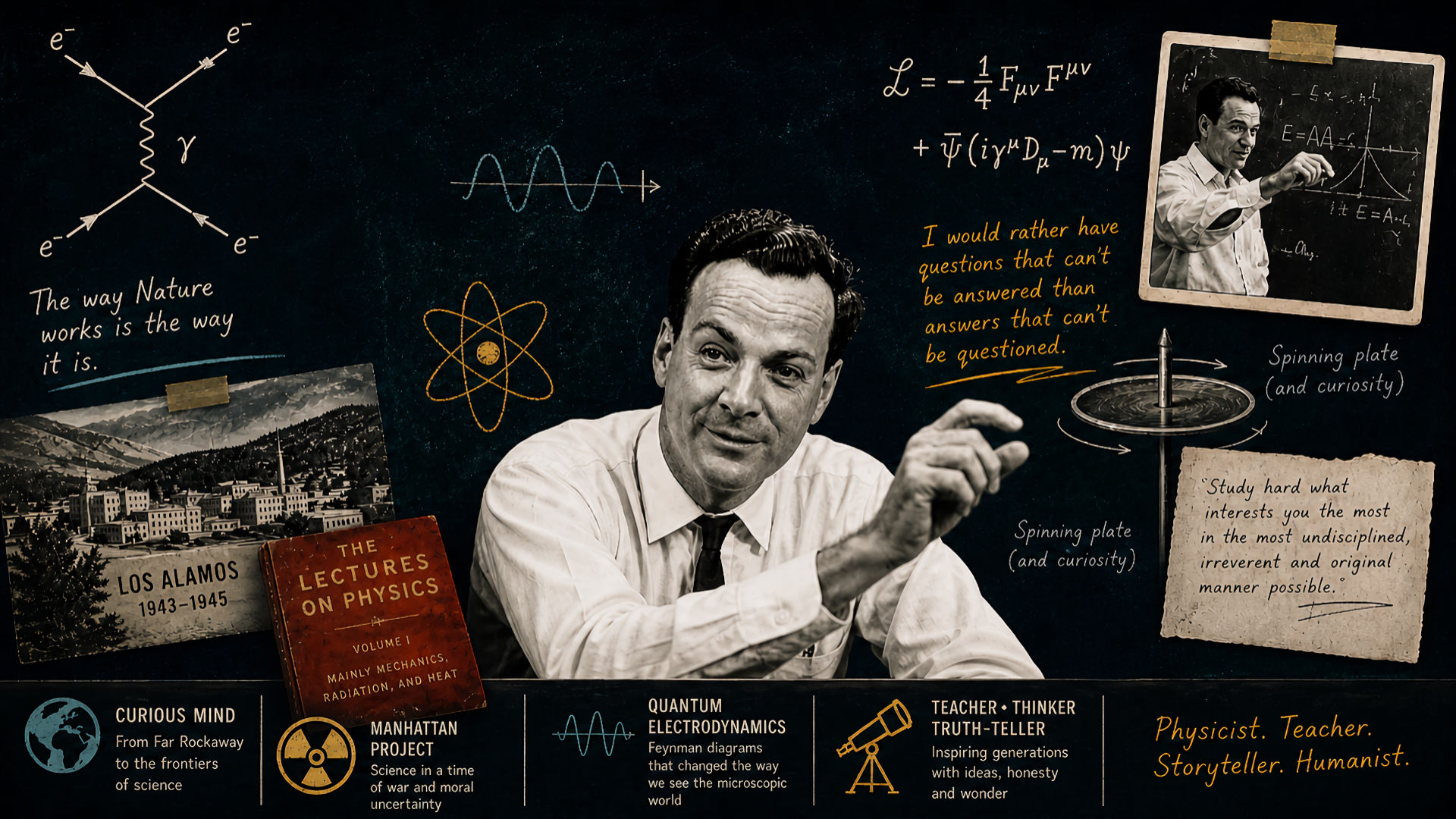
One of the stories often told about this period involves a plate spinning in the Cornell cafeteria. Feynman watched it wobble and began thinking about the relationship between its spin and its motion. The problem was playful, almost trivial, certainly not the sort of grand research programme that committees put into expensive folders. Yet it helped lead him back towards serious work, as Feynman’s genius often worked through play. He did not always begin with a formal objective. Sometimes he began with curiosity, followed it honestly, and found that it opened a door into deep physics.
The atomic age also left him with a complicated public position. Feynman was not a simple moral preacher about the bomb, nor was he careless about what had been made. He belonged to the generation of scientists who had helped create nuclear weapons because they feared what might happen if Nazi Germany got there first. After 1945, that justification no longer removed the unease. The bomb existed. The world had seen what it could do. Scientists could no longer pretend that their work floated above politics, war, or human consequence.
In 1950, Feynman moved to the California Institute of Technology, better known as Caltech, where he would spend the rest of his career. Caltech suited him. It gave him room to think, teach, argue, calculate, and perform. He became not only a major researcher but a presence, the sort of figure students remembered even when they did not understand every equation. That was no small achievement, because some of the equations were, scientifically speaking, absolute beasts with teeth.
His later personal life also began to take shape. After a brief, unsuccessful marriage to Mary Louise Bell, he married Gweneth Howarth in 1960. They had two children, Carl and Michelle. This domestic chapter did not turn Feynman into a conventional figure, because conventionality had taken one look at him and wisely left by the side door. Yet it did give his life a new structure, one that ran alongside his growing fame as one of the most original physicists of the modern era.
Quantum Electrodynamics, Feynman Diagrams, and the Nobel Prize
Feynman’s greatest scientific fame came through his work on quantum electrodynamics, usually shortened to QED. At its heart, QED deals with the interaction between light and matter, particularly the behaviour of electrons and photons. This was one of the central problems of twentieth-century physics. Quantum mechanics and relativity had transformed science, but bringing them together in a workable theory of electromagnetic interaction was extraordinarily difficult. The mathematics kept producing infinities, which meant the theory was not yet properly under control, even though it seemed to be pointing in the right direction.
Feynman approached the problem in his own characteristic way. While other physicists used highly formal mathematical methods, he developed a visual approach that represented particle interactions as diagrams. These became known as Feynman diagrams. They were not cartoons in place of equations, though they have sometimes been mistaken for that by hopeful students clutching highlighters and optimism. They were powerful tools that allowed physicists to organise calculations, represent possible interactions, and work out probabilities in a clearer and more manageable form.
The brilliance of Feynman diagrams was that they made an almost impossibly abstract world easier to handle without making it simplistic. They showed electrons, photons, and other particles interacting through lines and vertices, turning complex mathematical terms into visual structures. This changed how many physicists thought and worked. Feynman had found a way to make the invisible grammar of subatomic behaviour something that could be drawn, followed, and calculated. It was one of those rare scientific inventions that was both conceptually deep and practically useful.
Feynman was not alone in solving QED. Julian Schwinger and Sin-Itiro Tomonaga independently developed their own approaches to the same broad problem. In 1965, the three men shared the Nobel Prize in Physics for their fundamental work in quantum electrodynamics. Feynman was affiliated with Caltech at the time of the award, and his Nobel recognition placed him firmly among the great physicists of the twentieth century.
Yet the Nobel Prize did not turn him into a remote scientific monument. If anything, it made the contrast sharper. Feynman could operate at the highest level of theoretical physics, but he also enjoyed explaining, joking, playing the bongo drums, learning, performing, and refusing to act like a solemn statue of genius. His fame grew not only because of what he discovered, but because of how he embodied discovery. He made science look alive. He made thinking look like an adventure rather than a punishment invented by exam boards.
At Caltech, his influence widened through teaching as well as research. The lectures he gave in the early 1960s became The Feynman Lectures on Physics, one of the most famous physics texts ever produced. They were not easy in the ordinary sense, but they were vivid, ambitious, and full of intellectual energy. Feynman did not merely tell students what physics knew. He tried to show them how a physicist sees.
The Teacher, the Challenger Investigation, and the Feynman Legacy
By the later decades of his life, Feynman had become more than a Nobel Prize-winning physicist. He was a public symbol of scientific curiosity, scepticism, and intellectual independence. Books based on his stories, lectures, and conversations helped create the popular image of Feynman as a wisecracking genius who opened safes, played drums, challenged authority, and explained physics with a grin. Like most public images, it was partly true and partly polished by repetition. The real Feynman was more complicated, but the appeal was understandable. He made intelligence seem energetic rather than dusty.
His teaching became central to his legacy. The Feynman Lectures on Physics grew out of lectures delivered at Caltech in the early 1960s and became famous far beyond the students who first heard them. They did not make physics easy, because Feynman respected the subject too much to pretend that it was easy. Instead, they made physics feel worth the effort. They moved from basic principles to profound ideas with a sense of wonder that still reaches readers. Many people who never became physicists nevertheless encountered Feynman as the person who made them feel that the universe was not merely large and strange, but intelligible if approached with enough honesty and nerve.
In 1986, Feynman returned to national attention as a member of the commission investigating the Space Shuttle Challenger disaster. Challenger broke apart shortly after launch on 28 January 1986, killing all seven crew members. Feynman became one of the commission’s most memorable figures because he insisted on cutting through institutional language and asking what had physically gone wrong. In a televised demonstration, he showed how the rubber O-ring material used in the shuttle’s solid rocket boosters became less resilient in cold conditions. The point was simple, visual, and devastating. Nature, once again, was not impressed by management optimism.
His appendix to the Rogers Commission report was especially blunt about the gap between engineering reality and organisational confidence. He warned against treating previous lucky outcomes as proof of safety, arguing that erosion and blow-by in the O-rings were warnings, not reassuring evidence that the system was working. It was the mature form of the same habit he had shown since childhood, do not accept the label, inspect the mechanism. Do not trust the official sentence; ask what is actually happening.
Feynman died in Los Angeles on 15 February 1988 after a long illness. He left behind major contributions to physics, but also a broader cultural legacy. His name became shorthand for curiosity with teeth, for the kind of intelligence that refuses to bow before reputation, bureaucracy, or impressive nonsense. His life stretched from homemade radio repairs in Queens to the Manhattan Project, from Nobel-winning theory to public truth-telling after Challenger. Richard Feynman did not simply explain the world. He showed why finding out how it works can be one of the great joys of being alive.
Richard Feynman FAQ
Richard Feynman was an American theoretical physicist best known for his work on quantum electrodynamics, or QED. He shared the 1965 Nobel Prize in Physics and became famous not only for his scientific brilliance, but also for his teaching, humour, curiosity, and direct way of explaining difficult ideas.
Feynman diagrams are visual tools used in particle physics to represent interactions between particles, such as electrons and photons. They helped physicists organise complex calculations in quantum electrodynamics and became one of Feynman’s most famous contributions to modern physics.
During the Second World War, Richard Feynman worked on the Manhattan Project at Los Alamos, the secret American-led programme that developed the first atomic bombs. He was still a young physicist at the time and later reflected on the scientific excitement and moral weight of that period.
Richard Feynman served on the commission investigating the 1986 Space Shuttle Challenger disaster. He became widely known for demonstrating how cold temperatures affected the rubber O-rings used in the shuttle’s solid rocket boosters, helping show a key technical cause of the disaster.
Richard Feynman is remembered for his scientific achievements, especially in quantum electrodynamics, but also for his remarkable ability to teach, question assumptions, and communicate the joy of discovery. His books, lectures, and public appearances helped make him one of the most recognisable scientists of the modern age.