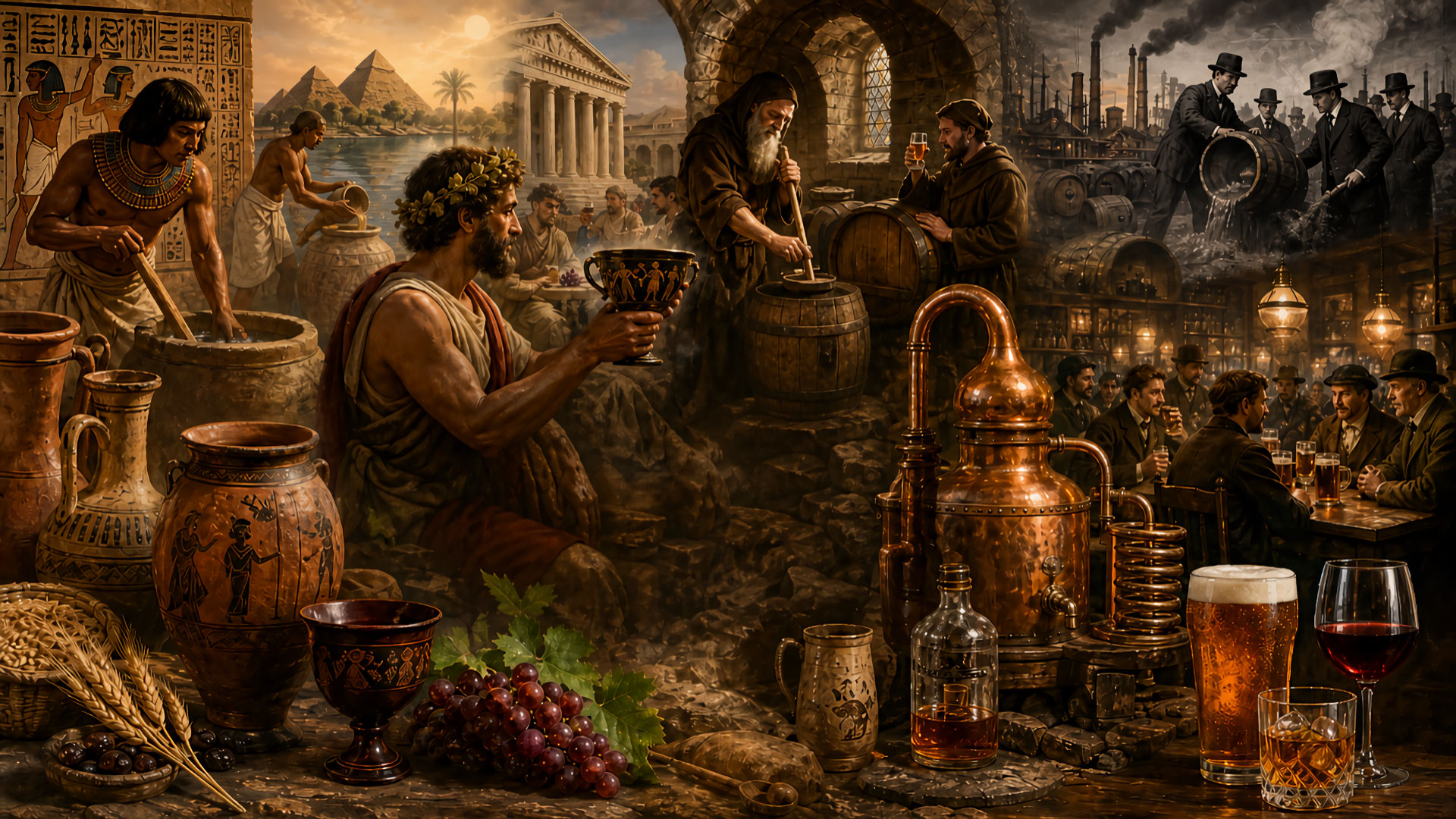
The History of Alcohol
The history of alcohol begins long before breweries, vineyards, taverns, pubs, or anyone loudly insisting they are “fine” while trying to unlock the wrong front door. It begins with something very simple: sugar, water, yeast, and time. Long before humans understood chemistry, wild yeasts naturally settled on fruits, grains, honey, and tree sap, turning sugars into alcohol through fermentation. Early humans almost certainly encountered alcohol by accident, perhaps in overripe fruit, fermented honey, or stored plant material that had begun to change. The discovery was not made in one place by one clever prehistoric genius wearing a lab coat made of mammoth hide. It happened gradually, wherever people noticed that certain foods and liquids could become strangely warming, mood-altering, and occasionally regrettable.
Archaeological evidence suggests that fermented drinks were being made thousands of years before written records. At Jiahu in China, residues found in pottery vessels dating to around 7000 BCE show traces of a fermented mixture made from rice, honey, hawthorn fruit, and grapes. In the Caucasus region, especially in what is now Georgia, evidence of early winemaking dates to around 6000 BCE. These discoveries show that alcohol was not a late luxury added to human society once everyone had spare time and fancy cups. It was part of the earliest experiments in settled life, food storage, agriculture, and ritual.
Alcohol mattered because fermentation made certain liquids safer, longer-lasting, and more useful. In a world without modern refrigeration, pasteurisation, or water treatment, fermented drinks could be stored, transported, and shared. That does not mean ancient alcohol was always strong, or that everyone spent prehistory blundering about like a badly organised stag weekend. Many early fermented drinks were probably low in alcohol compared with modern spirits. Even so, they had cultural power. They could mark gatherings, honour the dead, accompany feasts, and perhaps help communities bind themselves together.
So alcohol use in the past was never just about one thing. It was nourishment, medicine, ritual object, pleasure, social tool, and hazard all at once. From the very beginning, it sat in that awkward human space between usefulness and excess. It could bring people together, but it could also cause problems, which is roughly alcohol’s job description for the next nine thousand years. As humans moved from scattered communities into settled farming societies, fermented drink moved with them. The next step was the city, where beer and wine became not just occasional discoveries, but organised products of civilisation.
Beer, Wine, and the Birth of Cities
Once farming took hold, alcohol became more predictable, more abundant, and far more deeply woven into daily life. Grain made beer possible on a larger scale, while vines and fruit trees allowed communities to produce wine and other fermented drinks. In ancient Mesopotamia, beer was a familiar part of the diet, economy, and religious imagination. It appears in administrative records, myths, and ration lists, showing that it was not merely a weekend treat. Workers could be paid in beer, gods could be offered beer, and people could drink beer through long straws from shared vessels, which proves that even the ancient world had group activities that looked faintly ridiculous.
In ancient Egypt, beer was equally important. It was consumed by labourers, priests, officials, and households across society. Egyptian beer was often thick, nutritious, and made from grain, making it closer to liquid food than the clear modern pint many people imagine. Wine also had a place in Egyptian life, especially among elites and in ritual contexts, but beer was the everyday staple. Tomb paintings, offering lists, and archaeological remains show how central brewing was to Egyptian culture. It could be practical, sacred, and social at the same time.
In Greece and Rome, wine became especially prominent. The Greeks associated wine with hospitality, conversation, poetry, religion, and the god Dionysus, whose portfolio included ecstasy, theatre, fertility, and the kind of social energy that makes neighbours nervous. Drinking wine was often governed by custom, especially at the symposium, where elite men gathered to talk, debate, perform, and drink wine diluted with water. Drinking undiluted wine was often viewed as uncivilised or excessive. The Romans adopted and adapted many Greek drinking customs, making wine a major part of domestic, military, religious, and commercial life across their empire.
Alcohol helped build connections between the countryside and the city. Farmers grew grain and grapes, producers made beer and wine, merchants moved goods, and governments taxed or regulated supply. In many ancient societies, alcohol was tied to labour, class, worship, gender roles, and status. The type of drink, the vessel used, the setting, and the manner of consumption all carried meaning. A cup of wine or beer could tell you who someone was, what they could afford, what gods they honoured, and where they fitted in the social order.
By the time cities, kingdoms, and empires had emerged, alcohol had become a civilised product in both senses of the word. It was shaped by civilisation, and it helped shape civilisation in return. Yet the more important it became, the more people worried about it. Ancient societies enjoyed alcohol, celebrated it, and organised life around it, but they also knew it could unsettle discipline, judgement, and public order. That tension would only grow as alcohol became more deeply embedded in religion, morality, law, and community life.
Sacred Drink, Social Glue, and Moral Worry
Alcohol has always had a remarkable ability to appear at important human moments. It has been used to seal agreements, bless ceremonies, welcome guests, honour ancestors, celebrate harvests, mark marriages, and mourn the dead. In many cultures, sharing a drink was not just a casual pleasure. It was a way of recognising bonds between people, families, communities, and the divine. To offer someone a drink could be an act of hospitality, trust, and peace. To refuse one, depending on the setting, could be socially complicated.
Religion gave alcohol some of its most powerful meanings. Wine became central to ancient Mediterranean worship, from Greek festivals of Dionysus to Roman ritual life. In Judaism, wine was used in blessings and sacred observances, including the Sabbath and Passover. In Christianity, wine became deeply symbolic through the Eucharist, representing the blood of Christ and linking ordinary material substance with spiritual meaning. Other traditions took different approaches. Islam, which emerged in the seventh century, prohibited intoxicants, and Islamic legal and moral thought treated alcohol as a danger to discipline, clarity, and social order. Across the world, religious attitudes ranged from sacred use to strict rejection.
This variety shows that alcohol was never universally understood in the same way. In some societies, it was a blessed substance. In others, it was tolerated but controlled. In others still, it was feared as a source of moral failure, violence, or disorder. Even where drinking was accepted, drunkenness was often criticised. Ancient Greek writers warned against excess. Roman moralists complained about luxury and loss of self-control. Biblical texts contain both positive references to wine and warnings about drunkenness. Alcohol was admired, used, and enjoyed, but rarely treated as harmless.
The social role of drinking also changed depending on class, gender, age, and power. Public drinking could reinforce hierarchy, since some people had access to better wine, finer cups, and more prestigious drinking spaces. Taverns and drinking houses created places where travellers, labourers, merchants, soldiers, and locals could mix. These settings could be lively and useful, but they also attracted suspicion from authorities. Where people gathered, talked freely, gambled, argued, or sang badly at volume, rulers and moral reformers tended to develop concerns.
By the medieval period, alcohol was part of everyday European life, monastic production, trade, medicine, and hospitality. Monasteries brewed beer and made wine, partly for religious use, partly for guests, and partly because monks were human beings with excellent organisational skills. Alehouses, inns, and taverns spread through towns and villages, creating social hubs long before the modern pub. At the same time, complaints about drunkenness, disorder, and waste remained constant. Alcohol had become one of humanity’s most successful social technologies, but also one of its most persistent moral headaches. Then a new technique appeared, one that changed the strength, value, and danger of drink: distillation.
Distillation and the Rise of Strong Spirits
Fermented drinks such as beer, wine, cider, and mead depend on yeast, and yeast has limits. Once alcohol levels rise too high, the yeast struggles to survive, which keeps most naturally fermented drinks relatively moderate in strength. Distillation changed that. By heating a fermented liquid and collecting the vapour that condensed from it, producers could concentrate alcohol into a much stronger form. The basic principles of distillation were known in the ancient world, but the technique developed significantly through Arabic, Persian, and later European scientific and medical traditions. At first, distilled alcohol was often associated with medicine, alchemy, perfume, and experimentation rather than casual drinking.
In medieval Europe, distilled spirits were sometimes called aqua vitae, meaning “water of life”. That name sounds wonderfully dramatic, as if someone had discovered immortality in a bottle, although the practical results were usually less eternal and more wobbly. Distilled alcohol was used in medicine, both as a supposed remedy and as a carrier for herbal preparations. Over time, however, people noticed that it could also be consumed for pleasure, warmth, courage, or escape. Brandy developed from distilled wine. Whisky emerged from grain-based traditions in Ireland and Scotland. Vodka became associated with Eastern Europe and Russia. Gin evolved from medicinal juniper spirits into a widely consumed drink.
The arrival of strong spirits changed drinking culture because they were potent, compact, and commercially valuable. Spirits could be transported more easily than bulky beer or fragile wine, and they lasted longer. They could be taxed, traded, smuggled, prescribed, gifted, and abused with impressive efficiency. Their strength also altered the risks of drinking. A person might become intoxicated far more quickly with spirits than with small beer or diluted wine. This made them attractive, profitable, and alarming in equal measure.
In early modern Europe, spirits became entangled with urban life, trade, military culture, and state revenue. Governments saw a taxable opportunity. Traders saw profit. Consumers saw affordable intoxication. In eighteenth-century Britain, gin became infamous during the so-called Gin Craze, especially in London, where cheap spirits were blamed for poverty, crime, neglect, and moral collapse. The panic was not always fair, since it often targeted the poor more harshly than elite drinkers, but it did reveal genuine anxiety about powerful alcohol in crowded cities.
Distillation also helped turn alcohol into a global commodity. Spirits could be made from local crops, from grain to potatoes, grapes, sugarcane, or agave. Different regions developed distinctive drinks, each shaped by climate, agriculture, law, and culture. Alcohol was no longer only the fermented companion of ancient feasts and daily meals. It had become stronger, more portable, more profitable, and more politically significant. That made it perfectly suited to the next great force in its history: empire.
Empire, Industry, and the Age of Mass Drinking
From the sixteenth century onwards, alcohol became deeply tied to empire, colonial trade, slavery, and global commerce. European expansion connected drinks, crops, markets, and people across oceans, often through systems of brutal exploitation. Rum, in particular, became linked to the Atlantic world. Sugarcane plantations in the Caribbean produced molasses, which could be distilled into rum. That rum became part of trade networks connecting Europe, Africa, and the Americas. It was consumed by sailors, soldiers, settlers, enslaved people, and urban populations, while profits flowed through imperial economies built on violence and forced labour.
Alcohol also played a role in colonisation beyond commerce. European traders used alcohol in exchanges with Indigenous peoples in North America and elsewhere, sometimes with devastating social consequences. Colonial authorities often alternated between profiting from alcohol and condemning its effects. This double standard was not subtle. States, merchants, and settlers benefited from alcohol sales, then blamed communities for the disruption caused by the very trade they encouraged. In military and naval settings, alcohol could be part of official rationing. The British Royal Navy’s rum ration, later known as the daily tot, became famous before finally ending in 1970.
Industrialisation changed alcohol again. Brewing and distilling moved from small-scale, local, seasonal production towards larger commercial operations. Scientific advances improved consistency, while railways, canals, bottling, refrigeration, and later pasteurisation transformed distribution. The nineteenth century saw major growth in breweries, distilleries, public houses, saloons, and commercial brands. Alcohol became part of the industrial city: a comfort after exhausting labour, a marker of masculine sociability, a business opportunity, and a public-order problem. Where urban workers gathered, pubs and bars followed, often becoming centres of community life as well as targets of reform.
Mass production also created mass advertising. Alcohol brands developed identities, labels, slogans, and loyal customers. Beer, whisky, gin, rum, champagne, and fortified wines became tied to class, place, aspiration, and leisure. Some drinks became symbols of national identity, such as Scotch whisky, Irish stout, French wine, Russian vodka, Mexican tequila, and German lager. These associations were not ancient inevitabilities. They were built through agriculture, trade, technology, marketing, law, and storytelling.
At the same time, industrial alcohol intensified fears about poverty, domestic violence, crime, health, and lost wages. Temperance movements grew in Britain, the United States, Ireland, Scandinavia, and other regions, arguing that alcohol was not merely a personal weakness but a social danger. Some campaigners wanted moderation. Others demanded total abstinence. Women played a major role in many temperance campaigns, partly because alcohol-related poverty and violence often hit families hardest. By the late nineteenth and early twentieth centuries, alcohol had become a battleground between liberty and reform, pleasure and discipline, profit and public health. That battle would reach its most dramatic form in the age of prohibition.
Prohibition, Public Health, and the Modern Drinking Culture
The most famous attempt to control alcohol was Prohibition in the United States, introduced nationally in 1920 under the Eighteenth Amendment and enforced through the Volstead Act. It did not appear from nowhere. It grew from decades of temperance campaigning, religious activism, public-health concern, women’s organising, anti-saloon politics, and wartime arguments about grain, discipline, and patriotism. Prohibition aimed to reduce crime, poverty, family breakdown, and moral disorder by banning the manufacture, sale, and transport of intoxicating liquor. In practice, it created one of history’s most spectacular lessons in the difference between passing a law and changing human appetite.
Prohibition did reduce legal alcohol consumption, at least at first, but it also encouraged illegal production, smuggling, speakeasies, corruption, and organised crime. Figures such as Al Capone became symbols of the era, although the wider story involved countless smaller bootleggers, bar owners, corrupt officials, and ordinary drinkers who decided the government could kindly mind its own business. The policy became increasingly unpopular during the Great Depression, when legal alcohol promised jobs and tax revenue. In 1933, the Twenty-first Amendment repealed national Prohibition. The episode did not end debates about alcohol, but it changed them. Total bans looked politically risky, while regulation, taxation, licensing, and public-health messaging became more common tools.
Other countries had their own experiences. Finland introduced Prohibition in 1919 and repealed it in 1932. Canada saw provincial and local forms of prohibition. Russia, Iceland, Norway, and other nations experimented with restrictions at different times. These efforts varied widely, but they all showed the same basic tension. Alcohol could cause immense harm, yet banning it outright often produced black markets and public resistance. Modern states increasingly tried to manage drinking rather than eliminate it.
In the twentieth and twenty-first centuries, alcohol became a global consumer industry. Advertising associated drinks with sophistication, sport, romance, rebellion, tradition, and relaxation. Meanwhile, medical research made the costs clearer, including liver disease, addiction, cancers, accidents, violence, foetal harm, and mental health effects. Public-health campaigns began to focus on units of alcohol, drink-driving laws, minimum ages, warning labels, licensing hours, and responsible drinking. The tone changed from sin and morality to risk and harm, although moral judgment never entirely left the room.
Modern drinking culture is full of contradictions. Craft breweries, natural wines, premium spirits, cocktail culture, and alcohol-free alternatives all exist alongside binge drinking, addiction treatment, and debates about pricing and advertising. Some people drink for taste, ritual, relaxation, or sociability. Others avoid alcohol for health, religion, recovery, cost, or simple preference. The rise of low-alcohol and no-alcohol drinks shows that the social role of drinking is changing again, even if the ancient appeal of the shared cup remains powerful.
The history of alcohol is therefore not simply the history of getting drunk, although humanity has certainly put in the hours. It is a history of farming, cities, religion, medicine, empire, industry, law, pleasure, and harm. Alcohol has built communities and damaged them, raised revenue and ruined households, inspired poetry and caused appalling karaoke. From fermented fruit to global brands, it has followed humans almost everywhere, reflecting both our creativity and our inability to leave well enough alone.
The History of Alcohol FAQ
Humans were making fermented drinks thousands of years before written history. Archaeological evidence from ancient sites shows that early drinks were made from ingredients such as rice, honey, fruit, grapes, and grains.
Alcohol was important because it could be used as food, medicine, ritual offering, payment, trade product, and social drink. Beer and wine were especially important in ancient societies such as Mesopotamia, Egypt, Greece, and Rome.
Distillation made it possible to create much stronger alcoholic drinks, including brandy, whisky, vodka, gin, rum, and other spirits. This made alcohol easier to transport, trade, tax, and consume in more concentrated forms.
Prohibition was a legal attempt to ban the manufacture, sale, and transport of alcohol. The most famous example was in the United States from 1920 to 1933, where the ban encouraged illegal drinking, bootlegging, speakeasies, and organised crime.
Alcohol remains controversial because it has both social and harmful effects. It is associated with celebration, tradition, and leisure, but also with addiction, illness, accidents, violence, and wider public health concerns.