
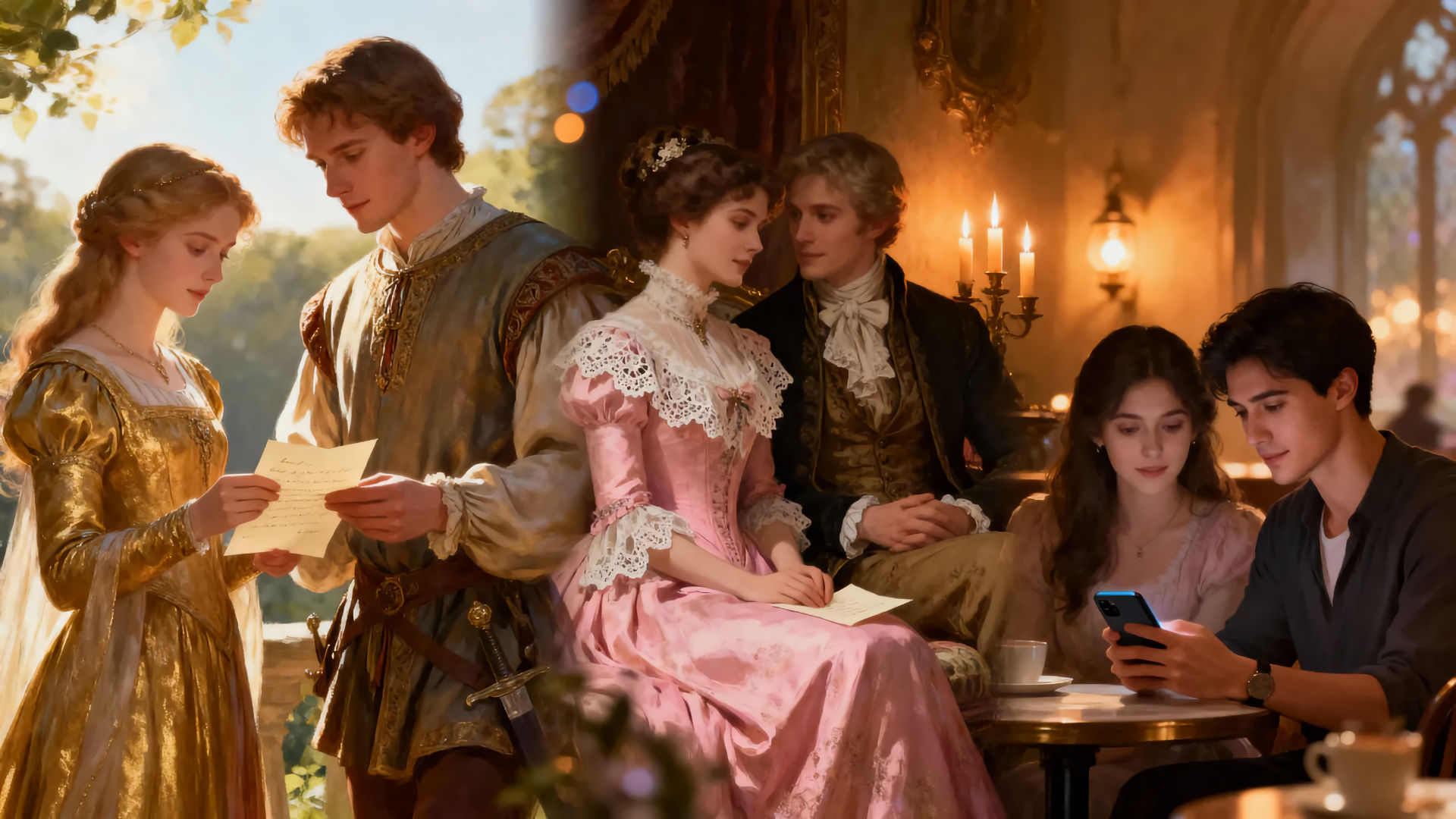
The History of Romance
Long before roses and heart emojis, romance was embedded in the myths, rituals, and power structures of ancient civilisations. In the ancient world, love was rarely viewed as a private affair. It was a tool of the gods, a mechanism for social order, and, in many cases, a strategic alliance rather than an emotional bond. And yet, even in these early societies, the seeds of what we now call “romance” had already been sown.
In ancient Mesopotamia, one of the earliest known love poems, written over 4,000 years ago, was composed for a Sumerian king. The poem, inscribed on a clay tablet, is an intimate expression from a bride to her groom, suggesting that even in structured royal marriages, there was room for affection and desire. Similarly, in ancient Egypt, personal letters and poetry reveal tender emotional exchanges between lovers. Married couples were often depicted holding hands or embracing in tomb art, hinting at the value placed on emotional companionship.
The Greeks and Romans took a more philosophical and, at times, chaotic approach to love. For the Greeks, love could be divine or destructive. The philosopher Plato famously explored various kinds of love in The Symposium, introducing concepts like eros (passionate desire) and agape (selfless love). Greek mythology was filled with romantic entanglements, from the tragic tale of Orpheus and Eurydice to the playful escapades of gods like Eros and Aphrodite. In contrast, Roman society placed a stronger emphasis on marriage as a civic duty, often more about property and lineage than passion. That didn’t stop the Romans from indulging in romantic poetry, think of Ovid’s Ars Amatoria, a tongue-in-cheek guide to seduction in ancient Rome.
Across the globe, in ancient China, Confucian values shaped romantic expression, prioritising family loyalty and social harmony. But love was far from absent. Classical Chinese poetry, particularly during the Tang Dynasty, is rich with longing and devotion. Meanwhile, Indian traditions embraced a spiritual dimension to love. The Kama Sutra, often misunderstood in the West, wasn’t merely a manual of physical intimacy, it was part of a broader discourse on love, pleasure, and emotional connection.
In essence, ancient civilisations didn’t romanticise romance the way modern cultures do, but they recognised its power, both as a force of nature and a cultural cornerstone. Through myth, marriage customs, and early literature, the foundations of romantic expression were laid, setting the stage for centuries of evolution to come.
Chivalry and Courtly Love in the Medieval Era
If the ancient world sowed the seeds of romance, the medieval period wrapped them in armour and set them to verse. The concept of romantic love underwent a dramatic transformation during the Middle Ages, particularly in Europe, where the ideals of chivalry and courtly love introduced a new kind of passion, equal parts poetic, pious, and painfully unrequited.
At the heart of this transformation was the knight, not just a warrior but an emblem of honour, bravery, and virtue. Chivalric codes were developed not only to govern conduct on the battlefield but also to elevate the pursuit of love into something noble and selfless. A knight’s devotion to a lady was framed as a moral exercise, his suffering a badge of honour. The lady, often married or unattainable, became an object of adoration, and the act of longing itself became a romantic ideal.
This stylised form of love, known as courtly love, was essentially a product of aristocratic courts, especially in regions like Aquitaine and Provence in what is now France. There, troubadours and poets composed verses praising the beauty, grace, and unattainability of noblewomen. These poems were full of metaphor and allegory, presenting love as a kind of spiritual journey, something that elevated the soul even as it tormented the heart.
One of the most influential literary examples of courtly love was Chrétien de Troyes’ tales of King Arthur and the Knights of the Round Table. The romance between Lancelot and Guinevere embodied the tension between duty and desire, loyalty and passion. Their tragic love story became a blueprint for countless medieval romances to follow, reinforcing the idea that true love was often forbidden, fraught, and ultimately unfulfilled.
Despite its lofty ideals, courtly love had little to do with marriage. In fact, marriage in medieval Europe was essentially a contractual arrangement, designed to consolidate land, wealth, and alliances. Emotional compatibility was rarely a consideration. In this context, courtly love functioned almost like an escape, a parallel world of yearning and idealised affection that stood in stark contrast to the pragmatism of real-life unions.
It’s also important to note that while courtly love was highly influential in Europe, similar traditions of romantic verse and stylised devotion existed elsewhere. In Persian literature, for example, poets like Rumi and Hafez explored the mystic and metaphysical dimensions of love, blending the earthly with the divine in ways that echoed the spiritual aspirations of courtly romance.
The medieval era may have given us chainmail and crusades, but it also laid the groundwork for a particular kind of romance, one defined by longing, nobility, and emotional restraint. In a world governed by strict social hierarchies and religious doctrine, love became not just a feeling but a performance, and one that would echo down the centuries in poetry, art, and myth.
The Renaissance to the Enlightenment – Love Gets Literary and Logical
As Europe emerged from the shadows of the medieval period, the Renaissance brought with it a renewed fascination with the individual, the body, and the complexity of human emotion. Romance, once the domain of knights and poets in distant towers, began to take on new dimensions, more personal, more sensual, and more human.
The Renaissance, spanning roughly from the 14th to the 17th century, was a time of artistic explosion and intellectual reawakening. Love stories moved beyond allegory and became more rooted in the emotional and physical realities of everyday people. Shakespeare, for example, didn’t merely write about love; he dissected it, celebrated it, mocked it, and lamented it. In Romeo and Juliet, love is intense and poetic, but also impulsive and tragic. In Much Ado About Nothing, it’s witty, combative, and delightfully frustrating. These weren’t distant ideals; they were recognisable human behaviours.
This era also saw a growing emphasis on companionship and mutual affection as part of romantic and even marital relationships. While arranged marriages were still the norm among the elite, love matches were becoming more desirable, especially among the middle classes. Literature began to reflect this shift. Writers like Miguel de Cervantes, Edmund Spenser, and John Donne tackled themes of romantic longing, physical desire, and emotional compatibility with a complexity that hinted at changing social attitudes.
By the time the Enlightenment arrived in the 18th century, romance was being filtered through the lens of reason and individualism. Philosophers and thinkers like Jean-Jacques Rousseau and Mary Wollstonecraft began to question not just the nature of love but its role in personal freedom and societal structure. There was a growing belief that romantic love could, perhaps should, be the basis for marriage, a radical idea when compared to centuries of marital alliances dictated by economics and lineage.
This period also marked the rise of epistolary romances, love stories told through letters, which allowed for deeper emotional introspection. Novels like Samuel Richardson’s Pamela or Goethe’s The Sorrows of Young Werther captured the turbulence of romantic emotion in ways that resonated deeply with contemporary readers. These books portrayed love as a personal, psychological experience, and their popularity hinted at a cultural shift toward valuing emotion, even when it defied logic or social convention.
Still, Enlightenment thinkers often tried to rationalise romance. Love was increasingly framed as something that could be understood, categorised, and even improved upon. The age of feeling was giving way to the age of reason, but romance, stubborn and mysterious, continued to resist easy explanation.
In this transitional era, love was neither wholly spiritual nor entirely logical. It straddled the line between the poetic and the pragmatic, preparing the way for the emotional revolutions that would define the centuries to come.
The 19th Century – Romance, Repression, and Revolt
The 19th century was a paradoxical time for romance. On one hand, it was the golden age of sentimental love and idealised courtship, on the other, it was an era of tight-laced moral codes and societal expectations, particularly in Victorian Britain. The result? A cultural pressure cooker where passion simmered beneath the surface, and literature, art, and personal letters became the escape valve.
In the early part of the century, romantic love was elevated to near-sacred status. The Romantic movement in art and literature rebelled against the cold logic of the Enlightenment, placing emotion, imagination, and the sublime at the centre of human experience. Writers like Lord Byron, Percy Bysshe Shelley, and Emily Brontë infused their work with longing, melancholy, and a sense of the forbidden. The love portrayed in these works was often tragic, tempestuous, and deeply tied to nature, fate, and death, a sharp contrast to the era’s buttoned-up public persona.
But this romantic idealism often clashed with Victorian society’s rigid norms, particularly regarding gender roles and sexual propriety. Women were expected to be chaste, passive, and domestic, while men were supposed to be honourable providers and protectors. Love was encouraged, but only within the narrow confines of marriage, and marriage itself was still essentially a social contract, especially among the upper classes.
That didn’t stop people from yearning for more. Secret letters, long engagements, and stolen glances became the stuff of real-life romance as much as the novels that captivated the public. In fact, the 19th century witnessed a boom in romantic fiction, thanks in part to mass literacy and the rise of the printed novel. Jane Austen’s sharp, socially observant stories of courtship and class, and later, the Brontë sisters’ darker, stormier visions of love, set the template for countless romantic narratives to come.
At the same time, social revolutions were slowly reshaping romantic expectations. The industrial revolution brought more people into cities and workspaces, where social mobility and personal choice became more common. Courtship became more democratic and more public. Dance halls, train rides, and even department stores offered new opportunities for romantic interaction outside of chaperoned drawing rooms.
And while same-sex love remained taboo, and in some cases criminalised, it found expression in coded letters, poetry, and art. Figures like Oscar Wilde dared to push against the tide, even as they paid a steep personal price.
By the end of the century, cracks were forming in the old romantic order. Love was becoming something people not only dreamed of, but demanded. The seeds of modern romance had been planted, ready to blossom in the revolutionary decades ahead.
The 20th Century – Love in the Time of Change
The 20th century revolutionised romance. In just one hundred years, the concept of love was unshackled from centuries of tradition, redefined by war, reimagined by cinema, and reshaped by civil rights. From flapper girls and jazz-age passion to free love and dating apps, romance became a cultural battleground, and everyone had a stake in the outcome.
At the start of the century, romance still largely followed the Victorian blueprint. Courtship was formal, modesty was prized, and marriage was often a foregone conclusion. But the World Wars changed everything. With millions of men overseas, women entered the workforce, found independence, and discovered the bittersweet taste of long-distance love; and loss. Wartime letters overflowed with yearning, and fleeting romances sprang up between soldiers and civilians. The trauma of war made love feel urgent, even desperate. People clung to each other in foxholes and on dancefloors, never sure what tomorrow would bring.
In the 1920s and ’30s, love began to loosen its collar. The Roaring Twenties brought new freedoms, especially for women. Shorter skirts, jazz clubs, and the invention of the “dating scene” signalled a shift from chaperoned visits to more casual encounters. Love was becoming more personal, and more public. Courtship left the parlour and headed to the movies, where silver screen romances set hearts fluttering and established new cultural ideals of passion, heartbreak, and happily-ever-afters.
The mid-century decades saw a tug-of-war between conformity and rebellion. The 1950s sold a picture-perfect package of domestic bliss: suburban homes, white picket fences, and nuclear families. Love was expected to follow a clean, linear path: date, marry, settle down. But not everyone fit into that mould. Civil rights movements, feminism, and gay liberation fought back against rigid definitions of love, demanding space for new voices, identities, and desires.
Then came the 1960s and ’70s, and the sexual revolution exploded. With the invention of the contraceptive pill and changing social attitudes, love was no longer inseparable from marriage or reproduction. “Free love” became a rallying cry, and romance took on political dimensions. Love could be an act of defiance, a celebration of personal freedom, or just a good time.
As the century progressed, technology transformed romance again. The personal ad led to speed dating, which led to swiping right. The internet introduced new ways to meet, connect, ghost, and rekindle. Long-distance relationships became viable. Texting replaced love letters. Emojis replaced subtlety.
By 1999, romance had splintered into infinite forms, some fleeting, some deep, all valid. The 20th century didn’t just modernise love. It gave it new wings and, occasionally, a dial-up tone.
Romance in the 21st Century – Swipes, Screens, and Shifting Norms
As the 21st century dawned, romance took another dramatic turn, straight into cyberspace. Technology didn’t just tweak how people met and connected; it completely redefined the rules. In a world of apps, algorithms, and instant communication, love became more accessible and more complicated than ever before.
The biggest game-changer? Online dating. What once carried a slight stigma quickly became mainstream. Early platforms like Match.com and eHarmony gave way to swiping apps like Tinder, Bumble, and Hinge. Instead of being introduced at parties or meeting through mutual friends, people now met their partners by curating profiles, writing bios, and deciding someone’s romantic fate with a flick of the thumb. Dating went digital, and the buffet was endless.
This shift brought freedom and fatigue. On one hand, apps helped people connect across social circles, countries, and even languages. Long-distance relationships became more common and more manageable thanks to video calls, instant messaging, and social media. On the other hand, the paradox of choice began to weigh heavy. “Ghosting,” “breadcrumbing,” and “situationships” entered the romantic lexicon, describing the often confusing, ambiguous landscape of digital dating.
Social media also began to influence not just how people found love, but how they performed it. Platforms like Instagram and TikTok became stages for curated glimpses of couples’ lives, proposal videos, anniversary reels, #couplegoals. Romance was now public and performative. But with that came pressure to keep up appearances and a growing awareness of how online envy could affect real-life relationships.
Cultural norms around romance also continued to evolve. The rigid roles of the past, man pursues, woman waits, began to dissolve. Dating apps often offered women more control, such as Bumble’s women-first message model. More importantly, there was broader acceptance of diverse identities and relationship structures. Queer relationships, polyamory, and non-monogamy gained visibility and legitimacy, expanding the definition of what love could look like.
At the same time, mental health and emotional literacy became a larger part of the romantic conversation. People talked more openly about boundaries, attachment styles, red flags, and self-love. Therapy-speak entered everyday dating chatter, and personal growth became a priority before partnership. In this fast-moving, hyper-connected world, one thing remains clear: while the tools and trends keep changing, the desire to love and be loved hasn’t gone anywhere. Whether it’s through emojis or eye contact, dating apps or dinner dates, the heartbeat of romance still beats strong, even if it now comes with push notifications.
The History of Romance FAQ
It refers to how societies have understood love, relationships, and emotional connection across different historical periods.
No. For much of history, marriage was primarily economic or political, while romance often existed separately or was discouraged.
Courtly love was a medieval ideal that celebrated devotion, longing, and admiration, often outside marriage and expressed through poetry and literature.
This shift largely occurred in the eighteenth and nineteenth centuries, influenced by changing social values and literature.
Modern romance places greater emphasis on personal choice, emotional fulfilment, and equality, shaped by social movements and cultural change.


