The Disappearance of Flight 19
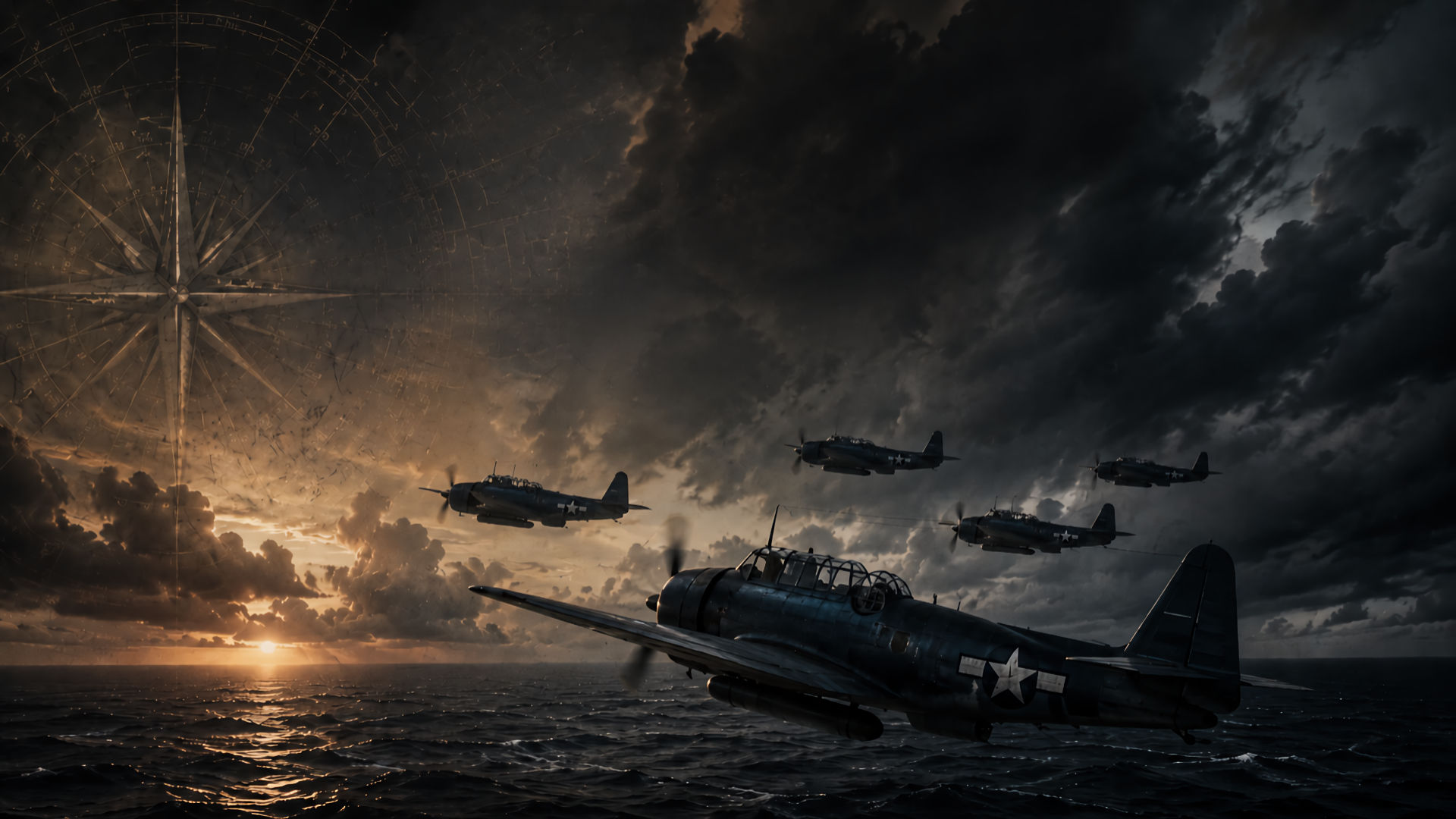
On the afternoon of 5 December 1945, five United States Navy TBM Avenger torpedo bombers took off from Naval Air Station Fort Lauderdale in Florida. The war had ended only months earlier, but the Navy was still training pilots for the demanding business of overwater navigation, where a small error could become a large ocean very quickly. The mission was not supposed to be dangerous, glamorous, or historically memorable, which is usually when history starts clearing its throat in the corner.
The group became known as Flight 19, and it was led by Lieutenant Charles Carroll Taylor, an experienced pilot with thousands of flying hours and wartime service behind him. Under his command were thirteen other airmen, including trainees learning the routines of navigation, formation flying, and bombing practice. Their aircraft, the Avenger, was a big, sturdy torpedo bomber, designed for war in the Pacific and widely respected by its crews. It was not invincible, however, and like any aircraft of its era, it depended on fuel, instruments, weather, and human judgement all behaving themselves at roughly the same time.
The planned route was a standard exercise known as Navigation Problem No. 1. Flight 19 would head east from Florida, carry out bombing practice near the Hen and Chickens Shoals in the Bahamas, continue on a second leg, then turn again and return to Fort Lauderdale. On paper, it was a triangle-shaped training route, not yet the capital-T Triangle of legend. The weather at take-off was considered suitable, visibility was acceptable, and there was no immediate sign that the afternoon would end in one of aviation’s most enduring mysteries.
At first, everything appeared to go as expected. The aircraft reached the bombing area, dropped practice bombs, and continued with the exercise. Nothing in those early stages suggested panic or disaster. The men were flying over a region used regularly by naval aircraft, and the route was familiar enough to instructors and students alike. But familiar waters can be deceptive from the air. Once the coastline disappears, the ocean becomes a vast, repeating surface, where clouds, islands, reefs, and waves can confuse even seasoned pilots. Flight 19 began as a routine training mission. Within a few hours, it would become a story told and retold for generations.
The First Signs That Something Was Wrong
The first clear indication of trouble came after the bombing exercise had been completed. Radio messages began to suggest that at least one pilot in Flight 19 was uncertain about the group’s position. The words that have echoed through the story ever since were not dramatic in the theatrical sense. They were worse than that. They sounded practical, confused, and deeply human. Someone in the flight believed they had become lost after making a turn, and that simple admission changed the entire character of the day.
Lieutenant Taylor then reported that his compasses were not working properly and that he was trying to find Fort Lauderdale. He believed he might be over the Florida Keys, which would have placed the flight far to the south and west of where many later analysts think it actually was. That belief mattered enormously. Navigation depends not only on knowing which direction to fly, but on knowing where you are starting from. If Taylor thought he was over the Keys when he was really somewhere east of Florida, then a correction that seemed sensible could carry the aircraft farther out to sea.
Radio operators on the ground attempted to help. They asked the flight to switch frequencies, use emergency channels, and take actions that might allow stations to determine their position. The difficulty was that communication was patchy, the pilots were under increasing strain, and the flight leader’s confidence in his own location had begun to collapse. There were signs that some members of the formation may have disagreed with Taylor’s assessment. One of the most painful elements of the story is the suggestion that at least one pilot believed they should simply fly west, because west would eventually bring them back to Florida if they were still east of the coast.
That disagreement reveals the human tension inside the mystery. This was not a neat puzzle in which one wrong compass needle doomed everyone instantly. It was a developing crisis, with incomplete information, fading daylight, growing fuel concerns, and multiple aircraft trying to remain together. The pilots had to decide whether to trust their instruments, their leader, their instincts, or the uncertain instructions coming through the radio. In a cockpit, confusion is not abstract. It is noise, vibration, cloud, fuel gauges, compass readings, and the knowledge that every minute spent deciding is a minute spent flying somewhere.
Lost Bearings and Fading Confidence
As the afternoon wore on, Flight 19’s problem became less about a single navigational mistake and more about the compound effect of uncertainty. Taylor’s belief that the flight was near the Florida Keys appears to have shaped his decisions, but radio direction finding suggested the aircraft may have been north of the Bahamas and well out over the Atlantic. In that situation, flying east rather than west would have been catastrophic. It would have taken the aircraft away from land, deeper into open water, and closer to the point where fuel became the final and most unforgiving navigator.
The formation itself added another layer of difficulty. These were five aircraft, not one, and the trainees were expected to follow the flight leader. Breaking formation and making an independent dash for home would have been a serious decision, especially for inexperienced pilots in worsening conditions. Military training, hierarchy, and survival instinct were all pulling at the same knot. In hindsight, flying west seems obvious if the aircraft were east of Florida. In the moment, with uncertain instruments and a respected leader convinced of a different position, obvious may not have looked obvious at all.
Conditions deteriorated as evening approached. Weather that had seemed manageable earlier became more threatening, and the setting sun reduced visibility. The sea below would have turned darker, rougher, and harder to judge. For aircraft low on fuel, ditching in daylight was dangerous enough. Ditching at night in rough water, in heavy torpedo bombers not designed to float politely while everyone climbed out, was close to a death sentence. The Avengers were tough machines, but the Atlantic had no respect for them.
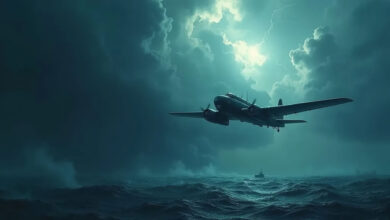
The last known messages from Flight 19 suggest the men understood how serious the situation had become. Taylor reportedly ordered the planes to close up tightly, with the implication that if one aircraft had to ditch, they would all go down together. That instruction is haunting because it carries both discipline and despair. It suggests a leader still trying to preserve order, even as options narrowed to almost nothing. By then, the aircraft had been airborne for hours, their fuel was running low, and the darkness was closing in. After the final transmissions faded, Flight 19 vanished from contact. No confirmed wreckage, bodies, or aircraft parts were recovered. Fourteen men had disappeared into an ocean large enough to hide almost anything.
The Search That Became Its Own Mystery
The Navy did not wait passively for Flight 19 to return. As the seriousness of the situation became clear, a search and rescue effort was launched. Ships were alerted, aircraft were dispatched, and the region off Florida and the Bahamas became the focus of an urgent operation. The working assumption was grim but practical. If the Avengers had run out of fuel, they may have ditched at sea, and survivors might be in life rafts, injured, cold, and very difficult to spot in the dark.
Among the aircraft sent out was a Martin PBM Mariner flying boat from Naval Air Station Banana River, on Florida’s east coast. The Mariner was designed for long-range patrol and rescue work, and it carried a crew of thirteen. Its role was to search the suspected area and help locate any sign of Flight 19. Yet within about twenty minutes of take-off, the rescue aircraft itself disappeared. It had sent a routine message shortly after departure, then contact was lost. In one terrible evening, the Navy was no longer searching for five missing aircraft. It was searching for six.
The likely fate of the Mariner is less mysterious than the fate of Flight 19, though no less tragic. Mariners had a reputation for fuel vapour problems, and the type was sometimes grimly nicknamed a flying gas tank. A ship in the area reported seeing a burst of flame and later passing through an oil slick, which strongly suggests the rescue aircraft exploded in mid-air. That explanation is plausible, but it did not remove the emotional force of the coincidence. A flight vanished, a rescue plane went after it, and then the rescuer vanished too. For anyone inclined to see patterns, the evening had supplied a very large spotlight and pointed it directly at the Atlantic.
The search that followed was extensive. Aircraft and vessels covered vast areas of ocean, including the Atlantic off Florida, the Bahamas, and surrounding waters. Crews looked for wreckage, oil, rafts, debris, signals, anything that might turn absence into evidence. But the sea gave back almost nothing. That lack of physical proof became the engine of the legend. Disasters with wreckage can be investigated, mapped, and filed. Disasters without wreckage become stories. Flight 19 had already been tragic. The failed search made it unforgettable.
Investigations, Theories, and the Bermuda Triangle Legend
The Navy investigation tried to turn confusion into an official explanation, but Flight 19 resisted neat closure. Early findings pointed towards navigational error, especially Taylor’s apparent misidentification of his position. If he believed he was over the Keys while actually east of Florida, then his decisions would make sense from inside the mistake while proving disastrous in reality. That is the cruel logic of navigation errors. The wrong assumption can become a prison, and every sensible decision made inside it can tighten the bars.
The official handling of Taylor’s responsibility later became controversial. His family objected to conclusions that placed blame on him, arguing that the evidence was incomplete and that instrument failure may have played a major role. The final classification of the cause became uncertain rather than a simple verdict of pilot error. That uncertainty is important. It does not mean that supernatural forces were involved, nor does it mean all explanations are equal. It means that the available evidence was too thin to support perfect certainty, which is exactly the sort of gap where legends live and grow.
The Bermuda Triangle legend grew much larger after Flight 19. The phrase itself did not become widely known until years later, and writers in the 1960s and 1970s helped transform a collection of maritime and aviation incidents into a supposed zone of mystery. Flight 19 was ideal material for that story. It had military aircraft, experienced personnel, strange radio messages, a failed rescue, missing wreckage, and just enough uncertainty to invite speculation. Aliens, Atlantis, magnetic anomalies, secret weapons, and stranger theories all eventually took their turn on the dance floor. Some brought evidence. Most brought speculation and conspiracy theories.
More grounded explanations focus on human error, instrument problems, radio confusion, worsening weather, fuel exhaustion, rough seas, and the difficulty of finding wreckage in a vast ocean. The Gulf Stream can move debris quickly, storms can scatter evidence, and aircraft that ditch badly may sink before rescuers arrive. The Bermuda Triangle is also a heavily travelled region, which means more ships and aircraft pass through it, giving statistics more opportunities to become spooky anecdotes. Flight 19 remains mysterious not because no natural explanation exists, but because the evidence needed to prove one conclusively, disappeared with the men and machines themselves.
What Flight 19 Still Leaves Behind
The disappearance of Flight 19 endures because it sits in the uncomfortable space between explanation and proof. The most plausible account is that the flight became lost, flew in the wrong direction, ran low on fuel, and ditched at sea in conditions that made survival unlikely. The rescue Mariner was probably lost in an explosion unrelated to any mysterious force, but tragically close enough in time and place to become part of the same legend. Taken together, the events form a story that feels almost designed to unsettle us. Five aircraft vanish, a sixth follows, and the ocean refuses to return the evidence.
Yet the real power of the story is not found in the wilder theories. It is found in the voices on the radio, the arguments over direction, and the slow realisation that trained men in powerful machines could still become helpless against distance, weather, darkness, and uncertainty. Flight 19 reminds us that technology does not abolish vulnerability. It merely changes the shape of it. The Avengers were impressive aircraft, Taylor was not a novice, and the Navy had procedures, stations, and search assets. Still, a chain of errors and conditions may have carried fourteen men beyond rescue, along with another 13 sent to save them.
The mystery also reveals how humans respond to absence. When wreckage is found, it anchors grief to something physical. When nothing is found, imagination rushes into the empty space. Families are left without graves, investigators without final evidence, and the public without the comfort of a clean ending. That is why Flight 19 became more than a military accident. It became a symbol of the unknown, a case where the lack of debris seemed louder than debris itself would have been. Today, the disappearance remains one of the most famous aviation mysteries of the twentieth century. It is often wrapped in Bermuda Triangle folklore, but it does not need sea monsters, portals, or underwater crystal pyramids to be compelling. The factual version is already haunting enough. A routine training flight left Florida in daylight and never came home. A rescue aircraft followed and was lost as well. The search found no confirmed trace of the Avengers, and the final answers sank somewhere beyond the reach of certainty. Flight 19 leaves behind a warning, a legend, and a silence over the Atlantic that still feels difficult to explain away completely.
The Disappearance of Flight 19 FAQ
Flight 19 was a group of five U.S. Navy TBM Avenger torpedo bombers that disappeared during a training flight from Naval Air Station Fort Lauderdale on 5 December 1945.
Fourteen airmen were aboard the five aircraft of Flight 19. A rescue aircraft later sent to search for them also disappeared with thirteen crew members aboard.
Yes. Flight 19 became one of the most famous stories associated with the Bermuda Triangle, although the Bermuda Triangle legend became widely popular years after the disappearance.
The most likely explanation is a combination of navigational confusion, worsening weather, fuel exhaustion, and the difficulty of surviving a forced landing at sea.
No confirmed wreckage from Flight 19 has been recovered. This absence of physical evidence is one reason the case remains so famous.