The Battle of Goose Green
By late May 1982, the Falklands War had moved from political shock and naval drama into the cold, muddy reality of a land campaign. Argentina had invaded the islands on 2 April, and Britain had sent a task force thousands of miles across the Atlantic to retake them. That journey alone was an extraordinary feat of logistics, but arrival did not mean victory. The Royal Navy had to fight its way into position, the Royal Air Force and Fleet Air Arm had to protect the force as best they could, and the ground troops still had to cross some of the most awkward terrain imaginable. East Falkland was not exactly designed for comfortable soldiering. It was wet, open, and windswept.
The British landings at San Carlos began on 21 May 1982. The area became known as “Bomb Alley” because Argentine aircraft repeatedly attacked British ships in and around San Carlos Water. The landings succeeded, but they came at a price. Several British ships were damaged or lost, and the loss of the Atlantic Conveyor was especially serious because it carried helicopters that would have helped move troops and equipment across the islands. That meant much of the campaign would now have to be fought on foot, with men carrying heavy loads over rough ground. It was not glamorous. It was not swift. It was warfare by boot leather and stubbornness.
Once the beachhead at San Carlos had been established, British commanders faced a difficult question. The main prize was Port Stanley, the capital, lying far to the east. The obvious thrust would be towards the high ground west of Stanley, where the final Argentine defensive line was expected. Yet before that advance could gather pace, there was a problem to the south. Argentine forces still held Darwin and Goose Green, two settlements on a narrow isthmus on East Falkland. They were not directly on the main route to Stanley, but they could not simply be ignored.
For the British, Goose Green became a test of momentum. The task force had endured heavy losses from air attack, and there was pressure to show that the land campaign was moving forward. For the soldiers, however, this was not about headlines. It was about closing with a defended enemy position in the dark, across open ground, with limited support and uncertain intelligence. The Battle of Goose Green would become the first major land battle of the Falklands War, and it would prove that the campaign on land would be no gentle march to Stanley.
Why Goose Green Had to Be Taken
At first glance, Goose Green looked like an odd target. It lay south of San Carlos, while Stanley lay to the east. A commander staring only at the map might have asked why British troops should spend precious time and lives attacking a settlement that was not directly blocking the main advance. But battles are rarely decided by tidy arrows on a map. Goose Green mattered because it sat on the Darwin and Goose Green isthmus, contained an airfield at nearby Condor, and housed a sizeable Argentine force that could threaten the British southern flank if left alone.
The Argentine garrison was based around elements of the 12th Infantry Regiment, reinforced by other units, including troops from the 25th Infantry Regiment and air defence personnel. Their commander, Lieutenant Colonel Ítalo Piaggi, had to defend a long, exposed area with troops of varying experience and preparation. Some were conscripts, but it would be a mistake to imagine that meant they would simply fold. Many fought hard, particularly around Darwin Hill and the defensive positions north of Goose Green. The British would soon discover that the Argentine defences were not just a token presence waiting to be politely collected.
There was also the matter of civilians. Falkland Islanders were being held in the community hall at Goose Green, and their presence added a human dimension to the operation. The British had come to retake the islands, not merely defeat Argentine troops in the abstract. Freeing civilians under occupation gave the attack a moral and political significance beyond its immediate tactical value. It also complicated the battle, because heavy firepower always becomes more complicated when non-combatants are nearby.
For Britain, Goose Green also carried symbolic weight. The landing at San Carlos had succeeded, but painful naval losses had followed it. A victory on land would show that the campaign had moved beyond survival and into offensive action. In London, commanders and politicians wanted evidence that the ground forces were not simply sitting inside the beachhead while ships burned offshore. On the ground, the calculation was colder and simpler. An Argentine force on the flank was a risk. An airfield in enemy hands was a problem. A settlement full of civilians under Argentine control could not be left indefinitely.
So Goose Green became more than a dot on the map. It became the place where the British Army would have to prove that it could take the initiative. The task fell to 2 Para, the 2nd Battalion, Parachute Regiment, under Lieutenant Colonel Herbert “H” Jones.
2 Para Moves South
On 26 May, 2 Para was ordered to move south from the San Carlos area and attack the Argentine positions around Darwin and Goose Green. The battalion was a tough, highly trained formation, but it was being asked to do a difficult job. It would have to advance across exposed ground, attack in darkness, overcome prepared positions, and do so with limited artillery and naval gunfire support. The attack began in the early hours of 28 May with limited naval and artillery support.
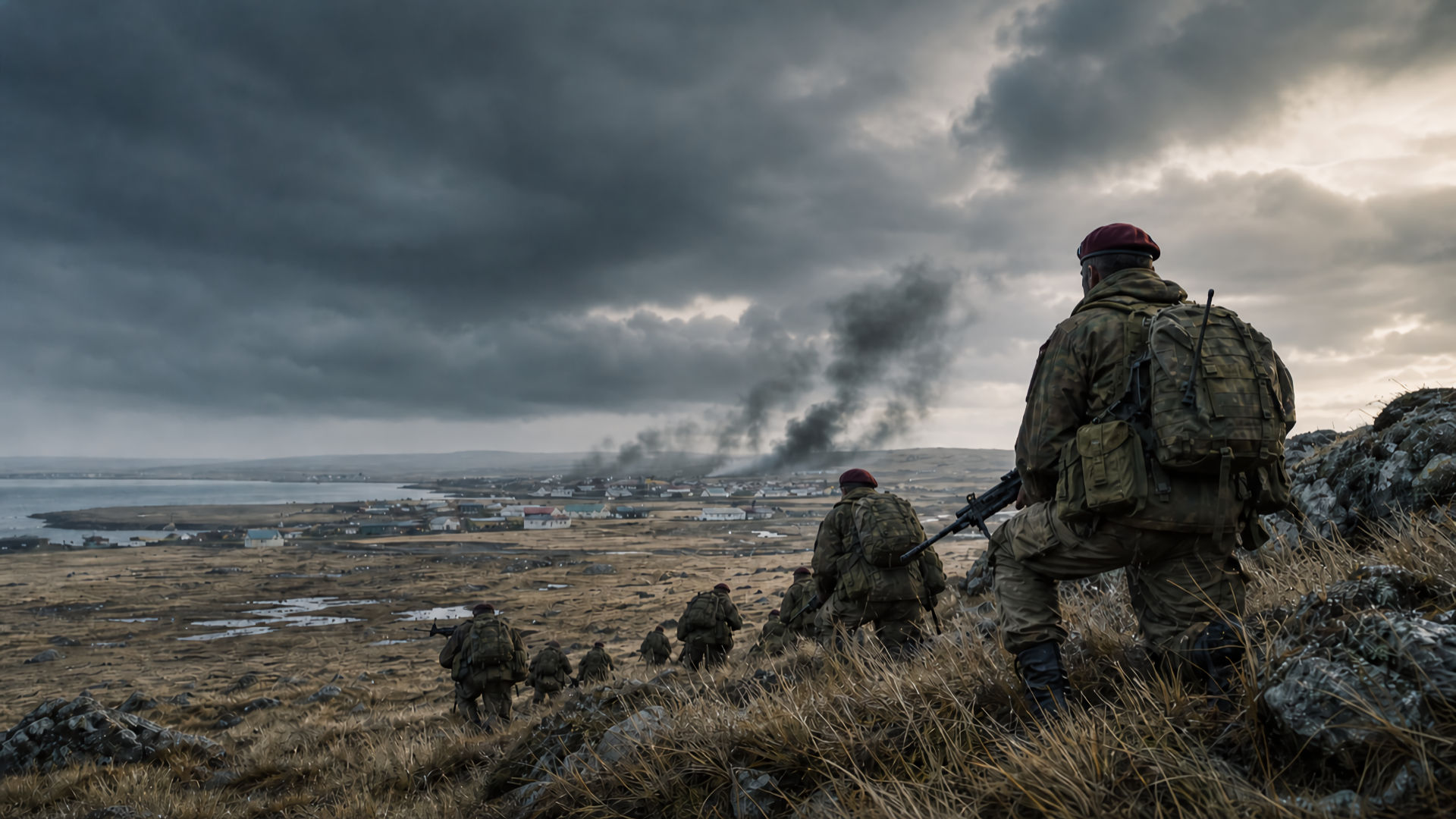
The plan involved a night attack, with the companies of 2 Para moving through successive objectives on the way towards Darwin, the airfield and Goose Green itself. The terrain was a major enemy in its own right. The Falklands offered little cover, and movement could be exhausting. The ground was often boggy, the weather harsh, and visibility poor. The paratroopers carried heavy loads, including weapons, ammunition and equipment, while trying to maintain direction in darkness. In theory, surprise and aggression would help them close the distance. In practice, night movement across unfamiliar ground has a way of turning even good plans into damp paperwork.
Lieutenant Colonel Jones was a forceful commander. He believed in speed, aggression and momentum, and he wanted his battalion to press forward hard. That spirit was part of 2 Para’s identity, but Goose Green would test whether aggression alone could overcome geography, enemy fire and the confusion of battle. The Argentine defenders were spread across a series of positions, some mutually supporting, and they had machine guns, mortars, artillery and anti-aircraft guns that could be used against ground targets. As dawn approached, British units became increasingly exposed.
The first stages of the attack made progress, but it was not the clean breakthrough hoped for. Argentine resistance stiffened around Darwin and the high ground that dominated the approaches. The battle became fragmented, noisy and dangerous, with companies trying to maintain momentum while coming under fire from positions that were hard to identify and harder to silence. Casualties began to mount. The simple order to take Goose Green now became a grinding fight through defended ground.
For 2 Para, this was the moment when the operation changed character. The move south had been demanding, but the real test came when the battalion hit determined resistance. The attack was no longer just about reaching Goose Green. It was about breaking through Darwin Hill.
Darwin Hill and the Death of H. Jones
Darwin Hill became the critical point of the battle. Argentine defenders held positions that allowed them to pour fire onto the advancing British troops. The ground gave them advantages, and the British attack began to slow. For an infantry commander, few situations are more dangerous than an assault losing momentum under fire. Men are pinned down. Communications become confused. Casualties create hesitation. Every minute gives the defenders more confidence. Jones saw the danger and decided that the attack had to be driven forward by personal example.
Jones moved forward during the fighting and attempted to lead an assault against an Argentine position. It was an act of conspicuous bravery, but also one that has been debated ever since. He was killed during the action, along with other men who were caught in the same deadly struggle around Darwin Hill. Jones was later awarded the Victoria Cross posthumously. The citation praised his courage and leadership in the face of a well-dug-in enemy, but the wider debate has never entirely disappeared. Was his action necessary? Was it inspirational? Was it too great a risk for a battalion commander? History, being history, refuses to sit quietly in the corner.
What is beyond dispute is that his death was a severe shock to 2 Para. Losing a commanding officer in the middle of battle can break the rhythm of an attack. It can create confusion at precisely the moment when clarity matters most. The battalion had already suffered casualties and was still facing determined opposition. For a brief period, the battle hung in a dangerous balance.
Command passed to Major Chris Keeble, the battalion’s second-in-command. His task was not simply to replace Jones, but to steady the battalion, reorganise the attack and continue the operation without allowing grief or confusion to stall the advance. That required a different kind of leadership. Jones had embodied fierce forward momentum. Keeble now had to restore control, coordinate the companies and make sure that the battalion’s effort did not dissolve into separate fights.
The fighting around Darwin Hill remained brutal. Argentine troops resisted with skill and courage in several positions, and the British had to push through them at close range. This was not a cinematic charge across open ground followed by a tidy victory. It was a hard, uneven battle in which local decisions mattered enormously. Junior officers, NCOs and ordinary soldiers carried much of the fight forward.
By the time Darwin Hill was finally overcome, 2 Para had paid heavily. The road to Goose Green was still not fully open, but the key defensive position had been cracked. The battalion could now press towards the airfield and settlement.
Chris Keeble, the Final Push, and Surrender
After Jones’s death, Major Chris Keeble brought a calmer and more methodical approach to the battle. That should not be mistaken for caution or softness. Keeble still had to defeat the Argentine garrison, but he understood that 2 Para needed coordination as much as aggression. The battalion had been fighting for hours, casualties had mounted, ammunition and fatigue were serious concerns, and the defenders were still capable of resistance. The next phase required pressure, but pressure applied with control.
British companies continued moving against the remaining Argentine positions around the airfield and towards Goose Green itself. The airfield at Condor was a significant objective, not least because Argentine aircraft had operated from the area. Anti-aircraft guns, designed for use against aircraft, could also be turned against troops on the ground, making them unpleasantly versatile. The paratroopers had to deal with strongpoints, open ground and the continuing risk of counterattack. Even after Darwin Hill had been taken, the battle was not finished.
As 28 May wore on, 2 Para gradually forced the Argentine defenders back. By last light, British troops had taken much of the ground around the isthmus, though Goose Green settlement itself remained to be fully secured. The situation for the Argentine garrison was deteriorating. They were under pressure, increasingly isolated, and facing an enemy that had not been stopped despite heavy resistance. Yet the presence of civilians and the possibility of further bloodshed made the final stage especially delicate.
Keeble opened surrender negotiations with Piaggi. This was one of the most important moments of the battle, because it prevented the fight from turning into a destructive final assault on the settlement. Keeble later described the surrender as being arranged on a sports field outside Goose Green, with the defenders allowed to lay down their arms with a degree of honour. That mattered. Soldiers who have fought hard do not need theatrical humiliation added to defeat. War is already quite full enough of stupidity without sprinkling extra nonsense on top.
On 29 May, the Argentine force surrendered. Hundreds of prisoners were taken, and the Falkland Islanders held in Goose Green were freed. For 2 Para, the victory had been won, but it had not come cheaply. The battalion had endured a long, exhausting battle against a larger force in difficult terrain. It had lost its commanding officer and many others. The final surrender brought relief, but not celebration in any simple sense. Goose Green was a victory, certainly, but it was the kind of victory that leaves mud on the boots and ghosts in the memory.
Victory, Cost, and the Road to Stanley
The Battle of Goose Green immediately changed the mood of the Falklands campaign. Britain had its first major land victory. Argentine forces south of the San Carlos beachhead had been neutralised. The civilians at Goose Green had been freed. The British could now look east with greater confidence, knowing that the beachhead was no longer threatened from that direction. The victory also had a powerful psychological effect. It showed that British troops could attack and defeat Argentine ground forces in prepared positions, even under difficult conditions.
The cost was severe. British losses are generally recorded as 18 killed and more than 60 wounded, while Argentine losses are commonly given as around 45 to 50 killed, with hundreds taken prisoner. 961 Argentine prisoners were reported, though it has been acknowledged that prisoner counts may not have been perfectly precise. Numbers matter, but they can also flatten reality. Each casualty was an individual life changed or ended. Each prisoner represented a soldier removed from the fight, but also a young man who had survived a battle he would remember for the rest of his life.
Goose Green also became one of the most discussed battles of the Falklands War. Some have argued that it was necessary to secure the flank and maintain momentum. Others have questioned whether the attack was strategically essential, given that the main route to Stanley lay elsewhere. Jones’s leadership has also remained the subject of debate, admired for courage yet examined for the risks he took. That is often the fate of famous battles. They become both memory and argument, with veterans, historians and armchair generals all circling the same ground. The armchair generals, it should be noted, usually have better heating.
What Goose Green undeniably did was restore initiative. After the battle, British forces continued the advance across East Falkland. The campaign would move towards the high ground around Stanley, where battles such as Mount Longdon, Two Sisters, Mount Harriet, Wireless Ridge and Mount Tumbledown would decide the final outcome. The road to Stanley was still hard, cold and dangerous, but Goose Green had shown that Argentine positions could be broken.
For 2 Para, Goose Green became central to the battalion’s history. It was a story of courage, loss, controversy and endurance. It included flawed decisions and remarkable bravery, confusion and control, aggression and negotiation. That is why the battle still fascinates. It was not neat. It was not simple. It was a battle fought by tired men in harsh terrain, under pressure from commanders, politicians, weather and enemy fire.
In the end, Goose Green mattered because it proved that the Falklands land campaign had begun in earnest. It did not win the war by itself, but it helped shape the conditions for victory. Stanley still lay ahead, but after Goose Green, the direction of travel was clear.
The Battle of Goose Green FAQ
The Battle of Goose Green was the first major land battle of the Falklands War. It was fought between British forces, mainly 2 Para, and Argentine troops around Darwin and Goose Green on East Falkland.
The battle took place across 28 and 29 May 1982. British troops began their attack in the early hours of 28 May, and the Argentine garrison surrendered the following day.
Goose Green mattered because Argentine forces there could threaten the British southern flank after the landings at San Carlos. The settlement also contained civilians, and a British victory helped restore momentum after heavy losses at sea.
The British attack was initially commanded by Lieutenant Colonel Herbert “H” Jones of 2 Para. After Jones was killed during the fighting near Darwin Hill, Major Chris Keeble took command and later negotiated the Argentine surrender.
The battle is debated because some historians question whether the attack was strategically necessary, while others argue it was vital for securing the flank and maintaining momentum. The actions of H. Jones are also discussed because they showed extraordinary courage but involved great personal and command risk.